
Way Out West: A Brief Look at Seattle’s Theatrical History
Way Out West:
A Brief Look at Seattle's Theatrical History
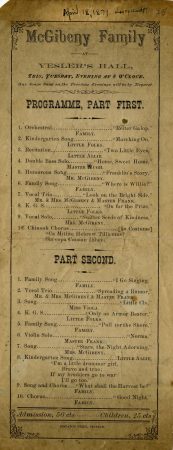
Program from Yesler's Hall, April 18, 1871. (Courtesy University of Washington Special Collections, Digital ID No. PAM684)
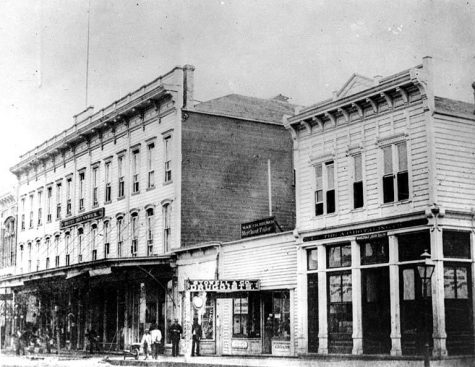
Squire's Opera House, left, on 1st Avenue in Seattle, ca. 1882. (Courtesy University of Washington Special Collections, Order No. SEA1596)
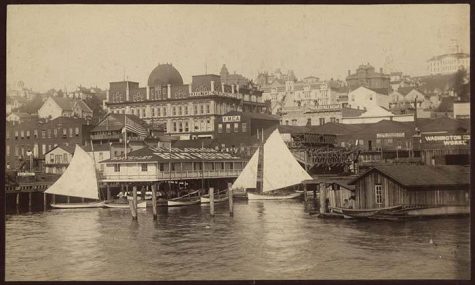
Seattle waterfront, ca. 1885, with Frye's Opera House looming above. (Courtesy Museum of History and Industry, Image No. 200854.31)
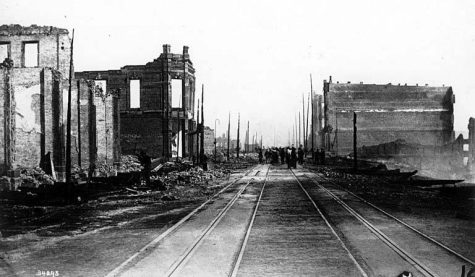
After the Seattle Fire, June 6, 1889. (Photo by Asahel Curtis, courtesy University of Washington Special Collections, Order No. CUR1320)
Act I: Something From Nothing
Arriving in the Northwest in the 1890s, J. Willis Sayre was able to witness much of Seattle’s early theatrical history first hand. But the city’s connection to stage entertainment began much earlier, in the pre-Civil War era, when it was little more than a tiny settlement on the shores of Puget Sound.[1]
While the area would eventually see its share of name performers, during the 1850s and 1860s entertainment was usually provided by the settlers themselves. These were hardly the type of gala events that would typify later theatergoing, but log rolling contests, prayer meetings and community dances were organized to distract from the rigors of settlement life. Not that there couldn’t be a touch of Eastern sophistication from time-to-time, though it was usually in the form of amateur theatrics. “Going West, [in] those restless days, was far more than a slogan: it was a state of mind,” noted Alice Henson Ernst in her 1961 book Trouping in the Oregon Country. “Tucking a hasty script or two into capacious carpetbags, the troupers arrived soon after the exhausted settlers. They found it native land. But even before the stage folk climbed up on makeshift platforms, curtains had been rising in the new frontier, often without the benefit of footlights. Folk entertainment – eager, spontaneous – does not always await the proscenium arch.”[2]
The city of Seattle was founded in 1851, but for its first decade or so formal theatrical engagements were the exception, not the rule. By the late 1860s, however, a handful of professionals were traveling throughout the region. Engagements were still rare, with perhaps no more than a handful per year, and were sometimes given with little advance notice. Others came about by pure accident. Edith Mitchell gave what is believed to have been the city’s first “true” theatrical presentation, a Shakespearean reading at Plummer’s Hall in April 1864, though she was performing not because she was on tour, but because she was stranded in Seattle waiting for a ship to take her elsewhere.[3]
Not all early engagements were as highbrow as the Mitchell performance. With many traveling acts an evening’s entertainment could include such diverse offerings as a scientific or political address, magic, a farce comedy or blackface routine, all in a single night.[4] Still, the itinerant nature of these early performers, some of whom returned to the region annually, made them popular both onstage and off. Not only did they provide much needed entertainment but gave Seattleites a connection with other localities in the Washington and Oregon Territories. With no established rail line until 1883, few overland wagon routes and the time and expense of water travel, most pioneers didn’t stray too far from where they settled. The arrival of performers from elsewhere was a link to the outside world.
Limited modes of transportation not only kept people in but also kept people out. For many years the sparse population base in Washington state made it impossible for larger, more established theatrical troupes to tour profitably in the Northwest. During the pioneer era most performers tended to work as single or double acts (or the occasional small troupe), their box-office take in any given locality providing a modest sum that, ideally, left enough for travel expenses to the next settlement. The dual problems of thin population and lack of cheap, convenient transportation were obstacles both to Seattle’s growth as a city and its growth as a theatrical center.
The first makeshift performance hall in Seattle was the Yesler Mill cookhouse, a tiny log structure built in the winter of 1852-1853 as a mess hall for mill owner and city founder Henry Yesler. For many years, the cookhouse was the city’s only site for meetings, court proceedings and other community gatherings. Later, in 1859, Charles Plummer built a meeting place above his store at the corner of Commercial (now First Avenue South) and Main streets, while Henry Yesler eventually built larger venues such as Yesler’s Hall (1861) and Yesler’s Pavilion (1866).[5] “Larger,” of course, is a relative term, since a crowded house at Yesler’s Hall was reportedly 40 people.[6] The conditions in these early theatres veered toward the minimal – they were designed as multi-purpose venues with the ability to host a variety of gatherings. For a visiting theatrical troupe, there were no dressing rooms, no equipment, and the stage (if there was an elevated platform at all) had to be lit with candles and oil lamps.
Even so, as Seattle continued to grow larger and more elaborate stage productions began arriving. The 1870s saw the rise of theatrical combinations, forerunners of the road shows and traveling repertory companies of a generation later. Combinations featured established performers in signature plays, many originating out of San Francisco, which fast became the theatrical center of the West Coast. One such combination was the Sawtelle Dramatic Company, which played a weeklong engagement at Yesler’s Hall beginning November 29th, 1876. Led by Mr. J. A. Sawtelle, this troupe of 13 players offered several dramas typical for the period, including East Lynne, David Garrick, Rip Van Winkle, Rosedale, and Under the Gaslight.[7]
Increasing visits by theatrical combinations eventually led to the erection of Seattle’s first legitimate theatre, in November 1879. This was Squire’s Opera House, built by Watson C. Squire, later governor of the Washington Territory and a United States Senator. Located on Commercial Street between Main and Washington, Squire’s Opera House had 1,200 square feet of stage area and seated almost 600, including several box seats on either side of the stage. Unfortunately, Squire’s was also of somewhat shoddy construction and remained open for only a few years before being remodeled into a hotel. Arguably it was ahead of its time – in the early 1880s there simply weren’t enough theatrical companies touring the Northwest for Squire’s to remain viable. Seattle didn’t get a formal theatre building until 1884, when George Frye erected Frye’s Opera House on First Avenue. With over double the seating capacity of Squire’s (Frye’s could accommodate up to 1,300 people), the venue was said to have been the largest north of San Francisco when it opened. By then, however, a key piece of regional infrastructure was already in place: rail service arrived in nearby Tacoma in 1883, making Puget Sound more accessible not only to new settlers, but also a growing number of traveling theatrical companies.
By Eric L. Flom – January 2026
Notes:
[1] An expanded version of this chapter appears in Eric L. Flom, “The Theatrical History of Seattle to 1930,” from More Voices, New Stories: King County, Washington’s First 150 Years, edited by Mary C. Wright (Seattle: University of Washington Press, 2002), Pages 112–132.
[2] Alice Henson Ernst, Trouping in the Oregon Country: A History of Frontier Theatre (Portland: Oregon Historical Society, 1961), Page 1.
[3] See program, Plummer’s Hall (23 April 1864), J. Willis Sayre Collection, University of Washington Special Collections; in the absence of an existing program, J. Willis Sayre typed a record of the engagement from an unknown source. See also Howard F. Grant, The Story of Seattle’s Early Theatres (Seattle: University Bookstore, 1934), Pages 7–8.
[4] Eugene Clinton Elliott, A History of Variety-Vaudeville in Seattle: From the Beginning to 1914 (Seattle: University of Washington Press, 1944), Page 5.
[5] Grant, 7–13. See also James William Ladd, A Survey of the Legitimate Theatre in Seattle Since 1856 (Master’s Thesis, State College of Washington, 1935), Pages 17–19.
[6] Information on Yesler’s Hall taken from photo caption in Elliott, between pages 8 and 9. Much of the information in his study came directly from newspaper clippings and theatrical summaries compiled as part of the Federal Theatre Project, a program of the Works Progress Administration that researched Seattle’s early stage history in the mid- to late 1930s.
[7] See programs, Yesler’s Hall (29 November-5 December 1876), J. Willis Sayre Collection, University of Washington Special Collections; in the absence of existing programs, J. Willis Sayre typed a record of the engagement from an unknown source.
Way Out West: A Brief Look at Seattle’s Theatrical History
Act II: Boxed In
A traditional theatre like Frye’s Opera House was, of course, a source of community pride, but the biggest growth in Seattle’s stage businesses during the 1880s was in so-called “box-houses” – essentially, saloons with stages attached. These venues, forerunners of variety and vaudeville, were hugely popular with working class (and male) audiences, despite being under constant scrutiny from civic and religious groups.
To Seattle’s more genteel citizenry, the very premise of a box-house was rife with the potential for sin. They were called box-houses because a section of each establishment consisted of isolated box seats that could be curtained on all sides, and where patrons could watch the show or otherwise enjoy themselves in complete privacy. That wasn’t objectionable in and of itself, but because box-houses made their money through the sale of alcohol (as opposed to charging admission), excess was rampant. Worse, the drinks were hustled by young women, many of whom doubled as chorus girls in the various stage offerings, often song and dance acts. The dangerous combination of alcohol, pretty girls and privacy was a bit too much for certain folks – particularly since these features were wildly popular with scores of men, not only from Seattle but from outlying communities as well.
Box-houses could be rowdy, many were ill-kept, and reformers alleged that many of the women serving drinks were prostitutes. While the actual conditions in Seattle’s early box-houses have been debated, there’s no question that they cultivated a very permissive atmosphere. Author Murray Morgan, in his landmark Seattle history Skid Road, noted that the area’s early box-house establishments willingly turned a blind eye toward girls who enhanced their income with a few extracurricular activities. Most venues do not appear to have had a stake in the practice but, in Morgan’s words, it was good business for a the local box-house manager to employ “entertainers whose talents were not the type to appear to the best advantage on a stage.”[1] Conditions in local box-houses were probably no better than those in comparable establishments, like saloons, but because each house’s promotional efforts gave them a larger profile in the community, box-houses became a lightning rod for criticism. (And to be sure, Seattle had plenty of brothels at the time, some of which had long and prosperous histories.)
The key factor distinguishing box-houses from later variety and vaudeville theatres was their reliance on alcohol as a revenue source. Packed houses and quick audience turnover, so critical to financial success in vaudeville, were not part of the business model. On the contrary, the typical box-house manager did everything he could to keep customers in the house and would even push drinks far into the night if there were patrons still willing (or able) to part with their hard-earned money.
Under these conditions, the entertainment portion of the typical box-house was a secondary consideration. But, in an effort to distinguish their houses, managers gradually began to separate the stage show from the “floor” show. Although the performers themselves may not have been the main attraction, box-houses typically offered singing and dancing acts, comedy skits, minstrel shows, and the occasional play, although these productions were hardly on the scale of a stock company or theatrical combination. And newspapers almost never covered the entertainments offered in local box-houses, no matter how talented the performers. Because these businesses catered to a boisterous, lower-class clientele (unbecoming for an ambitious young city on its way up), Seattle’s box-houses were given little in the way of press coverage. “Variety was to struggle long to free itself of the stigma of its association with the saloon and honky-tonk,” Eugene Clinton Elliott noted. “The fact that it did succeed in becoming respectable [under the guise of vaudeville] speaks highly of its vitality and should earn it the right to be seriously considered as an art form and a true expression of the temperament and mind of a nation.”[2]
Box-houses (together with brothels) may have been an unavoidable byproduct in the development of early Seattle, but they could, at the very least, be controlled through geography. At the time the downtown area was divided at approximately Yesler Way, otherwise known as “Skid Road.” (Lumbermen from the Yesler Mill had earlier used the thoroughfare to drag logs from their cutting areas to the waterfront.) South of Yesler Way stood most of the brothels, bars, and box-houses; proper citizens generally stayed to the north. Particularly during its early years, when Seattle was dominated by lumbermen and miners, the Skid Road area – which today encompasses much of the historic Pioneer Square district – was not only one of the least respectable places in the city, but also one of its most dangerous, particularly after dark.
By Eric L. Flom – January 2026
Notes:
[1] Murray Morgan, Skid Road (New York: The Viking Press, 1951), Page 125.
[2] Eugene Clinton Elliott, A History of Variety-Vaudeville in Seattle: From the Beginning to 1914 (Seattle: University of Washington Press, 1944), Page 10.
Way Out West: A Brief Look at Seattle’s Theatrical History
Act III: The Lure of the Open Road
The arrival of the railroad to the Pacific Northwest in 1883 had a tremendous impact on the region, not only in terms of economic and population growth, but in terms of theatrical growth as well. Though the initial terminus was in Tacoma, the transcontinental railroad was the key feature that allowed the old theatrical combination to give way to its larger, more elaborate cousin, the road show.
Often organized in the East, road shows allowed other parts of the country to see the stars and productions drawing raves in the theatrical world. Unlike a repertory actor touring with a collection of plays, the road show put all its eggs in one basket: one play, with all the trimmings. Expanding rail networks allowed Broadway producers to mount national tours, taking shows into the larger theatres in the larger cities, many times with the personnel and settings used to mount the original New York productions. With generous pre-engagement publicity and a growing number of circuit houses in which to play, producers found that American audiences responded enthusiastically to shows that were proven hits.
This was certainly the case in Seattle. Writing in the April 1937 edition of Pacific Northwest Quarterly, Bernard Berelson and Howard F. Grant counted a total of 15 road productions playing the city in 1870, a figure that did not include variety shows which may have appeared in Seattle’s smaller venues. Ten years later, in 1880 (three years before the rail connection in Tacoma was established), this figure had grown to 21. By 1890, however, one year after a fire destroyed much of Seattle’s business core and with only four small theatres in operation, the number of touring shows jumped to 178. By 1900, this figure skyrocketed again, much like the city’s population during the same period. Berelson and Grant identified 606 touring productions playing Seattle that year, despite the fact that the number of legitimate theatres in operation had dropped from four to three.[1] Factors other than the railroad contributed to this explosive growth – continued westward migration and the impact on Seattle of the Klondike Gold Rush (which began in July 1897) helped boost these swelling numbers. Conditions were aided, too, by the fact that men and women were starting to enjoy more time away from the workplace toward the end of the 19th century, with theatergoing becoming a popular form of leisure activity.
Yet even though these numbers were increasing substantially, the American theatrical industry still wasn’t fully organized. Prior to 1895 local managers had a difficult task securing a season’s worth of stage productions, due in part to Seattle’s distance from the New York theatrical establishment. Even though booking arrangements for shows were made several months in advance, it wasn’t uncommon for financial, travel or logistical problems to plague these troupes as they moved from city to city. As a result, some shows were unable to keep their original Seattle dates, and a few never made it to the Pacific Northwest at all.[2]
This situation began to change in the late 1890s. In Seattle it was John Cort, long one of the city’s most prosperous box-house managers, who helped bring a new era of road show attractions to Seattle.[3] Even though Klondike prospectors were filling his box-houses to capacity, Cort recognized these venues had no long-term future and began plotting a move into the world of legitimate theatre. He selected the perfect moment to change his business focus.
While the Gold Rush was changing the complexion of Seattle, prominent men in the East were establishing large circuits to coordinate road show tours nationwide. These organizations, often referred to as “the syndicates,” sought to organize and consolidate theatrical bookings by providing a steady, predictable stream of touring shows to member houses in return for a cut of the box-office receipts. The move can be easily (and truthfully) depicted as an attempt by certain business moguls to seize control of the industry, but it was also an effort to bring order out of chaos. “It was a necessary development that was taking place,” maintained Eugene Clinton Elliott. “The confusion in booking, with hundreds of small theatres independently operated scattered all over the country and with every producing unit existing by itself, increased the hazards of management many times and could not be allowed to continue indefinitely.”[4]
Even while a box-house manager, John Cort recognized that organization was the key to expanding and thriving in the theatrical business. By the late 1880s, he had spearheaded efforts to coordinate the booking of talent with other Northwest box-houses, a significant factor in his ability to draw acts from outside the region. Even prior to the Seattle fire of 1889, through connections forged with other West Coast theatres, Cort could book acts for a guaranteed run of 16 weeks, traveling a route that took them to major cities such as San Francisco, Portland, and Seattle, followed by an eastern swing through Spokane to Butte, Montana, hitting smaller towns all along the way.[5] Cort’s regional circuit positioned him nicely with syndicate forces a decade later. By purchasing or forging business ties with theatres all along the Pacific Coast (he controlled 37 outright by 1903), Cort made himself a figure to reckon with when the Eastern interests looked to expand into the Pacific Northwest.[6]
Shortly after 1900 John Cort signed an agreement with Marc Klaw and Abraham Erlanger, then the preeminent booking agents of dramatic talent in America, to bring their circuit shows to Cort’s houses. The move firmly established him as the top theatrical manager in Seattle, if not the Pacific Northwest. That same year he also completed the local venue that would house these road show attractions: the Grand Opera House, built at a cost of nearly $40,000. Cort’s new house stood as the jewel of the city’s entertainment venues, usurping that title from the Seattle Theatre, built in 1892, which stood less than half a block away. Until competing houses such as the Moore (erected in 1907) and the Metropolitan (1911) were constructed, the Grand hosted the largest and most elaborate road productions playing the city. Located on Cherry Street between Second and Third Avenues, it seated 2,278 people and was hailed as one of the best theatres on the entire West Coast.
But while John Cort’s new house and his syndicate agreement was initially seen as a business coup, over time the quality of the road shows arriving in Seattle somewhat polarized the local theatrical scene. Many were stellar productions, but after a few seasons theatre patrons (along with a handful of vocal journalists) began to complain that Klaw and Erlanger often delivered quantity over quality, while actively preventing other, independent touring companies from playing the Northwest. Some syndicate offerings, critics complained, were substandard productions whose sole purpose was to keep their circuit houses from going dark. Worse, perhaps, was the fact that their play selection frequently hinged on box-office potential as opposed to artistic merit. “Ever since Klaw & Erlanger first began to throttle independent theatrical attractions there is no question but that the tone of the stage [in this city] has been lowering,” The Argus complained in a 1909 editorial. “Scenery, costumes and stage settings have taken the place of ability. A playwright with a good thing has been obliged to accept the dictated terms. The same old chestnuts have been served up year after year.”[7] James William Ladd, in his 1935 survey of legitimate theatre in Seattle, made a similar observation:
In their desire to fill [the syndicate’s] costly theatres over the country, acting companies were thrown together in haphazard fashion and hustled out for road consumption. Whenever a hit appeared on Broadway duplicate companies, from one to ten in number, were hurriedly assembled to play the circuits, often with far inferior actors. As a result of this policy audiences in cities such as Seattle, and throughout the country, were increasingly dissatisfied with the legitimate theatre.[8]
Syndicates like Klaw and Erlanger’s brought order to the national booking system, but they also brought a business ethic to the dramatic arts that didn’t always sit well with theatergoers in Seattle or elsewhere. “The theatre became controlled by businessmen, as the policies of the syndicates evidenced,” Ladd continued. “Their sole object was the making of a profit…art became a business.”[9]
Audiences eventually tired of substandard road productions and repeat engagements. John Cort was not unaware of the situation, and in 1910 he led a rebellion by forming the National Theatre Owners’ Association, a group representing 1,200 theatres in the West, Midwest, and South that bolted from Klaw and Erlanger by booking independent shows.[10] After several months of pocketbook pressure, Klaw and Erlanger eventually cut a deal with association members, allowing them to book both independent and syndicate attractions at their houses. By that time, however, the cost of mounting such elaborate road show productions was becoming too great for all but a handful of productions, and the frequency of touring presentations across the United States went into decline. During the early teens, large theatres such as the Moore and the Metropolitan, originally built to showcase road productions, sometimes went dark or filled scheduling voids by booking local theatre companies or motion picture attractions. “As the public refused to accept the mediocre standards offered them, [they] turned to other forms of entertainment,” commented James William Ladd. “[T]he syndicates, after destroying the legitimate field in Seattle, were themselves eventually destroyed by the very system they had set up.”[11]
By Eric L. Flom – January 2026
Notes:
[1] See detailed chart of performances in Bernard Berelson and Howard F. Grant, “The Pioneer Theater in Washington,” The Pacific Northwest Quarterly, XXVIII (April 1937), Page 124. Berelson and Grant are careful to note that their figures do not include shows that played local box-houses or amateur performances.
[2] Edward Leonard Nelson, The History of Road Shows in Seattle from Their Beginnings to 1914 (Master’s Thesis, University of Washington Drama School, 1947), Page 81.
[3] See Eric L. Flom, “John Cort (1861–1929),” HistoryLink (https://www.historylink.org/File/3296), accessed 17 February 2025).
[4] Eugene Clinton Elliott, A History of Variety-Vaudeville in Seattle: From the Beginning to 1914 (Seattle: University of Washington Press, 1944), Page 45.
[5] Ibid., Page 22.
[6] Ibid., Page 46.
[7] “Opening of the Alhambra,” The Argus, 17 July 1909, Page 1.
[8] James William Ladd, A Survey of the Legitimate Theatre in Seattle Since 1856 (Master’s Thesis, State College of Washington, 1935), Page 48.
[9] Ibid., Page 45.
[10] Elliott, Page 47. See also Mary Katherine Rohrer, The History of Seattle Stock Companies: From Their Beginnings to 1934 (Seattle: University of Washington Press, 1945), Pages 21–22. Like Eugene Clinton Elliott, Rohrer pulled much of her research material directly from the newspaper clippings and summaries compiled as part of the Federal Theatre Project.
[11] Ladd, Page 57.
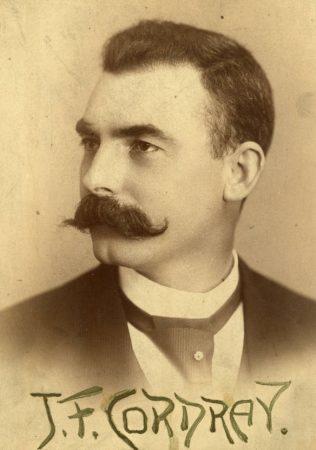
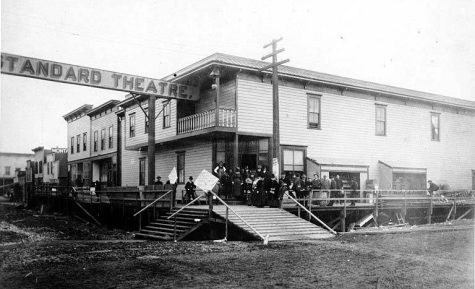
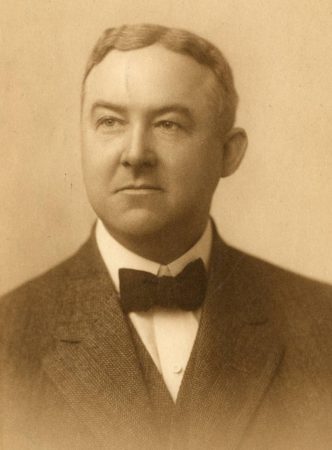
Northwest theatrical manager John Cordray, ca. 1890. (Courtesy University of Washington Special Collections, Order No. 156558)
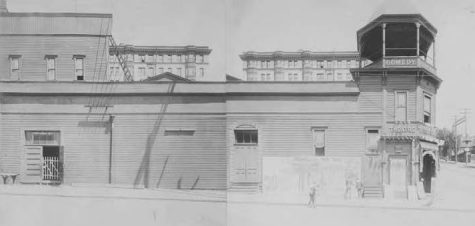
Third Avenue (formerly Cordray's) Theatre, ca. 1901-1903. (Photo by Asahel Curtis, courtesy University of Washington Special Collections, Order No. SEA3772)
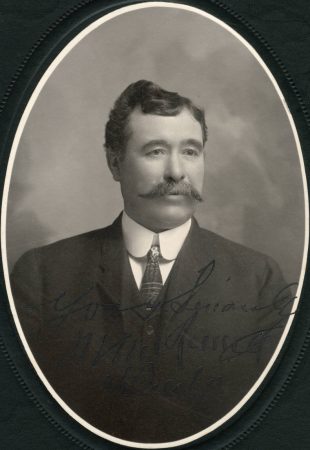
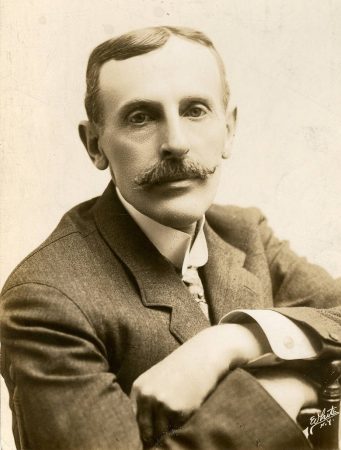
Seattle theatrical manager William M. Russell, ca. 1894. (Courtesy University of Washington Special Collections, Order No. JWS12848)
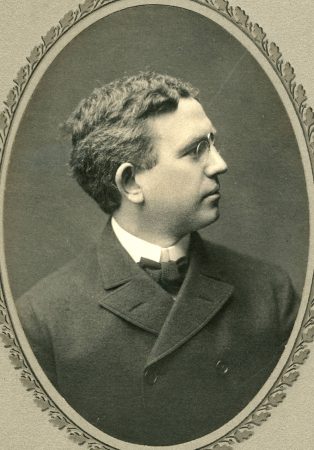
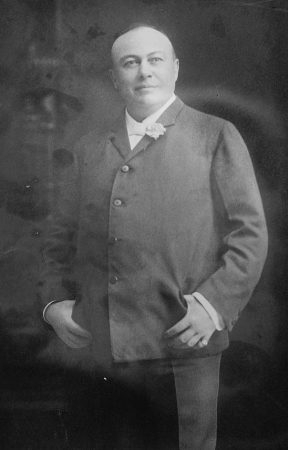
Seattle theatrical manager Edward L. Drew, ca. 1904. (Courtesy University of Washington Special Collections, Order No. JWS16577)
Way Out West: A Brief Look at Seattle’s Theatrical History
Act IV: Reel 3: The Homestand
Often providing a worthy alternative to road show attractions, stock companies thrived as an alternate entertainment during this same period of Seattle’s theatrical history. Stock differed from theatrical combinations and road shows in that the companies were resident troupes of their respective houses – a stable of actors presenting a variety of plays over an extended period. The performers may have been from outside the Pacific Northwest, but stock companies were routinely booked for runs of a few weeks to an entire season or more, such that they became members of the broader community – theatrical or otherwise.
Stock was an ideal training ground for young actors, but it was also a consuming lifestyle, even with the grind of travel largely removed. Days without matinee performances were spent rehearsing upcoming productions, while evenings were taken up with the play at hand. Sundays and holidays – any day of rest for the masses – were busy ones for stock actors, as was also the case for vaudevillians. Within these troupes, typically made up of 8 to 10 regular performers (extra talent could be hired from within the community if needed), typecasting was the norm. Each of the company’s principal players was generally suited for a specific type of role (a hero or a heavy, for instance) and often played these parts in succeeding shows. Productions generally ran for no more than a week at a time, though some ambitious troupes changed plays more frequently.
For the typical stock engagement, tight production schedules and limited resources were the norm. Yet while these productions, often popular melodramas, may have lacked the polish of a road show presentation, the troupes could nonetheless present some amazingly good shows. In addition, with theatergoers returning week after week to the same houses, many stock actors established a bond with the local audience, something that only a handful of traveling performers enjoyed. “Plainly, better results for both actors and the public could be achieved by professional groups resident at the larger playhouses,” Alice Henson Ernst observed. “With proper time for rehearsals, adequate backstage facilities and a skilled director, greater finish was possible. The public could enjoy a planned series of standard plays, staged with rewarding care…Spurred by the shoddy output of many road shows, resident professionals became worthy and formidable rivals.”[1]
In many ways, stock theatre in Seattle didn’t follow the traditions of the East, an attribute that at least one historian, Mary Katherine Rohrer, chalked up to the city’s provincialism.[2] Stock companies in the Northwest, for example, rarely performed new plays, as was the case elsewhere. Instead, local audiences tended to prefer established favorites and proven successes, even when out of popular favor. These productions also rarely toured, even locally. Moreover the employment of guest stars, a frequent promotional feature in the East, wasn’t typically seen in Seattle until after 1910, when the city’s theatrical scene was starting to feel pressure from movies and other forms of popular entertainment.[3] A credible argument can be made, in fact, that Seattle stock was simply an offshoot of the flourishing (and much more “traditional”) stock theatres of neighboring Portland. Not only was Seattle’s first stock company from there, but two of the city’s longest-running stock companies, the George Baker and Henry Duffy troupes, were also organizations based out of Portland.
It wasn’t until 1890 that stock theatre debuted in Seattle. This pioneering troupe was organized by John Cordray, a businessman from Portland looking to expand his theatrical interests northward. Late that year Cordray took over the Madison Street Theatre at Third Avenue and Madison, gave it a reported $20,000 facelift, and promptly named the venue after himself. Cordray was adamant about providing family-style entertainment – no liquor, no rowdiness and no profanity. Even peanut eating wasn’t allowed in his venues. “[A]nyone who can’t comply with the rules…must not be surprised if they are invited by [the] Police Officer of the house to vacate immediately,” Cordray warned in his early programs.[4]
Not surprisingly, then, when the 1,172-seat Cordray’s Theatre opened for business, it was exactly the type of entertainment that many civic reformers and box-house opponents had longed to see. Debuting on December 1, 1890, with The Lady of Lyons, the Cordray troupe began a nearly three-year run of stock productions.[5]
With the difficult economic conditions of the mid-1890s, however, John Cordray abandoned the venue to William M. Russell and Edward M. Drew, who continued this family-style entertainment well into the 20th century, hosting stock companies and independent touring shows. Renamed the Third Avenue in 1896, the theatre became a haven for the type of “blood and thunder” melodrama preferred by the working classes, and by 1904 (despite the increasing presence of road show productions) it was perhaps the most popular theatre in the city. Tickets for the Third Avenue were sometimes in such demand that young boys made extra money by standing outside the box office, holding a place in line for someone else.
The Third Avenue, Seattle’s primary venue for stock theatre, continued its success until early 1907, when the house was demolished – a victim of the regrading projects transforming Seattle’s downtown. Stock theatre continued to enjoy broad appeal for several more years, particularly at the Lois, located at Second Avenue and Seneca, but eventually gave way to other forms of entertainment such as vaudeville and motion pictures. As Mary Katherine Rohrer observed of Seattle’s early stock theatres:
The stock theatre was a family theatre; its plays were tried and true, not old enough or good enough to be termed classic, yet successes because they appealed to the average taste. The companies attracted few stars and soon lost those to greener fields, but they developed such a following that three or four companies could exist in Seattle at one time, as was the case in 1908, 1909, and 1910. They served as buffers to the trusts and syndicates; they furnished entertainment when every other source failed; and they filled a very real place in the hearts and lives of people of that period.[6]
By Eric L. Flom – January 2026
Notes:
[1] Alice Henson Ernst, Trouping in the Oregon Country: A History of Frontier Theatre (Portland: Oregon Historical Society, 1961), Page 118.
[2] Mary Katherine Rohrer, The History of Seattle Stock Companies: From Their Beginnings to 1934 (Seattle: University of Washington Press, 1945), Pages 1–3 and 27.
[3] Ibid., Page 27–28.
[4] See “Auditorium and Theatre Notes,” program, Cordray Theatre (1 December 1890), J. Willis Sayre Collection, University of Washington Special Collections.
[5] Rohrer, Page 6.
[6] Ibid., Page 30.
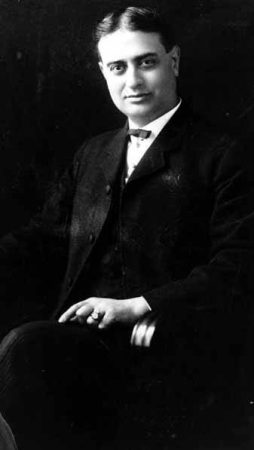
Undated photo of Seattle vaudeville manager Alexander Pantages. (Courtesy University of Washington Special Collections, Order No. POR0124)
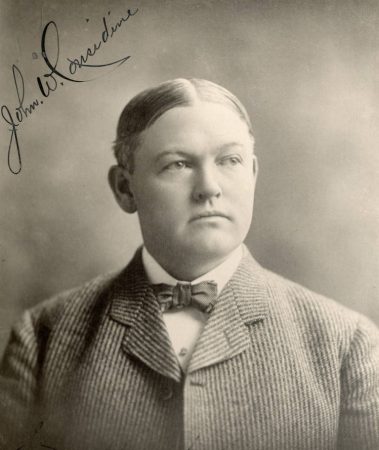
Vaudeville impresario John W. Considine, ca. 1908. (Courtesy University of Washington Special Collections, Order No. 34148)
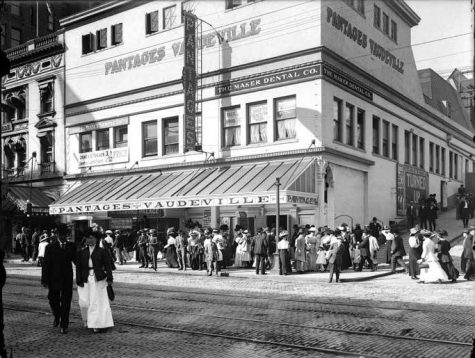
The original Pantages Theatre on 2nd Avenue, ca. 1909. (Photo by Webster & Stevens, courtesy Museum of History and Industry, Image No. 1983.10.8221.2)
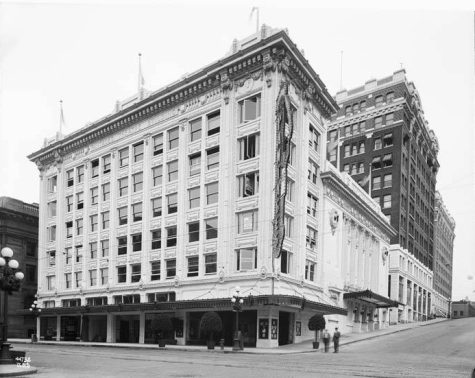
The new Pantages Theatre at 3rd and University, ca. 1915. (Photo by Webster & Stevens, courtesy Museum of History and Industry, Image No. 1983.10.10119)
Way Out West: A Brief Look at Seattle’s Theatrical History
Act V: Variety is the Spice of Life
An outgrowth of Eastern variety shows, vaudeville had the most significant impact on Seattle and its theatrical reputation in the early 20th century. Variety entertainment slowly outgrew its origins in local saloons and box-houses, eventually proving attractive, in a slightly different form, not only to men but also to women and children. “Up to five years ago there were only three theaters in Seattle north of Yesler way,” the Post-Intelligencer observed in 1907. “About that time the craze for 10-cent vaudeville swept over the country and did not skip Seattle. Half a dozen stores were vacated for the 10-cent houses, which were followed by the Orpheum, the Star, later Pantages’ theater, and more lately a number of others. The Coliseum was reconstructed from a skating rink into a ‘ten-twenty-thirty’ house last summer by Sullivan & Considine.”[1]
Vaudeville, of course, showcased a series of live acts, or a “bill,” each act being independent of the others and varied in terms of style and content. A dramatic playlet, for example, may have headlined a show that also featured a knockabout comedian, a juggler, a contortionist, trained bears, a knife-throwing exhibition and a high-wire act. Diversity was the key attribute of vaudeville; as Anthony Slide has noted, crowds returned to their favorite theatres week after week because “[a]n audience could sit through fifteen minutes of a second-rate comedy routine, secure in the knowledge that the next act would probably be a good one.”[2]
As was the case with legitimate drama, circuit houses were a critical factor to gaining a foothold in the emerging vaudeville business, both from the standpoint of performers and managers. Because vaudeville acts existed as individual units, for example, they had to coordinate their own travel, ship their gear, and pay for their lodging and meals, all of which came out of their pocket. Guaranteed playing time on a circuit of houses was therefore an essential element to a vaudevillian’s survival, particularly in the West, where the jump between cities could be considerable. The situation was equally important to managers, however, who gained bargaining power in their ability to sign acts to contracts lasting several weeks or months as they traveled between circuit houses. “Vaudeville [was] one of the most expensive forms of theatrical entertainment ever offered to the general public,” noted Eugene Clinton Elliott. “The players of seven separate acts, each, so to speak, a star, and the musicians, stagehands, electricians, and management personnel necessary for the presentation of such acts, [were] an aggregate commanding an astounding weekly expense. In order to support such a crew one essential [was] an assured audience, best obtained by moving from city to city throughout the country along a regularly assigned route.”[3]
As the business developed, in fact, circuits became such a vital element of western vaudeville that they multiplied much faster than their eastern counterparts – the exact opposite of legitimate theatre, where circuits were largely organized and controlled by the eastern syndicates. This is exactly where Seattle showmen such as Alexander Pantages and John Considine made their mark. “All in all, the most important contribution of the Northwest to the national theatrical business was the origin and development of popular priced vaudeville circuits,” Bernard Berelson and Howard Grant have argued. “The stock companies and road shows spread East to West; vaudeville, from West to East.”[4]
Notable among the Northwest vaudeville magnates was Alexander Pantages.[5] An immigrant from Greece, Pantages was a latecomer to the city’s theatrical scene, not even arriving until 1902 after having worked as a waiter, barkeep, and theatre manager in Dawson, Alaska. His first theatrical enterprise in Seattle was the Crystal Theater on Second Avenue, an immediate hit with the public. Pantages had a particular gift for measuring the taste of his audiences, and the popularity of his house was such that in 1904 he built a much larger venue, which he named after himself. Located at the northeast corner of Second Avenue and Seneca, Seattle’s Pantages Theatre was the first of many venues throughout America that would eventually bear his name. (Later, in 1914, Pantages built a modernized Pantages Theatre at the northeast corner of Third and University.)
The growth of Pantages’s vaudeville holdings was remarkable. In 1906, two years after opening the original Pantages Theatre, the showman erected the Lois Theatre a short distance away, named in honor of his wife. There he housed various stock theatre companies along with the occasional vaudeville bill. He even had the foresight to swoop into San Francisco after the 1906 earthquake and fire, buying six small houses on the cheap (the chain’s flagship theatre had been destroyed). By 1909, seven years after arriving in Seattle, he could offer stage acts a run of 26 consecutive weeks in his circuit houses. Two years later, thanks to agreements forged with other regional circuits throughout the United States and Canada, this had increased to almost 60 weeks.[6]
Alexander Pantages thrived in a rather cutthroat business. Managers were known to blacklist troublesome performers, break up larger acts so they could rehire the portion they liked, or terminate the contracts of performers while they were on the road, in the middle of nowhere, forcing them to sign a new contract at a fraction of their original salary. Sometimes the tables were turned on the managers, however. According to one story, Seattleite John Considine (a significant competitor in the field of popularly priced vaudeville) briefly made a habit of stealing acts from the Pantages circuit by offering salaries he knew Alexander Pantages could not or would not match. This tactic worked in the short term, until Pantages responded by sending his men to the train station to locate each performer’s gear when they arrived in town. If a performer announced their intention to jump to a rival circuit, Pantages countered by threatening to destroy their costumes and props – for many vaudeville acts, the key to their livelihood.[7]
Pantages’ astonishing success came not because he knew how to play hardball, but because he was simply a better businessman and a better showman than many of his competitors. If someone else was planning to offer a notable high-wire or animal act, for example, Pantages might locate a similar one and play it a city or two ahead of his rival, taking the wind out of the competitor’s prize discovery. Pantages also booked talented but lesser-known artists, saving costs while rivals were sometimes all-too-willing to empty their pocketbooks on name acts.
In the early 1920s Alexander Pantages moved his business offices from Seattle to Los Angeles, but the Northwest was nonetheless the birthplace of the famous Pantages vaudeville circuit, which grew to cover most of the United States and parts of Canada. Toward the end of the decade Pantages began selling his venues to RKO and Warner Bros., but he remained a prominent show-business figure right up to his death in 1936.
By Eric L. Flom – January 2026
Notes:
[1] “Theaters Mark Seattle History,” Seattle Post-Intelligencer, 29 December 1907, Page 5. “Ten-twenty-thirty” is vaudeville slang for the ticket prices charged by the house – ten cents for general admission, up to 30 cents for a box seat. Ten-twenty-thirty theatres were also known as “popularly- priced” vaudeville houses.
The Coliseum, the first permanent home for Orpheum vaudeville in Seattle (and formerly known as the Dreamland Skating Rink), should not be confused with the Coliseum Theatre built at the corner of Fifth Avenue and Pike in 1916, which was devoted exclusively to motion pictures. As a vaudeville theatre, the Coliseum at the corner of Third Avenue and James was said to have been the largest venue west of Chicago, seating upwards of 1,800 people.
[2] Anthony Slide, The Encyclopedia of Vaudeville (Westport, Conn.: Greenwood Press, 1994), Page xv.
[3] Eugene Clinton Elliott, A History of Variety-Vaudeville in Seattle: From the Beginning to 1914 (Seattle: University of Washington Press, 1944), Page 45.
[4] Bernard Berelson and Howard F. Grant, “The Pioneer Theater in Washington,” The Pacific Northwest Quarterly, XXVIII (April 1937), Pages 118–119.
[5] See Daniel Statt, “Alexander Pantages (1876–1936),” HistoryLink (https://www.historylink.org/File/2999), accessed 17 February 2025.
[6] Elliott, Page 60.
[7] Ibid., Page 59.
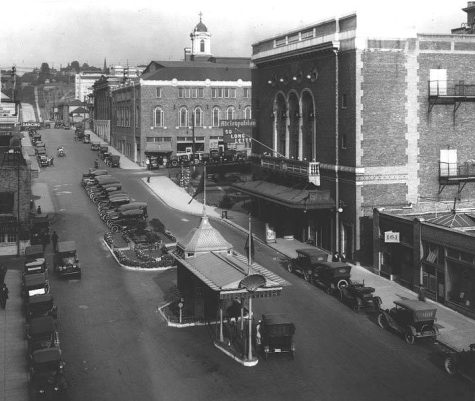
Metropolitan Theatre, right, ca. 1917. (Photo by Asahel Curtis, courtesy University of Washington Special Collections, Order No. CUR1340)
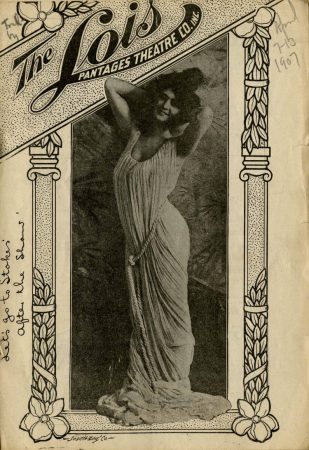
Lois Theatre program, week of April 7, 1907. (Courtesy University of Washington Special Collections, Digital ID No. PAM0592)
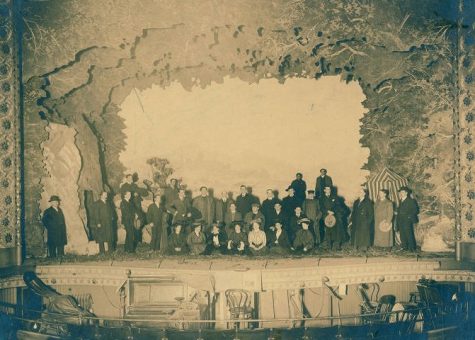
The James Neill Stock Company onstage at the Seattle Theatre, ca. 1905. (Courtesy University of Washington Special Collections, Order No. JWS24142)
Way Out West: A Brief Look at Seattle’s Theatrical History
Act VI: The Curtain Falls
Seattle was never a creative center for the American stage, but through the business endeavors of men such as John Cort, John Considine and Alexander Pantages, it held a prominent place in national theatrical affairs during the early 20th century. In the process, it gained the reputation of being an excellent show town, a fact that the Post-Intelligencer trumpeted in 1907.
Fifteen years ago Seattle had but one real theater, Cordray’s. Fourteen years ago it had but two, Cordray’s and the Seattle. Seven years ago it had three, with the addition of the Grand. Now it has more than fifteen, including ten-cent [vaudeville] houses, all playing to a profitable business. Fourteen years ago the theaters of the city combined to seat but 2,200 people. In 1907, on Sundays or holidays, Seattle’s playhouses frequently played to 30,000 to 40,000 people, including the matinee and evening performances….[A]s [William M.] Russell [manager of the Third Avenue Theatre] observes, “Seattle is the manager’s Mecca of the West. A week stand in Seattle assures any company’s railroad fare back to the Missouri river.”[1]
But regardless of theatre’s popularity with local audiences, Seattle was not immune to industry trends, and as the booming conditions that fed the American stage began to wane in the teens, the city began to see less and less in the way of professional stage talent.
Through the 1910s, road show tours (whether syndicate or independent productions) gradually became fewer each season, a decline attributable both to the enormous cost of mounting such tours and the growing popularity of motion picture entertainment. In Seattle, the trend was sharp and measurable. During the first decade of the 20th century road show companies appeared on a regular basis, yet in 1912 the new Metropolitan Theatre was dark a full 20 weeks, while the Seattle and the Moore Theatres were empty 15 and 12 weeks respectively.[2] According to research compiled by James William Ladd, between 50 and 75 touring productions played Seattle during 1910, while only six arrived during all of 1935.[3]
Stock theatre, too, was hard hit during the 1910s and 1920s, even with fewer road show attractions with which to compete. After the demise of the popular Third Avenue Theatre in 1907, Alexander Pantages’ Lois Theatre seemed to fill the void, running continuously until it was destroyed by fire in 1910. But the Lois fire marked an end to the popularity of stock in Seattle – or at least it never again held its former sway. Despite a handful of troupes operating after 1915, most efforts to revive stock theatre lasted only a handful of seasons. As America moved into the Jazz Age, the audience for stock was no longer there, siphoned away by changing times and competing forms of entertainment, including motion pictures, radio and sporting events.
Like roadshow and stock productions, vaudeville faced its own challenges during this period. Recognizing the public’s fascination with motion pictures, many Seattle vaudeville houses altered their formats after World War I, offering a feature film in addition to a bill of live entertainment. The move wasn’t just good showmanship, considering the popularity of movies, but also made economic sense. Vaudeville houses could still provide a full bill of entertainment but cut some of their overhead by employing fewer live acts and, consequently, fewer theatre personnel.
Through the 1920s, however, the emphasis in Seattle’s vaudeville houses gradually shifted. Early on motion pictures were a supplement to the live bill, but by the end of the 1920s, at the Pantages, the Palace Hip, and other venues, the films often held the spotlight. The stage portion of the bill was still the house’s selling point, but the live portions were gradually shortened to the point where some houses could sometimes accommodate a pair of first- or second-run films in addition to a truncated stage program.
The death of Seattle vaudeville wasn’t officially recorded until the doors shut on the Palomar (formerly the Pantages Theatre at Third and University), which continued to offer live acts and feature films into the early 1950s. Even so, by the time the Palomar closed vaudeville hadn’t been a popular draw in well over 20 years – the house was clearly a vestige of past times, drawing on a small and mostly nostalgic crowd of older Seattleites.
The decline may have been inevitable, but nevertheless the period from the 1890s through the 1930s saw some the era’s top stage talent (not to mention future film talent) passing through Seattle’s theatrical venues. Often these performers made a loop through the Northwest, either coming west from Minneapolis or north from San Francisco, hitting the major rail stops of Portland, Tacoma, Seattle, and Spokane along the way, and sometimes using the Puget Sound area as a jumping off point for trips to Vancouver and Victoria, British Columbia. Such an itinerant life on the road could be anything but comfortable. Long stints away from home, constant traveling, cheap hotels, and bad food were common experiences for struggling actors. With the grinding and often lonely conditions put upon the average touring performer, a move into the fledgling motion picture industry had obvious advantages. Among other things, most of the earliest films were shot in and around New York, where the countryside doubled for the Wild West, Europe, the Orient, or whatever the setting may have required. Rather than contend with the hardships of constant touring, motion picture work allowed actors to put down roots, earn a fair living and, if their dreams of Broadway were undiminished, remain in touch with the New York theatrical establishment.
Very few stars of the silent era were also proven successes on the stage. Only a handful of motion picture stars – John Barrymore or Charlie Chaplin, for instance – might have been able to enjoy long and distinguished careers strictly in the footlights. A few others, such as Douglas Fairbanks and cowboy star William S. Hart, made fair livings onstage prior to their introduction to the “flickers,” as they were often referred to by detractors. But there is little to suggest that the majority of silent cinema’s illustrious figures would have achieved anything more than fleeting success on the stage. Nothing, certainly, on the order of the acclaim and public adulation they eventually found on the movie screen.
More often than not it was the performer of limited stage achievement who found success in moving pictures. Ironically, the opposite was also true. Stage performers with established reputations, once they condescended to performing before the camera (most often when the price was right), often brought their theatrical acting styles with them – appropriate for the stage, but which didn’t transfer smoothly to the new medium. The heavy gesturing and exaggerated movements required to communicate to all corners of a legitimate theatre appeared excessive and overdone on the more intimate movie screen. It’s a lesson that many brilliant theatrical personalities failed to learn. Their movies, typified by Sarah Bernhardt’s Queen Elizabeth (1912) – a critical though not necessarily popular hit of the time – rarely display the qualities that made them popular figures. Sadly, however, these are often the only way for later generations to view their work at all.[4] The reputations of performers such as the Divine Sarah lay in the legend of their stage exploits, while their motion picture work most often remains a footnote to their distinguished careers.
During its infancy the film industry strove for greater cultural respectability (wherein lay higher profits), and there were concerted efforts to lure established stage talent to the screen – it was Adolph Zukor, Daniel Frohman, and Edwin S. Porter, founders of the Famous Players Film Company, who brought Bernhardt’s film (originally a French production) to America. The goal of Famous Players, at least, was to convey legitimacy on an entertainment form attempting to mature rapidly, an effort that didn’t always work. Early film audiences weren’t necessarily the same people who attended high-class theatre offerings, so the marquee value of many well-known stage actors may not have justified the expense of securing their services – the prestige often out-weighed the box office returns. (This was a lesson another early production company, Triangle, learned the hard way.) Additionally, many early films were comprised mostly of medium to long shots, with the distance between actor and camera encouraging broad gesturing to convey thought and emotion. This was particularly true for “old school” performers such as Sarah Bernhardt.[5]
Hundreds of lesser stage actors, however, found they could make ends meet with an occasional stint in the movies. Furthermore, many had earned their stripes performing stage melodramas, with plotlines and stylized acting more readily accessible to the sensibilities of early film audiences. Frequently “at liberty” (or, more bluntly, unemployed), these small-time actors could find extra work at the Edison or Biograph Studios, earning as much as five dollars a day. Later, after many production companies began relocating to the West Coast, troupers from San Francisco and Los Angeles enjoyed similar opportunities. The pay was decent and, more importantly, for someone still hoping for a career on the legitimate stage, the recognition was low – in the beginning, at least. Because nearly all motion picture companies prior to 1910 never advertised the names of their performers, few of their stage colleagues might learn of their descent into the lowly world of motion picture acting. Yet it was often these people – the supporting characters and extras of the legitimate stage – who found fame and fortune as the early motion picture industry developed, attaining stardom they almost certainly would never have achieved in theatre.
A look at the performers who passed through Seattle during the late 19th and early 20th centuries demonstrates this point. Although many silent stars managed to carve long (if only mediocre) careers as stage actors, their historical notoriety rests not on their appearances in the footlights but on their motion picture exploits. Unknowingly, many Seattle theatergoers spent years watching future Hollywood stars develop their craft on local stage bills.
By Eric L. Flom – January 2026
Notes:
[1] “Seattle is the Best Show Town in the Country,” Seattle Post-Intelligencer, 29 December 1907, Page 5.
[2] See Mary Katherine Rohrer, The History of Seattle Stock Companies: From Their Beginnings to 1934 (Seattle: University of Washington Press, 1945), Page 25; and Edward Leonard Nelson, The History of Road Shows in Seattle from Their Beginnings to 1914 (Master’s Thesis, University of Washington Drama School, 1947), Page 149.
[3] James William Ladd, A Survey of the Legitimate Theatre in Seattle Since 1856 (Master’s Thesis, State College of Washington, 1935), Page 50.
[4] Seen today, Queen Elizabeth doesn’t seem as theatrical in terms of acting as it does in the primitive way in which it was staged and filmed. Comprised of full-length shots, each scene is announced in advance by a title, followed by the performers who pantomime the action with no cutting or shot variation to enhance the dramatic situations. In this respect, the picture is very much like viewing a presentation from the front row of a theatre, albeit one in which you must imagine the dialogue.
For her part, the 68-year-old Bernhardt, then suffering from a knee injury (her leg would be amputated in 1915), enacts most of the role while standing still or sitting. Her efforts to move about the “stage” on her own are quite labored and are usually done while being supported by one of the other players. Nevertheless, after Queen Elizabeth’s ludicrous death scene to end the film, the final shot is of Bernhardt herself making a curtain call, responding to the plaudits of a make-believe audience.
[5] Eileen Bowser, The Transformation of Cinema: 1907– 1915 (Berkeley: University of California Press, 1994), Pages 91–93.