
Roads of Destiny: A Few More Roadshow Engagements
Roads of Destiny:
A Few More Roadshow Engagements
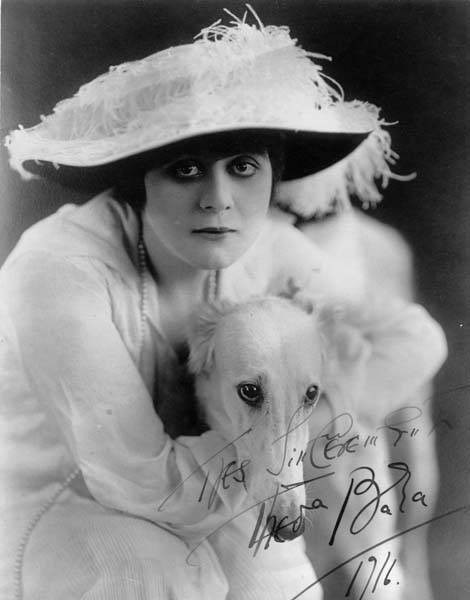
Actress Theda Bara, ca. 1916. (Courtesy University of Washington Special Collections, Order No. SOC20330)
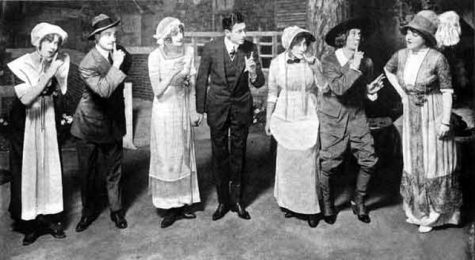
Scene from the stage musical "The Quaker Girl," ca. 1911.
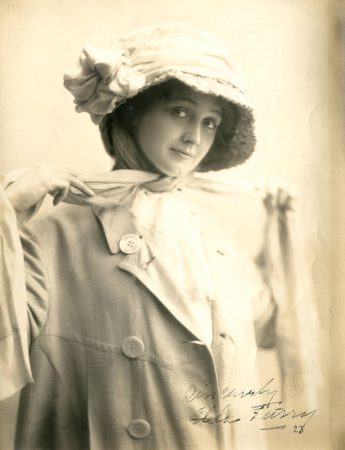
Stage actress Elda Furry, aka gossip columnist Hedda Hopper, ca. 1911. (Courtesy University of Washington Special Collections, Order No. JWS13240)
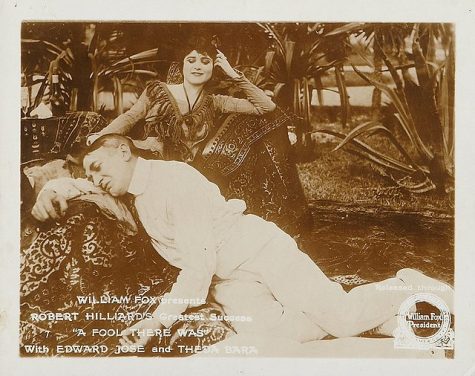
Theda Bara gloats over a conquest in "A Fool There Was" (Fox, 1915).
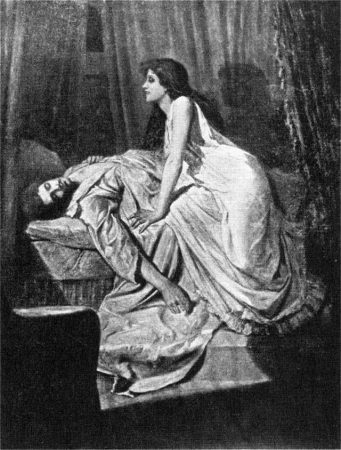
The provocative imagery in Philip Burne-Jones' "The Vampire" (1897).
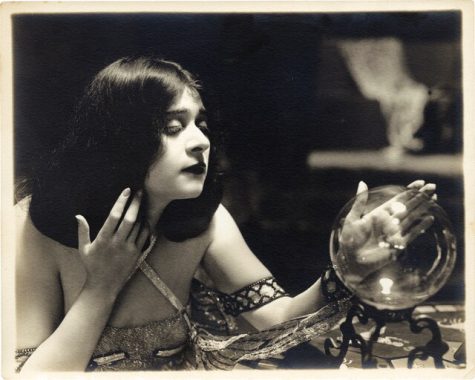
Theda Bara and her crystal ball, ca. 1917. (Photograph by Walter Seely, Witzel Studio)
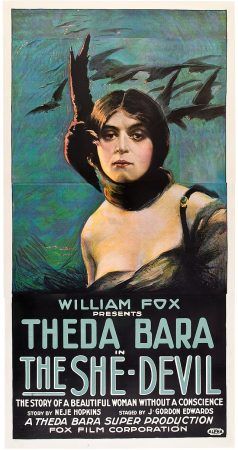
Film poster for "The She-Devil" (Fox, 1918).
Act I: Theda Bara
Interestingly, while early film audiences embraced someone like Douglas Fairbanks for the natural and appealing qualities he brought to his characters, Theodosia Goodman rose to fame for the opposite reasons. Goodman, better known onscreen as Theda Bara, was one of Hollywood’s first and most notorious pre-packaged stars, sprung on audiences who were not always wise to the ways of the modern pressman. While the public eventually caught on to the ruse, her “vamp” screen character – whose smoldering sexuality and diabolical cunning enticed men to their ruin – turned the film industry on its ear and generated public furor over her onscreen behavior. Yet she nonetheless became one of Hollywood’s great early figures: much like Rudolph Valentino, she’s a star whose screen persona has proved more enduring than her motion pictures.
Born Theodosia Goodman in Cincinnati, Ohio, in July 1885, Theda Bara had a relatively simple and uneventful childhood. In high school, she showed talent not only as an actress but as a writer and even attended the University of Cincinnati for two years. She dropped out, however, to pursue her acting dreams, first playing in local shows before heading for New York in hopes of catching on with a large Broadway show.
Theodosia Goodman achieved that goal by 1908, obtaining a small role at the Garden Theatre in a version of Franz Molnar’s play The Devil, with Edwin Stevens in the title role. (A competing version in New York – the U.S. rights to Molar’s play were in dispute at the time – found George Arliss playing “his Satanic Majesty.”) The role was small, and Theodosia de Coppet (which she selected as her stage name) apparently did not join one of the companies organized to tour with the show, or at least did not appear with the troupe that played Seattle in December 1908.[1]
After The Devil, Theda Bara’s stage career again becomes fuzzy for a period before she is known to have played in a musical comedy called The Quaker Girl, the original version of which served as a vehicle for actor DeWolf Hopper. Minus Hopper’s talents, at least two formal touring companies were sent out onto the road, with The Quaker Girl coming to Seattle late in 1912. The play centered on Prudence, a girl from the English countryside who is shunned by her own people and (quite improbably) accompanies a princess to France, where she becomes the toast of Parisian society after being discovered as a dress model. Bara – identified as Theodosia “de Cappet” in the Metropolitan Theatre program – supported Natalie Alt and Victor Morley in the small part of Diane, a young French model.
Arriving at the tail end of December, the Metropolitan billed the weeklong engagement as “the quality musical play that radiates sunshine, beauty and laughter.”[2] The show was large, boasting 20 original songs, including “Come to the Ball,” its most popular tune, and claimed to have a total entourage of over 100 people. (One reviewer, however, complained that for all its hype the show contained less than 40 actors.) Scenery was hauled from stop to stop in three rail cars. Additionally, the first two rows of seats at the Metropolitan Theatre had to be removed to accommodate an augmented orchestra.
Scheduled to open Sunday, December 29, the Quaker Girl company inadvertently found themselves delayed en route to Seattle. Severe rains caused a washout along the Northern Pacific Railroad line near Kalama, some 40 miles north of Portland, which kept the troupe from arriving in the city until the morning of the 30th. The Metropolitan was not the only entertainment house in Seattle affected by the weather – vaudeville acts heading west from Spokane to Seattle’s Orpheum, Empress, and Pantages theatres were slowed by heavy snows in the Cascade Mountains and arrived only hours before those theatres were scheduled to open. Additionally, troupes farther ahead on the circuit, looking to make the jump from Tacoma to Portland, were slowed by the same washout that kept the Quaker Girl company from coming northward.[3] J. Willis Sayre, reporting on conditions in his theatrical column for the Daily Times, speculated that many of the Portland matinees for December 29, at the very least, would have to be canceled as a result of the delays.
Ironically, the crew and scenery for The Quaker Girl must have been sent ahead of the actors themselves, for the Metropolitan was completely set up for the scheduled opening night performance. In the belief, apparently, that the troupe could arrive before the curtain rose, a full audience gathered before management finally had to cancel the show. The Metropolitan offered refunds and seat exchanges to disappointed patrons.
The following evening, however, the troupe – which must have been exhausted after their extended journey – managed to give a pleasing performance. “The Quaker Girl,” noted the Seattle Star, “which opened at the Metropolitan Monday night for a week’s engagement, is decidedly satisfying and delightful. It never attempts to break into the comic or light opera field at any stage. It is a musical comedy, pure and simple…Starting rather tamely, with an unattractive setting and little interest, it works up to a beautiful and pleasing climax in the last act.”[4] Jack Bechdolt, writing for the Post-Intelligencer, was also satisfied with the show. “The Quaker Girl is pretty throughout both as to music and setting. The music is sweet and the strains haunt one. To judge from the enthusiasm with which several of the song hits were received last night they will continue to haunt some for some time to come…[The play] is all that it pretends to be – tuneful, pleasing music and good clean comedy, with plenty of pretty girls and dresses thrown in.”[5]
J. Willis Sayre wasn’t exactly enthralled with the production, but still felt the show was a good one. He was particularly taken with the work of Victor Morley, cast as Tony, who falls hopelessly in love with the title character.
Not a bit Quakerish, not a bit Quakerish.
If any folks are staying away from The Quaker Girl at The Metropolitan because its name suggests sackcloth and ashes, they are making a mistake. Maybe that name has cost the piece a lot of money, though its long runs in London and New York wouldn’t indicate it. It could just as aptly be called The Belle of Paris, for it is in that town that most of the action is laid. The piece is mostly clean and wholesome; there is no catering to the vulgar and the low brow [sic] elements of the populace; but aside from that it is bright and tuneful. What it decidedly lacks is sensation either in the comedy or music, or the “punch” that is found in successful American musical plays. In this respect it is typically English.[6]
Sayre found but one major flaw in The Quaker Girl, which Jack Bechdolt also observed, when he pointed out that the play was longer than the average touring production visiting Seattle. “The show is too long,” Sayre wrote. “Some relentless stage director ought to take fifteen minutes out if it at the points of least resistance.”
The notations about the clean aspects of The Quaker Girl are interesting – each of Seattle’s dailies made comments to this effect, together with almost uniform praise for the catchy musical portions. The indication, perhaps, was that although roadshow presentations were beginning to dwindle in numbers by late 1912, those that played Seattle may have contained a certain amount of questionable material. J. Willis Sayre’s comments, in particular, are noteworthy – long an opponent of censorship efforts, he was also a vocal critic of vulgarity on both stage and screen. Throughout his tenure as a dramatic critic, these were concerns he never fully reconciled.
But while The Quaker Girl managed to garner positive, if only lukewarm praise during its Seattle engagement, Theodosia de Coppet went unnoticed in print reviews for the engagement. According to Eve Golden’s Vamp, one of few biographies on Theda Bara, the Morley troupe was the second-string touring company, and when the actress – who originally signed for $25 per week – was informed that her salary would be reduced to $18, she promptly left the show.[7] The salary cut, however, may have been warranted. One of the few comments about Bara’s stage talent from this period comes from Hedda Hopper, future Hollywood gossip maven. Eventually to wed DeWolf Hopper, star of the original Broadway version of The Quaker Girl, Hopper met the future Theda Bara while performing in the show herself. “Theodosia played a Frenchwoman,” she noted in her book From Under My Hat, “with an accent that wouldn’t fool a five-year-old.”[8] For the Seattle engagement of The Quaker Girl, Hedda Hopper, performing under her given name of Elda Furry, played the role of Mathilde, “an exiled Bonapartist princess.” She earned plaudits from both Jack Bechdolt at the Post-Intelligencer and J. Willis Sayre at the Daily Times for her performance.
While theatre work never garnered Theda Bara much success, she got her big break in 1915 when she was tapped by director Frank Powell to star as a temptress in the lurid thriller A Fool There Was (Fox, 1915), a screen version of Porter Emerson Brown’s stage play. The play was based in part on a poem that Rudyard Kipling had penned for the exhibition of his cousin’s graphic painting The Vampire (1897), which shocked art patrons upon its unveiling. The portrait depicted a rather seductive woman hovering over the prostrate body of her lover, yet the interpretation was deceiving – either the man was dead, drained of his blood, as the title suggested, or he was sexually drained, which the painting may also have implied. Brown’s play centered on a married man who is led to ruin through the sinister guile of a temptress – or vamp, as Bara later became known.
To help promote the film, studio head William Fox hired two press agents, Johnny Goldfrap and Al Selig, with instructions to invent an off-screen life for the movie’s star that mirrored the exotic character she portrayed in A Fool There Was. That they did, and all too well. Reaching back into family tree, Theodosia Goodman became Theda Bara – an anagram for “Arab death,” it was alleged – and her background as a simple Jewish girl from Cincinnati was all but obliterated. Instead, she became the daughter of a French actress and an Italian sculptor, born at an oasis in the Sahara Desert and educated in Paris; it was there, too, that Bara was said to have first performed as an actress.
Film audiences – not all of them very sophisticated at the time – gobbled up these fabulous tales, and after A Fool There Was proved a sensational hit for Fox, similar vamp roles were devised for Bara, together with even more elaborate publicity schemes. Yet after only a couple of releases, the actress became a prisoner of her own popularity. Though Bara lived quietly with her family in New York, the Fox Studios purchased an exotic penthouse with eclectic furnishings where she conducted press interviews, and she was somewhat restricted from appearing in public without the “appropriate” settings being prepared in advance. The private Theda Bara was a relatively simple and modest person, but to the public (thanks to Fox publicity) she was evil incarnate – reporters, it was said, were afraid to interview her alone, such was her power to lead virtuous men to ruin.
The effort to build her public image became more absurd with each successive film release. Bara liked to recall the Goldfrap and Selig idea of writing her so-called autobiography, which was then syndicated in newspapers across the country. These pieces, which found widespread readership, helped promulgate further distortions of Theda Bara’s life. “Not only didn’t Theda write the articles,” biographer Eve Golden noted, “she didn’t even proofread most of them before they went to press. Each morning, she and [her sister] Lori would sit over breakfast of coffee and sausages and ‘roar with laughter’ at each new chapter in her autobiography. ‘I read so many lies about myself that I hardly know what is the truth anymore,’” Bara is alleged to have remarked.[9]
The Seattle Star, while not one of the papers running Bara’s so-called autobiography, did run a similar collection of articles in the spring of 1916 – special releases which aimed, the Star noted, at “correcting popular impressions of her vampiring work in the movies.”[10] Though she had a certain appeal with motion picture audiences, Theda Bara had, at the same time, also become a target for civic and religious groups appalled by the scandalous morals of her screen characters.
The first article of the series, in fact (all of which were attributed to Bara’s pen), was deemed front-page news by the Star. She attempted in her own words to explain the destructive characters she portrayed in the movies. “Since my vogue upon the screen has been denounced in some sections, by those who are not broad-minded or far-sighted enough to realize I am benefiting humanity by appearing in pictures in which righteousness triumphs and vice is annihilated, people have been coining appellations to fit me.”[11] Particularly disturbing to the actress was the public’s perception that her screen and private personas were one and the same. Her films generated piles of fan mail, but also piles of hate mail, written by a segment of the public outraged by her shameful “vampiring.” Reaction to her films was such that impacted Bara’s private life.
[People who recognize me] do not mean to be rude and I think that if they knew they are making it difficult for me to take my recreation at all, they would do all in their power to remedy matters. That is why I am writing of it. To let them know just how I feel about it.
Of course it is pleasant to be really known – and I do not resent it, but what distresses me is that after I am recognized I am not allowed to go on my way, undisturbed. I am followed, sometimes by crowds of little children, who pick me to pieces, audibly, and compare my screen-self and my real-self with alarming frankness.
Then, again, little groups of whispering grown-ups dog my footsteps. And that is worse. Because I cannot hear what they are saying – and I imagine all sorts of discomforting things.[12]
Despite these earnest pleas, however, the articles were clearly another facet of Fox’s promotion efforts. Printed daily (barring Sundays – the Star did not issue a Sunday edition), they ran for almost five weeks, missing in only a handful of editions. Yet what started out as, ostensibly, Theda Bara’s side of the story ended with telling readers such pointless facts as her belief in tarot card readings (April 12th), how she would spend her ideal day away from work (April 14th), about her favorite food, clothes, and sports (April 18th), sharing favorable fan mail (April 28th and May 17th), discussing why convicts seem to have had a special fascination for her screen character (May 1st), the colors she selected for her bedroom (May 12th), and how she enjoyed window shopping (May 19th). That the pieces were part of Selig and Goldfrap’s publicity schemes was also demonstrated by Bara’s references to her childhood in Paris, and her mention of several personal items of mystical importance, including a 2,000-year-old emerald ring given to her by a blind sheik who claimed to be over 110 years old.
Despite the fakery involved, Theda Bara proved a gold mine for William Fox, so much so that she was discouraged from attempting projects outside the profitable vamp formula. Occasionally she managed to play parts a bit more meaty – 1915’s Carmen, for instance, which dueled with the Geraldine Farrar version that Cecil B. DeMille made for Paramount, or the lavish production of Cleopatra (1917). Though few were made, Theda Bara’s non-vamp films failed to produce comparable box-office results, and her opportunities to escape Hollywood type-casting became increasingly difficult.
Audiences eventually tired of Bara’s vamp character and the many actresses at other studios who were enlisted to mimic her success. After World War I Theda Bara became a near parody of herself, with filmgoers no longer willing to accept the fantastic conjurings of Fox press agents, not to mention the repetitive nature of her releases. Although she continued to play her part offscreen, even Bara took to lampooning herself a bit. After telling one reporter for Photoplay that she communicated via crystal ball with the spirit of her dead dog, to which the reporter, after gazing into the orb himself, claimed that he couldn’t detect anything, she simply glared at the young man, visibly annoyed. The harder he concentrated, she said firmly, the more interesting his article was bound to be.[13]
Theda Bara eventually married English director Charles Brabin in the early 1920s and settled into a familiar Hollywood social lifestyle, far away from the cameras that catapulted her to fame. Although she returned to the stage twice after her rise in motion pictures, once in 1919’s poorly received The Blue Flame, and again in an informal Beverly Hills play in the 1930s, she pretty much retreated from acting by the mid-1920s.
Theda Bara died of cancer in 1955. That same year saw the Broadway debut of The Vamp, a musical based loosely on her career, with Carol Channing in the title role. The show, unfortunately, proved a miserable failure.
By Eric L. Flom – January 2026
Notes:
[1] Program, Moore Theatre (5 December 1908), J. Willis Sayre Collection. “De Coppet” was the maiden name of Bara’s mother.
[2] Program, Metropolitan Theatre (23 December 1912), J. Willis Sayre Collection.
[3] J. Willis Sayre, “Quaker Girl Delayed,” Seattle Daily Times, 30 December 1912, Page 9.
[4] “At the Metropolitan,” Seattle Star, 31 December 1912, Page 8.
[5] Jack Bechdolt, “The Quaker Girl a Tuneful Show,” Seattle Post-Intelligencer, 31 December 1917, Page 7.
[6] J. Willis Sayre, “English Comedy Put on at Metropolitan,” Seattle Daily Times, 31 December 1912, Page 9.
[7] Eve Golden, Vamp: The Rise and Fall of Theda Bara (Vestal, New York: Emprise Publishing, Inc., 1996), Page 23.
[8] Hedda Hopper, From Under My Hat (Garden City, New York: Doubleday & Company, Inc., 1952), Page 38.
[9] Golden, Page 85.
[10] Theda Bara, “What is it Like to be a Vampire?,” Seattle Star, 11 April 1916, Page 1.
[11] Theda Bara, “‘Love – Bah! What is Love Without Brains?’ Asks Theda,” Seattle Star, 17 April 1916, Page 8.
[12] Theda Bara, “Penalty of Fame,” Seattle Star, 24 April 1916, Page 8.
[13] Golden, Pages 196–198.
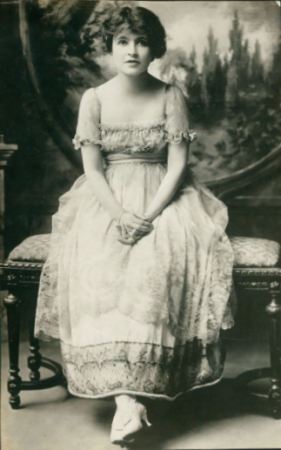
Undated photo of silent film actress Marguerite Clark.
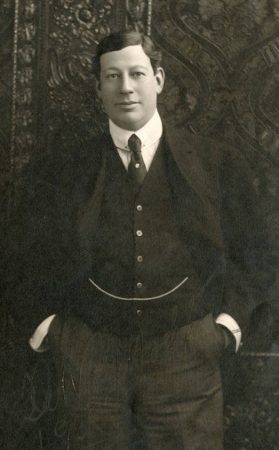
Actor DeWolf Hopper, ca. 1908. (Courtesy University of Washington Special Collections, Order No. 20113)
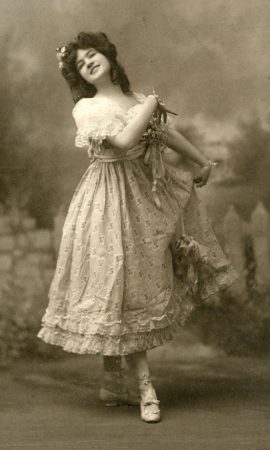
Stage actress Marguerite Clark, ca. 1903. (Photo by Otto Sarony Co., courtesy University of Washington Special Collections, Order No. 33535)
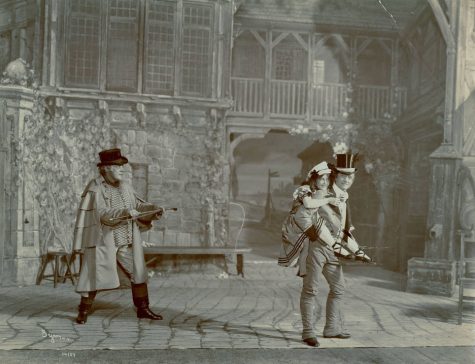
Clark piggybacking on Digby Bell in "Mr. Pickwick," ca. 1903. (Photo by Byron, courtesy University of Washington Special Collections, Order No. 23734)
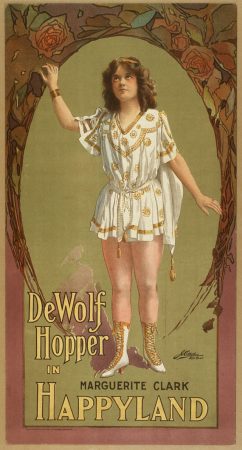
Theatrical poster for "Happyland" featuring Marguerite Clark, ca. 1905. (J. Ottmann Lithographic Co.)
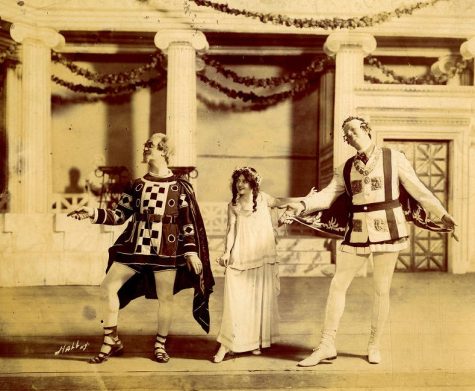
William Wolfe, left, Clark and DeWolf Hopper in "Happyland," ca. 1908. (Photo by Hall Studios, courtesy University of Washington Special Collections, Order No. JWS23799)
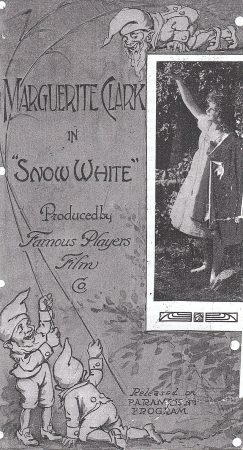
Advertisement for the film "Snow White" (Famous Players, 1916).
Roads of Destiny: A Few More Roadshow Engagements
Act II: Marguerite Clark
Although Theda Bara’s screen image offered one, albeit skewed look at womanhood, there were other female stars in the silent era who projected entirely different images. Mary Miles Minter, for example, was cut from the Mary Pickford cloth and gained notoriety by portraying more innocent, wholesome screen characters. Another such actress was Marguerite Clark, who initially rose to fame on the stage opposite one of the day’s premier singing comedians, DeWolf Hopper.
Marguerite Clark was born in February 1887 in a suburb of Cincinnati, Ohio. Both her parents died when she was quite young, leaving her sister Cora – Marguerite’s elder by 14 years – with parental responsibilities. Recognizing that her sister possessed an excellent singing voice, Cora pushed Marguerite into a stage career as a way to support them both. Marguerite Clark’s debut performance was in Baltimore in 1899, but in time the sisters made their way to New York where young Marguerite began earning raves for her stage work.[1] Clark’s voice eventually got her noticed by DeWolf Hopper, with whom she made both of her Seattle appearances. Although it was an early point in her stage career, unlike many struggling actors and actresses supporting famous stars, Marguerite Clark was already a featured member of the company by the time of her Seattle debut. DeWolf Hopper may have been the audience draw, but Clark was billed a close second for each production and figured prominently in print ads for each show.
In November 1903, when she was just 16, the pair arrived for Hopper’s first-ever local engagement and she was already being touted as “a most clever ingénue of national fame” in the show’s publicity.[2] “Marguerite Clark, one of the quaintest, daintiest and prettiest soubrettes who has been seen on the American stage in many years, will play the character of Polly in DeWolf Hopper’s production of Mr. Pickwick when the big musical production – a stage version of the Dickens masterpiece – come [sic] to the Grand next Thursday afternoon. Miss Clark has made a sensation in the part and has endeared herself to her audiences.”[3] The same notice, in fact, appearing in The Argus, centered exclusively on the actress, although the dramatic page for the issue was still graced with a large photo of DeWolf Hopper. Even so, Marguerite Clark scored a coup of sorts when her photograph, and not Hopper’s, graced the program for their engagement.[4]
Starting on Thursday, November 26th, 1903, and drawing Thanksgiving crowds, DeWolf Hopper and Marguerite Clark played the Grand Opera House for three days (and five performances) in Mr. Pickwick, a musical interpretation of Charles Dickens’ The Pickwick Papers, which debuted 10 months earlier in New York. The show, which featured a cast of 75, came with very high praise after playing New York’s Herald Square Theatre for three full months. The Seattle engagement boasted much of the original cast as well as the scenery and costumes that helped make the show a Broadway sensation.
That DeWolf Hopper’s talents commanded respect was evidenced by comments from the Seattle Daily Times, whose reviewer expressed some relief that the opening performance drew the city’s more responsible theatregoers.
It was a matter of gratification alike in the eminent comedian, DeWolf Hopper, who made his first appearance in Seattle last night and to those theatre-goers who take a pride in seeing their city give proper recognition in all theatrical engagements of great merit, to note the magnificent audience which assembled to witness the initial presentation of Mr. Pickwick at the Grand. It was a holiday throng, but not of the character which usually assembles in the playhouses on a festival day. The noisy, farce comedy element was happily not there; Dickens would not attract it. The house was filled with the best class of theatregoers, people who take the drama seriously, who are not demonstrative, but who know and intensely appreciate really clever stage art.
It must be a pleasure to Mr. Hopper to know that three thousand miles away from the Lambs Club he can draw as discriminating an audience as on Broadway. Of course the audience last night closely followed the precedent set by Solomon some time ago in the matter of gorgeous array. There were more silks, satins and diamonds in the house than have been displayed before in a very long time.[5]
Thankfully the city neglected to show its rougher edges at the Grand, and audiences were greeted with “the best [cast] that Seattle has ever seen in a musical play.” The Post-Intelligencer felt the show was first-rate. “While Dickens’ characters and his dry humor make the production particularly attractive and the cleverness of DeWolf Hopper is pronounced,” wrote their reviewer, “the musical comedy features of the production are worthy of mention. The music is tuneful, the choruses dainty and pleasing in the manner of voice and costume. They made a pretty picture in the rainbow dance, and their different specialties make a good impression.”[6]
Hopper particularly delighted the opening night crowd by responding to a thunderous curtain call after the first act, appearing out front and never once dropping his stage character throughout his remarks. Among other things, he told the gathering how nice it was to be sleeping in a real bed. Touring in one-night stands made for complications, the star remarked. He had been sleeping on trains for so long that the only way he could get comfortable in a hotel room was to hire a couple of strong men to stand at his bedside, shake it violently throughout the night and throw cinders in his eyes.[7]
The production of Mr. Pickwick found Marguerite Clark in the role of Polly, and although she shared billing honors for the engagement, the attention lavished on DeWolf Hopper during his first Seattle visit found her work somewhat relegated to the background. The Post-Intelligencer neglected to expand on her performance, though she proved quite pleasing to the reviewer for the Seattle Daily Times. “Marguerite Clark gives unmitigated delight as Polly. When Mr. Hopper discovered her talent, she was playing small parts with the Lederers, but his giving her so important a role as the ingénue in Mr. Pickwick is more than justified by the favor which she finds with her auditors. She is very pretty, very graceful, has a tuneful throat and gives a bright color to every stage picture in which she forms a part,” their critic noted, ending his remarks with the somewhat confusing observation that Clark was “a diamond in the smooth.”[8] The Star was also complimentary of Marguerite Clark’s stage work, although they thought a bit comical the statures of the lead actors – Clark was four feet 10 inches tall, Hopper well over six feet.
Sharing honors with Mr. Whopper, nee Hopper, in favor was Miss Marguerite Clark, the daintiest bit of femininity seen on the stage in Seattle for many moons. She was graceful in her dances, petite in appearance and her slang was characteristic. The cutest part of the whole piece was a foolish little song, “Three Little Piggies,” sung by Mr. Whopper and Miss Clark. Whopper and his seven feet and Miss Clark with her scant five made a great contrast. She walked over his chest as if he were a horse, and so he appeared when in her presence. His song was good, however, and the singers were recalled several times.[9]
It would be five years before DeWolf Hopper and Marguerite Clark returned to Seattle, but they were still performing together in 1908, when they came to the Moore Theatre for a three-day engagement beginning January 30. The new production was Happyland, adapted expressly for Hopper, a comic opera with a fairy tale setting in which the king of a faraway land, who has tired of the perpetual happiness under his rule, orders his subjects to wed since he has observed that married people are uniformly unhappy. Hopper and Clark originally debuted the show in New York in October 1905, and had toured extensively with it since then, carrying with them, according to the Moore program, over 100 performers in the cast.
Marguerite Clark again enjoyed second billing in the troupe, and again managed to get a leg up on the star in the Sunday edition of the Seattle Daily Times, where the announcement for the Happyland engagement carried a photo of Clark more than twice the size of DeWolf Hopper’s.[10 ]
Again, Seattle warmly received Hopper and his brand of comic opera, which played to a capacity house at the Moore, even if the Daily Times found elements of Happyland lacking. “[Reginald] De Koven wrote the music and Frederick Rankin the book. Neither is remarkable,” the paper observed, “but Mr. Hopper needs neither a clever book nor a brilliant score to make a success; his mouth and his legs are enough. Both are eloquently expressive.”[11] Similar sentiments were voiced by the Star, which felt that while the production was entertaining with genuine, slapstick fun, the play “will neither prove popular nor live on among the standard works” of comic opera. “Happyland has the advantage of being given with a splendid company and with unusual settings and costumes. Without these it is questionable as to whether the opera itself would be a success.”[12]
The writer for the Post-Intelligencer had obviously seen Hopper perform elsewhere, for not only did he feel differently, calling Happyland far and away better than Mr. Pickwick, but suggested that it was the best thing the actor had done since Wang, the play DeWolf Hopper was most famous for. (And a production which Seattle audiences, unfortunately, never had the opportunity to see him perform.) “Hopper is the biggest thing in comic opera and his Herculean energies are being applied to the chromatic and infectious fun making that the two long acts of the Dekoven [sic] and Rankin joint work affords. He has also furnished the limit in the matter of contrasts by an association with the daintiest and prettiest of comediennes, Marguerite Clark, who is the multum in parvo of artistic capability.”[13]
Clark played the role of Sylvia, the daughter of the King, and shared supporting honors with William Wolfe, cast as Altimus, a rival King, whose comic interplay with Hopper very nearly stole the show. Clark’s charm and manner quickly won over the audience, which the Post-Intelligencer felt was a considerable help in downplaying some weak singing on her part. The Daily Times detected no such faults in Clark’s work, but again (with reference to her stature) gave her some peculiar praise. “There are no words small enough and pretty enough to describe dainty, petite, winsome Marguerite Clark,” they gushed. “She’s a perfect little person, and she ought to be mounted and worn for a brooch or a watch fob.”[14] The Star‘s thoughts were more conventional. “Marguerite Clark is about as charming a bit of femininity as has ever tripped through comic opera in this city. She combines ingénue, soubrette and prima donna soprano in a most attractive way, her capacity for comedy and dainty acting being equaled by her ability to sing tastefully and pleasingly.”[15]
Seattle’s rowdier element, however, which seems to have avoided the opening night of Mr. Pickwick five years earlier, was on hand for DeWolf Hopper’s return engagement. The young men from the Phi Delta Theta house at the University of Washington, all 70-plus of them, filled the gallery at the Moore, and at the close of the first act began shouting for Hopper to recite “Casey at the Bat,” renditions of which the actor had been giving onstage for nearly 20 years.[16] Reappearing before the curtain, the star willingly obliged, although from the description in the Daily Times he probably had little choice. At the very least, however, the Phi Delta Theta men were grateful, as was the rest of the audience – the fraternity led a rousing round of applause after the poem and showered the stage with flowers in tribute.
Marguerite Clark made no known Seattle appearances after the Happyland engagement in 1908, mostly concentrating on the Eastern stages before being lured into motion pictures by Adolph Zukor. The difficulties of touring life, in particular, did not appeal to her, just as it didn’t appeal to many actors playing the circuits. In 1912, Clark shared her thoughts with the Chicago Record in an article called “Truth to the Stagestruck,” which attempted to dispel notions on the so-called glamorous life of a stage actor.
I loved [touring] at first, but that soon wears off. And then when the edge of novelty goes, the ceaseless travel becomes a nightmare – miserable hotels, bad food; cold cars; up and out of bed at dawn to catch trains (because the night stand falls to all beginners and they must go through its lengthy ordeal); no time for relaxation, little time to take care of one’s health; no new faces, but the same old persons to talk to day in and day out – in short a gypsy life without a dash of color, without the vaguest tinge of romance.
Even in later years after the hard years of apprenticeship, there come months of this sort of thing. The period of stay in the larger cities is variable and fickle, and the road must be resorted to in the endless campaign for financial gain. Even after success comes, that dreaded nightmare of travel haunts the actress. She has no place she may call home. She no longer gets settled in a place than off she must go. And this holds for the most famous star as it does the lowliest chorus girl.[17]
By 1914, the year the Clark sisters were floored by Zukor’s three-year contract offer at $1,000 per week, Marguerite Clark was widely regarded as one of the stage’s brightest young talents. Motion pictures made her an even bigger star. Marguerite Clark was Zukor’s effort to create another Mary Pickford (whom he also had under his wing at the time), playing similar screen roles and gradually proving herself one of the industry’s most talented competitors to America’s Sweetheart. For publicity purposes, even, a rivalry of sorts was concocted between the two female stars.
In the long run, however, Marguerite Clark’s heart wasn’t set on remaining an entertainer. During World War I, while selling bonds during a Liberty Loan tour, the actress met Lieutenant Harry Palmerson-Williams, a wealthy socialite from Louisiana, whom she married in 1918. Although she continued her acting career until 1921, Clark ultimately left the industry and retired to her husband’s estate, where she became active in social and charity functions. According to DeWitt Bodeen, Clark was appointed by then–Governor Huey Long to a seat on Louisiana’s motion picture censorship board, earned the prestigious title of Queen at a society ball during the 1925 Mardi Gras celebration and, together with her husband, selected upwards of 20 young men and women each year from the town of Patterson and funded their college educations.[18]
Although it was rumored in the 1920s that she would return to Hollywood to play the title role in J.M. Barrie’s Peter Pan, Marguerite Clark never resumed her screen career. (The role of Peter ultimately fell to Betty Bronson for Paramount’s 1924 adaptation.) After her husband died in 1936, Clark and her sister Clara moved to New York, where the actress died in 1940 at the age of 53.
Marguerite Clark may be little remembered today and only a handful of her films survive, but she nonetheless made a lasting impression on the industry in at least one obscure way. One of her earliest silent films, based on her stage success in the same part, was the title role in Snow White (Famous Players, 1915), which is said to have been a favorite for a young Kansas City boy named Walt Disney.[19] The experience helped fire Disney’s interest in the movies, and it was the image of Marguerite Clark, some have contended, that served as the model for Disney’s animated likeness in the 1937 feature.
By Eric L. Flom – January 2026
Notes:
[1] DeWitt Bodeen, “Marguerite Clark Was a Bit More Sophisticated than Pickford but Not so Hard-Working,” Films in Review (December 1964), Pages 611–612.
[2] The engagement was special not only because it was Seattle’s first opportunity to see DeWolf Hopper, but also because the actor apparently had local connections: the DeWolf family of Seattle claimed to be cousins of the singing comedian, the actor’s unusual first name being his mother’s maiden name. (See “The Thanksgiving Billboards,” Seattle Daily Times, 22 November 1903, Section V, Page 1.)
[3] “DeWolf Hopper,” The Argus, 21 November 1903, Page 6.
[4] Program, Grand Opera House (22 November 1903), J. Willis Sayre Collection.
[5] “Hopper Receives an Ovation,” Seattle Daily Times, 27 November 1903, Page 7. Rowdyism in the galleries, together with late-arriving or noisy patrons, were common nuisances for theatergoers. Early in 1903, just months before DeWolf Hopper arrived in Mr. Pickwick, gallery antics had reached such a level in Seattle that the daily newspapers were calling for some sort of action to curb the disturbances. “Possibly at the Grand, because the gallery is of far the greatest capacity, trouble seems to center,” observed The Argus’ roving columnist, the Stroller. “It is a deplorable fact that whenever any tender love passages between the hero and heroine are about to come off on that stage, the people downstairs hold their breath in dread of the outburst of noisy insult that is due from the gallery. And it always comes.”
Though no action was taken by the city, that didn’t stop the Stroller from suggesting his own solution. A devotee of the theatre, the columnist argued that until the City Council acted, theatre managers and the police department should take matters into their own hands. “[T]here should be a special policeman in citizens’ clothes in the center of the gallery,” the Stroller advocated. “He should be provided with a club that is not stuffed. With this, as an example he should beat the first two or three offenders nearly to death. Then as they strike the sidewalk on the outside he should kick them personally…It wouldn’t be necessary to do this more than two or three nights before the disturbing element would learn that its price of admission did not entitle it to go through with the ruffianism with which it now disgraces itself.” (“The Stroller,” The Argus, 21 February 1903, Page 2.) The proposal remained just that, but to the Stroller, apparently, preserving the civilizing influence of the theatre was important enough that the ends justified the means.
[6] “Makes a Big Hit,” Seattle Post-Intelligencer, 27 November 1903, Page 5.
[7] Ibid.
[8] “Hopper Receives an Ovation,” Seattle Daily Times, 27 November 1903, Page 7. DeWolf Hopper actually noticed Marguerite Clark when the actress performed on Broadway opposite Eddie Foy in 1902’s The Wild Rose. She was under the management of George W. Lederer at an earlier period in her career.
[9] “DeWolf ‘Whopper,’” Seattle Star, 27 November 1903, Page 2.
[10] “Seattle is the Best ‘Show Town’ on the Coast – De- Wolf Hopper This Week in Happyland,” Seattle Daily Times, 26 January 1908, Page 44. The effort was likely part of an ongoing campaign by Marguerite Clark’s sister Cora (who had become her manager) to promote the actress’ talents to the theatre-going public. Just two years earlier, in 1906, she got another nice publicity write-up in The Argus, even though neither she nor Hopper were touring the Pacific Northwest at the time. “Miss Clark has been on the stage for about four years, but in that time her talent and her unusual personal charm have brought her into an enviable position in the ranks of light opera. She is one of the youngest musical stars on the stage, not yet out of her teens, and one of the hardest workers. She is constantly adding to [her] effectiveness. Her sister watches her at every performance, and it is due in part to her suggestions that the young singer’s acting is so successful.” (“Dramatic Notes,” The Argus, 9 June 1906, Page 6.) One has to think Cora Clark penned this notice herself.
[11] “DeWolf Hopper, Ecstatically Received, is Almost the Whole Show in Happyland,” Seattle Daily Times, 31 January 1908, Page 11.
[12] “Hopper, Clark, Happyland,” Seattle Star, 31 January 1908, Page 7.
[13] “DeWolf Hopper in Happyland,” Seattle Post-Intelligencer, 31 January 1908, Page 7.
[14] Ibid; see also “DeWolf Hopper, Ecstatically Received, is Almost the Whole Show in Happyland,” Seattle Daily Times, 31 January 1908, Page 11.
[15] “Hopper, Clark, Happyland,” Seattle Star, 31 January 1908, Page 7.
[16] DeWolf Hopper eventually made a five-reel film of “Casey at the Bat” for the Triangle Company in 1916, which played a three-day engagement at Seattle’s Liberty Theater beginning on July 6th of that year. It was the culmination of almost three decades of reciting the poem onstage – people never seemed to tire of it, and Hopper accommodated almost every request. His only respite was at a small gathering one evening in Worcester, Massachusetts, when Hopper first had the opportunity to meet the author of the famous poem, Ernest L. Thayer. “That was one of the few events of the sort in nearly thirty years when I did not recite ‘Casey,’” Hopper was quoted as saying in Triangle publicity for the film. “[The party] did better. They made Mr. Thayer do it.” (“Hopper Gives Life History of Casey,” Seattle Daily Times, 18 June 1916, Section III, Page 2.) Unfortunately, the photoplay version was one of the ill-fated Triangle Company’s most publicized duds, perhaps because audiences knew from the opening credits how the story was going to turn out. Hopper, incidentally, was also called upon to recite “Casey” during his Pickwick engagement in 1903, which he made along with a selection for the women of the house, “They Met by Chance (The Cow and the Cowcatcher).”
[17] “Truth to the Stagestruck,” Chicago Record, 31 March 1912; cited in Curtis Nunn, Marguerite Clark: America’s Darling of Broadway and the Silent Screen (Fort Worth, Texas: The Texas Christian University Press, 1981), Page 11.
[18] Bodeen, Page 621.
[19] Richard Schickel, The Disney Version: The Life, Times, Art and Commerce of Walt Disney (New York: Simon and Schuster, 1968), Page 60. Schickel mistakenly identifies Marguerite Clark as “Marguerite White” in his discussion.
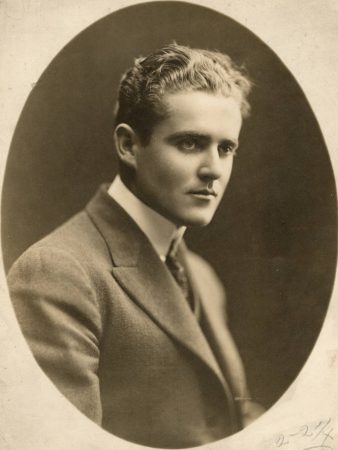
Marshall Neilan, ca. 1913. (Courtesy University of Washington Special Collections, Order No. 12509)
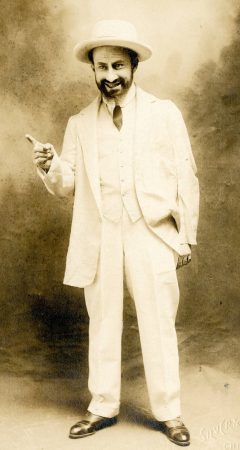
Stage comedian Barney Bernard, ca. 1912. (Photo by Silver and Friedman, courtesy University of Washington Special Collections, Order No. 14432)
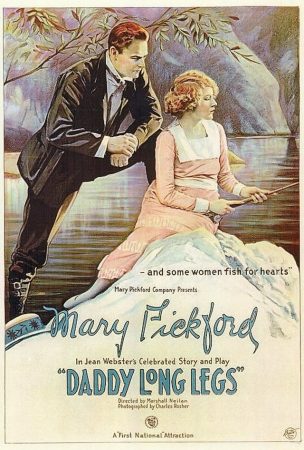
Poster for the Neilan-directed film "Daddy Long Legs," (First National, 1919), a hit for actress Mary Pickford.
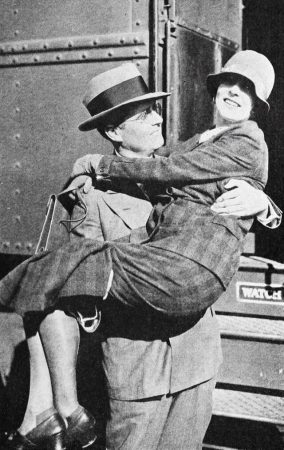
Director Marshall Neilan with wife Blanche Sweet, ca. 1925. (Exhibitor's Herald, 28 November 1925, Page 41)
Roads of Destiny: A Few More Roadshow Engagements
Act III: Marshall Neilan
Interestingly, one of Marguerite Clark’s leading men during her screen career, a player in the 1916 Paramount film Mice and Men, was a young actor named Marshall Neilan, who would eventually establish himself not as a performer, as he originally began, but as a silent film director. Neilan, a self-destructive talent whose screen reputation was hindered by an excessive lifestyle, was one of several directors to have made their way across the stages of Seattle. In addition to himself, the likes of D.W. Griffith, Thomas Ince, and Cecil B. DeMille, as well as other figures such as Reginald Barker, Fred Niblo, Charles Reisner, Walter Edwards, Lloyd Ingraham, King Baggott, James Kirkwood, Edwin Carewe and James Cruze all played Seattle at one time or another.
It’s been observed that many silent film directors never actually set out to become one, but rather fell into the position by chance or accident. The oft-told story, for instance, is that when an open directorial position at the Biograph Company was offered to D.W. Griffith, he accepted only on the condition that he could continue work as an actor if it didn’t work out. Others took more bizarre routes to the director’s chair. Allan Dwan, whose directorial career spanned well over half a century, was an engineer by trade who was lured into the movie business by Essanay president George S. Spoor, who hired him to light the company’s Chicago studio. Later, when Dwan was working for the American Film Company (known as “the Flying A”), he was dispatched from Arizona to southern California to locate a production crew which had not been heard from for some time. He found the troupe near San Juan Capistrano, where their director, a binge drinker, had abandoned them for the wetter climate of Los Angeles. Dwan quickly wired the home office and suggested they disband the company, since they had no director; Flying A wired back, instructing him to direct. Caught off guard, Dwan assembled the troupe and announced the gist of American Film’s decision: accept a novice at the helm or face unemployment. To this the actors enthusiastically declared Dwan “the best damn director we ever saw.”[1]
Most silent film directors, however, were more in the Griffith mold – that is, actors who found their métier behind the camera rather than in front of it. Such was the case for Marshall Neilan. According to historian Jack Spears, Neilan was a true restless spirit – a man who probably could have been successful as an actor or a director, or perhaps even as a bricklayer, assuming the job held his interest long enough. Born in 1891 in San Bernadino, Neilan’s mother (his father passed early) ran boarding houses in southern California, and although he doesn’t seem to have been bitten by the stage bug right away, it’s said that young Marshall once earned a small sum as a child extra at the Alcazar Theater in San Francisco.
Though he held a succession of jobs as a younger boy, Neilan eventually landed in the footlights with the Belasco Stock Company in Los Angeles, playing small roles but never really achieving much success. He eventually left the troupe in an abortive attempt to study at the Massachusetts Institute of Technology, and when that failed to materialize, he traveled around the United States for two years before arriving back in California. In 1905, Marshall Neilan returned to the stage, signing on with the Barney Bernard stock company.
It was with the Bernard company that Neilan made his only known Seattle appearance, in June 1905, when he put in two performances as Dan in H.D. Cottrell’s The Financier. The comedy had been written especially for the talents of Bernard, a Jewish comedian who had achieved considerable success in San Francisco, and would later be known for his work in the stage play Potash and Perlmutter. Barney Bernard was held in quite high regard for his talents – or at least he was in his own press releases, which described him as being “different from the customary stage Hebrew comedian. He is funny, original and artistic. He seems real. He can only be associated with the character he portrays. When Mr. Bernard comes on the stage his appearance creates a laugh; his walk, his beard, his peculiar attire, the fit of his clothes. He has been on stage but a few minutes when you forget that his is portraying the part of a Hebrew. He is a real character; you feel that he cannot help doing it; that he has to talk and walk that way. This is why Barney Bernard is artistic: he is acting, but he does not appear to be.”[2] This was fair praise, but on some level, Barnard tended to play stage characters that traded on commonly held stereotypes.
The plot of The Financier had more than a few similarities to incidents in The Auctioneer, which David Warfield brought to Seattle some three years previous. Bernard played a Jewish real estate man who invests $25,000 in a South African diamond mine, yet on the day of his 20th wedding anniversary he learns that the mine is a bust and his investment ruined. The blow to his finances costs him nearly everything, and within a matter of months he is reduced to operating a clothes cleaner, earning a meager existence. Yet suddenly, in the last act, after a good deal of pathos is extracted from the Bernard character coming to grips with his loss, a diamond expert arrives from Africa with the news that the mine is not worthless at all but valued in the millions of dollars. “The Financier is a departure from the stock methods of the playwright, in that it portrays a Jewish character that is not intended as a butt of ridicule or contempt. The play is brisk in dialogue and full of bright speeches and funny situations, with here and there a bit of real pathos in admirable contrast.”[3]
Unfortunately, Barney Bernard and his company were unable to make the first two of their three scheduled performances at the Grand Opera House, the evening show on June 16 and the matinee performance the following day, as an unidentified train delay would not allow the troupe up the coast. “There will be no performance of The Financier at the Grand tonight,” the Daily Times announced on June 16th, 1905. “It was found late this afternoon that it would be impossible to get Mr. Bernard and his company here in time for the performance, owing to a serious delay of the train bringing the company to this city. Tonight’s tickets will either be exchanged for their purchase price or made good for tomorrow night, the only performance now scheduled.”[4]
By Saturday evening, however, Bernard and his troupe had arrived and were able to give the only performance of The Financier during their scheduled engagement. “Barney Bernard’s first appearance in Seattle at the Grand last night in H.D. Cottrell’s comedy The Financier was evidence that Manager [John] Cort will do well to bring this comedian here again,” commented the Seattle Daily Times. “The performance delighted an audience that was large and appreciative…At the end of the second act the star was encored so often that he was forced to respond briefly in a short but well-timed speech.”[5] Although the Daily Times admitted the comedy was essentially a one-man show and that the background players, among them Marshall Neilan, contributed little to the merriment, “[at least] what there is of it is done well.” The Star concurred. “Barney Bernard gave a fine production of his new piece, The Financier, at the Grand, Saturday night,” they noted in a very brief review. “The hit was so pronounced that a return engagement for next Monday night was booked before Barney Bernard left town. Bernard, as an interpreter of Hebrew character, is in the Dave Warfield class, and that is saying a good deal.”[6]
The Post-Intelligencer felt differently about the production, approving only of the leading man’s performance. Bernard, in his first starring role, made ample use of his background in vaudeville and burlesque to enliven the piece, but ultimately The Financier was a weak play and Bernard’s support was less than adequate. “With the single exception of Miss [Ada] Levick, as the financier’s wife,” they noted, “the company was only moderately good and in spots it was disappointingly bad.”[7]
Yet there was enough positive reaction to The Financier, as the Star noted, that John Cort re-engaged the company for a single night, June 26, 1905, some nine days after their initial performance at the Grand. The arrangements were made to honor patrons who missed one of the two canceled shows, although Cort had to wait until after a special engagement of German comedians Kolb and Dill in the musical comedy I.O.U. Thus, on the evening of June 26, Barney Bernard returned to the Grand for a single performance of The Financier; none of Seattle’s daily papers, however, felt it necessary to review the show a second time.
Nonetheless, Marshall Neilan – despite possibly being one of the “disappointingly bad” elements of The Financier, as observed by the Post-Intelligencer – continued to ply his trade as a stage actor. Yet with his changing interests, he would once again abandon the stage for (of all things) work as a stagecoach driver in Nevada, and later a car salesman in Los Angeles. It was as a salesman that Neilan was offered the opportunity to chauffeur a bit, first for West Coast stage producer Oliver Morosco, then for the director of one of the many Eastern film companies that were invading Los Angeles during the winter months – an old friend from his stage days, D.W. Griffith.
During the winter of 1909-1910, it seems, Neilan served as Griffith’s driver while the Biograph crew was in California, and it was he who encouraged Neilan to try his luck in motion pictures. Neilan did, accepting work with the Kalem Studios in Santa Monica, where he eventually developed into a credible screen actor. Though he initially bounced around to various film companies and perhaps could have made a name for himself in front of the camera, he instead turned his talents toward directing, where he seemed to show natural talent. Neilan was, in fact, hand-selected by Mary Pickford for her 1917 Artcraft release Rebecca of Sunnybrook Farm (while an actor, the two had played opposite each other in 1915’s Madame Butterfly, made for Famous Players), the start of a collaboration that represented some of the best work from both artists during the late 1910s.
Yet although Neilan’s directorial talents had earned him considerable clout within the film industry by the early 1920s, his flamboyance and excessive lifestyle eventually became more notable than his screen work. Over time his absences from sets became frequent, rude behavior and public drunkenness a constant hazard. Jack Spears notes that with one such film, the Anita Stewart project In Old Kentucky (First National, 1919), directorial credit actually went to “Marshall Neilan and Staff,” since his frequent absences during production forced Neilan’s assistants to shoot much of footage themselves.[8] He also openly detested many of Hollywood’s most powerful studio executives; “an empty cab drove up,” went one of his more famous put-downs, “and Louis B. Mayer got out.” Such comments were hazardous enough while his career was on track, but later, when projects began to dry up, they made it difficult for him to get jobs. Although he continued directing into the 1930s, good opportunities were few and far between. “Unlike Griffith or [Erich] von Stroheim (or, to cite a later example, Orson Welles),” Richard Koszarski has noted, “Marshall Neilan’s tragedy had little to do with the cost, style, or box-office success of his pictures. His story cannot be read as a failure of the system but only as the inability of one talented, undisciplined, and self-destructive individual to adjust to the success he had wrested from the system itself.”[9] Neilan died in 1958; one of his last bits of film work was as an actor, playing Senator Fuller in Elia Kazan’s A Face in the Crowd (Warner Bros., 1956).
By Eric L. Flom – January 2026
Notes:
[1] Peter Bogdanovich, Allan Dwan: The Last Pioneer (New York: Praeger Publishers, Inc., 1971), Page 17. Bogdanovich later used the incident in the 1976 film Nickelodeon.
[2] “No Performance Tonight,” Seattle Daily Times, 16 June 1905, Page 7.
[3] “Show Season Drawing Toward the Close,” Seattle Daily Times, 25 June 1905, Social Section, Page 10.
[4] “No Performance Tonight,” Seattle Daily Times, 16 June 1905, Page 7.
[5] “Bernard Pleases Big Audience at Grand,” Seattle Daily Times, 18 June 1905, Page 18.
[6] “At the Theaters,” Seattle Star, 19 June 1905, Page 8.
[7] “The Financier,” Seattle Post-Intelligencer, 18 June 1905, Page 4.
[8] As a stage performer, Anita Stewart appeared in Seattle only once, a vaudeville appearance at the Seattle Theatre in February 1929. Stewart headlined the live bill in Oh, Teacher, a singing and dancing act that also featured Ray Bolger in a minor role. The stage acts supported feature film The Canary Murder Case (Paramount, 1929) starring William Powell and Louise Brooks. (See program, Seattle Theatre [9 February 1929], J. Willis Sayre Collection.)
[9] Richard Koszarski, An Evening’s Entertainment: The Age of the Silent Feature Picture, 1915-1928 (Berkley, CA: University of California Press – 1990), Page 232.
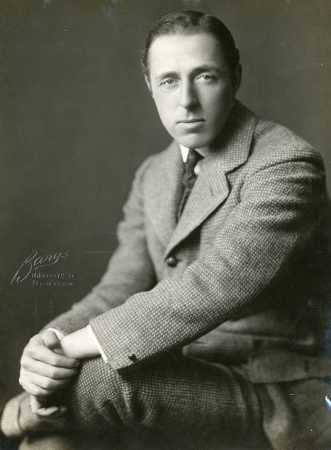
Director D.W. Griffith, ca. 1922. (Photo by Bangs Studio, courtesy University of Washington Special Collections, Order No. JWS18536)
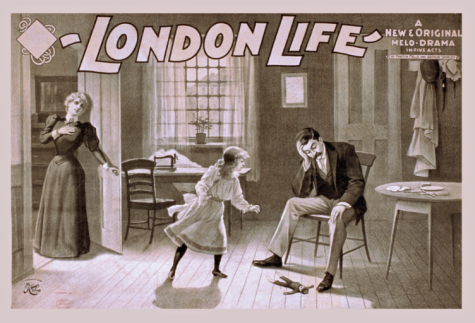
Undated poster for the stage play "London Life."
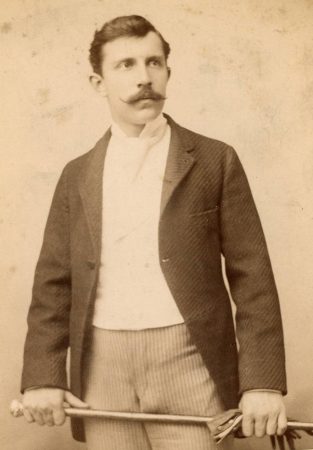
Actor Harry Glazier, ca. 1892. (Photo by W.D. Wentworth and Son, courtesy University of Washington Special Collections, Order No. JWS18043)
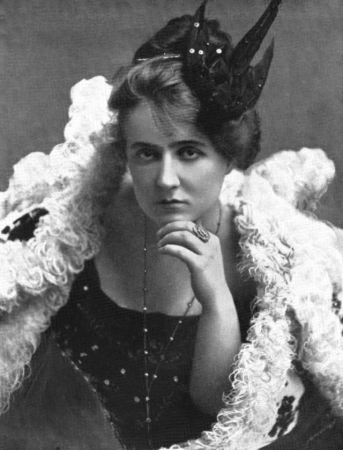
Nance O'Neil as Magda, ca. 1902. (Photo by Bushnell Studios, San Francisco)
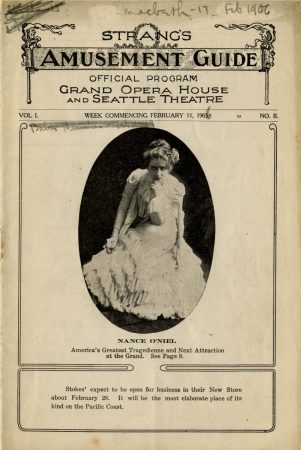
Nance O'Neil on the Grand Opera House program, week of February 11, 1906. (Courtesy University of Washington Special Collections, Digital ID No. PAM732)
Roads of Destiny: A Few More Roadshow Engagements
Act IV: D.W. Griffith
An interesting footnote to Marshall Neilan’s appearance in The Financier is that the show may have paired him, briefly, with the silent era’s most noted director, though that wasn’t the case for the Seattle engagement. David Wark Griffith was also known to have been a member of the Bernard troupe for a period and played with Neilan during an early engagement of The Financier – an acquaintance that later served as Neilan’s connection for breaking into the picture business. Russell Merritt, in compiling a chronology of D.W. Griffith’s stage appearances, noted that Griffith (who routinely used stage names throughout his career) played a detective named Warburton in The Financier, an engagement that began in San Francisco in May 1905.[1] The Grand’s program for the Bernard engagement, however, gives no indication of such a character in the play, nor do press reviews mention a detective figuring into the plot.[2] Interestingly, however, there was a character named Mathews, a sewing machine collector, played by someone named “Harry” Griffith, who also served behind the scenes as the troupe’s carpenter.[3]
It’s unlikely that “Harry” Griffith was D.W. Griffith, but we can’t know for sure. Biographer Richard Schickel noted that the Griffith didn’t tour with Neilan and the rest of the Bernard company, and even Merritt’s detailed chronology couldn’t determine whether the director played other West Coast dates. Nonetheless, Seattle would have at least three confirmed stage appearances by the silent era’s most acclaimed director.
David Wark Griffith was born in rural Kentucky in January 1875 but moved to Louisville as a young boy after his father passed away. It was there, while working in a bookstore that served as an unofficial meeting place for local literary folk, that Griffith (who never really had a formal education) began taking an interest in the stage. Yet for him, acting was merely a conduit for his ideal profession, that of becoming a playwright.[4] Taking a place in the footlights, he was told, was the ideal training ground for a dramatic writer, so D.W. Griffith began learning stagecraft as an actor, despite the fact that it wasn’t the most reputable of occupations. He apparently didn’t do much to enhance the profession during his years onstage – though accounts of his acting skills vary, few who knew him during this period classified his work as anything more than adequate. For his own part the director liked to disparage his skills, helping perpetuate the notion of his having been one of the poorest actors to ever grace the American stage. While Griffith was being modest, some who worked with him at the time wouldn’t argue.
D.W. Griffith spent several years playing small parts with an excellent stock troupe, the Meffort Company out of Louisville. He later got on with several touring companies originating in the Midwest, tried his hand at New York theatrics and, later, headed west to San Francisco for the same. Once in California, Griffith likely had a number of opportunities to head up the coast to Seattle with organizations originating out of the Bay Area, such as the troupe that brought Barney Bernard in The Financier. It may be impossible to know precisely how many times he played on the city’s stages, however, given his frequent use of stage names, something he did to protect his family’s reputation.
The first of his known engagements occurred in January 1900, when D.W. Griffith arrived at the Seattle Theatre for a two-day appearance in London Life, a five act English melodrama that had reportedly played to enthusiastic audiences in London, Paris and New York. The play centered upon an aged aristocrat who’s new (and very young) Spanish bride is found by Gladys, the aristocrat’s daughter, to be in league with Granger, his scheming secretary. Due to the old man’s failing health, Gladys does not disclose this knowledge. Eventually, however, her father demands that she marry Granger, but Gladys refuses, her heart pledged to another. Angered by this betrayal, the old man banishes her from his house, and in despair she throws herself into a river. But she is saved by Jack Ferrers – “Happy Jack,” as he is called – who is also a sworn enemy of Granger’s, having once been framed by him for forgery. The two band together to seek retribution, the result of which, as one publicity notice phrased it, “assured a future full of prosperity and happiness” for both.
“London Life, the new drama [to be] presented at the Seattle theater Saturday and Sunday, January 20 and 21, is going to be a big affair,” boasted an advance notice in the venue’s program. “Not only has it a first class cast, but it has certain striking scenes, fraught with sensationalism and realism. These effects include Fleet street at publishing time, a life-like representation of Ludgate Circus, a beautiful river set, and a pawnshop in full swing.” Redundantly, the Seattle Theatre ended this notice by encouraging patrons to “(l)ook to find also a murder scene of a most murderous character.”[5]
Some accounts claim that D.W. Griffith left the production of London Life shortly after closing a swing through the Midwest, heading back to New York while the remainder of the company headed to California for the beginning of a coastal tour. His appearance at the Seattle Theatre with London Life contradicts this information. The actor – performing as “Lawrence” Griffith – played the lead, Jack Ferrers, in a company that also featured Harry Salter. (Salter, together with actor Max Davidson, is generally credited with recommending motion picture work to Griffith eight years later when all three were in New York.) Griffith was paired with Meta Brittain as Gladys. “Few plays have been more pretentiously produced. In order to faithfully realize the various scenes of the play, an entire carload of special scenery is necessitated for the production. The company engaged to interpret the play is one of uniform excellence and has no superior among traveling organizations.”[6]
Unfortunately, actual reviews for London Life are in short supply. Opening on a Saturday evening, two of Seattle’s three major dailies (the Star and Times) were not publishing Sunday editions at the time, and neither devoted commentary to the presentation in their Monday editions. Thus, the only critique of the play comes from the Post-Intelligencer, and it’s a grim one indeed. While some writers have noted that both Griffith and the play met with success earlier in the tour, the company’s lone notice from Seattle was horrific.
If “London Life” is as presented at the Seattle theater last night it would be advisable for Americans not to go abroad until matters can be readjusted. In fact, if “London Life” be as ridiculous as the company which presented the supposed picture of it, one cannot help wishing that the Boers will succeed in dismembering the British empire. The play at best is a very cheap melodrama, and the manner in which it was presented was as one who was present expressed it, “simply awful.” The play is without a solitary redeeming feature. The plot is time worn, the acting is miserable and to witness it is self-inflicted torture.
Had Manager [J.P.] Howe at the end of the first act last night run down the curtain and refunded the box receipts he would have done a thing that would have met with the unanimous approval of the fair-sized audience that came expecting to see a good performance, and was so grievously disappointed.
The stage settings of the play are well arranged, but the incongruity between them and acting was so striking as to cause laughter in the audience at inopportune moments, when tears were supposed to be in order. Lawrence Griffith, by courtesy called the leading man of the company, goes through his part like an automaton, and during the most affecting part of his lines, the audience simply tittered at him. Miss Meta Brittain, the leading lady, also by courtesy, is probably the most incompetent actress that ever essayed to play an important part on a local stage, and the support was fully in keeping with the standard set by those essaying the two leading roles.[7]
Most certainly licking their wounds, the London Life company slipped out of town on January 22, three days before their leading man, “Lawrence” Griffith, was to celebrate his 25th birthday. Taking their place at the Seattle Theatre that evening, interestingly, was noted tragedian Frederick Warde, in the engagement that brought young Douglas Fairbanks to Seattle for the first time. Some 15 years later, at D.W. Griffith’s Fine Arts Studio, Fairbanks would make his motion picture debut in The Lamb, made for the Triangle Corporation. The two would later become founding members of United Artists.
It doesn’t appear that D.W. Griffith stayed with the London Life company for long after this January engagement, for his second appearance in Seattle was only two months later, in March 1900. Considering the amount of time which would have been necessary for Griffith to have closed the show, travel to San Francisco (where his next company seems to have originated), obtain a position, rehearse and get back out on the road, it seems clear that his tenure with the company (assuming it did not disband altogether) was close to an end by the time London Life played Seattle.
But when D.W. Griffith returned a mere two months later, it was in an entirely new production, playing Athos in a revival of Alexandre Dumas’ The Three Musketeers. The play was a starring vehicle for Harry Glazier in the role of D’Artagnan. Significantly, Griffith was performing under a new stage name for the Musketeers tour; coming so soon off the catastrophe of London Life and likely appearing in many of the same West Coast cities, he was now going by “Lawrence Underwood” rather than “Lawrence” Griffith. This was most certainly an alteration made to avoid recognition for his earlier work as Jack Ferrers.
With a three-day engagement beginning on Thursday, March 29, 1900, the Glazier troupe – ironically enough, considering Griffith’s later fame – took over the Seattle Theatre not from another stage company, but from an early motion picture exhibition. And, as fate would have it, the film was produced by Griffith’s future employer, the American Mutoscope & Biograph Company.
Manager J.P. Howe kicked off the week at the Seattle with an exclusive presentation of the official film of the James J. Jeffries/Thomas Sharkey heavyweight title bout that had taken place at Coney Island on November 3, 1899.[8] A 25-round fight in which Jeffries was declared the victor, the road show of the film was one of at least six touring versions organized by the Biograph Company. It was a hit at the Seattle, despite a film break during its premiere screening that didn’t allow the last portion of the film to be shown. Nonetheless, the Post-Intelligencer lauded the presentation for its “remarkable” clarity and felt the pictures justified the judges’ slightly controversial decision awarding the title to Jeffries. (Their tune changed a bit on the Sunday following the Biograph presentation, when the paper complained of multiple projection difficulties throughout the engagement. Their writer, not at all enamored with motion picture technology, complained that the flickering images “makes [the film] exceedingly trying on the eyes.”[9])
The Harry Glazier company arrived in Seattle with a number of favorable notices, all generously supplied to the city’s newspapers by the actor’s business staff. “Attention is called to the extremely flattering reports of our correspondence to Harry Glazier’s Three Musketeers Company, which is called one of the best organizations on the road,” went one such announcement in The Argus.[10] Similar notations from the Seattle Daily Times also held the play up as a banner production. “(T)he Three Musketeers is now enjoying a revival that has developed into a positive craze on both sides of the Atlantic. Harry Glazier, the young romantic actor who appears in a new version of The Three Musketeers at the Seattle Theatre tonight, has worked his way to a leading position in his profession by a thorough training in the companies of such artists as Lawrence Barrett, Thomas W. Keene, Stuart Robson and Katherine Kidder. Mr. Glazier has youth, an expressive face, a powerful, well-modulated voice, and the impetuous temperament that Dumas’ D’Artganan [sic] demands.”[11]
The adaptation of the famous story, undertaken by Edmund Day, reportedly followed Dumas’ novel “as closely as stage requirements will permit.” In addition, a good deal of effort was spent on settings and costumes that were not just breathtaking but historically accurate. “The costumes worn by the ladies in The Three Musketeers company, it is said, cause a flutter in the hearts of the feminine potion of the audience.”[12]
Although he went unmentioned in the reviews of Seattle’s dailies, D.W. Griffith was probably relieved to be working with a troupe garnering better notices than his previous effort in London Life. While the Oregonian in Portland, where the Glazier company played a two-night stand earlier in the week, reported that the Athos of “Lawrence Underwood” was quite good, much of the praise from Seattle critics was heaped upon Glazier and other supporting players. Said the Post-Intelligencer:
Harry Glazier and an excellent company presented a splendid dramatization of Dumas,’ the elder, Three Musketeers at the Seattle theater last night. The company headed by Mr. Glazier is a strong one, and did full justice to one of the strongest melodramas based on fiction of the medieval period…
Mr. Glazier, as Phillip D’Artagnan, a musketeer and loyal friend of the queen, displayed much talent, and won round after round of applause by his clever acting. John P. Barrett, who played the part of Cardinal Richelieu, the prime minister and stealthy enemy of the queen, is also a capable actor. The other male members of the company are all good.
Miss Vail de Vernon, who assumed the part of Lady de Winter, an adventuress and spy for Richelieu, is a strong emotional actress. Blanche Stoddard, who appears as Anne of Austria, is an exceptionally clever artist, and her interpretation of her part was nearly faultless. Miss Maud Durand, as Constance, the faithful servant of the queen, displayed much talent.[13]
The Daily Times was in full agreement; although their own notice as quite small, they felt that the entire cast – particularly Glazier – played their parts to perfection, and that the show as a whole was “well staged and mounted.”[14]
Yet even with such favorable notices, the play doesn’t appear to have gone very far; Richard Schickel, in his biography of D.W. Griffith, claims The Three Musketeers closed in Vancouver, British Columbia.[15] Where D.W. Griffith went to following the Musketeers tour is a mystery; it wouldn’t be until October 1900, almost six months later, that his theatrical whereabouts can again be pinpointed, when he began a short Eastern tour in the vaudeville playlet Richelieu’s Stratagem, supporting J.E. Dodson.[16]
Although D.W. Griffith spent considerable time working out of San Francisco prior to entering the film industry, it would be another six years before his next confirmed visit to Pacific Northwest.[17] This occurred during the most notable theatrical engagement of his stage career, supporting Nance O’Neil, the American actress dubbed (at least in her own publicity) as the stage’s “most acclaimed tragedienne.” In February 1906, at the Grand Opera House, D.W. Griffith (returning to the use of his most common stage pseudonym, “Lawrence” Griffith) made his last known Seattle appearance.
O’Neil, whose real name was Gertrude Lamson, was a fixture of the San Francisco theatrical scene, and had made her first Seattle visit some 12 years previous, in 1894, appearing in a three-day run of The Canuck at the Seattle Theatre. Since then she had attained stardom under the watchful eye of stage veteran McKee Rankin and developed a repertoire of plays that she would tour with for several years. Many were popular dramas and well-known classics; one was Judith of Bethulia, and there is little doubt that Griffith, who consistently drew on stage material for his early Biograph films, utilized his familiarity with the O’Neil production when he selected the story as his first venture into feature-length filmmaking in 1913. Nance O’Neil’s second Seattle engagement, in March 1899, featured several of the offerings she would be noted for: six different plays over six nights, including Magda, The Jewess, Camille, Ingomar the Barbarian, The New East Lynne and Oliver Twist.
Seven years later, this time with Griffith in her company, little had changed: four shows in three days, including the actress’s signature piece, Magda, presented as the Saturday matinee performance.[18] O’Neil’s reputation, however, had grown significantly since her first Seattle visit, as her publicity suggested. “Nance O’Neil stands today absolutely without a rival on the English-speaking stage and she has won her enviable position by an enormous amount of energy and the hardest kind of work. All over the world the name of Nance O’Neil is known far and wide as the exponent of the best in classical drama, as a woman possessed of remarkable tragic force and magnetic power, but, above all, as an actress who injects into the roles she presents a keen mentality and intellectual thought that result in renditions artistic and memorable…Thomas Bailey Aldrich, the distinguished American poet, consented to write Judith of Bethulia for Nance O’Neil, so impressed was he by her acting, this being the only instance in the history of the American drama where a recognized poet of this country has written a blank verse play for an American actress.”[19]
Not only were Nance O’Neil’s own advance notices impressive, but her reputation was such that reporters from both the Daily Times and the Post-Intelligencer sought personal interviews with the star. These were conducted shortly after her arrival at the Hotel Washington, where she was staying during her engagement, and where she basked in an aura of theatrical royalty. “In common with all who have traveled over the world and viewed all of the famous beauty spots of the old world and new,” wrote the interviewer for the Daily Times, “Miss O’Neil is an enthusiast upon the magnificent scenery of this Coast, and Western Washington in particular. ‘I feel that the grandeur of the Western country has impressed itself upon me,’ she said this morning, ‘as it has upon thousands. It gives me inspiration.’”[20]
Nance O’Neil, who in addition to D.W. Griffith was supported by her mentor, McKee Rankin, began a three-day engagement at John Cort’s Grand Opera House on February 15th, 1906, with Fires of St. John, a new play to her repertoire. The controversial work focused on George, a young man of means who is in love with Marie, the daughter of a gypsy woman. George, thinking his love unreturnable, eventually gives up his infatuation and becomes engaged to Gertrude, the gypsy woman’s youngest daughter. Yet as the wedding plans progress, he discovers that Marie actually does love him, rekindling his interest and calling his relationship with Gertrude into question.
The Seattle Star was quite impressed with the play, calling the dialogue “brilliant, its situations strong and the story throughout of intense interest.” Not only was the play a triumph for Nance O’Neil, but her support was “thoroughly in keeping with the splendid work of the star.”[21]
For their own part, the Post-Intelligencer had very little to say about the production beyond noting that the performances of O’Neil and her company were “almost flawless.” Instead, its unnamed reviewer chose to expound in general on Nance O’Neil’s dramatic gifts, particularly in presenting the works of Maeterlink, Ibsen, and Sudermann (who wrote both Magda and Fires of St. John) to mass audiences – intellectually out of reach, in his opinion, to the average theatregoer. “Temperamentally Miss O’Neil is the best qualified actress before American audiences today to interpret the heroines of these three writers on subjects generally gloomy and unwholesome, and her splendid talent should go far toward establishing their dramatic worth. If the heredity of sin, unhappiness, misfortune and kindred qualities are to be made attractive, then it remains for Miss O’Neil to paint them so.”[22]
The reviewer for the Daily Times focused more on technique than substance, although he readily noted that in Fires of St. John “Sudermann almost outshudders Ibsen.”
It was to be expected that any play which could get the staid Bostonians wild with delight must be different from the common or garden variety of modern dramas, but [Fires of St. John] is even more than that…
Miss O’Neil has grown more placid with her advancing stage experience. Always splendid in scenes of declamation and turbulence, she has learned repression, and an actress need go no further than the example of [Minnie Maddern] Fiske or Mrs. [Patrick] Campbell to learn that repression often counts the most in effectiveness. Miss O’Neil’s gestures are more varied and convincing, her left hand, which in Elizabeth, on her last visit here, was acting more than half the time, has now learned repose, and grace and general stage ease have taken the place of her former restlessness. Miss O’Neil is destined to be numbered with the great ones.[23]
D.W. Griffith had no credited role in Fires of St. John, but did appear the following night, playing Borso in the presentation of Maurice Maeterlinck’s Monna Vanna, set in 15th century Italy and carrying more than a few similarities to Griffith’s later screen adaptation of Judith of Bethulia. Nance O’Neil played the title role, the wife of Guido, political and military figurehead of Pisa. The Florentine army, led by Prinzivalle, has surrounded the walls of Pisa and is threatening to launch a full-scale assault.
However, Prinzivalle sends word that he will spare the citizens if Guido sends his beautiful wife, Monna Vanna, to his tent that evening. He agrees, but only out of desperation. When Monna Vanna arrives, she recognizes Prinzivalle as a childhood sweetheart, and he expresses his strong and genuine affection for her. When dawn arrives, Prinzivalle accompanies his love back to the city, although Guido, full of rage and jealousy, has the Florentine commander seized and thrown in jail. Failing to understand that Monna Vanna has saved Pisa from certain destruction, he unleashes a tirade upon his wife, which only serves to alienate her. Monna Vanna then frees Prinzivalle and escapes from Pisa, spurning her husband in the process.
Unfortunately, Monna Vanna wasn’t as well received as Fires the day before. Although noting that Nance O’Neil and her supporting cast fared well in the piece, the Post-Intelligencer had reservations about the play itself. “Both the book and play have been harshly criticized, not for any lack of dramatic interest, although its construction has been attacked but because of its moral atmosphere approached too closely the line of degenerate pessimism…Reviewed in its entirety, last night’s bill was not as marked for dramatic possibilities as that of the opening night, and the personal triumph for Miss O’Neil was not as great.”[24]
The Daily Times agreed with that assessment. “The character of [Guido] is so drawn that there is no sympathy for him at any point,” they wrote, “and his long-drawn out harangue against his wife in the closing act, with the audience already in full possession of all the facts concerning what transpired in the tent scene, is an element of dramatic weakness, rather than strength, in the play.”[25] The Star wasn’t particularly impressed either. “Monna Vanna, the most talked of problem play of the season, was Nance O’Neil’s vehicle at the Grand opera house last night. Many were there to see and pass upon the Maeterlinck drama, and all were favorably impressed with the acting of Miss O’Neil, and of her leading man, Andrew Robson. But Monna Vanna failed to score a sensation, although perfectly acceptable as a means of displaying the artist’s talents.”[26]
In addition to O’Neil, who apparently gave the performance despite being very hoarse, several members of the cast, most notably Robson, were singled out for their excellent work. D.W. Griffith, however, wasn’t one of them. Collectively, the cast ranged from “excellent” in the Star to lesser commendations elsewhere. “The balance of the cast was even” is all that can be noted of Griffith’s Borso from the Post-Intelligencer, while the Daily Times felt that “Miss O’Neil’s company…certainly did not appear so favorably last evening as in The Fires of St. John [sic].” Part of the problem, the Times observed, was that stage veteran McKee Rankin took no role in Monna Vanna.
The following day, Saturday, Nance O’Neil’s troupe gave the last performances of their engagement at the Grand. The matinee was her famous rendition of Magda; all women in attendance were promised an autographed photo of the star.[27] The plot concerned a young German woman who is shunned by her family, but despite hardships, eventually becomes a celebrated opera singer. She later reunites with her father, a German soldier, who is ashamed to learn that Magda has borne a child out of wedlock. The father orders her to marry and save both their reputations, but he also demands that she give up the child for the sake of appearances. Torn, the singer ultimately refuses and her father, unable to bear the scandal thrust upon him, chooses to take his own life.
The Post-Intelligencer, whose reviewer for the engagement was fixated more on the types of plays Nance O’Neil was presenting than the performances themselves, found the whole of her Seattle engagement somewhat morose. Despite the giveaway photos and expensive costuming in Magda, which attracted a large female contingent to the matinee show at the Grand, it is difficult to determine whether the writer was intrigued or repulsed by the characters O’Neil played.
The Magda of Miss O’Neil is a consistent interpretation of a character hard to understand. It is in the quality of misunderstanding that Sudermann deals extensively and it is after patient diagnosis of one of his plays – a vivisection of his characters – that something like light breaks over it all. Not a glare of understanding but a dim comprehension that might filter between the pickets of the high fence that separates Sudermann from the rest of the world. In Magda only suggestions of a smile are allowed to express appreciation in the earlier scenes. The only brightness of the entire O’Neil engagement is then, and then but briefly. All the rest is covered with a gray pall of gloom that is lifted to show the wrecked lives of women. Women who are uncommon and strange, according to accepted types; abnormal women who think things and walk in unbeaten paths of understanding; moral degenerates who cling bat-like to the under side of life.[28]
Magda was dismissed out of hand by the Daily Times as “being in the repertoire of every actress of prominence in the New and Old Worlds,” but felt that seeing Nance O’Neil essay the role at least assured audiences that they were seeing one of the better renditions.
Again, “Lawrence” Griffith had no part in Magda, at least according to the Grand program, though he assumed the role of Banquo in the “mammoth” evening performance of Macbeth.
Fortunately, Shakespeare’s play fared a little better with the Daily Times, or at least more space was devoted to O’Neil’s version of it, even though they still felt the production was lacking in spots. While the backdrops seemed unusually good (patrons had been warned that the curtain would rise promptly at 8:05 P.M., owing to the heavy scenic effects), the supporting players as a whole – including Griffith – were “not all that [they] should have been…Of the long list of other supporting characters, none stood out with undue prominence. They ranged all the way from good down to the man who played Lennox [Milton Stallard, also Nance O’Neil’s stage manager], whose voice carried possibly six feet, but no more.”[29] The voice trouble that seems to have plagued O’Neil since the second day of her engagement was even more pronounced in her turn as Lady Macbeth.
The Post-Intelligencer found the selection of Macbeth jarring and a bit disappointing, considering the other works Nance O’Neil had presented as part of her repertoire. However, the paper also noted that Macbeth garnered the largest house of her engagement, “due possibly to a larger understanding of Shakespeare and blood-letting than to the murder of moral comprehension.”
O’Neil apparently gave an unusual rendition of Lady Macbeth (the Star referred to her interpretation as “much discussed and disagreed upon”), departing from stage tradition on several occasions, much of which (undescribed in print reviews) met with general approval. Other players, however, were greeted indifferently; John Glendinning’s Macbeth seemed too tame and uninteresting, although Andrew Robson’s Macduff managed several fine moments. Poor Milton Stallard, however, who was also singled out in the Daily Times for his take on Lennox, received even more of a lashing from the Post-Intelligencer, which held no affinity for O’Neil’s supporting cast. “Several of the company, playing minor characters, failed to grasp the full importance of their opportunities, notably Mr. Stallard as Lenox [sic], who could hardly be heard beyond the orchestra rail. Mr. Stallard demonstrated the unimportance of several speeches which heretofore have served to connect incidents in the play, and Macbeth continued up the closing scene without it being discovered that Mr. Stallard was speaking.”[30]
Yet despite the mixed reaction to the plays in Nance O’Neil’s repertoire and the sometimes-critical response that greeted, in particular, her supporting company, the engagement as a whole seems to have been a successful one, at least for the actress herself. Such was demonstrated in the Post-Intelligencer’s dramatic pages on the Sunday following her engagement. “Nance O’Neil must have been much pleased with her audience and the reception which she obtained Thursday night [when presenting] Fires of St. John. Coming immediately after the grand opera season, it was a question of the size of her audiences, but Miss O’Neil’s engagement demonstrated that she is at once popular with local theater goers and that her reputation as a great actress is firmly established.”[31]
Despite going unmentioned in the press throughout Nance O’Neil’s Seattle engagement, D.W. Griffith earned an opportunity with the company later that spring, as the troupe continued to travel the United States. Linda Arvidson, Griffith’s first wife, recalled that although the actor began the O’Neil tour playing supporting roles, he graduated to larger ones after McKee Rankin fell ill. Griffith apparently got his big break in Magda, where he took over Rankin’s former role as the stern father and, despite his youthfulness, impressed Nance O’Neil with his performance.[32] The balance of the O’Neil tour then found him playing meatier parts than the Seattle engagement, where he seems to gone unnoticed by both audiences and reviewers.
While a temporary boost to his theatrical prospects, playing opposite Nance O’Neil didn’t jump-start Griffith’s stage career. But it wasn’t long before the aspiring playwright found his true calling – which, to some degree, gave him the satisfaction of authorship he always yearned for. Only two years after departing Seattle’s Grand Opera House with the O’Neil company, Griffith, in New York and out of work, found himself standing in front of a brownstone at 11 East 14th Street, home of the American Mutoscope & Biograph Company, looking for an opportunity to sell photoplay scenarios. His written work was rejected, but he caught on as an actor, and later director; ultimately it was a union that produced some of early cinema’s finest screen moments. Griffith, of course, eventually graduated from his groundbreaking Biograph shorts into feature filmmaking, eventually producing the controversial blockbuster The Birth of a Nation (1915), followed by Intolerance (1916). Griffith continued to be an influential director until the early 1920s, when he retreated from Hollywood to establish his own film studio in Mamaroneck, New York. This move proved financially disastrous – though not before films such as Orphans of the Storm (1921) and America (1924) had been completed – so Griffith returned to contract studio work in Hollywood, though his projects were not nearly as ambitious or innovative as his earlier work. He had a fair success with his first sound film, Abraham Lincoln (1930), but would produce only one more film before retiring altogether. Griffith passed in 1948, nearly forgotten by the industry he helped popularize.
By Eric L. Flom – January 2026
Notes:
[1] Russell Merritt, “Rescued from a Perilous Nest: D.W. Griffith’s Escape from Theatre Into Film,” Cinema Journal, Volume 21, Number 1 (Fall 1981), Page 26.
[2] Richard Schickel, D.W. Griffith: An American Life (New York: Simon and Schuster, 1984), Pages 67–68.
[3] Program, Grand Opera House (17 June 1905), J. Willis Sayre Collection.
[4] Although D.W. Griffith wrote a number of plays, in addition to several short stories and poems, only one of his full-length stage works, A Fool and a Girl, is known to have been produced. The play served as vehicle for stage actress Fannie Ward. In the spring of 1908 it opened in Washington, D.C., before moving to Baltimore after a week, but was received indifferently in both places and closed without much fanfare. The “Play Index” for the J. Willis Sayre Collection makes no reference to A Fool and a Girl as having been performed in Seattle. It also does not appear that another Griffith work, a vaudeville sketch entitled In Washington’s Time, ever played locally.
[5] See “London Life” program, Seattle Theatre (19 January 1900), J. Willis Sayre Collection.
[6] “The Drama,” Seattle Daily Times, 20 January 1900, Page 15.
[7] “London Life at the Seattle,” Seattle Post-Intelligencer, 21 January 1900, Page 17.
[8] Fight pictures were extremely popular with early filmmakers, and securing the exclusive motion picture rights to a championship bout was a prized acquisition. However, in an era when many early film companies openly copied the work of competitors by re-staging successful releases (or, in some cases, by duping an actual film and inserting their own titles), holding the “exclusive” rights to anything was a tenuous proposition. The Biograph Company received the rights to the Jeffries/Sharkey title bout and took special precautions to ensure the quality of the presentation – fight fans were not allowed to smoke lest it interfere with filming, for example. But Biograph was not alone in covering the event. The American Vitagraph Company managed to smuggle a camera into the match and film a few rounds, and Sigmund Lubin, as was his practice, staged a re-enactment of the actual bout with actors portraying both fighters. (Charles Musser, The Emergence of Cinema: The American Screen to 1907 [Berkeley: University of California Press, 1990], Page 203.)
[9] See “Jeffries-Sharkey Contest Pictures at the Seattle,” Seattle Post-Intelligencer, 26 March 1900, Page 10; and “At the Theatre,” Seattle Post-Intelligencer, 1 April 1900, Page 17.
[10] “Dramatic,” The Argus, 24 March 1900, Page 6.
[11] “The Three Musketeers,” Seattle Daily Times, 29 March 1900, Page 5.
[12] “The Three Musketeers,” Seattle Post-Intelligencer, 29 March 1900, Page 7.
[13] “The Three Musketeers,” Seattle Post-Intelligencer, 30 March 1900, Page 5; see also “The Three Musketeers,” Portland Oregonian, 27 March 1900, Page 7.
[14] “The Three Musketeers,” Seattle Daily Times, 30 March 1900, Page 7.
[15] Schickel, Page 61.
[16] Merritt, Page 23.
[17] In his unfinished memoirs, D.W. Griffith recalled once being offered a stock engagement with the Baker company in Portland, which he accepted despite a low salary. Rather than pay out-of-pocket travel expenses from San Francisco to Portland, Griffith instead took work on a lumber ship scheduled to dock there in return for passage. The ship, however, was caught in a storm at the mouth of the Columbia River, delaying its arrival. By the time Griffith reported for work, the Baker company had already filled the opening with another actor. (D.W. Griffith and James Hart, The Man Who Invented Hollywood: The Autobiography of D.W. Griffith [Louisville: Touchstone Publishing Company, 1972], Pages 59–60.) Richard Schickel’s biography of Griffith places the missed Portland engagement as coming roughly a year after The Three Musketeers tour had ended. (See Schickel, Page 61.)
[18] “Miss Nance O’Neil Talks of Ideals,” Seattle Post-Intelligencer, 16 February 1906, Page 4. Magda was a play close to Nance O’Neil’s heart – her Persian cat, who traveled with her on the road, was also named Magda.
[19] “Nance O’Neil Tonight,” Seattle Post-Intelligencer, 15 February 1906, Page 7.
[20] “Talks of Stage Life,” Seattle Daily Times, 15 February 1906, Page 5.
[21] “The Theaters,” Seattle Star, 16 February 1906, Page 5.
[22] “Fires of St. John,” Seattle Post-Intelligencer, 16 February 1906, Page 4.
[23] “Nance O’Neil in Tragedy,” Seattle Daily Times, 16 February 1906, Page 5.
[24] “Monna Vanna,” Seattle Post-Intelligencer, 17 February 1906, Page 5.
[25] “Monna Vanna is Seen,” Seattle Daily Times, 17 February 1906, Page 7.
[26] “Nance O’Neil,” Seattle Star, 17 February 1906, Page 3.
[27] See “Nance O’Neil in Tragedy,” Seattle Daily Times, 16 February 1906, Page 5.
[28] “Macbeth” [dual review of Macbeth and Magda], Seattle Post-Intelligencer, 18 February 1906, Page 14.
[29] “Nance O’Neil Seen as Lady Macbeth,” Seattle Daily Times, 18 February 1906, Page 8.
[30] “Macbeth” [dual review of Macbeth and Magda], Seattle Post-Intelligencer, 18 February 1906, Page 14.
[31] “Dramatic,” Seattle Post-Intelligencer, 18 February 1906, Magazine Section, Page 10.
[32] Mrs. D.W. Griffith [Linda Arvidson], When the Movies Were Young (New York: Dover Publications, Inc., 1969), Page 17.
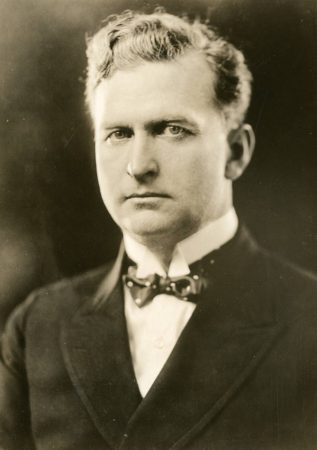
Director Thomas Ince, ca. 1922. (Courtesy University of Washington Special Collections, Order No. JWS20036)
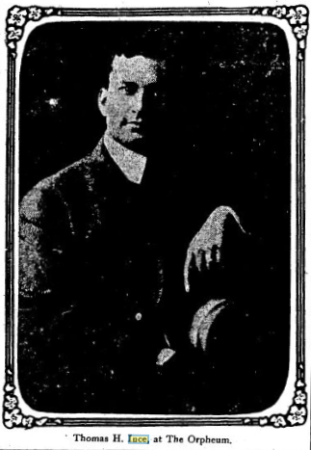
Thomas Ince as he appeared in the "Daily Times" in 1909. (Seattle Daily Times 4 May 1909, Page 9)
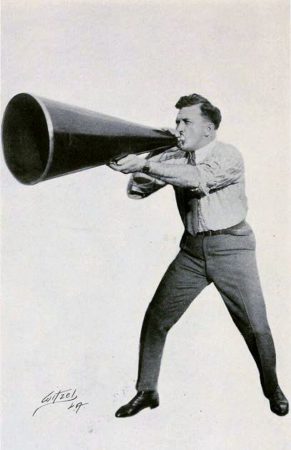
Thomas Ince as he appeared in the "Daily Times" in 1909. (Seattle Daily Times 4 May 1909, Page 9)
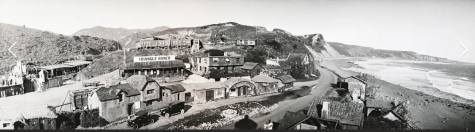
Panoramic view of the Inceville studio complex, ca. 1916, on land that is now the corner of Sunset Boulevard and the Pacific Coast Highway.
Roads of Destiny: A Few More Roadshow Engagements
Act V: Thomas Ince
Yet another major director, and one of the few who enjoyed a comparable reputation to Griffith in the early silent era, was Thomas H. Ince. As a director (and, more importantly, as a producer) Ince helped establish production methods that revolutionized the industry and helped lay the groundwork for the powerful studio system that flourished from the 1920s through the 1950s.
Ince was born in 1882 in Newport, Rhode Island. At that time the city enjoyed the reputation of being one of America’s most fashionable resorts, though the Ince family was certainly not among the many Gilded Age millionaires who vacationed there. His father and mother were onetime stage performers; Ince’s father eventually became a theatrical agent in New York. It appears that Thomas Ince made his first appearance onstage as a child, around 1890. By the turn of the century, before turning 18, Ince was already appearing on Broadway, landing a small role in a revival of Shore Acres.
As a stage performer, however, Ince was never overly successful, almost always playing small character roles despite high personal ambitions. After saving money earned on an extended road tour and some other engagements, one summer Ince organized a vaudeville series in Atlantic Highlands, New Jersey, a venture that failed to catch on with audiences.[1] Later, in between stints performing onstage, he worked to promote an Eastern stock company; this, too, went nowhere.
As such, Thomas Ince lived a precarious life as a stage performer – even when he was working, his meager savings almost always went toward some other endeavor. Times were tough. One cold and hungry winter, even, when an engagement was particularly hard to come by, he was forced to room with two other struggling actors in the Barrington Hotel on Broadway and 42nd Street in New York, a place that cost $9.50 per week between the three of them. One of those actors, a man Ince had earlier toured with in the play Hearts Courageous, was William S. Hart, later to become the director’s biggest screen star.
Thomas Ince’s first Seattle engagement, like that of many other notable figures who made their way through town, was in a small role with a large touring show. He played a vagrant named Count de Bullion in the Arthur C. Aiston company’s presentation of At the Old Cross Roads, a five-act melodrama of the old South that played the Third Avenue Theater beginning December 29, 1901. Only 19 years of age, Ince also served as stage manager for the Aiston production.
The play was set in the old South but didn’t take the Civil War as its primary storyline. Rather, its focus was racial amalgamation, a theme that ran through numerous books and stage plays of the period, most notably in the works of Thomas Dixon, Jr., whose novel (and stage play) of Southern Reconstruction, The Clansman, served as the basis for D.W. Griffith’s The Birth of a Nation. Though a good deal lighter in presentation than description, At the Old Cross Roads dealt with an innocent Southern girl who becomes a pawn between feuding parents when her father leads the girl into believing her mother has been tainted with black blood. The mere stigma of association between the two races leads both mother and daughter to be ostracized from society. Ultimately, however, the father’s treachery is discovered, and the play ends with the mother’s remarriage, preserving the good name and purity of both women.
Interestingly, it would have been very difficult for the public to learn about the show’s plot based on the advance publicity provided by the Aiston organization; the above account, in fact, was taken from a subsequent presentation of At the Old Cross Roads. “The play is described as one of great heart interest and genuine comedy,” went a typically vague pre-engagement notice from the Ince visit. “It has been a decided success everywhere.”[2] The Post-Intelligencer thought the show distinguished.
At the Old Cross Roads, which was presented at the Third Avenue theatre to a packed house last evening, for the first time, easily heads the drama seen at this popular theater this season. It is a heart story, as beautiful, interesting, pathetic, as it is realistic, with a vein of comedy through it. It kept the vast audience alternating twixt tears and laughter. The scene in the second act, where Jane Corcoran, as Annabelle Thornton, scornfully repudiates her own mother, upon the discovery that she is the daughter of an Octoroon, was tragic, and held the audience spellbound. It [would be] hard to find a finer portrayal of emotional acting on the boards of any theater than of Estha Williams as Parepa, the octoroon, in this scene. She was given a triple encore…The company throughout is excellent and individually was awarded well-merited plaudits.[3]
Since it now appears that the Daily Times issue that would have reviewed At the Old Cross Roads no longer exists, it is unfortunate that the city’s other daily paper, the Seattle Star, ran only a short critique of the show. “It is a melodramatic production,” was about all they could muster, “but out-classes most of its type in the approximation to reason.”[4]
Just seven years later Thomas Ince returned to Seattle. Yet instead of plying his trade as a dramatic actor, he – like Lionel Barrymore during his second engagement in the city – arrived in a vaudeville troupe. On May 3rd, 1909, “Thomas H. Ince and his Comedians” began a weeklong engagement at the Orpheum Theatre in a vaudeville playlet called Wise Mike, written by Ince himself. The work concerned a man named Percy Stubbs, played by Ince, who attempts to scare his wife by dressing as a burglar and breaking into his own house. Unfortunately, the effort backfires when he discovers a real burglar in the house at the same time, leading to a series of comic mix-ups. The skit came with favorable advance notice on the prestigious Orpheum vaudeville circuit; Ince and his troupe certainly weren’t the top of the bill, but they were playing a respectable sixth in a field of nine acts. Among other attractions, the venue also offered Wells and Sells, comedy acrobats, Dorothy Drew, a singing comedienne, a short musical comedy called The Last of the Troupe, and a group of black performers offering representative Southern scenes entitled The Sunny South. Headlining the show was Rosina Casselli’s trained dogs.
The day following the troupe’s first performance in Seattle, a smart promotional photo of Ince graced the “Amusements” section of the Daily Times, the only theatrical picture printed that day. A rather handsome man, the dapper-looking Ince is seated, hat in hand. Unfortunately, the review of the Orpheum bill that went with it – a collection of acts highlighted by “dogs and darkies,” according to a rival paper – wasn’t half as distinguished. “Thomas H. Ince and an assisting company of two have a sketch called Wise Mike,” wrote the Times, “which isn’t up to the requirements of the three people who play it. Ince is a comedian of merit and he is ably assisted by Blanche Alexandre and Edward Gillespie. Things didn’t go well for them last night, the lights and their bag of stage dynamite played tricks with them to the disadvantage of their sketch which needed help instead of hindrance, but they managed to get away with it.”[5] The Seattle Post-Intelligencer, for their part, mentioned Ince’s act only briefly in their review of the Orpheum bill, noting that the skit had a “poor ending with a dummy and explosion.”[6] With such reaction it is no wonder that Ince was soon to reevaluate his career as a stage performer; the most impressive feature at the Orpheum that week were Casselli’s trained chihuahuas, which earned far more critical attention than Ince did.
It would be just a year after his engagement at the Seattle Orpheum that Thomas Ince tried his hand at film acting. He would get his chance to do so at the Biograph Studios under the direction of D.W. Griffith, with whom his later directorial work would sometimes be compared. In 1911 Ince was hired by Carl Laemmle to direct the IMP Company’s newest hires, Owen Moore and Mary Pickford, in a series of pictures shot in Cuba. The following year he joined the New York Motion Picture Company, heading up their studios in Edendale, California, later known as “Inceville.” It was there, thanks to the popular success of his western photoplays, that Ince managed to make a name for himself as a director and producer. Inceville is also where William S. Hart came in 1913 in search of his own opportunity in the motion picture business.
Shortly after Hart’s screen debut, Thomas Ince began spending less and less time behind the camera, delegating projects to the growing stable of competent directors (though sometimes not much more) beneath him. Even so, Ince kept careful control over the production of his films, which continued to bear his name above the title. His associate directors adhered to meticulous shooting scripts, many personally approved by Ince himself, in which virtually every scene, prop and camera angle was planned with painstaking detail. Ince’s work from World War I and into the 1920s was in productions that were well-made and bankable, even if they lacked much innovation. Whereas D.W. Griffith aspired to art in his motion pictures, Thomas Ince balanced art with commerce, creating an assembly line atmosphere at his studio.
This he did successfully until 1924, when Ince, only 42 at the time, reportedly took ill on William Randolph Hearst’s yacht and died within days. The facts surrounding Ince’s untimely death are clouded, and have sparked a number of sinister rumors, a few involving infidelity and foul play. (The plot for Peter Bogdanovich’s The Cat’s Meow [2001], which provides a fictional account of the events on Hearst’s yacht, details what the filmmaker calls “the whisper told most often.” In this version, Ince is shot in the back by a jealous William Randolph Hearst, who mistook the producer for Charlie Chaplin, who had been having an affair with Hearst’s mistress Marion Davies. The parties then orchestrate a cover-up to conceal the crime.) Unfortunately, from an historical perspective the mystery surrounding Thomas Ince’s final hours has tended to overshadow his considerable screen accomplishments.
By Eric L. Flom – January 2026
Notes:
[1] George Mitchell, “Thomas Ince was the Pioneer Producer who Systematized the Making of a Movie,” Films in Review (October 1960), Page 465.
[2] “At the Old Cross Roads,” Seattle Star, 28 December 1901, Page 3.
[3] “At the Old Cross Roads at the Third Avenue,” Seattle Post-Intelligencer, 30 December 1901, Page 6.
[4] “At the Old Cross Roads,” Seattle Star, 30 December 1901, Page 4.
[5] “Good Vaudeville in Town,” Seattle Daily Times, 4 May 1909, Page 9. Although Blanche Sweet is known to have appeared as a child actress under the name “Blanche Alexander,” the similarity to the performer in Thomas Ince’s troupe is purely coincidental. Unmentioned in the Daily Times’ review was Art Elmore, who played a policeman in the sketch.
[6] “New Vaudeville Shows are Good,” Seattle Post-Intelligencer, 9 May 1909, Page 5.
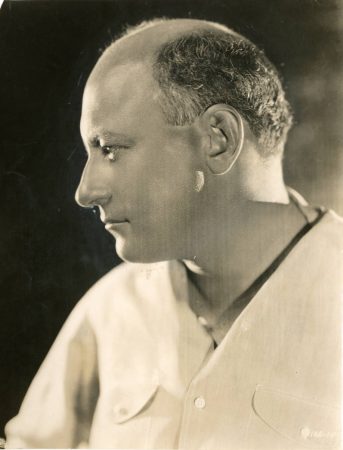
Director Cecil B. DeMille, ca. 1923. (Courtesy University of Washington Special Collections, Order No. JWS16381)
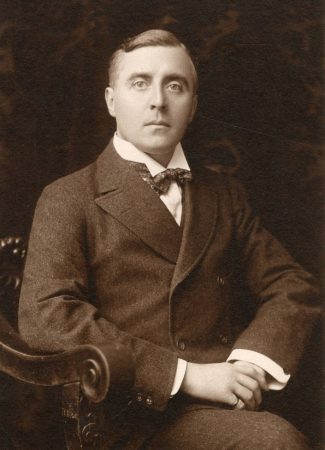
Leading man E.H. Sothern, ca. 1911. (Photo by Otto Sarony Co., courtesy University of Washington Special Collections, Order No. JWS14660)

Scene from the E.H. Sothern production "If I Were King," ca. 1901.
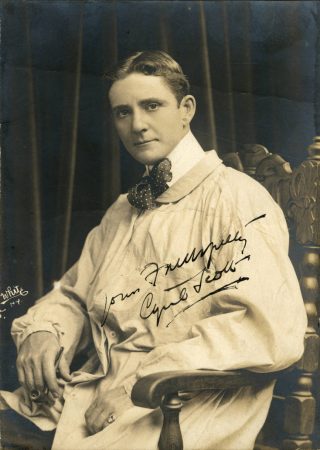
4.6 Actor Cyril Scott, ca. 1907. (Photo by White Studios, UW Spec, Order No. JWS35499)
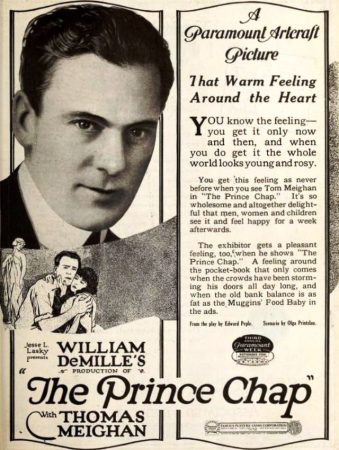
William de Mille eventually adapted "The Prince Chap" for the screen in 1920. (Exhibitor's Herald, 28 August 1920, Page 9)
Roads of Destiny: A Few More Roadshow Engagements
Act VI: Cecil B. DeMille, Actor
Yet another actor-turned-director visiting Seattle’s stages early in his career was Cecil B. DeMille.[1] Born in 1881, DeMille, like Thomas Ince, came from a theatrical family. His father, Henry de Mille, a former minister, deserted the pulpit to pursue a career as a playwright, finding success in association with another up-and-coming young man of the theatre, David Belasco. The pair collaborated on four plays – The Wife (1887), Lord Chumley (1888), The Charity Ball (1889), and Men and Women (1890), society dramas which met with considerable acclaim in their day. Although Henry de Mille died of typhoid in 1893, skillful exploitation of his plays by Cecil’s mother (who also ran a girl’s school in New Jersey) allowed the family to remain connected to the theatrical industry. Later, she parlayed these relationships into a career as a talent agent.
Drama also fired the imaginations of Henry de Mille’s sons, William and Cecil, both of whom entered show business with relative ease given their industry connections. While Cecil concentrated on acting, William found success as a playwright, his most famous stage production being 1908’s The Warrens of Virginia. Cecil had similar aspirations, though his own plays (the brothers also collaborated on a few projects) met with less success.
Cecil B. DeMille is known to have made only two Seattle appearances as an actor. His first was in 1902, supporting E.H. Sothern in a three-day engagement of Justin Huntly McCarthy’s If I Were King, which played the Grand Opera House.[2]
Sothern, born in New Orleans in 1859, was the son of famed actor E.A. Sothern, who earned a considerable reputation in the United States playing, among other roles, Lord Dundreary in Our American Cousin. Though educated in England, E.H. Sothern returned to America as a young man and eventually made his stage debut in 1879, at the age of 20. The family name guaranteed him recognition as a performer, but Sothern built his own reputation as the leading man at Lyceum Theatre in New York, where he developed into a successful romantic actor while also indulging in his passion for Shakespeare. If I Were King was more in the romantic vein, but Sothern would eventually team with actress Julia Marlowe (whom he would marry in 1911) for a much-heralded tour of Shakespearian offerings, bolstering their reputations as first-rate talents. Sothern continued stage work into the 1920s, passing away in 1933.
If I Were King, as with anything Sothern brought to the Northwest, was highly anticipated by local audiences. “Expectations of theatre-goers have for months been centered upon the coming of E.H. Southern, and the appearance of this eminent artist here will be the great event of the dramatic season at the Grand Tuesday, Wednesday and Thursday nights,” stated the Daily Times. “No play presented in New York in the last half dozen years made a deeper impression than did Sothern’s production of this medieval romance, and theatre-goers here who have had to wait a considerable time since its first presentation before seeing the play are keenly taking advantage of the current opportunity.”[3] The Argus was no less grandiose. “This play is by general consent admitted to be not only the greatest success Sothern has ever had but by general consent of critics and the public alike to be the best seen on the stage during the last two seasons.”[4] The Grand itself reported that ticket sales for the Sothern engagement were so brisk that house attendance records were likely to be broken.
Based on the historical character of Villon, the play – set in the 15th century court of French King Louis XI – found Sothern as the vagabond poet, who is drugged by the monarch and placed on the throne after he overhears a poem as to what Villon would do “if he were king.” The King, whose country is in a precarious position, affords Villon full governmental authority, with the poet becoming embroiled in political intrigue before eventually righting the direction of France and winning the hand of Lady Katherine.
The show came with a considerable reputation, as well as a considerable entourage – it took nearly 100 people to stage the tour, with 32 different speaking parts in the play alone. Sothern was reportedly playing to only 30 cities across the United States; Seattle was thusly honored as being “worthy” of the actor’s visit.
The Daily Times, while very impressed with Sothern’s work, seemed a little miffed by the whole production. Although the paper devoted well over three-quarters of its review to retelling the story (including liberal quotations of dialogue), they ended their piece by claiming, “there isn’t much of a plot. It’s too improbable to be real, and too realistic to be true.” Even so, out of respect for Sothern, one suspects, they hailed this highly improbable, highly realistic, but largely plotless play as a masterpiece. “A change of linen, a perfumed bath, a rose-decked garden and a beautiful woman enabled E.H. Sothern to prove what he would do if he were king, at the Grand Opera House last night, and incidentally bound 3,000 people with a magic spell…The lines sway one; the air invades one, the love, hate, scorn and triumph brought out as the play is unfolded, impelled by the hand of a master, carries one back through the years that have vanished until the hearer lives with the actor, suffers and triumphs with him through it all.”[5] Fortunately the Post-Intelligencer managed to give a more straightforward account of the Sothern engagement. Even so, their critique didn’t appear as a normal theatrical review, since E.H. Sothern wasn’t a typical actor. Instead, the comments were printed under “City News,” a sign of the show’s heightened importance:
Few pleasures are greater than to witness a character, the outlines of which are shadowy in the imagination, invested by a great actor with all the warmth and vividness of reality. Francois Villon, scholar, poet, housebreaker and reveler, long since consigned to the dead and dusty past, lived again last evening in the eloquent art of [E.H.] Sothern…Seattle’s playgoers enjoyed at the Grand the event of the theatrical season, the loud and continuous applause with which the production was greeted testified to their appreciation…
Sothern charms by his delicate and refined art, the nobility of his features, the grace of his manner and his expressive repose. His underlying poetic temperament gives to the loves [sic] scene with Katherine [Cecilia Loftus] in the garden the touch of pathos and poesy. He expresses the brilliancy, spirit and wit of Villon, evolving gradually the character of the daring, adventurous, [and] tender vagabond poet. He suits the gesture and expression to the word, and portrays the changing emotions of the poet from joy to sadness to defiance and exultation.[6]
Nor was the Post-Intelligencer through praising E.H. Sothern, even several days later. “Sothern’s appearance at the Grand last week for three successive nights in If I Were King will not soon be forgotten,” the paper noted following his departure. “The large audiences that witnessed the finished and artistic acting of the greatest American actor showed their appreciation by rounds of applause. The face of the actor is one to haunt the memory, and the quick flashes of the eye, the quick changes of expression, the grace of his gesture and ease of his manner, all create a lasting impression upon the audience.”[7]
Although the experience of touring alongside an actor of E.H. Sothern’s ability was no doubt a treasured one for Cecil B. DeMille, who played the role of Colin de Cayeiux in If I Were King, he was easily lost in the large production and went unnoticed in reviews for the show.
That was corrected, to a degree, when DeMille made his only other Seattle stage appearance some four years later, in September 1907. DeMille returned to the Grand Opera House supporting Cyril Scott in Edward Peple’s The Prince Chap, the story of an American sculptor in London who raises the child of a model who died in his studio, and who eventually falls in love with the young girl. “Few of the possibilities of The Prince Chap can be gained by a glance at the synopsis,” a notice from the Daily Times assured theatregoers. “It is said to hold more suspense than noisy melodrama, yet it is all played as quietly as a drawing room charade.”[8] The show had apparently confounded detractors in Great Britain, or so its publicity noted, by playing London’s Criterion Theatre for over 150 nights despite getting bashed by reviewers critical of the playwright’s erroneous representation of English life.
Regardless, the show received good reviews in Seattle, despite the Star’s opinion that the story was “winsome, if tedious” and that some of the supporting cast were only mediocre.[9] DeMille appeared as the Earl of Huntington, a genteel acquaintance of the sculptor William Peyton, played by Cyril Scott. “Cyril Scott established himself firmly as a Seattle favorite at the Grand last night,” wrote the Post-Intelligencer, “when he began a week’s engagement in Edward Peple’s play The Prince Chap, one of the most delightful bits of story and stage craft thus far revealed to Seattle play patrons…Mr. Scott’s methods are pleasing. He is decidedly well fitted to play the part of Peyton, and everything he does is convincing and sincere. The remainder of the company is of almost faultless balance…It deserves the full house that greeted the piece on its opening night and the succession of houses that will continue the popularity of The Prince Chap in Seattle should be of the liberal sort.”[10] Scott, for his part, received multiple curtain calls.
The Daily Times also found the show quite agreeable, although like the Star, it cast a more critical eye toward a few elements – particularly the work of playwright Edward Peple, and to a lesser extent, Cyril Scott.
A house without a vacant seat welcomed Mr. Cyril Scott and his company last night at the Grand. At the close of the second act he said how much he appreciated it, and received an added compliment on his ability to make a clever curtain speech…
Mr. Edward Peple has written a play which appeals to the heart, and which is carried to convincing success by the sheer force of sentiment. [But i]ts dramatic construction, especially in the first act, could be improved…
Mr. Scott plays “Billy Peyton,” the “Prince Chap,” in a rather more buoyant and exuberant manner than the story would lead one to expect – the part suggests a quieter key. The artistic temperament, however, follows no set rules and possibly it is better understood by those who belong, or more accurately described by “Puckers,” the Prince Chap’s little slavey, who says you can qualify for it “when you can live on nothink, and you don’t give three ’oops in ’ell.”[11]
All three of Seattle’s daily papers singled out Cecil B. DeMille as one of the show’s memorable characters. To the Daily Times he made “a capital English Lord,” while the Star observed that “Cecil B. de Mille [sic] is an exaggerated, but nevertheless clever, Earl of Huntington, friend of ‘The Prince Chap.’” The Post-Intelligencer had similar comments, pointing out that “Mr. De Mille plays the part of the Earl of Huntington in an exaggerated sort of way, emphasizing some Britishisms so as to earn both laughter and sympathy.”[12]
Interestingly, following the close of The Prince Chap the Grand Opera House hosted the original theatrical tour of The Squaw Man featuring William Faversham, the 1914 film version of which (with Dustin Farnum in the leading role) would launch Cecil B. DeMille’s career as a motion picture director. (DeMille would remake The Squaw Man twice, once for Famous Players-Lasky in 1918 with Elliott Dexter in the lead and again in 1931 as a sound film for MGM starring Warner Baxter.)
Yet despite his work as a character actor, Cecil B. DeMille claimed in his autobiography that his true desire at the time was to write and possibly direct for the stage. DeMille was, in fact, far more successful with his literary endeavors than his stagecraft, with his written works seen on Seattle’s stages more frequently than he was.
By Eric L. Flom – January 2026
Notes:
[1] Although born Cecil B. de Mille, the director modified has last name to “DeMille” during his stage years. His brother William, who would also have a career as a silent film writer and director, kept the original spelling of the family name.
[2] DeMille likely won a part in the company based on E.H. Sothern’s familiarity with Henry de Mille, the playwright. Sothern first visited Seattle in 1890, playing Turner Hall in a repertoire of plays that included the de Mille/Belasco collaboration Lord Chumley, with a cast that also featured Tully Marshall and, in a child role, Maude Adams. (Program, Turner Hall [9 May 1890], J. Willis Sayre Collection. In the absence of an original program, J. Willis Sayre typed his cast list from an unknown source.)
[3] “At the Theatres During the Present Week,” Seattle Daily Times, 28 June 1903, Social Section, Page 6.
[4] “E.H. Sothern in If I Were King,” The Argus, 20 June 1903, Page 6.
[5] “Sothern in If I Were King Pleases a Large Audience,” Seattle Daily Times, 1 July 1903, Page 8.
[6] “If I Were King,” Seattle Post-Intelligencer, 1 July 1903, Page 7.
[7] “The Drama,” Seattle Post-Intelligencer, 5 July 1903, Page 28.
[8] “This Week’s Playbills,” Seattle Daily Times, 15 September 1907, Section III, Page 50. Interestingly, a film version of The Prince Chap would become the directoral debut for William de Mille, Cecil’s brother, in 1920. (See “William C. De Mille [sic] Special Pictures Announced by Famous Players – First to be The Prince Chap,” Moving Picture World, 13 December 1919, Page 851.) An earlier version of The Prince Chap, directed by and starring Marshall Neilan, was made for Selig in 1916.
[9] “Amusements,” Seattle Star, 16 September 1907, Page 8.
[10] “The Prince Chap of the Right Sort,” Seattle Post-Intelligencer, 16 September 1907, Page 7.
[11] “The Prince Chap, with its Triplicate Heroine, Very Interesting Indeed,” Seattle Daily Times, 16 September 1907, Page 7.
[12] Ibid. See also “The Prince Chap of the Right Sort,” Seattle Post-Intelligencer, 16 September 1907, Page 7.
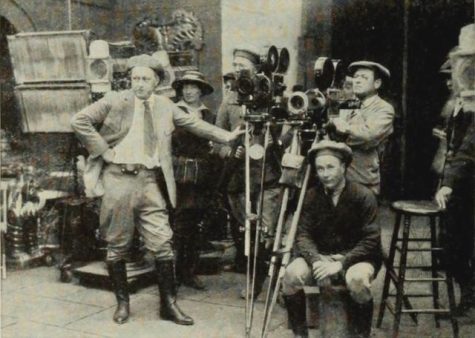
Cecil B. DeMille at work, ca. 1922.
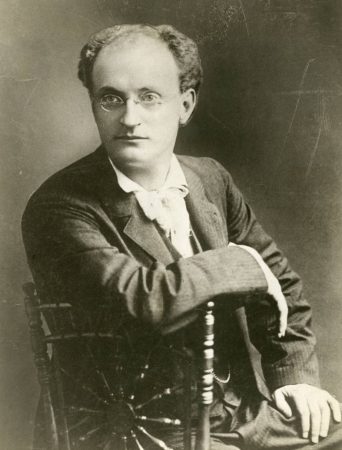
Undated photo of playwright Henry C. de Mille. (Courtesy University of Washington Special Collections, Order No. 16990)
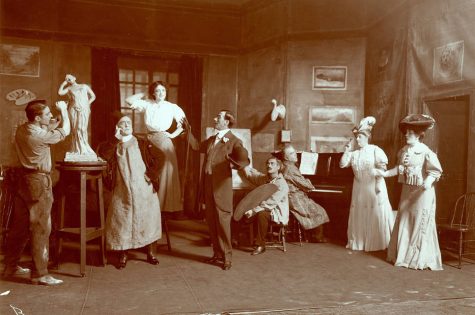
Nat Goodwin, second from left, in Act I of "The Genius," ca. 1907. (Photo by Byron Studios, courtesy University of Washington Special Collections, Order No. JWS23277)
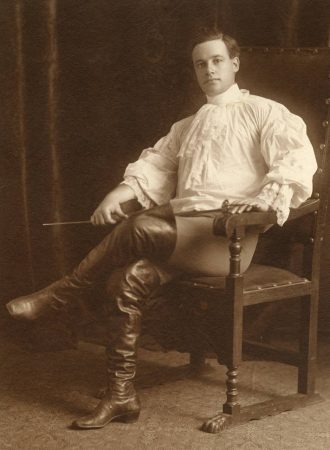
Swashbuckling actor Carlyle Moore, ca. 1909. (Photo by Marceau Studios, courtesy University of Washington Special Collections, Order No. JWS25588)
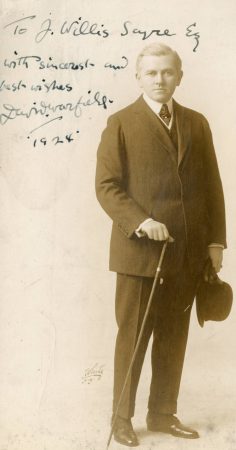
Famed stage actor David Warfield, ca. 1913. (Photo by White Studios, University of Washington Special Collections, Order No. JWS27265)
Cecil B. DeMille’s lone mention in the 1913 program for "The Return of Peter Grimm." (Courtesy University of Washington Special Collections, Order No. UW27850z)
Cecil B. De Mille in the trailer for "The Ten Commandments" (Paramount, 1956), a remake of his silent feature from 1923.
Roads of Destiny: A Few More Roadshow Engagements
Act VII: Cecil B. DeMille, Playwright
Just the year prior to Cecil B. DeMille’s appearance in The Prince Chap, in July 1906, the first of his written works, a stage collaboration with his brother William called The Genius, with the celebrated Nat C. Goodwin enacting the title role, made its Seattle debut at the Grand Opera House.
Nat C. Goodwin was born in Massachusetts in 1857 and became a comedic draw on Eastern stages during the first part of the 20th century, playing in classics such as A Midsummer Night’s Dream as well as more contemporary plays like In Mizzoura. The oft-married Goodwin (he had a total of five wives) had a strong desire to play serious drama, but his efforts in that area were less successful. Eventually the performer’s tumultuous romantic life caught up with him and Goodwin began losing favor with the public, such that his final tour before his death in 1919, a series of vaudeville engagements, was cancelled due to audience apathy.
Nat C. Goodwin’s Seattle engagement in The Genius was a special one – it began on a Tuesday, interrupting the house’s resident troupe at the time, the San Francisco Opera Company, which was then producing The Princess Chic. (Managers William M. Russell and Edward Drew, who were leasing the Grand Opera House from John Cort at the time, moved the company southward for a brief appearance in Tacoma during the Goodwin engagement.) Goodwin performed The Genius on Tuesday and Wednesday, both performances proceeded by the playlet In a Blaze of Glory, written by Paul Armstrong, who had also written The Heir to the Hoorah. On Thursday, the last day of Goodwin’s Seattle appearance, he enacted his acclaimed version of When We Were Twenty-One. The Princess Chic then returned to the Grand for performances on Friday and Saturday.
The Genius was a three-act farce comedy well-suited for Goodwin’s talents. It’s the story of a wealthy New York businessman who becomes infatuated with a society woman who has made it well-known that she’s seeking a man with the appropriate “artistic temperament.” Accordingly, the hero employs the services of three artists – a painter, a sculptor, and a pianist – and agrees to reward them handsomely for making him their pupil. But, during the course of his education, a renowned art critic, scouring the country for “the next American sensation,” notices the young man’s work and is made to believe that the real artists are actually taking suggestions from him. This attracts the attention of the society woman, though maintaining the ruse becomes exhausting; in the process the businessman loses interest in his romantic prize. In the end, he finds true love with a model he has met in one of the studios, then goes back to his business a wiser and much happier man.
The opportunity to see Nat C. Goodwin, however brief, was a treat for Seattle audiences. The engagement also afforded theatregoers the first opportunity to see Goodwin’s newest leading lady, Edna Goodrich, who would eventually become the actor’s fourth wife in 1908. (They would divorce in 1910.) The Genius premiered to a capacity audience at the Grand on July 3, 1906, and was well-received by critics, who saw in it characteristics of Goodwin’s former comedic successes. “With an all-around strong company, Mr. Goodwin never appeared to better advantage in reminding his host of admirers of his comic acting,” observed the Star. “The Genius [is] essentially adapted for Mr. Goodwin, whose keen analysis of comic situations has placed him in the top niche of contemporary comedians.”[1]
The Daily Times felt similar. “Nat Goodwin has come back to his own – low comedy,” they announced. “It was a restored, a rejuvenated, a screamingly comical Nat Goodwin that appeared before that fine audience at the Grand last night, and his play was a plain, ripping old farce-comedy, a two-hour dramatized laugh, a homeopathic dose of broadly comic lines, lively situations and sometimes, notably in the last act, purely burlesque fun. Goodwin and his comedy cohorts simply tore both the play and the audience to pieces and some hundreds of starched shirt fronts melted, not so much through the heat of the night as from the perspiration roused by an extraordinary degree of inward risibilities.”[2] Everyone in Goodwin’s company, according to the Daily Times, was worthy of praise, particularly Edna Goodrich and her splendid costuming, which was “strictly the summer of 1906, which helps with some of the feminine auditors.” Virtually their only negative comment went to the play itself, which the paper felt lacked the depth of some of Goodwin’s previous shows, even though they also speculated that it may have been the “biggest laughing effort” of his stage career. But regardless of this perceived flaw, the damage was slight to the reputations of the DeMille brothers, since the Times incorrectly credited authorship of The Genius to their father Henry.
But The Genius didn’t go over half as well with the Post-Intelligencer; tactfully, it seems, their review of the show made every effort to discuss the production without rendering an opinion on it. Goodwin and the whole of his company did well, and the show was a throwback to the star’s comedy roots, but most of their review was essentially a plot summary. While the paper’s reaction seemed generally positive, especially since they deemed the curtain raiser, Paul Armstrong’s In a Blaze of Glory, “grewsome” [sic] and difficult to hear, given late-arriving patrons at the Grand, the focus was on Goodwin rather than the play itself.
The Post-Intelligencer’s true feelings could be found in their dramatic column the Sunday following Nat C. Goodwin’s appearance, where the paper occasionally reflected on the past week’s theatrical engagements. Rarely were these remarks very detailed, nor were they negative in tone. But on July 8th, after the comedian and his troupe had left town, the paper opened up on the actor’s appearance, laying responsibility for the engagement’s failings on the play itself.
Nat Goodwin arrives just in time to catch Seattle’s first touch of hot weather, but in spite of the heat good-sized audiences turned out to see him. He has been visiting this city at off-season times during recent years, and it is a tribute to Goodwin’s drawing powers that he always gets good houses. And this in spite of mediocre plays.
In The Genius there is not the slightest chance that Mr. Goodwin has what he has been looking forward to in years, a rattling good farce company that will give Goodwin a chance. It was a discarded play, remodeled and worked over for Goodwin with the hope that it might “go” and be a sufficient success to warrant presenting it on Broadway, the mecca of every star. This is not saying there are not many laughs, or good lines to the play. But it is not in the class, by many points, with the plays with which Nat Goodwin’s name has been and will be inseparably connected. No effort of press agent or booming management can make for The Genius the success that attended In Mizzoura, An American Citizen, A Gilded Fool or When We Were Twenty-One.[3]
It appears that the Post-Intelligencer, at least, held their true critique of The Genius until after Goodwin and his troupe had left town. But there must have been more positive reaction to the play in other locales, since Goodwin kept The Genius as part of his touring repertoire and would, in fact, bring it back to Seattle two more times over the next three years.
Nat C. Goodwin returned next on April 29, 1907, a mere nine months following the debut of the play in Seattle, where The Genius formed part of a representative selection of the actor’s works during a weeklong engagement at the Grand: A Gilded Fool (Monday), An American Citizen (Tuesday); When We Were Twenty-One (Wednesday evening and Saturday matinee); The Genius (Thursday and Friday); and a new production for Goodwin’s troupe, What Would a Gentleman Do? (Saturday evening).
The Daily Times, as before, felt The Genius was a commendable production, “a three-act play in which [Goodwin] always scores in,” noting that “from the rise of the curtain until the last lines had been spoken there was close interest and every few minutes an outburst of applause that buoyed the players and made them work earnestly and faithfully.”[4]
For this second visit, the Post-Intelligencer changed its tune toward The Genius, although their critic (as did his counterpart at the Daily Times) also gave clues as to why the show seemed to have improved.
In The Genius Mr. Goodwin returns to a line of parts that first made him conspicuous as a comedian, and while the West was first afforded an opportunity of seeing him as Jack Spencer less than a year ago, suggestions of modernizing are discernable already, Mr. Goodwin adding touches of his own personality that appear in impromptu speeches and brushing up expressions of a year ago with conversational embellishments of today. For instance, Messrs. De Mille hadn’t heard of lemons or of the mystic “23” at the time they concocted The Genius, but Mr. Goodwin succeeds in making these expressions fit into the lines of the play, and they earned laughter last night.
Of course, all the liberties that Mr. Goodwin takes with the author’s lines are not so apparent as the use of familiar slang, and nobody is quite sure what the import of one of his inspirational asides will be. Last night, on more occasions than one, the unexpected happened, and Mr. Goodwin had his associate actors laughing, where no laughter is looked for in the situation. Sometimes this is a stage trick, as it appears to let the audience into the confidence of the players, to the enjoyment of the former, who credit themselves with a discovery. But Goodwinisms are proverbial, and the theatre attaches and policemen who saw the piece last night will hear something new tonight, when the bill will be repeated.[5]
At least in the opinions of Seattle’s dailies, Nat C. Goodwin not only stuck with the production but improved it by making the play a good deal more contemporary. The only mildly dissenting opinion on the engagement, in fact, came from an unnamed editor at The Argus, who took aim more at Goodwin’s frequent and well-publicized romantic tangles than his theatrical work. “Nat Goodwin ought to be good as A Gilded Fool,” went a short note during the actor’s engagement at the Grand. “He has played it both on and off the stage for years.”[6] (Goodwin was a regular target for Argus writers, who held no affection for him as a performer or a gentleman.)
Two years later, in June 1909, Goodwin again returned to Seattle with The Genius, the last time the play appears to have been presented in the city. The visit was a weeklong affair at the Moore Theatre, which found the show playing the last three nights of the engagement, in addition to Thursday and Saturday matinees. It was paired with a new Goodwin presentation, The Easterner, by George Broadhurst, which played the first four nights of the visit.
Ironically the Post-Intelligencer, by the time The Genius was presented, was quite prepared to laud the show; the DeMille play was helped considerably by the failure of The Easterner, in their eyes, to meet expectations. “Comparisons are odious: consequently it would not be fair to say that the Broadhurst play occupies relatively the same position to the De Mille play that an Ibsen drama might to a Theodore Kramer melodrama, as that would not be doing justice to Mr. Kramer, but all will agree that there is a wide difference in favor of what the De Milles have done, and then again it gives Miss Goodrich a chance to prove that she is becoming an actress of light roles, and that there is much to hope for along these lines…”[7]
The Seattle Star was in agreement. The Genius, while not the best vehicle Nat Goodwin had ever presented, was nonetheless the bright spot on the Moore bill.
The difference between last night’s performance and that of The Easterner was the difference in comedies. Goodwin was the same, but last night he had an opportunity to exercise his peculiar comedy skills…
Nat Goodwin and Neil O’Brien [as musician Otto Vogelsberger] furnish most of the amusement [in The Genius]. The role of Miss Goodrich, a milk and water sort of an artist’s model, affords her opportunity to behave herself in a young lady-like manner. The others in the cast get out of their parts all there is in them, which is not overmuch, for while The Genius shines brightly this end of the week, it does so mostly because of the darkness which preceded it. It is by no means a great comedy, but with Goodwin it is amusing.[8]
The Daily Times again lauded The Genius, but appears to have saved their only critical comments (like the Post-Intelligencer had done in 1906) until Mr. Goodwin was long out of town. Their review went accordingly:
In the light and bright comedy, The Genius, Nathaniel – that is to say, Mr. N.C. Goodwin – was himself again last night, and the large audience at The Moore was thoroughly well entertained. This clever little play by “the De Mille boys” was last seen here at the time of Mr. Goodwin’s engagement here two years ago, and is as funny now as it was then…
The De Mille comedy is lively and original and is a smart slap at art critics and enthusiasts who don’t know what they are talking about but who love it just the same.
The lines are clever and there are plenty of laughs. Goodwin in low comedy is very funny, and [he] made much of his several good scenes…Miss Goodrich was radiantly lovely, as usual, and in the last act wore a marvelous – oh, such a marvelous gown.[9]
A mere two days after penning this review, however, the Times displayed a new attitude toward the play, of which they had been staunch defenders during Goodwin’s previous appearances. Again, the inconsistency between a review for The Genius and later reaction seems an obvious attempt not to offend either Goodwin or his management (coming, as it did, following the actor’s departure from Seattle), although it may also have been that the uncredited pieces were the work of different writers. “The engagement of Nat Goodwin and Edna Goodrich, which closed last night, was remarkable chiefly for the unmistakable proof that Mr. Goodwin must get a good play or retire from the legitimate stage,” wrote the Times in their Sunday theatrical column. “As he himself said, in these columns, the public is tired of his old ones and if he can’t get a good new one he will retire or go into vaudeville. It is a wise decision.”[10]
The Genius wasn’t the only dramatic work that Cecil B. DeMille authored prior to his entry into filmmaking, but few of those, it seems, were presented outside of the East. One that did turn up in Seattle, however, was a short vaudeville sketch entitled The Man’s the Thing, presented by Carlyle Moore at the Star Theatre in January 1909. The playlet was set in the public room of “The Lion and the Unicorn” in 1760 England, but aside from having a cast of five, little is known about the sketch other than that it climaxed with a spectacular swordfight. That lone aspect, in fact, tended to overshadow everything else about the production, as was evidenced by the pre-engagement notice in the Daily Times. “The Star Theatre intends to spread itself during the coming week, starting at tomorrow’s matinee, in the presentation, for the new week, of a one-act drama put on by five well-known actors, the cast being headed by Carlyle Moore, a local favorite. The playlet, The Man’s the Thing, is from the pen of Cecil De Mille, who has written plays [that have been] successfully used by Nat Goodwin and others. The scene is laid in England in 1760. There are fair ladies and gallants and cavaliers, and a sword fight that, it is said, would turn James K. Hackett green with envy.”[11]
Reviews from the Star Theatre tended to focus almost exclusively on the swordplay in DeMille’s playlet, which headlined a bill that included the comic playlet The Ashes of Adam, a pair of singing acts, and bicycle tricks demonstrated by the Baker Troupe. The bill ended with the screening of some unidentified motion pictures.
According to the Post-Intelligencer, The Man’s the Thing was easily the highlight of the Star’s bill.
One of the merriest sword fights ever staged in Seattle in the interests of persecuted heroines of the age of chivalry is being pulled off at the Star theater at every performance of this week’s new bill. Carlyle Moore is the hero of the battle, and, disdaining to match his skill against a single adversary, he takes on two of the enemy and lays them low, after a two-minute conflict which everything but blood is spilled, and the audience is almost brought to its feet in sheer excitement at the unequal but finally triumphant contest. It is a real romantic drama, and Moore and the two men who support him make it all seem very real. Two pretty women, about whom all the fuss is made, form an attractive background for the picture. Moore is an old stock favorite in Seattle, and many of his former friends of the Baker and Florence Roberts stock days were on hand yesterday to welcome him home after his long absence. The sketch which he uses, The Man’s the Thing, is almost pure comedy up to the moment of the sword combat, which brings the action to an end.[12]
The Daily Times, on the other hand, detected a few problems with the opening performance, despite approving wholeheartedly of the playlet. “There as almost a tragedy on the stage of The Star yesterday when Carlyle Moore was having a fierce sword fight in his one-act sketch, The Man’s the Thing,” they began. “It was a two-to-one fight and if the noble lord and his friend hadn’t held back every now and then in order to let ‘Mr. Charles Newcomb’ (Mr. Moore), get a good position and his wind he would surely have been killed, for the foils were real, if the fencing wasn’t. The fight aside, Mr. Moore’s playlet is a pretty and artistic sketch of English manners in the 18th century, and it was well acted both by himself and the four other people in the company.”[13] The Seattle Star was impressed with the entire bill but could only muster “Carlyle Moore is the real thing” with respect to the DeMille playlet.
From all appearances, Cecil B. DeMille’s effort in The Man’s the Thing offered little to distinguish itself, save for the climactic sword fight. The work was a lesser one in DeMille’s career as a playwright, and there’s nothing to suggest the sketch played Seattle again; the director doesn’t even bother to mention it in his autobiography.
Only one other of Cecil B. DeMille’s plays is known to have been produced in Seattle, though his name was not formally attached to the production. The show was David Belasco’s The Return of Peter Grimm, which proved a considerable stage triumph not only for its producer but also for its leading man, actor David Warfield.
DeMille recalled being hired by Belasco, the longtime family friend, to write a play. The manuscript DeMille eventually prepared went roughly so: a wealthy and ruthless industrialist dies and, in the afterlife, realizes his earthly misdeeds, particularly toward the girl who had been his ward. To set things right, he returns in spirit form to right some of the wrongs he helped create.
DeMille turned the play over to Belasco, who liked the concept but not the execution. When the play eventually opened on Broadway, the lead character was not an industrialist but a kindly nurseryman, entire themes had been altered, scenes eliminated, and supporting characters changed. The alterations were substantial enough, in fact, that David Belasco took sole credit for writing the play.
In his 1959 autobiography, Cecil B. DeMille recalled how desperately he wanted his name associated with a successful Broadway play at that point in his career. But, as a consolation, he earned a small mention in the program for having “suggested” the idea – for the general public, the play was the work of Belasco’s pen. A version of that credit was carried in the Metropolitan program for the play’s first Seattle engagement: “The initial idea of the play was first suggested by Mr. Cecil De Mille, to whom Mr. Belasco acknowledges his indebtedness. A conversation with Professor James of Harvard, and the works of Professor Hyslop, of the American branch of the London Society of Psychical Research, have also aided Mr. Belasco.”[14] Though stung by this turn of events, in retrospect DeMille, writing shortly before his death, admitted that David Belasco had improved his manuscript and brought it in line with prevailing theatrical tastes. Belasco’s version was also specifically tailored to suit actor David Warfield, whereas DeMille’s was not.
I had written a good play. Belasco made it, as only Belasco could, an outstandingly successful play. I still have the manuscript. It still reads well. But I know that it would never have had the success that greeted The Return of Peter Grimm.
Nor can I accuse Belasco of breaking his word. He had not promised me joint author’s credit. He had promised me acknowledgement on the program. Literally, he kept his promise. There was my name, even if it was buried in fine print among learned references to Professor William James and other authorities on the subject of psychical research.
I do not for a moment believe that Belasco deliberately chose to cheat. He was not small. When it was time to print the programs, after revision and rehearsal and all the thousand absorbing details of production, very probably he believed in all sincerity that The Return of Peter Grimm owed more to his work and less to mine than was actually the case.[15]
The Return of Peter Grimm made two appearances in Seattle at the Metropolitan Theatre, the first in January 1913 (in a show that immediately followed Theda Bara’s local appearance in The Quaker Girl), and the second almost a decade later, in February 1922. The first engagement, of course, saw not only Belasco’s latest triumph make its Northwest debut but also brought along David Warfield and what promoters claimed to be much of the original Broadway cast. Actor Thomas Meighan, later a popular leading man at Paramount (with a couple of Cecil B. DeMille films under his belt), played the role of James Hartman during the 1913 engagement of The Return of Peter Grimm.
By design, little about the plot of the play was released in publicity material. Instead, most advance notices carried sweeping assurances that David Belasco’s latest creation would hardly disappoint, and was, perhaps, the greatest production of his career. “One of the best parts of a Belasco performance is the element of surprise” a piece from the Post-Intelligencer explained. “The motive of the play appears from the following lines that are spoken by Peter Grimm: ‘Only one thing really counts – only one thing – love. It is the one thing that tells in the long run; nothing else endures to the end.’”[16]
The Return of Peter Grimm topped an interesting week in Seattle theatrical circles. In addition to the Belasco production at the Metropolitan, Lily Langtry was headlining at the Orpheum, while James J. (“Gentleman Jim”) Corbett, former world heavyweight champion, was sharing boxing stories with audiences at the Empress. Meanwhile, Dr. Frederick Cook, the adventurer claiming (incorrectly) to have discovered the North Pole, was lambasting fellow explorers during a stereopticon presentation at the Pantages. Dr. Cook confidently boasted to Seattle audiences that his rivals in Arctic exploration “do not know the difference between the North Pole and a barber’s pole.”[17] Still, the theatrical focus for most reviewers was on David Warfield, and J. Willis Sayre, writing for the Daily Times, was all raves.
PERFECTION in all three great essentials, play, staging and acting, marks The Return of Peter Grimm at The Metropolitan. It is one of the most completely satisfying dramatic performances given here in years, one which is just as close to the ideal as any of us are apt to ever see. Of Seattle’s beauty and chivalry there was a complete houseful last night, despite the snowstorm which old Dr. Cook brought to town with him, and the message of everyone who was there last night, to all of his friends, will be: “Go to see Warfield.”
First of all the inevitable comparison with The Music Master might as well be disposed of. The writer has been asked twenty times the past week to express an opinion in his review as to whether or not the new play were the equal of the old…
The answer is that there can be no arbitrary comparison between the two plays because they are entirely different. But those who went last night “just to see Warfield” in spite of the play, were agreeably disappointed. Peter Grimm is greater than The Music Master in several particulars, in pathos, in the originality and daring of its theme and the novelty of its scenes…Aside from its wonderful psychology, Peter Grimm is a drama of faultless construction. It is art within art; the second act could stand as a complete play with the unseen visitor eliminated. And so it is with the first and the third acts, there are not waste moments, no superfluous lines, not a single situation that does not advance the action. It should not be understood that the play is heavy drama throughout. There is capital comedy in every act and a happy ending.[18]
So great was Warfield’s accomplishment in The Return of Peter Grimm, in fact, that coupled with his previous stage triumphs, J. Willis Sayre went as far as to compare him with the likes of Edwin Booth and Maude Adams, placing him amongst the greats of American drama.
Jack Bechdolt of the Post-Intelligencer could hardly argue with Sayre’s assessment (at least with respect to the play itself), although he was a little more impressed with the spiritualism aspect of the play, represented by the ghost of Peter Grimm, which in Belasco’s version connects with the living through the medium of a young boy. “Peter Grimm, the spirit,” he wrote, “is a ghost with a sense of humor, another of Belasco’s daring ideas, yet the sense of humor never destroys the illusion that the man of flesh and blood who moves about the stage is really a disembodied spirit. That is the triumph of acting and stage craftsmanship.”[19]
With Warfield in the title role and the full Belasco splendor behind it, The Return of Peter Grimm overwhelmed audiences from start to finish, hiding its weaknesses fairly well. “David Warfield’s art is, as always, wonderful,” the Star commented at the end of their review. “The company is adequate.”[20]
David Warfield came back in The Return of Peter Grimm nine years later, in February 1922, when a revival production came to the Metropolitan for a weeklong engagement. The actor still enjoyed excellent critical reception for his work, and David Belasco’s play itself was then being hailed (at least in its own publicity) as a modern masterpiece.”[21] The work also seemed more contemporary in 1922 than it had been in 1913. The post-war interest in spiritualism, not only with average citizens but amongst scientists and intellectuals as well (Sir Arthur Conan Doyle being the movement’s notable proponent), helped make elements of the play connect with audiences even more than it had during its original run. Belasco’s (and to a degree, DeMille’s) work now seemed very much ahead of its time. Interestingly, however, despite the fact that Cecil B. DeMille had, by 1922, risen to a level of prominence in Hollywood that may have helped the play in a promotional sense, the show was still being credited solely to David Belasco, and this time arrived without any mention of DeMille’s name in the program. Perhaps there was no need for extra publicity. Glenn Hughes, for instance, writing for the Seattle Star, lauded not only the exquisite attention to detail given in the production (a Belasco trademark), but also the quality of the supporting cast. The bulk of his praise, however, was saved for Warfield himself. “It is unnecessary to tell Seattle audiences that Warfield is a powerful actor,” wrote Hughes, a guiding force in developing the University of Washington Drama Department. “For years he has entranced capacity houses with his portrayal of the quaint and sympathetic character roles which have made him famous. He is an actor whose technique is studied with utmost care, and whose ability to bring forth at will a tear or a smile is equaled only by his own confidence in that ability.”[22]
The Daily Times was no less enthusiastic over the return engagement.
When David Belasco first produced The Return of Peter Grimm several years ago, it was scarcely what might be termed “a timely play.” Rather, it was a daring experiment. But the widespread interest in psychic research that followed the World War has made its revival now a certain success. At least there can be no doubt that its argument falls on much more sympathetic ears than it did on the occasion of its former tour some years ago.
Last night’s audience at The Metropolitan, where David Warfield began a week’s engagement in the play, was fascinated by the beauty of it and the luminous art of its interpreter. The Return of Peter Grimm is not a play for any actor or any producer to attempt. It probably would fall far short of conviction in the hands of less gifted artists than David Belasco and David Warfield, but the combined genius of the two makes its spiritual charm complete.[23]
The Post-Intelligencer had equally kind words. “[David Warfield] succeeded so well last night at the opening performance of his week’s engagement at the Metropolitan Theatre,” they reported, “that at the close of the last act members of the audience retained their seats to continue their applause, and the curtain was raised three times to permit the eminent performer to bow his acknowledgement.”[24]
Despite the fact that The Return of Peter Grimm came and went from Seattle with scarcely a mention of Cecil B. DeMille’s name, it wasn’t long after the play’s original 1913 engagement that the struggling playwright brought his talent to a new medium, attaining for himself a measure of success similar to that of David Belasco. DeMille was perhaps at his most innovative with the sex comedies he made for Paramount in the World War I era, releases typified by Male and Female (1919) and Why Change Your Wife? (1920), which featured starlet-in-the-making Gloria Swanson. By the mid-1920s, however, DeMille settled into the type of pictures which would cement his reputation: lavish spectacles, sometimes based on historical events, with plots that mixed sin and sainthood. Although these productions sometimes proved huge at the box office, from The Ten Commandments (1923) to his color remake 33 years later, detractors have argued that many of these films forewent the promising innovation of his early work in favor of sheer popular appeal.
The director himself responded to critics of his work in his autobiography, a rebuttal that found him allied with David Belasco, whom he found a kindred artistic spirit. “It amuses me that some critics find in DeMille pictures the same faults that similar critics two generations ago found in Belasco plays. If the same faults are there, so are the same virtues. In both cases, I am willing, as Belasco was, to let the public judge which is which.”[25] Cecil B. DeMille died in 1959, after having remained a top Hollywood figure from the industry’s early days right up until his passing.
By Eric L. Flom – January 2026
Notes:
[1] “The Genius at the Grand,” Seattle Star, 4 July 1906, Page 7.
[2] Goodwin Opens to Big House,” Seattle Daily Times, 4 July 1906, Page 5.
[3] “Theatrical,” Seattle Post-Intelligencer, 8 July 1906, Magazine Section II, Page 10.
[4] “Goodwin Seen in Pure Farce,” Seattle Daily Times, 3 May 1907, Page 7.
[5] “Goodwin is Funny as The Genius,” Seattle Post-Intelligencer, 3 May 1907, Page 13. See also “Goodwin Seen in Pure Farce,” Seattle Daily Times, 3 May 1907, Page 7.
[6] “Editorial Notes,” The Argus, 4 May 1907, Page 1.
[7] “Goodwin Clever in The Genius,” Seattle Post-Intelligencer, 18 June 1909, Page 10.
[8] “The Genius at the Moore,” Seattle Star, 18 June 1909, Page 11.
[9] “Goodwin Funny as Ever in The Genius,” Seattle Daily Times, 18 June 1909, Page 9.
[10] “Town Talk,” Seattle Daily Times, 20 June 1909, Section III, Page 10.
[11] “Home Again,” Seattle Daily Times, 10 January 1909, Part III, Page 7.
[12] “Sword Fight at the Star,” Seattle Post-Intelligencer, 12 January 1909, Page 7.
[13] M. McV. S., “Hot Sketches at The Orpheum this Week,” Seattle Daily Times, 12 January 1909, Page 9.
[14] Program, Metropolitan Theatre (6 January 1913), J. Willis Sayre Collection.
[15] Cecil B. DeMille (edited by Donald Hayne), The Autobiography of Cecil B. DeMille, (Englewood Cliffs, New Jersey: Prentice-Hall, Inc., 1959), Page 61.
[16] “The Stage,” Seattle Post-Intelligencer, 5 January 1913, Section III, Page 6. The same quote figured prominently in the Metropolitan program for the play’s original Seattle engagement. (See Program, Metropolitan Theatre [6 January 1913], J. Willis Sayre Collection.)
[17] “Dr. Cook Lambastes Enemy at Pantages,” Seattle Daily Times, 7 January 1913, Page 9. Today it’s generally accepted that Admiral Robert Peary (1856–1920) discovered the North Pole on April 9, 1909. Dr. Frederick Cook served as Peary’s team surgeon on several of the explorer’s early Arctic expeditions, but was ambitious in his own right, breaking away from Peary and organizing his own run for the Pole. As Peary began his historic trek, Cook emerged from the frozen North claiming that he, in fact, had discovered the Pole on April 21, 1908. While many initially accepted Cook’s accomplishment at face value, his story eventually fell apart, since the photographic and scientific data he provided were inconclusive. (Cook was showing several of his photographs as part of his stage presentation at the Pantages.) Dr. Cook’s reputation was also damaged his claim of having been the first person to scale Alaska’s Mount McKinley in 1906, something his supposed climbing partner discredited. Later, in the 1920s, Cook served jail time for mail fraud and was accused of making false claims in a Texas oil scheme.
Despite Dr. Frederick Cook’s questionable integrity, however, the force of his personality and conviction of his beliefs won him supporters, even to the end of his life. Shortly after Cook fell gravely ill in May 1940, influential friends helped secure him a pardon from President Franklin D. Roosevelt, which briefly lifted his spirits. Cook died in August of that year.
[18] J. Willis Sayre, “Warfield’s Drama Delights Everyone,” Seattle Daily Times, 7 January 1903, Page 9.
[19] Jack Bechdolt, “Peter Grimm is Lifelike Vision,” Seattle Post-Intelligencer, 7 January 1913, Page 8.
[20] “At the Metropolitan,” Seattle Star, 7 January 1913, Page 7.
[21] “Attractions for the Week,” Seattle Daily Times, 5 February 1922, Amusements Section, Page 6.
[22] Glenn Hughes, “David Warfield Stages Triumphal Reappearance,” Seattle Star, 7 February 1922, Page 3.
[23] “Belasco Play Charms,” Seattle Daily Times, 7 February 1922, Page 11.
[24] “Peter Grimm by Warfield Shows Genius of Actor,” Seattle Post-Intelligencer, 7 February 1922. Page 9.
[25] DeMille, Page 61.