
A Race Across the Continent: A Collection of Roadshow Engagements
A Race Across the Continent:
A Collection of Roadshow Engagements
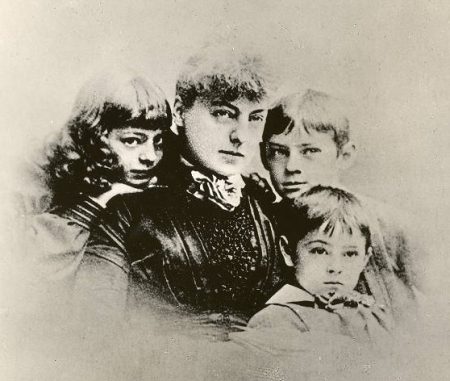
Georgia Drew Barrymore with children Ethel, Lionel and John, ca. 1883. (Courtesy University of Washington Special Collections, Order No. 23269)
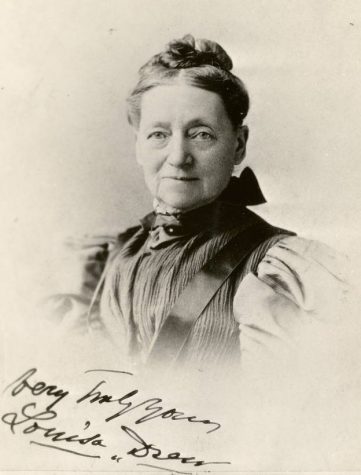
Stage Actress Louisa Drew, ca. 1880. (Courtesy University of Washington Special Collections, Order No. JWS16791)
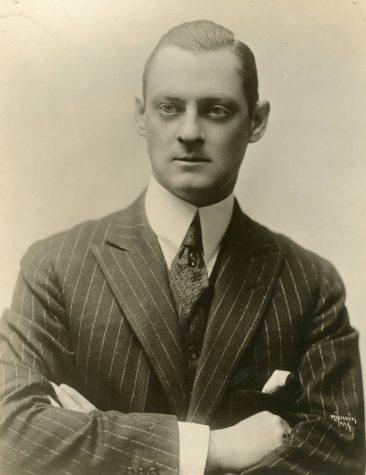
Actor Lionel Barrymore, ca. 1919. (Photo by Mishkin, courtesy University of Washington Special Collections, Order No. JWS18040)
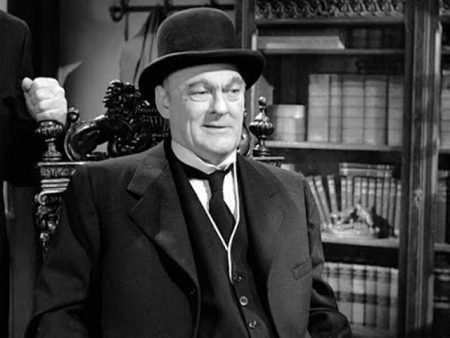
Lionel Barrymore as the nefarious Mr. Potter in Frank Capra's "It's a Wonderful Life" (RKO, 1946).
Act I: Lionel Barrymore
Just a few years after the fire of 1889 devastated much of Seattle and its existing theatres, a touring engagement for one of the era’s great stage families brought a future silent film star to the city, then only in his teens. The Drews, headed by matriarch Mrs. John Drew (Louisa Lane), had been popular dramatic personalities in the East for more than a generation by the 1890s. One of Drew’s daughters, Georgie, was a noted comedienne who eventually married Maurice Barrymore, uniting the Drews with yet another family with a considerable stage reputation. Although Mrs. John Drew had, toward the late 1880s, scaled back her performance schedule, she nonetheless toured on occasion, usually in repertoire engagements where she reprised the roles that made her famous. In October 1893 she made one of those appearances at the Seattle Theatre, the city’s newest theatrical venue, located at the northeast corner of Third and Cherry.
Mrs. Drew’s company for her 1893 appearance featured several members of the extended Drew family, including her 15-year-old grandson, Lionel Barrymore, the eldest of Maurice’s three children. The cast also included Lionel’s uncle Sidney Drew, who would later appear in screen comedies for Vitagraph and Metro.[1]
The Drew company was engaged for two nights at the Seattle, beginning October 5. The first evening was reserved for one of Mrs. Drew’s most famous roles, the actress appearing as Mrs. Malaprop in Richard Brinsley Sheridan’s comedy The Rivals. The following night the company gave Thomas Holcroft’s The Road to Ruin.
The Barrymore children – Lionel, Ethel, and John – were heirs not only to their father’s stage legacy but also to the Drew family’s as well, and all three siblings regularly jumped between stage and screen throughout their careers. That said, none of them, at least initially, desired a career in acting. Ethel, who became one of the premier actresses of the early 20th century, originally pursued an interest in music. This was also the case with Lionel, though his true calling, as it was with younger brother John, was art – both were painters of modest accomplishment. Each of the Barrymore children, however, fell into acting as a way to pay the bills, their family connections and natural talent affording an easy entry into stage work. Lionel, however, didn’t always see it that way. In his autobiography, he credited his rise as a performer as owing more to “fraud and undeserved promotions” than talent. “As an actor,” he wrote in 1951, “I resemble an amateur fireman who got thrown in with the professionals early, failed to find his métier anywhere else, and had to keep running to various theatrical conflagrations because he couldn’t get out of the way.”[2]
The Seattle engagement of The Rivals is notable because it predates what is generally thought to have been Lionel Barrymore’s stage debut and proves that his initial run in the play was longer than the two meager performances he mentions in his autobiography. What had generally been accepted is that Lionel Barrymore made his acting debut in Kansas City on October 28th, 1893 – three weeks after he played the part of Thomas, a coachman, at the Seattle Theatre. Furthermore, Barrymore reported that he took a walk-on role in The Road to Ruin around Christmas of that year, but it seems he was playing these roles earlier than believed.
The Seattle engagement throws water on a colorful story Barrymore liked to tell about his (supposed) debut in Kansas City. Lionel was on the tour at the time due to the recent death of his mother, Georgie; with Maurice Barrymore also working, the family stepped in to care for the children. With John staying elsewhere and Ethel away at boarding school, Mrs. John Drew brought young Lionel on the road and, mid-tour, decided it was time for him to learn the family trade. According to Barrymore, she suddenly announced one day that he would begin playing the part of Thomas in The Rivals beginning with the company’s Kansas City engagement.
Lionel dutifully rehearsed the part and on October 28th he gave two performances as Thomas in The Rivals, both horrendous. The role was a small one, he remembered, but he badly mishandled it – his make-up was atrocious, costume ill-fitted, and his delivery flat and monotone. The crucial business for his character occurred in the so-called “front scene,” opening the play, where Thomas meets and acknowledges a character named Fagg (played by Edwin Wallace during the Seattle engagement), both performers conveying to the audience that they recognize each other before they actually greet. Barrymore thought the scene far too difficult for a novice actor. “Well,” he recalled years later, “when I attempted it with my seventy-five-dollar-a-week partner, poor devil, it was as one critic said of Joe Jefferson’s production of The Rivals: ‘Sheridan was thirty miles away’…there was no wit and no comfort attached to my miserable first effort. I crept on stage in apathy of embarrassment and muttered my words like an automation that needed the oil can. The scene was too much for me, as indeed, any scene would have been too much for me at that time.”[3]
Embarrassed, Lionel retreated from theatre after the matinee performance in Kansas City and did not return to the troupe’s boarding house until later, just before the evening show. When he arrived in his room, he found a handwritten message awaiting him.
My Dear Lionel:
You must forgive your Uncle Sidney and me for not realizing that when Sheridan wrote the part of Thomas he had a much older actor in mind. We feel that we were very remiss in not taking cognizance of this – although we are both happy that you are not at the advanced age you would have to be in order to be good in this part.
We think, therefore, that the play as a whole would be bettered by the elimination of the front scene and have decided to do without it after this evening’s performance.
Sincerely and with deep affection, your Grandmother,
Mrs. Drew[4]
“Since my debut, most performances of The Rivals have gone on without the front scene,” Barrymore mocked in his autobiography. “I seem to have killed it for good. Or perhaps directors have been worried lest I come back and play the part again.”[5] Relieved with the decision to drop him from the production, Barrymore remained on tour but occupied his time with various odd jobs for members of the company, which included mixing martinis for his uncle Sidney.
While Lionel Barrymore’s appearance as Thomas in Seattle doesn’t necessarily change the complexion of the story, it suggests that he tried acting for longer than the two Kansas City performances for which he is generally credited. The whole account seems a little suspect, at any rate, since the role of Thomas was a relatively small one in The Rivals, and it would have been just as easy for Mrs. Drew to install a replacement for her grandson as it would have to cut the part entirely. (Barrymore was being thrown onstage in the middle of the tour, after all, so someone in the troupe had been assigned that part before Lionel took up the reigns.)
But in the Northwest, at least, Lionel Barrymore (according to cast listings in Seattle newspapers – no actual programs survive) played small parts in The Rivals and The Road to Ruin. Both plays were presented under the direct supervision of the 73-year-old Mrs. Drew, and anticipation was high for her appearance.
The dramatic season covering the fall and winter amusements in Seattle cannot be said to have opened yet. The [1893] financial crisis…has driven many traveling companies from the road and those in the financial condition to weather the storm are reluctant about coming so far west, fearing unsatisfactory results…
Mrs. John Drew is at the head of the Drew Comedy company, which is booked at the Seattle theater, October 9 and 10, when she will be seen in her celebrated characterization [of Mrs. Malaprop]. To our older theatergoers [The Rivals] is well known. The younger playgoers, who seek laughter producing attractions of the high order, will find it meets the requirements demanded in a stage performance.[6]
The Seattle Post-Intelligencer also looked forward to the engagement. “Mrs. Drew is the oldest as well as one of the best actresses now playing, and though she has passed the age when most actresses retire, she has lost none of her power and is still inimitable as an interpreter of old English comedy. She has played the part of Mrs. Malaprop so long that it has come to be regarded as instinctively her own…”[7]
The role of Mrs. Malaprop was so much Mrs. Drew’s, in fact, that the Post-Intelligencer’s critic hardly felt the need to comment on her performance the following day. “Of course, Mrs. Malaprop was portrayed, as it always was by Mrs. John Drew – to perfection. There were no invidious comparisons to make here, for there never was another Mrs. Malaprop.”[8] Instead, most of their small review went to praising Sidney Drew as Bob Acres, a role that had become a staple for the legendary Joseph Jefferson; Drew acquitted himself rather nicely despite inevitable comparisons.[9] Unfortunately, as can be expected from such a small part, Lionel Barrymore went unmentioned by name, though the Post-Intelligencer did note that “(t)he minor members of the company were uniformly clever and the play throughout provoked the heartiest appreciation of a large audience.”[10]
It doesn’t appear that an issue of the Seattle Press-Times – the city’s other major daily – has survived, so it’s impossible to determine their reaction to The Rivals. And no reviews whatsoever exist of Friday night’s show, Thomas Holcroft’s The Road to Ruin, which concerned a young man who, after bleeding his father’s bank account, looks to marry a wealthy society matron and restore the family riches. For this production Mrs. John Drew was to essay the role of “the gushing Widow Warren.” The Press-Times issue is again missing, while the Post-Intelligencer did not critique the play in their Saturday edition, nor did they discuss the Drew engagement in their Sunday theatrical column. Barrymore’s slated role, as a footman, certainly wouldn’t have garnered any press recognition, though the play was promised as a show “which the company can, as a whole, be cast to far better advantage than in The Rivals.”[11]
Lionel Barrymore continued to play stage roles off and on for years, and by his early twenties had established himself as a genuine actor – first as a leading man, then in the type of character parts that distinguished his later film career. Painting, however, remained his first love, and after marrying Doris Rankin in 1906 he abandoned the stage for formal training in Paris; the Seattle weekly The Argus even carried an announcement of his intentions.[12] Ethel Barrymore, who by then had also made a name for herself onstage (her first success coming in 1900’s Captain Jinks of the Horse Marines), funded the trip.[13] Ethel paid for Lionel’s schooling and sent the couple an allowance, though he voluntarily returned to America in 1909 when Ethel herself married. Lionel went back onto the stage but eventually discovered motion pictures as a new outlet for his acting (and occasional writing) abilities. It took some effort, as his connection to the industry was somewhat reluctant to hire a member of the famous Barrymore clan (fearing, among other things, the price for his services), but Lionel managed to convince director D.W. Griffith to take a chance on him. Barrymore appeared in a number of Griffith’s later Biograph films, beginning with Fighting Blood (1911), then worked off and on with the director through his Revolutionary War epic America (1924). Still, Lionel Barrymore’s move to the big screen didn’t mark the end of his stage career, even though motion pictures would occupy the bulk of his later professional work.
Shortly after returning from Paris, in fact, he put together a vaudeville tour that passed through Seattle in October 1910, 17 years after his initial visit. Playing the Orpheum at Third and Madison, Barrymore’s act headlined the week’s bill and teamed him with wife Doris Rankin and veteran actor McKee Rankin, Doris’ father, in a skit called The White Slaver. The playlet, penned by Barrymore himself, was inspired by an investigation into New York prostitution headed by John D. Rockefeller, Jr. Set on the Lower East Side, Doris Rankin played Marion, an exploited girl, while McKee Rankin was Al Kendricks, an Eastside politician and the title “white slaver.” Lionel Barrymore portrayed an Italian coal dealer. Not much to describe the one-act play exists, although after dealing rather bluntly, it seems, with the subject of forced prostitution in exchanges between Marion and Kendricks, Barrymore’s coal dealer enters for a delivery and discovers, thanks to a discarded photograph of Marion’s father, that the girl is actually his long-lost sister.[14] A climactic knife fight between the men ends the playlet, with Kendricks being killed and the siblings reunited. “The ignorance of foreigners, who come to America almost without hope, who are made the dupes of men for whom there is no adequate description in English, when their discussion is serious, is represented in the twenty minutes that are needed to tell The White Slaver.”[15]
The Post-Intelligencer’s critique of the Orpheum bill neglected to print much more about the act than a general plot description, save for the admission that it “painted a dreary picture,” and noting that “it is the first time that anything quite like The White Slaver has come under local observation as a feature of this generally cheery habit of vaudeville.”[16] The sparseness of their review seems a tactful omission, perhaps due to the fact that both Barrymore and McKee Rankin were popular stage figures and widely regarded as first-rate artists.
Edgar H. Thomas of the Seattle Daily Times, on the other hand, showed little reservation in panning the playlet, which capped what he felt to be a miserable bill at the Orpheum. Similarly, J. Willis Sayre at the Star had to search for anything positive to say about the Barrymore contribution. Their opinions are in direct contrast to those of Margot Peters and Hollis Alpert, each biographers of the Barrymore clan, both of whom called The White Slaver a notable vaudeville success.[17]
In Thomas’ opinion, only one act was worthy of admission: Frank Morrell, a blackface singer who managed to lift the proceedings with his song selections and comedy monologue. He was preceded by a quartet of fiddlers, all Civil War veterans (two from the Confederacy and two from the Union), who attempted to rouse the crowd with their patriotic music and colorful tales. In Thomas’ mind, however, they were a reminder of sad times, and he couldn’t help but be cynical about their appearance. “The act is undoubtedly attractive from a box office standpoint. It is also very entertaining, principally because of its novelty and pleasant informality. Yet it does seem too bad to have a commercial price set upon one’s patriotism…it is so obvious a lure for dollars. However, the veterans directly concerned declare they are having a good time traveling over the country, so if they don’t mind being made the goat, the public should not.”[18]
When it came to discussing The White Slaver, however, Thomas was less forgiving.
The headliners of the new show, according to the billing, are McKee Rankin, Lionel Barrymore and Doris Rankin, in a one-act tragedy by Mr. Barrymore called The White Slaver. Personally, it strikes us as something of a sacrilege to speak ill of the offering, but it is really a shame that an artist of the seasoning, wonderful experience and recognized ability of Mr. Rankin, for whom we have nothing but respect and admiration, should appear in such a poor vehicle as this…
The White Slaver reflects, disconnectedly, certain miserable conditions and practices extant in New York’s East Side life, wherein a young girl is bought and sold at the price of honor and shame, her earnings going to fill the filthy pockets of her master. The playlet, it may be seen, is intensely dramatic. It has been badly handled by Mr. Barrymore, who presents the story in garbled and almost unintelligible form. The piece would have been more effective and even more artistic if presented in pantomime. As it is, no one can possibly understand the gibberish emitted by Mr. Barrymore or hear the words of Miss Rankin, who is altogether too confidential. Mr. Rankin himself has been given a hopelessly bad part which is wholly unworthy of him.[19]
J. Willis Sayre had similar views in the Star. Morrell was the highlight of the show, but the Old Soldier Fiddlers, in his opinion, “comprise one of the most unique acts ever offered in vaudeville…There’s a difference between the way these old fellows wave the flag and the way George Cohan waves it. This time it smells of patriotism, and not of the box office.” But Sayre was as direct as Thomas when it came to discussing The White Slaver. “Very few vaudeville playlets present three so accomplished actors as Lionel Barrymore, McKee Rankin and Doris Rankin. The trio play an act by Mr. Barrymore entitled The White Slaver. Its subject matter is unwholesome, and Mr. Barrymore’s Italian dialect is perhaps necessarily so thick that much even of the broken English is not intelligible. It would seem that these three players could select a new playlet which would show them to better advantage than this 14-minute tragedy…”[20] And yet Sayre must have felt a tad guilty writing those words, adding that it was a presentation “which they of course act splendidly.”
Thus it was on this rather dismal note that Lionel Barrymore made his last known appearance on the stages of Seattle – one that was wasn’t on par with his reputation or abilities. Still, he would continue working onstage, in motion pictures and, later, in radio, with lengthy and distinguished careers in each medium. He won an Academy Award for playing a lawyer in A Free Soul (MGM, 1931) and later appeared in several of the original Dr. Kildare films. Although his brother John became the bigger cinema star in the silent era and Ethel (who earned her own Oscar in the 1944 RKO picture None But the Lonely Heart) who reigned supreme onstage, Lionel was the Barrymore sibling who invested the most into motion pictures, and in turn had the longest and most distinguished career in front of the camera. Barrymore died in 1954.
By Eric L. Flom – January 2026
Notes:
[1] Sidney Drew’s engagement in 1893 was his only known stage appearance in Seattle. Following Drew’s death in 1920, his wife (known professionally as Mrs. Sidney Drew) performed in Seattle on two occasions, vaudeville appearances in 1922 and 1924.
[2] Lionel Barrymore (as told to Cameron Shipp), We Barrymores (New York: Appleton-Century-Crofts, Inc., 1951), Page 1.
[3] Ibid., Pages 37 and 38.
[4] Ibid., Page 39.
[5] Ibid.
[6] “Plays and Players,” Seattle Press-Times, 30 September 1893, Page 6.
[7] “The Drew Comedy Company,” Seattle Post-Intelligencer, 5 October 1893, Page 5.
[8] “The Drew Comedy Company,” Seattle Post-Intelligencer, 6 October 1893, Page 8.
[9] Joseph Jefferson brought The Rivals to Seattle some 18 months prior to Lionel Barrymore’s engagement; Mrs. John Drew also essayed the role of Mrs. Malaprop in this earlier version. (See program, Seattle Opera House [27 February 1892], J. Willis Sayre Collection. In the absence of an original, J. Willis Sayre typed the program from an unknown source.)
[10] “The Drew Comedy Company,” Seattle Post-Intelligencer, 6 October 1893, Page 8.
[11] Ibid.
[12] “Dramatic Notes,” The Argus, 9 June 1906, Page 6.
[13] Seattle wouldn’t see Ethel Barrymore in Captain Jinks of the Horse Marines until June 1907, when she played a two-day engagement at the Grand Opera House. (See program, Grand Opera House [28 June 1907], J. Willis Sayre Collection.) The visit was Ethel Barrymore’s first known appearance in Seattle.
[14] Hollis Alpert, author of The Barrymores, notes that the girl in The White Slaver was the coal man’s daughter, not his sister. (See Hollis Alpert, The Barrymores [New York: The Dial Press, 1964], Page 140.) The version here is taken from the plot recounted in the Seattle Post-Intelligencer, which clearly notes the relationship as being brother/sister. (See “Orpheum Show Has Big Names,” Seattle Post-Intelligencer, 10 October 1910, Page 12.) In their own reviews, neither the Star nor the Daily Times made an effort to relate the story of the playlet.
[15] “Orpheum Show Has Big Names,” Seattle Post-Intelligencer, 11 October 1910, Page 12.
[16] Ibid.
[17] Margot Peters, The House of Barrymore (New York: Alfred A. Knopf, 1990), Page 123; see also Alpert, Page 140.
[18] Edgar M. Thomas, “New Vaudeville on Tap,” Seattle Daily Times, 11 October 1910, Page 6.
[19] Ibid.
[20] J. Willis Sayre, “At the Theatres,” Seattle Star, 11 October 1910, Page 5.
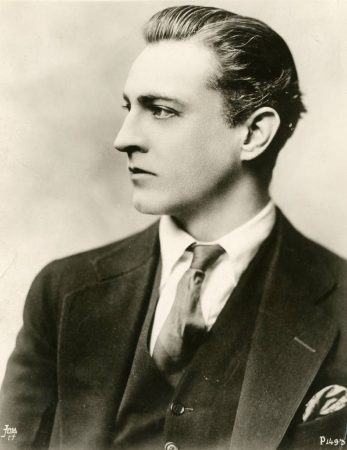
Actor John Barrymore, ca. 1918. (Courtesy University of Washington Special Collections, Order No. JWS17706)
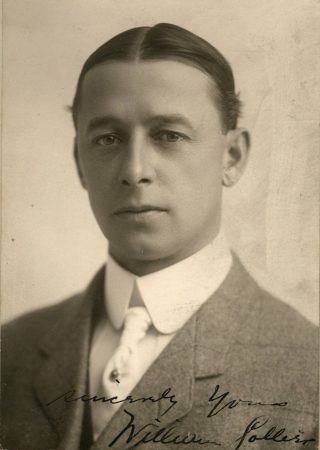
Actor William Collier, ca. 1906. (Courtesy University of Washington Special Collections, Order No. JWS15897)
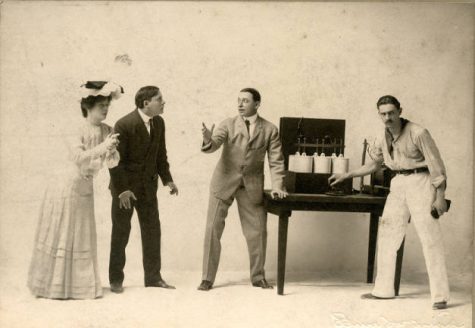
William Collier, center, and John Barrymore, right, in "The Dictator," ca. 1905. (Courtesy University of Washington Special Collections, Order No. JWS23841)
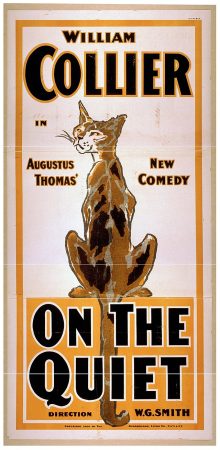
Undated theatrical poster for one of William Collier's "On the Quiet" tours. (Strobridge and Co., Lithographers)
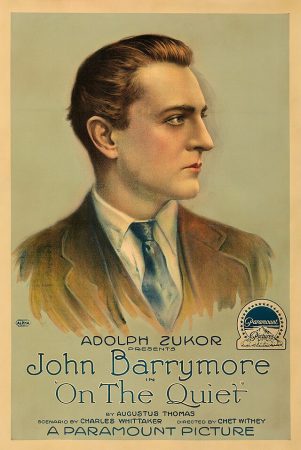
Poster for the John Barrymore film version of "On the Quiet" (Paramount, 1918).
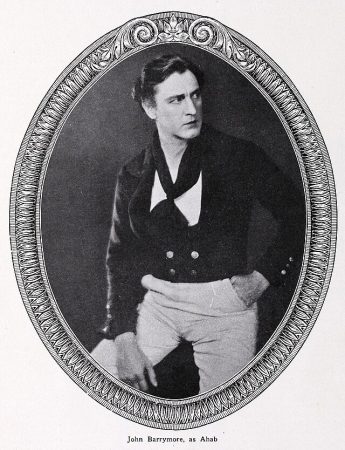
John Barrymore as Captain Ahab in "The Sea Beast" (Warner Bros., 1925), a screen adaptation of "Moby Dick."
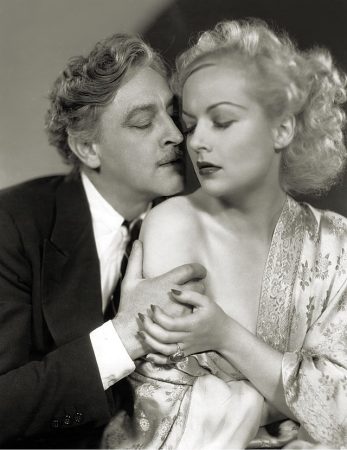
John Barrymore and Carole Lombard in "Twentieth Century" (Columbia, 1934).
A Race Across the Continent: A Collection of Roadshow Engagements
Act II: John Barrymore
Lionel Barrymore eventually became known as a versatile character actor, both onstage and in films, lending his talents (particularly during the sound era) to many a supporting role in films such as Captains Courageous (MGM, 1937) and Frank Capra’s It’s a Wonderful Life (RKO, 1946). He never found fame as a leading man in the sense that his younger brother would. Although John Barrymore first entered films in 1914, his biggest screen successes would come a decade later, in the mid- to late 1920s. In fact, following a critically acclaimed run of Shakespearian roles on Broadway earlier that decade, there was hardly a bigger matinee idol. Though he preferred more substantial cinematic roles like Dr. Jekyll and Mr. Hyde (Paramount, 1920), his appearance in Warner Bros. films such as Beau Brummell (1924) and the pre-Jazz Singer sound production Don Juan (1926) helped cement his reputation as “the Great Profile.”
John was the youngest of the Barrymore clan, born in Philadelphia in February 1882. Like Lionel, he initially preferred art over acting, but wasn’t nearly as high-minded about his abilities. Shortly after the turn of the century Barrymore was working as a newspaper cartoonist in New York, while also submitting freelance work to other publications. Motivated, perhaps, by thin prospects an illustrator, in 1903 John decided to take up acting and landed a role in one of his sister’s touring productions. Within a few years he graduated from small roles to Broadway, where his reputation continued to grow.
A scant two years after his first known stage appearance, John Barrymore played the first of two engagements in Seattle, supporting comedian William Collier in The Dictator, which played the Grand Opera House for three nights beginning January 19, 1905. At the time of his appearance, the young Barrymore, who had joined Collier’s troupe only nine months previous, was fast approaching his 23rd birthday.
Based on the story by Richard Harding Davis, The Dictator concerned a New York socialite who, after being falsely accused of murder, flees with his valet to hide out in Porto Banos, a fictional Central American country. On the southbound steamer this socialite, Brooke Travers, meets a Colonel Bowie, United States Consul to Porto Banos, who confides to Travers that, due to political instability in the country, he is practically its acting dictator.
Yet as the pair approach their destination, Colonel Bowie learns of a revolution in Porto Banos that will put him in danger if he steps off the ship. Travers, with nothing to lose (or so he thinks), offers to take Bowie’s place as the new American Consul to Porto Banos, to which the Colonel agrees. The result, of course, is a travesty of government, as the country’s political situation threatens to careen out of control.
Charles Frohman’s production of The Dictator had earlier finished a five-month run at the Criterion Theatre in New York, and was part of an effort to promote William Collier as a comedy star. Born in 1867, Collier originally found stardom in the theatrical world in farce comedy roles. Touring at the time as “Willie” Collier, he was spotted by Frohman, who brought the actor under his wing and put his talents to work in more mainstream comedies. (For The Dictator in 1905, coming early in Collier’s almost 20-year association with Charles Frohman, much was made of the fact that the popular comedian was now going by “William” rather than “Willie.”) William Collier proved a successful Broadway actor into the 1920s, associating himself with some of the biggest theatrical names of the day, including collaborations with performers such as Sam Bernard and George M. Cohan. Though semi-retired by the 1930s, Collier made occasional appearances on the New York stage all the way until his death in 1944, at the age of 77.
Despite this professional rebranding by Charles Frohman, William Collier’s comedic talents were still on ample display, and audiences at the Grand greeted him warmly. “William Collier is no less entertaining than he was as ‘Willie’ Collier, and the fact that, in considering himself seriously, he decided to allow the more juvenile patronymic to slide back into the shadows of the past and to bid for a niche in the Thespian temple of fame…should not be held against him,” declared the Post-Intelligencer. “[Collier’s] comedy is quiet, effective, intelligent, and from all standpoints of his own making, and the laughter he inspires is the laughter of genuine enjoyment.”[1] The Daily Times had similar observations. “Mr. Collier’s comedy is just as free and easy as ever, and again every move, gesture, word or look seems to bring out a torrent of mirth.”[2]
Curiously, though, both papers wholeheartedly approved of Collier’s stage work despite serious reservations about the play. “Naturally, from an offering which is flatly advertised as a farce, not a great deal is to be expected aside from the quality of humor,” explained the Daily Times. “One does not look for strength of plot or dramatic continuity in a farce. Nevertheless, the Davis play is clever and ingenious, both in what it does do and what it does not do.”[3] The Post-Intelligencer was even more blunt. “In The Dictator Richard Harding Davis has furnished Mr. Collier with two uproariously funny and well devised acts and has then allowed the interest in a great measure to die out. The third act is comparatively tame, and is only funny in spots – that is, when one remembers the first and second. The final curtain is rung down on a finish that is almost dull.”[4]
John Barrymore enacted dual roles in the production, as Samuel Codman and Charley Hyne, but it was as Hyne – a telegraph operator on the Red C Steamer Line to Porto Banos – for which he garnered the most attention. Even so, other than a brief mention in the Post-Intelligencer as being “conspicuously good,” passing notice was about all he received from Seattle’s dailies. The Star, in fact, was the only paper to mention him at any length, although it was his family’s stage reputation that inspired their comments. “John Barrymore does credit to the histrionic fame of his name in the role of the ‘wireless’ operator. The role is a rollicking one and, in manner as well as in lines, Barrymore gives the character its due of quick action and ready wit.”[5]
Following The Dictator’s run, it would be roughly 18 months before John Barrymore returned for a second engagement in Seattle. In the interim, the young actor continued his association with Charles Frohman and William Collier, circling the globe in their employ. In the summer of 1905 Frohman sent Collier and his company to London, where they found success presenting some of the actor’s previous triumphs, including the Augustus Thomas comedy On the Quiet. Following an extended run in England, Collier returned to America before embarking on an Australian tour in the summer of 1906 with the same repertoire and enjoying comparable success.[6]
Shortly after returning from Down Under, Collier was back on the American stage with On the Quiet; the Frohman forces were having some difficulty locating a new property for their talented young comedian. Very early on this new tour William Collier and John Barrymore returned to the Grand Opera House in Seattle, with On the Quiet playing a four-day run beginning September 9, 1906. In addition to Barrymore, the cast also included Mabel Taliaferro as Agnes Colt, who herself (along with her sister Edith) would later forge a career in silent films.[7]
On the Quiet centered upon Robert Ridgeway (Collier), a Yale man who secretly elopes with the daughter of a society figure from New York, knowing full well she’ll be disinherited for marrying without her father’s consent. Based on a previous Collier visit with the same play a few years earlier, that brief plot description was all that was needed to interest Seattle audiences.[8] “On the Quiet is the play with the college and yacht scenes and the Jap who keeps asking when the wind is coming up,” noted the Daily Times in their review. “That description is ample to recall the play to the minds of those who have seen it before, and is just vivid enough to make them want to go and see it again. As for those who have not seen it, the statement should be made here that this is one of the best comedy events that the present season in Seattle will bring forth.”[9] Fairly heady praise, considering that the 1906-1907 theatrical season was all of 10 days old at the time.
Nevertheless, the Collier appearance was an excellent start to the new season at the Grand.
Fresh from his comedy conquest of the world, during which he had visited some of the out-of-the-way corners of the planet, where English is and is not spoken, William Collier, whose star is in the perihelion of success, is again back in Seattle after an absence of almost two years…[T]he comedian is offering one of the very best of his old repertoire, and the Augustus Thomas comedy, On the Quiet, is tendered as an excuse for filling theaters and dispensing hilarity. Mr. Collier is unctuous and his effervescent joyousness is as acceptable as it ever was…[he] doesn’t disappoint his following, and always has his particular brand [of comedy] to tender his friends, and his friends are fond of that particular brand.[10]
The Daily Times, describing Collier and the play as “old friends,” noted several changes to the show’s dialogue that helped make the humor more contemporary, though the play was strong enough on its own merits to gain favor with audiences. “The house was packed,” they reported of Collier’s opening, “and judging by the spontaneous and ever ready applause the crowd caught everything Collier said and did…[he] is not only a comedian, but a straight-away actor of big attainments.”[11] At the same time, however, the paper wondered openly if the actor wasn’t a bit tired reinterpreting his former glories. “His press agent declares that Mr. Collier personally still gets a good deal of fun out of the role [of Robert Ridgeway in On the Quiet]. The principal fun probably comes in the [pay] envelope [on] Tuesday nights…”
As with The Dictator some 18 months previous, William Collier’s supporting cast was also lauded for their efforts, with this visit bringing a little more recognition for young Barrymore. “John Barrymore, relative to all sorts of famous American Thespians,” noted the Daily Times, “has far too little to do as Hyde Ogden, but he succeeds as well as he did with the [telegraph] operator in The Dictator.”[12] The Post-Intelligencer went further, both on the talents of Barrymore and his colleague, Mabel Taliaferro.
Mr. Frohman has surrounded [William Collier] with a company that shares the success attending the present visit, and several names are included in the roster of the company that are well known in Seattle. Jack Barrymore ambled on in exactly the same way that he appeared when he presented the telegraph operator in The Dictator, Mr. Collier’s last vehicle for journeying this way. This time Mr. Barrymore wears evening clothes in the first act; so do all the rest. But Mr. Barrymore appears uncomfortable in them, which, however, does not make much difference. His comedy is quite as much his own as is that of the star. He is entirely necessary to the telling of a tale of absurdities.
Mabel Taliaferro is Mr. Collier’s leading lady, and she is a dainty little woman who is essentially young, and whose appreciation of comedy situations is delightful. Miss Taliaferro is charged by a very recent issue of a New York paper with being in the same class as Elsie Janis…With acknowledged youth and capacity to her credit, Miss Taliaferro seems to have a pleasant future mapped out for her…[13]
John Barrymore, like siblings Lionel and Ethel, continued to ply his trade on the stage for many seasons before jumping into motion pictures. In 1913 he signed with Adolph Zukor’s Famous Players and made a handful of films, including An American Citizen (1914), based on his own stage success, as well as screen versions of The Dictator (1915) and On the Quiet (1918). But despite this early foray into motion pictures, he tended to specialize in dramatic roles, as opposed to the comedic ones in which he appeared during his early visits to Seattle. Particularly noteworthy were Barrymore’s interpretations in Richard III and Hamlet on Broadway in the early 1920s, highly acclaimed performances that demonstrated his considerable abilities.
In 1922 John Barrymore signed a picture contract with Warner Bros., where he began to appear in swashbuckling roles such as The Sea Beast and Don Juan (both of 1926). He later jumped to Metro-Goldwyn-Mayer, his extensive stage background making for a smooth transition into sound pictures.
Yet, at the height of his popularity, things began unraveling for John Barrymore, an undoing that is perhaps as legendary as his stage or screen exploits. For years Barrymore had been a heavy drinker, and gradually the effects of this punishment began to show – the “Great Profile” was sliding fast. Coupled with four tumultuous marriages (the third to Delores Costello, herself an actress and daughter of Vitagraph great Maurice Costello), Barrymore gradually became an unreliable performer and saw fewer and fewer screen roles. He was institutionalized at least twice in the late-1930s to combat his drinking, in between playing roles that varied from leading men in minor pictures to character work that sometimes parodied his own screen image. Although John Barrymore continued to land parts up to his death in 1942, his later film work was a shadow of the performances that originally took both stage and screen by storm. His downfall has since formed one of the most tragic portions of the Barrymore family legacy.
By Eric L. Flom – January 2026
Notes:
[1] “Collier as The Dictator,” Seattle Post-Intelligencer, 20 January 1905, Page 7.
[2] “Gets Very Warm Welcome,” Seattle Daily Times, 20 January 1905, Page 7.
[3] Ibid.
[4] “Collier as The Dictator,” Seattle Post-Intelligencer, 20 January 1905, Page 7.
[5] “The Dictator,” Seattle Star, 20 January 1905, Page 3.
[6] An amusing incident involving John Barrymore is said to have occurred shortly before the Collier company embarked on their Australian tour. As told in William Collier’s 1944 obituary in Variety, Collier and Barrymore were in San Francisco during the 1906 earthquake and fire, and found themselves called to duty as part of local search and rescue efforts. (In the aftermath, federal troops took charge of the city and organized brigades of citizens to search for survivors and clear debris from the streets.) When one of Barrymore’s relatives learned of these civic efforts, he is said to have remarked “It took a quake to get Jack out of bed and the U.S. Army to put him to work.” (See Jack Pulaski, “Wm. Collier, Comedian-Author, 77, Dies on Coast After Long Illness,” Variety, 19 January 1944, Page 59.)
[7] Beginning as a child performer, Mabel Taliaferro is known to have played Seattle at least four times, including the 1905 Collier engagement. Her first documented appearance was in 1894, in a touring version of the play Killarney. However, the “Performer Index” to the J. Willis Sayre Collection cites her first appearance as having occurred in 1892, when she arrived supporting Frederick Warde in a series of Shakespearian offerings. No program survives from the Warde engagement, and Sayre’s typed substitute does not list Taliaferro has having appeared with the company. (See program, Seattle Opera House [7 April 1892], J. Willis Sayre Collection. In the absence of an original, J. Willis Sayre typed the program from an unknown source.) Following the 1905 Collier engagement, Mabel Taliaferro returned to Seattle in 1915, supporting William H. Crane and Maclyn Arbuckle in The New Henrietta, and again in 1928 in a vaudeville playlet.
Mabel’s sister Edith also appeared in Seattle on a number of occasions, the first two coming in 1897 and 1898 when she toured alongside James A. Herne in the popular favorite Shore Acres. She also appeared in The Bonnie Brier Bush in 1902 (in a cast that also featured Helen Holmes), in Weather Beaten Benson in 1905, and played Lovey Mary in Mrs. Wiggs of the Cabbage Patch at the Grand Opera House in April 1907. The cast for Mrs. Wiggs also included King Baggott. Finally, Edith Taliaferro put in a special two-week guest appearance at the Moore Theatre in 1931 with the Bainbridge Players, one of the last semi-permanent stock companies to play the city.
[8] William Collier originally appeared in On the Quiet during a four-day run at the Grand beginning 12 December 1901. George W. Parsons played the part of Hyde Ogden, John Barrymore’s role for the 1906 engagement, in this earlier presentation. (See program, Grand Opera House [12 December 1901], J. Willis Sayre Collection.)
[9] “Comes Back to America,” Seattle Daily Times, 10 September 1906, Page 7.
[10] “Collier Presents Thomas Comedy,” Seattle Post-Intelligencer, 10 September 1906, Page 7.
[11] “Comes Back to America,” Seattle Daily Times, 10 September 1906, Page 7.
[12] Ibid.
[13] “Collier Presents Thomas Comedy,” Seattle Post-Intelligencer, 10 September 1906, Page 7.
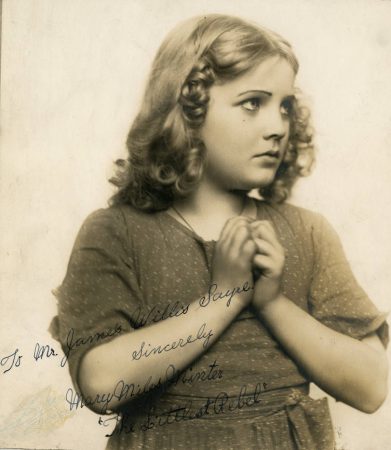
Inscribed photo of Mary Miles Minter, 1912. (Courtesy University of Washington Special Collections, Order No. 28687)
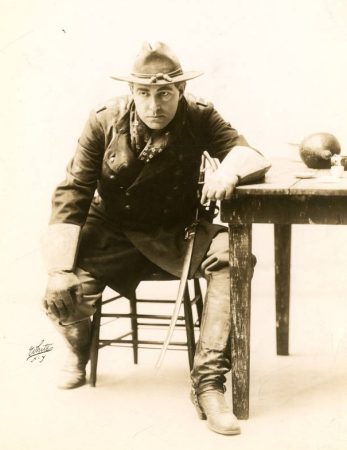
Leading man Dustin Farnum in "The Littlest Rebel," 1912. (Courtesy University of Washington Special Collections, Order No. 10129)
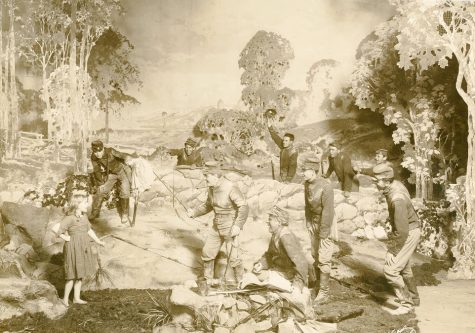
Mary Miles Minter, bottom left, in a scene from "The Littlest Rebel," ca. 1912. (Courtesy University of Washington Special Collections, Order No. 23288)
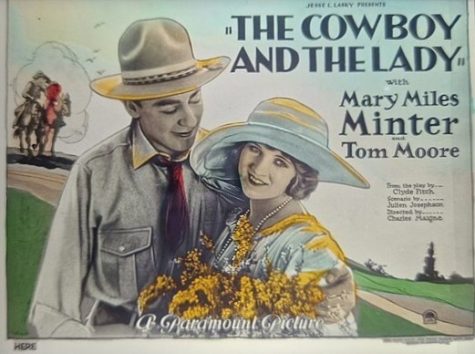
Lantern slide for the film "The Cowboy and the Lady" (Paramount, 1922).
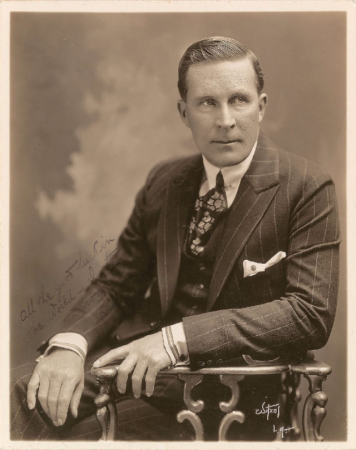
Director William Desmond Taylor, ca. 1917. (Photograph by Albert Witzel)
A Race Across the Continent: A Collection of Roadshow Engagements
Act III: Mary Miles Minter
Another silent star whose life would take a tragic turn was Mary Miles Minter, an actress who was an exceptional box-office draw into the early 1920s, often in the types of juvenile roles that also made Mary Pickford famous. Her career as a motion picture actress was short, but her appeal was considerable – in her 1984 obituary Variety recalled that among screen actresses she was, for a brief period, second only to Pickford in terms of audience popularity.[1]
Minter was born Mary M. Reilly in Shreveport, Louisiana, in 1902, and through the efforts of a persistent stage mother began performing at a very young age. Appearing under the name Juliet Shelby, she played small parts in a number of productions, though Minter’s breakthrough role came when she was only nine years old, playing the title character in Edward Peple’s Civil War drama The Littlest Rebel.
The notoriety helped launch Juliet Shelby’s acting career, but not all the attention was welcomed. Cast as Virgie Carey, she performed in The Littlest Rebel from 1911 to 1914, but became a target for the Gerry Society, which sought to protect children from exploitation in theatrical circles. (Buster Keaton was another of the Society’s longtime concerns while performing in his family’s vaudeville act.) One story out of Chicago had the actress under such pressure to leave the cast of The Littlest Rebel that her mother finally traveled to Louisiana to fetch the birth certificate of one of her deceased nieces. Upon her return, the show formally announced that Juliet Shelby was, in fact, leaving the show, to be replaced by an unknown actress named Mary Miles Minter, 16 years old and of legal age. The change was in name only – Juliet Shelby and Mary Miles Minter were one in the same.[2]
The ruse, if it occurred, worked like a charm, and Minter’s stage career blossomed with The Littlest Rebel’s success – notoriety that eventually led to a career in the film industry.[3] Yet after several years of popularity with motion picture audiences, Minter’s screen career came to a screeching halt in 1922. At the mere age of 20, she and comedienne Mabel Normand were linked to the slaying of director William Desmond Taylor, an ill-timed scandal (coming, as it did, on the heels of the Roscoe Arbuckle trials) that combined charges of drugs, sex and murder.[4] Though she publicly denied having a relationship the elder Taylor, love letters discovered during the investigation ran counter her public statements. For a short time both Minter and her mother (who either strongly disapproved of the liaison or, according to some rumors, was herself having an affair with the director) were considered suspects. Following the scandal and its aftermath, Minter played out the remainder of her contract with Adolph Zukor and ended her acting career, which, she always contended, was her mother’s passion and not her own.[5]
The only known Seattle appearance for Mary Miles Minter occurred in 1912, when she arrived in Edward Peple’s The Littlest Rebel. The show had been written specifically to suit the talents of leading man Dustin Farnum, and it did not disappoint, becoming one in a string of hit plays for the famed matinee idol. Nowadays, of course, The Littlest Rebel is more fondly remembered for the retooled 20th Century-Fox version from 1935 that put Shirley Temple into Minter’s old role of Virgie Carey.
Dustin Farnum was an extremely popular stage actor at the time of The Littlest Rebel engagement, the last of his seven known appearances in Seattle.[6] Farnum was born into a theatrical family in 1874; his father, George Dustin Farnum, was an actor and manager of note, while his mother Adele also plied her trade as a performer. Dustin himself is said to have made his stage debut at 15, after which he and his younger brother, William, began building experience with small companies associated with their father. A number of stage successes shortly after the turn of the century, particularly in western-themed plays such as Arizona, The Virginian, and The Squaw Man, helped turn Farnum into the prototypical western hero. It was a characterization he brought directly to motion pictures in 1914, including screen adaptations that year of both The Squaw Man and The Virginian, both made for Jessie Lasky under the direction of Cecil B. DeMille. (Oscar Apfel co-directed The Squaw Man.) Yet for all his stage popularity Dustin Farnum never quite connected with motion picture audiences, though he worked onscreen well into the 1920s. He died in 1929.
At the time of his 1912 Seattle engagement, Farnum was at the height of his drawing power as a stage star. In The Littlest Rebel he played Colonel Morrison, a Union officer who lends help to a Rebel scout and his starving daughter near the end of the Civil War, a sympathetic decision that gets him court-martialed. Unabashedly sentimental, the play focused not on the actual fighting (though the battle scene in the third act was said to be “the best since the Shenandoah days”), but rather the scars left on the war’s innocent victims, personified in the title character, a little girl named Virgie.
Taken as a whole, the show – presented by A.H. Woods and playing a solid week at the Metropolitan Theatre beginning November 3rd, 1912 – was perhaps the strongest overall production that Farnum ever brought to Seattle. The popular actor seemed uniquely suited for his role, and his performance was without a flaw. J. Willis Sayre was at the Metropolitan on opening night.
Seattle playgoers have never seen Dustin Farnum in evening dress or modern city duds and it is to be hoped that they never will, for he does the out-of-doors stuff so much better than most of his male star contemporaries. Farnum snugly fits into the ideal of the romantic actor of today, an ideal that has supplanted the mental picture of the heroic swashbuckler of ten years ago. Whether appearing in chaps and Fuller’s earth atmosphere of Arizona and The Virginian or in the quaint century-old getup of the lead in Cameo Kirby Farnum needs and has always had a highly picturesque background for his own highly picturesque personality.
In The Littlest Rebel, in which he opened to a big and enthusiastic house at The Metropolitan last night, he finds another graceful chance at just the sort of role that enables him to shine with his maximum brilliance. Farnum and the character of the Union colonel fit into one another as deftly as the component ball and socket joint. It shows him at his matinee-idol best and at the same time keeps him as effectively a “man’s man” as any of his previous characterizations.[7]
“Mr. Farnum is as handsome, manly and sympathetic as ever he has been,” agreed Jack Bechdolt of the Post-Intelligencer, “which is to say he is quite at his best.”[8] Bechdolt, however, wasn’t quite as enthusiastic about the production, although he had to admit it was a first-rate show. “The story of The Littlest Rebel is plain war melodrama, with a new twist to it in that it deals with a little girl instead of a love affair across the Mason and Dixon line. There is no love making in it except for the homage paid the little girl, but it wins more smiles and sighs than half a dozen romantic footlight wooings.”[9]
But while Dustin Farnum was the drawing card for The Littlest Rebel, it wasn’t he who earned the most plaudits from Seattleites. Rather, that honor went to 10-year-old Mary Miles Minter, whose turn as the plucky Virgie Carey easily upstaged him, bowling over audiences and critics alike. In his review, J. Willis Sayre simply gushed over her performance, noting that the play’s second act, which put Minter’s character front and center, was “one of the most finely sentimental bits of child portraiture to be found in the literature of the English-speaking stage.” In it, according to Sayre, Minter demonstrated that she was “the cleverest child actress that ever Seattle eyes lit upon,” calling her “[Minnie Maddern] Fiske in miniature.”
Then comes the child, Mary Miles Minter, a pretty, chubby, golden-haired little thing with amazing naturalness and wonderful combination of babyish ingenuousness and a mother instinct to fight for her own when put to the test. Much of the second act is a duel between the Yankee officer and this littlest rebel for the life of her father, the Confederate scout, and the child not only holds her own in the battle of wits, but makes the scene tender and affecting in the extreme. Let it be recommended to the management that the youngster be given a curtain call alone at the end of this act. She is worth it.[10]
Jack Bechdolt was no less enthusiastic in the Post-Intelligencer about Minter’s performance, his one criticism being minor.
A little girl comes perilously near to capturing the stellar honors of The Littlest Rebel, in which Dustin Farnum and his support began a week’s engagement at the Metropolitan last night. It is no discredit to Mr. Farnum to say that Mary Miles Minter, who plays Virgie, the littlest rebel, does the most effective work in the piece, for the whole story revolves about her part and if this little actress was anything but the clever little actress that she is, the play would be very, very flat, despite all the star’s clever work. It is much to Mr. Farnum’s credit that he has such capable support…[I]t is going to be difficult to make those who have not seen [Minter] believe what a lovable little rebel she is with her quaint smile and charming drawl. Perhaps she is a trifle too plump a little rebel to corroborate her story of starvation, but it is she who makes the story convincing, and just as there is no other Dustin Farnum, so there remains to be discovered another Mary Minter like this one.[11]
Bechdolt, like Sayre, was also highly taken with the second act, though he was willing to give Farnum a bit more credit for its success. “It is a scene so nicely divided between tearful laughter and smiling tears that it should suffice to move the most careless playgoers.”
Shortly after leaving the production of The Littlest Rebel, Mary Miles Minter embarked on her movie career, an eight-year span that would produce a total of 51 films. While never a great actress and with few notable pictures, her screen efforts – typified by Barbara Fretchie (Metro, 1915) and the William Desmond Taylor-directed Anne of Green Gables (Paramount, 1919) – were nonetheless embraced by early film audiences.
But following the Taylor murder, Mary Miles Minter ceased working in Hollywood, her final releases being a handful of films completed for Paramount prior to the tragedy. At the tender age of 21 she officially retired from the business, but in no way was she a broken woman, given her shrewd investments in Los Angeles real estate. Relations between herself and her mother deteriorated considerably throughout the 1920s, and often Minter, who became something of a recluse following the Taylor scandal, was heard from only when publicly feuding with Mrs. Shelby, or when details surrounding the William Desmond Taylor murder somehow resurfaced.
Mary Miles Minter rarely made personal appearances, even following her mother’s death in 1939, but eventually married a Los Angeles real estate developer in 1957. When her husband died in 1965, Minter returned to her comfortable but reclusive ways, living out the remainder of her life in Santa Monica, California. She died in 1984, leaving behind an estate of over $4 million dollars.
Eric L. Flom – January 2026
Notes:
[1] “Silent Film Actress Mary Miles Minter Succumbs at 82,” Variety, 15 August 1984, Pages 4 and 24.
[2] Ken Du Main, “Correcting Misinformation about Miss Mary Miles Minter,” Films in Review, November 1986, Page 274.
[3] As Juliet Shelby, Minter appeared in her first film in 1912, a Powers release called The Nurse.
[4] William Desmond Taylor, a man of murky background who eventually came to ply his trade as an actor, is known to have played Seattle only once – a brief stock run at the Seattle Theatre in the spring of 1910. Taylor played opposite actress Victory Bateman, who essayed the female lead for the company. The Beck troupe, as they were known, opened on February 6, 1910, with the tragic melodrama The Night Before Christmas (no relation to the famous poem). In this sensational tale, Taylor played a man who is falsely accused of murder and loses everything, including his wife and child, only to gain part of it back during a tearful reunion with his little girl on Christmas Eve. The Seattle Post-Intelligencer, calling Taylor’s role “limited” within the confines of the narrative (Victory Bateman had the showier part), noted that he played it intelligently. (See “New Stock Company at Seattle Theatre,” Seattle Post-Intelligencer, 7 February 1910, Page 7.)
The company continued their successful run at the Seattle Theatre for another few weeks, but William Desmond Taylor wasn’t around for some of them. During the week of February 13 the troupe offered William Gillette’s Civil War play Held by the Enemy, with Edgar H. Thomas of the Daily Times calling Taylor’s portrayal of Col. Charles Prescott a “finished piece of work…” But changes within the troupe spelled a quick end to Taylor’s time in Seattle. “The fact that [William Desmond Taylor] is to accept a place in another company was accompanied by the comment that his place would be filled with a capable leading man,” Thomas complained. “The natural inference was that he is not capable, one that is manifestly unfair to him since he is a player of recognized ability and one whose services are highly valued by the Russell & Drew organization.” (Edgar H. Thomas, “New Seattle Players Score Heavily in Civil War Play,” Seattle Daily Times, 14 February 1910, Page 9.) Victory Bateman and her husband, George A. Cleveland, also left the troupe at this time.
[5] In Charles Higham’s book Murder in Hollywood: Solving a Silent Screen Mystery (Madison: University of Wisconsin Press, 2004), the author purports to have solved one of Hollywood’s most notorious crimes: the killer of William Desmond Taylor was Mary Miles Minter. Although Higham also runs through the cases against other key participants – Mabel Normand, the last to see Taylor alive; Charlotte Shelby, the protective mother; members of Taylor’s household staff, some of whom had questionable backgrounds – it’s clear from the outset that Minter is the focus of his investigation. That the book’s cover features a movie still of Mary Miles Minter holding a revolver is a dead giveaway as to the author’s conclusion. (See Higham, Pages 201–204, for the author’s detailed account of what may have occurred in William Desmond Taylor’s apartment on the evening of February 1, 1922.)
Higham’s research is more than speculation. The author was a confidant of director King Vidor, who took a special interest in the case during his later years and planned to write of it himself. Vidor’s materials, together with information Higham obtained from Joseph Reilly, Minter’s half-brother, adds significantly to the research of others, in particular Bruce Long (longtime editor of the Taylorology newsletter, which was devoted to details surrounding the case). Even more important was Higham’s own connection to Mary Miles Minter – the author met her on a handful of occasions and was once approached about the possibility of helping pen the actress’ memoirs. Higham ultimately found her a bit too loopy in old age for the memoir project. But in an early taped encounter, Higham got Minter to open up about the Taylor murder, her words intimating that there was more to the story than had been told. The following day, however, Minter contacted Higham and demanded the tape. (The author complied, although he had already made a copy.) It was Higham’s last encounter with Minter and the memoir was never completed – the actress apparently taking whatever secrets she may have had all the way to the grave. (See Higham, Pages 9–10.)
[6] Dustin Farnum’s seven Seattle engagements are detailed in Appendix I, as is the only known engagement for William Farnum, Dustin’s younger brother, a notable stage performer in his own right who eventually had the bigger career in motion pictures. William’s only stage appearance in Seattle appears to have been in 1910, when he headlined the Orpheum in the vaudeville playlet The Mallet’s Masterpiece. Edward Peple, who penned The Littlest Rebel, also wrote this playlet.
[7] J. Willis Sayre, “Metropolitan Has One More Winner,” Seattle Daily Times, 4 November 1912, Page 7.
[8] Jack Bechdolt, “Littlest Rebel at Metropolitan,” Seattle Post-Intelligencer, 4 November 1912, Page 7.
[9] Ibid.
[10] Sayre, Page 7.
[11] Bechdolt, Page 7.
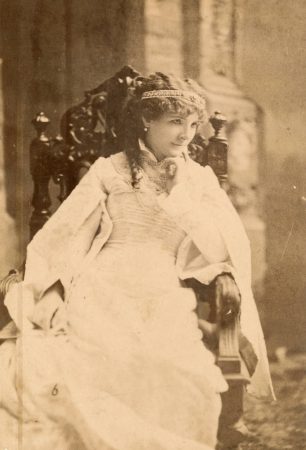
Madame Hortense Rhea, ca. 1893. (Courtesy University of Washington Special Collections, Order No. JWS13469)
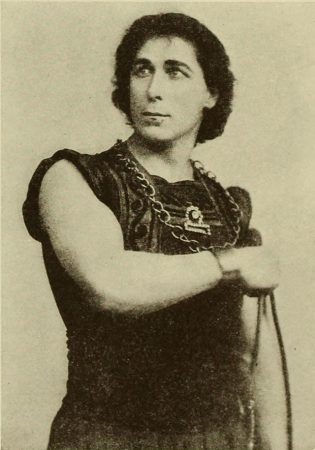
William S. Hart as Messala in "Ben Hur," ca. 1907. (Photoplay, April 1921, Page 47)
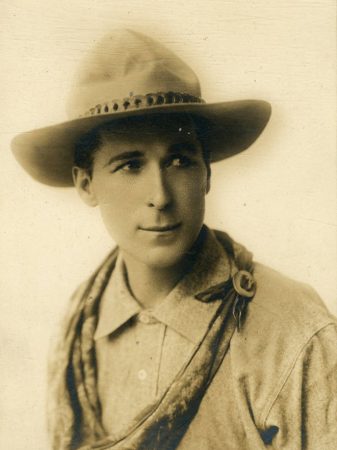
Cowboy stage actor William S. Hart, ca. 1908. (Courtesy University of Washington Special Collections, Order No. 16177)
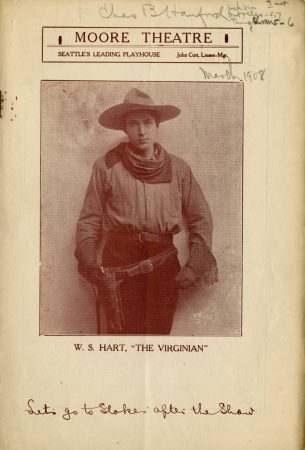
Moore Theatre program, week of March 5, 1908. (Courtesy University of Washington Special Collections, Digital ID No. PAM0574)
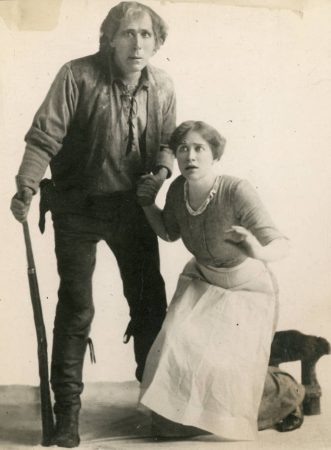
William S. Hart and Charlotte Walker in "The Trail of the Lonesome Pine," 1913. (Courtesy University of Washington Special Collections, Order No. JWS18067)
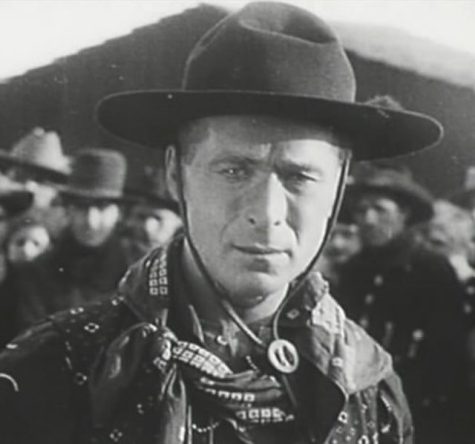
William S. Hart in "Hell's Hinges" (Triangle, 1916).
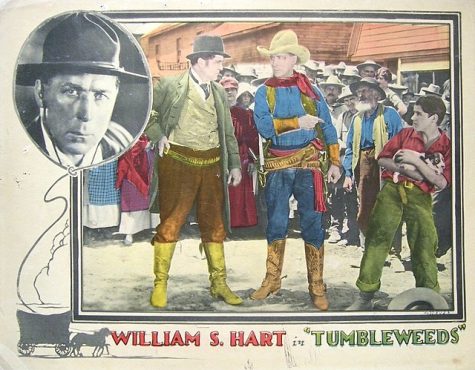
Lobby card for William S. Hart's final motion picture, "Tumbleweeds" (United Artists, 1925).
A Race Across the Continent: A Collection of Roadshow Engagements
Act IV: William S. Hart
Yet another silent star with a connection to Dustin Farnum, eventually taking over Farnum’s role in The Virginian, was William S. Hart. Like Farnum, Hart also established himself as a western actor, first onstage and later as one of early cinema’s most popular cowboy heroes. Yet although he eventually found screen success, it was only after spending 20-plus years as a small-time leading man onstage. In fact, Hart made his Seattle debut in November 1893, about six weeks after Lionel Barrymore made his appearance in The Rivals. As a struggling 28-year-old actor, Hart arrived at the Seattle Theatre in a touring production of The Queen of Sheba, a starring vehicle for Madame Hortense Rhea.
William S. Hart was born in Newburgh, New York, in 1865, and though he spent his formative years on the East Coast, his early childhood was colored by memories of traveling the Midwest with his father, a grist mill laborer who hoped of establishing his own milling enterprise.
William S. Hart’s introduction to theatre came during his teens, after the family had returned to the East and he served as a messenger for several Manhattan hotels. After hopes of a military career at West Point were dashed by his lack of education, he turned to life as an actor to support the family. Although his career was lengthy, Hart enjoyed only moderate success onstage and would be almost 50 years old by the time he made his first film. He would, of course, become one of the screen’s most enduring cowboy heroes, bringing an emotional and psychological complexity to films such as Hell’s Hinges (Triangle, 1916) that set his pictures apart from the relatively simple westerns produced by others.
Hart’s first visit to Seattle came less than five years after beginning his stage career. He played only one season (1893-1894) with Madame Rhea, a Belgian-born actress with extensive training in Europe and Russia who became a considerable draw on the American stage in the 1880s. Yet although he played with Rhea only briefly, Hart had fond memories of the actress in his memoirs. “I had some wonderful roles with Madame Rhea – Benedict, Armand Duval, Claude Melnotte, Julian Grey, Pygmalion, Napoleon, and many others,” he wrote in 1929. “She was a delightful woman; never a great actress, but remarkable of training and experience.”[1]
In The Queen of Sheba Hart played the role of Hiram, architect of a temple honoring King Solomon, who falls in love with a picture of a woman being placed in the temple. Believing the woman dead, Hiram offers to forgo his salary in return for the portrait. Solomon consents, with the unusual condition that Hiram also must leave Jerusalem for a specified period. Hiram agrees, but on his way out comes upon the entourage of visiting Queen Tamar (Madame Rhea), Solomon’s bride. Hiram initially thinks she is an otherworldly incarnation of the woman in the picture. But realizing the Queen is truly the woman he’s longing for, and learning that he has also caught her eye, Hiram instead decides to stay in Jerusalem, a move that puts his life in jeopardy as Solomon’s guards attempt to end the budding love affair.
William S. Hart was billed a prominent second behind Madame Rhea, whose local appearance (her fourth and final in the Northwest) drew some of the city’s most prominent citizens.
Since the issue of the Seattle Press-Times with reaction to the play appears to no longer exist, the only local viewpoint comes from the Post-Intelligencer, which observed that the opening night crowd took a while to warm up. “The Queen of Sheba, as presented by Mademoiselle Hortense Rhea and her company at the Seattle theater last night, won the plaudits of an unusually critical audience,” noted the paper, “for the drama which was received with mild interest at the opening, closed with an outburst of genuine enthusiasm – the best possible tribute to the genius of the leading actress and the strength of her support.”[2] Calling her the “ideal” queen, the Post- Intelligencer was even willing to overlook the fact that Madame Rhea apparently retained her heavy French accent throughout what was, ostensibly, a Biblical play.
Nearly everyone benefited from the positive reaction to The Queen of Sheba. “The next best part after that of Tamar is naturally that of Hiram, and is well sustained by Mr. W.S. Hart. Gifted with a fine, manly form, an expressive face and a voice capable of deep expression, he sustained the part to perfection, and worthily shared in the honors the play won. A more realistic vision of a man intoxicated with love for a woman he had never seen has not been presented than that which he gave of Hiram as he rhapsodized over the picture of Tamar.”[3]
Based on previous visits to the city, Madame Rhea used her weeklong stay to renew old acquaintances. Several receptions around town were held in her honor – one, in particular, by prominent society ladies at the Rainier Hotel. An unidentified Post-Intelligencer reporter was invited to this event and was able to augment the paper’s review with a bit of Rhea’s thoughts on Seattle.
“When here I feel that I am at home,” said she. “And I think I have some right to the feeling, for I own twenty acres of real estate here. I have two homes, one in Paris and the other in Seattle, and all the way between the two I have boomed Seattle, and tried to make it as well known as my other home. Ah, it is a long time since I was here last, but you cannot imagine how often Seattle has been in my thoughts and on my lips since then. And has the city prospered so much as I hear it has? It seemed so full of life on the streets, while the rest of the country is so dead, that I hardly dared to trust my senses…
“The theater I played in [on my previous visit] was a very queer place, and it seemed that our heads almost touched the ceiling. But it was packed with an appreciative audience, and you know that is more grateful to an actress’ heart than a grand stage, beautiful scenery and spacious dressing rooms if the ‘house’ be [sic] small and cold. I like the people of the West. Nothing seems to daunt them, and unfavorable conditions seem to excite their energies the more.”[4]
The Rhea company, which came to Seattle directly from an engagement in Spokane, was slated to move south to Tacoma for a pair of performances on Thanksgiving Day, 1893, after which they presumably continued down the coast to Portland.
It would be nearly 10 years before William S. Hart would again tour the Pacific Northwest, but ironically his return did not find the actor appearing in Seattle. Instead, Hart was replaced as the lead in a road show production of Hall Caine’s The Christian, and on the eve of the play’s opening at Seattle’s Grand Opera House.
According to the actor’s memoirs George Tyler, head of the then-struggling Broadway firm of Leibler & Company, offered Hart a role opposite Viola Allen, late of the Frohmans, in The Christian. The story centered on a man of the cloth, John Storm, whose lifelong feelings for the young Glory Quayle tempts him to abandon his beliefs (and possibly commit homicide) when he discovers her purity in jeopardy. Tyler offered Hart the plum role of John Storm, playing opposite Viola Allen’s Glory Quayle, but Allen – the bigger stage name – had other ideas. She went to the Frohmans and convinced them that the role of Storm would be the perfect vehicle for their own leading man, Edward Morgan, and arranged to have them loan Morgan to the Leibler organization. William S. Hart thus found himself out of a job, but after attending the opening night performance in Albany, New York, even he had to admit that Morgan carried the show, despite the fact that The Christian was designed as a vehicle for Viola Allen.[5] George Tyler would again offer the part of John Storm to Hart when Edward Morgan eventually left the show, but a conflicting engagement forced him to decline.
Still, William S. Hart would one day get his chance to play John Storm in The Christian. When the decision was made to tour with the play, the Leibler organization put together two road show companies for the circuits – an “A” company for the East, re-engaging Edward Morgan and pairing him with Elsie Leslie (Viola Allen having moved on), and a “B” company for the West that featured William S. Hart and Lillie Vane as the protagonists.[6]
It was on this tour, in 1902, that Hall Caine’s The Christian opened in Seattle, beginning a four-day engagement at the Grand Opera House on March 10th.[7] Yet although the locals were slated to see the Leibler’s “western” company enact the play, neither Hart nor Vane arrived with the show. Ironically, for the second time, Hart lost the part of John Storm to Edward Morgan, who by the time of the Seattle engagement had closed his tour on the East Coast and was sent westward to take over the second company. This change in personnel occurred following the Vancouver, British Columbia, engagement, which ended a mere two days before the play was to hit Seattle.
In the days leading up to his replacement, however, William S. Hart had been proving himself more than capable as John Storm. Just a week before the show arrived in Seattle, The Christian made a two-day stop at the Spokane Theatre, opening on Monday, March 3, 1902, where The Spokesman-Review found the performer anchoring a worthy production. “W.S. Hart,” they observed, “who played the part of John Storm, is deserving of all commendation. His part is strictly an emotional one, and he throws into it all the strength and fire of a strong personality. There is scarcely a weak point in his acting. Its chief charm is in its perfect naturalness and its entire lack of melodramatic effect.” Although the paper lamented a rather sparse opening night crowd and some deficiencies amongst the cast (among them, Lillie Vane’s lack of conviction as Glory Quayle), they concluded that “(l)aying aside the errors of some of the company, Mr. Hart’s acting sufficient to make The Christian well worth seeing.”[8]
In contrast, when the show arrived in Tacoma for its next engagement, on March 6th, the reviewer for the Evening News found both leading players “not quite up to standard. W.S. Hart’s John Storm and Miss Vane’s Glory Quayle each lacked the divine fire and there was ever present the consciousness that they were ‘acting’ their parts.”[9] William S. Hart’s final efforts in The Christian, however, engagements in Victoria and Vancouver, British Columbia, provided redemption. In Victoria, a one-night stand on Friday, March 7, the actor “took the part of John Storm to perfection,” according to the Daily Colonist, “and judging from the applause given him last night, has made himself popular in Victoria.”[10] In Vancouver, a single evening spent at the Vancouver Opera House, the Province took issue with Hall Caine’s play and the performance of Lillie Vane, but Hart prevailed on his last night with the company “despite the almost necessary ranting entailed by his part.”[11]
Regardless of William S. Hart’s success in portraying John Storm, however, period audiences were keen to see Edward Morgan enact his famous role – the Seattle engagement in The Christian, in fact, was Morgan’s first appearance in the city.[12] The production earned tremendous praise (the Daily Times called The Christian “a play for high foreheads”), and although Seattle audiences missed their opportunity to see a future Hollywood star, few would have minded given Edward Morgan’s excellence. “Morgan was in perfect form last evening,” gushed the Daily Times, “and gave a sympathetic and very sincere characterization of the leading role in the piece. He doesn’t act John Storm; he is John Storm, heart and soul, and it would be very hard to note the slightest lapse from the character during the entire performance.”[13] The Star concurred. Noting that Morgan earned three curtain calls following the prologue alone, Seattle was delighted by its first look at the popular actor. “Mr. Morgan is a strong and natural actor, full of blood and virility, easy and graceful in his stage manners, and at all times delightful to listen to. His sonorous voice is his fortune, or, rather, the greatest of his many good fortunes. It would be a treat to hear E.J. Morgan read a page from the Congressional Record.”[14]
William S. Hart’s departure from The Christian tour in 1902 was a (temporary) blow to his fortunes. “We closed our tour in Vancouver the latter part of March – it had been a short season,” he recalled 30 years later. “And when just my railroad ticket was handed to me and no sleeper accommodations for the long return trip [to the East], I put on a blue flannel shirt, bought some crackers and cheese, rode in the smoker, and roughed it going home. What money I had I needed badly.”[15]
Hart didn’t actually reappear in Seattle for many years following his turn opposite Madame Hortense Rhea in 1893, although in the interim he pounded the boards with several companies. The Christian, of course, was one of them, but he was known to have had stints with troupes supporting Daniel E. Bandmann, Julia Arthur, and Madame Helena Modjeska, all of whom made several Northwest visits throughout their careers, though not with Hart as a member of their company. He also originated the role of Messala in one of the period’s most durable stage productions, General Lew Wallace’s Ben Hur; his stage work even earned him a personal compliment from Wallace himself, an honor Hart claimed to share with no other actor in the production.
The Ben Hur engagement was a long and successful one for William S. Hart, but another that never brought him to Seattle. Even so, in the 15 years between his first and second appearances there, he managed to find a valuable niche on the stage, aided by the public’s fascination with the closing of the American frontier. Hart, drawing from his childhood experiences in the Midwest, eventually built his theatrical name in the cowboy roles that had become increasingly popular at the time – characterizations he would eventually bring into motion pictures.
While any number of western-themed plays crowded the American stage in the first decade of the 20th century, one of the most popular was Owen Wister’s The Virginian. Adapted from the novel, The Virginian quickly became one of the country’s biggest touring shows – a response to the popularity of Wister’s best-seller, not to mention the works of other period fiction writers such as Rex Beach and Zane Grey. Exclusive rights to the stage production were secured by the Kirk LaShelle Company, and after the show proved a tremendous smash in New York – catapulting its stars, Dustin Farnum and Frank Campeau, to national fame – the LaShelle organization quickly put the show on the road.
By the time William S. Hart assumed the title role from Farnum, who toured the country for at least three seasons in the play, The Virginian had already appeared in Seattle twice, in 1905 and 1907. Even so, audiences never seemed to tire of the production – all told, the LaShelle Company brought The Virginian to Seattle five times in a span of six years, and while casts varied from show to show, four of those engagements featured performers with later connections to the early motion picture industry.
The company headed by William S. Hart arrived in Seattle in March 1908.[16] The third local engagement of the production, the show played a weeklong stint at the Moore Theatre; Hart was the lone casting change amongst the principal actors who appeared with Dustin Farnum at the Grand Opera House the year before. The actor thus had the task of playing not only the leading man but drawing inevitable comparisons between his own work and Farnum’s – difficult considering Farnum’s overwhelming success in the part. For evidence of this, perhaps, one had only to look at the program for the Moore engagement. Although the cover clearly indicates “W.S. Hart, The Virginian,” the photo gracing the program is that of Dustin Farnum, a still left over from one of his two previous visits.[17] That the LaShelle people recognized the difficulty of Hart’s undertaking was evidenced by the considerable publicity given the tour throughout the season, even though The Virginian had already played the country several times over.
The play itself contained elements of typical western fare – in this case, the trials of an honest rancher pitted against the local bad man – but also focused on the romance between the Virginian and the character of Mollie. Mollie is a New England schoolteacher who comes to Wyoming Territory and meets the Virginian after he rescues her from a runaway stagecoach.
Despite being familiar to theatregoers, the play once again opened to excellent critical reception. Yet by this, the show’s third appearance in Seattle, it wasn’t the title character carrying the production, but rather the villainous Trampas, portrayed by Frank Campeau, who firmly held the spotlight. This was a suggestion, perhaps, that the play had been slightly re-tooled following Dustin Farnum’s departure.
Of course Frank Campeau runs away with the performance. He is a great favorite in Seattle, and one of the best actors on the stage today. His “Trampas” will take its place in stage history side by side with his “Tom” in Pudd’nhead Wilson and his “Tony” in Arizona.
W.S. Hart is eminently satisfactory as “The Virginian.” Comparison between his work and that of Dustin Farnum, who created the part, is almost impossible, owing to the fact that Mr. Hart is undoubtedly hampered by tradition. Mr. Farnum’s advantage over Mr. Hart is probably due simply to the fact that “he saw it first.”[18]
The Post-Intelligencer, while lamenting the glut of western plays being produced at the time, greeted the show with genuine enthusiasm, and like the Times was sympathetic to the difficulty of Hart’s undertaking. Interestingly, almost seven years before he would leave the footlights altogether, their reviewer observed qualities in Hart’s stage work that eventually made him one of the greatest screen cowboys of all time. “There is an absence of the matinee idol’s smile in the Virginian which Mr. Hart delivers, but there is compensation in the manly way in which he goes at his work, without any suggestion that the part bores him. It is a hard job to follow in the footsteps of the original in any part, and the character of the Virginian had grown so closely to the reputation of Mr. Farnum as an actor that something of a task was assigned to Mr. Hart when it was offered him. He succeeds very well in a role that has at all times the sympathy of the audience and he looks the cowboy as well as anyone.”[19]
Surprisingly, the Seattle Star found William S. Hart’s version of The Virginian better than Dustin Farnum’s, though they failed to cite their rationale.
With all the vital interest that marked the original, The Virginian returned to the Moore theatre last night for a week’s run, and a large, enthusiastic house, which called for repeated curtain calls at the end of each act, showed that this western Kirke La Shelle production has lost none of its popularity.
W.S. Hart, the new Virginian, succeeds very well in the role which Mr. Farnum originated. Mr. Hart looks and acts the cowboy splendidly, and to many gives a better interpretation than did the original.
Frank Campeau is still in the cast, and his reckless, dare-devil character of Trampas is both admirable and disagreeable. Admirable in the excellent manner acted, and disagreeable in its villainous nature.[20]
Despite the inevitable comparisons to Dustin Farnum and the appeal of Campeau’s work, the elevation to star was no doubt gratifying for William S. Hart, considering the production itself wasn’t his personal favorite. As an actor who adamantly touted the accuracy of his western characterizations (stage and screen), Hart gently complained in his memoirs that many situations in Owen Wister’s play were patently false.
I loved the part of The Virginian. It’s a beautiful story and a wonderful play – a monument to the fact that a truly great writer can make the moon look like green cheese and get away with it. But I am afraid I offended Owen Wister and lost his friendship in saying so.
Owen Wister was a wonderful writer. His stuff was human, simple, and delightful. He loved the West. He loved to write of the West…
Perhaps I should have remained quiet, but I couldn’t and didn’t. The truth of the West meant more to me than a job and always will! I never sought to offend any one [sic], I never said my little say publicly, but I said it privately and to Mr. Wister, personally.
Fundamentally, the book, the play of The Virginian, as far as the West is concerned, is at variance with cowboy life as I knew it.[21]
Of course, Hart wasn’t the only acquaintance of Owen Wister’s offering his two cents about The Virginian. Another, more favorable endorsement came from one of the playwright’s personal friends, President Theodore Roosevelt, who spoke highly of the author’s work in his autobiography when recalling his own frontier adventures during the mid-1880s. “I have been sometimes asked if Wister’s Virginian is not overdrawn,” the former President noted; “why one of the men mentioned in this chapter was in all the essentials of the Virginian in real life, not only in his force but in his charm. Half of all the men I worked with or played with and half the men who soldiered with me afterwards in my regiment might have walked out of Wister’s stories or [Fredrick] Remington’s pictures.”[22] (One wonders if the “unidentified” man wasn’t Roosevelt himself.)
Despite reservations about the material, William S. Hart managed to make a name for himself playing in The Virginian; the notoriety helped put him in demand, particularly for western plays. The following season, in fact, found him playing Dan Stark in Rex Beach’s The Barrier and, later, Cash Hawkins in The Squaw Man, neither of which brought him to Seattle. But Hart returned to the Puget Sound area for the last time as a stage actor in November 1913, touring with yet another western production, this time supporting Charlotte Walker in The Trail of the Lonesome Pine. The actor essayed the role of “Devil” Judd Tolliver in a weeklong engagement at the Metropolitan Theatre.[23]
The play was adapted from John Fox, Jr.’s hugely popular novel, and focused on a pair of Easterners looking to develop a mining operation in the Cumberland foothills on land dominated by two long-feuding families. A mountain girl named June is in the middle of this dangerous mix, who serves as the object of affection not only for Hale, one of the engineers, but also for Dave Tolliver, the youngest son of the Tolliver clan. The resulting competition for her hand almost turns deadly, and although Hale and June are ultimately married, Dave – who is very nearly implicated for murder – is spared by the kindness of Hale’s business partner, Berkley.
Hart remembered that he first won the role of Judd Tolliver, a part “an actor could not go wrong in,” after the player who had been originally cast passed away before the show opened.[24] Hart stepped in and won accolades for his work, although he gave up the role before the show went on an extended tour, opting to pursue other projects. However, Klaw and Erlanger, the show’s producers, negotiated for Hart’s return midway through the tour, and he eventually signed on for two additional seasons in the road production.
For a display of his own talents, The Trail of the Lonesome Pine must have been a bit of a disappointment. Charlotte Walker, as June, dominated reviews of the play, so much so that the Seattle Star ran their entire critique without mentioning that there was anyone supporting her. Although much of their review was a simple plot summary, the Star’s opinions (limited as they were) were wholly positive. “From every standpoint, the play, which drew a capacity house at the Metropolitan Sunday night and will run all week, is one of the most delightful of the season. Scenically, it is there with a large sized punch. Histrionically, Charlotte Walker is an artist of true stellar caliber. Dramatically, it is a love story that is wonderfully poetic.”[25]
Although devoting much more space to the production than the Star, the Post-Intelligencer chimed in with a rather bland review of The Trail of the Lonesome Pine. Aside from recounting the plot and mentioning a few of the actors in passing, all they could add was that Charlotte Walker was “simple, unaffected and altogether delightful.”[26] J. Willis Sayre was far more descriptive in the Daily Times.
Seattle renewed acquaintance last night with a very alluring personality, belonging to Charlotte Walker. She had not been seen here before or since, at the beginning of her important stage work, she came here twelve seasons ago as the school teacher in Sag Harbor…
The Trail of the Lonesome Pine does not strike any such wonderful new lead as Eugene Walter [who adapted the novel for the stage] developed in his masterpiece, Paid in Full…[But e]veryone will go away from The Trail of the Lonesome Pine satisfied that he has had an enjoyable evening. The play will do an enormous business here because it strikes the chord of popular sympathy and because it is clean and wholesome and everyone who sees it will tell everyone else about these things…
It will not be easy, when Charlotte Walker moves on to newer conquests, to find a successor who can stand comparisons with her in the role of June, for she fits all of its phases with exactness…Charlotte Walker is very much of the success of [the play].”[27]
Unfortunately, Sayre wasn’t half as enthusiastic about Walker’s co-star. “W.S. Hart,” he noted, “an admirable and experienced actor, is a bit too staccato in his third act melodrama; suppressed intensity would have been Judd Tolliver’s way of gaining his point rather than much physical action.”
William S. Hart, obviously, wasn’t one of the show’s primary draws. In fact, excitement over the Seattle engagement of Lonesome Pine not only centered around Walker’s appearance, but also the appearance of her spouse. Eugene Walter, Charlotte Walker’s husband and the man who had adapted the Fox novel for the stage, had once been a journalist in Seattle before becoming a playwright. His arrival marked his first visit to the city in over a decade and the press, accordingly, treated him as the local boy who made good. Walter split his time between the Daily Times and Post-Intelligencer, offering each a different perspective on his stay. He told J. Willis Sayre, for instance, that he couldn’t resist making the trek up from San Francisco to see the old town again. Meanwhile, in the Post-Intelligencer, Eugene Walter offered some extended thoughts on Seattle past and present.
When I was doing newspaper work in Seattle ten years ago this was a picturesque city. It was rough, crude, primitive, but fascinating. There were hotels in those days of all shapes, sizes and complexions. Strange bearded men came out of the North and paid their scores in gold dust poured from greasy pokes. There was open gambling on the streets and a picturesque “dead line.” It was a town full of strange oaths and wide latitude. I find it today flattened out, closed, orderly, topographically as though someone had run an iron over it. The hotels are just like the hotels in all the great cities. The streets, buildings, lights, people are all stamped with the same convention…It is no doubt a great city, but I liked the old town best.[28]
Despite slightly disappointing notices for the actor while in Seattle, William S. Hart had an ulterior motive for making this particular tour of The Trail of the Lonesome Pine – one that puts his 1913 appearance very near a turning point in his career. Already his interest had been piqued by motion pictures, which was based in part, he claimed, on a visit to a Cleveland movie house where he witnessed a crude western photoplay. “Here were reproductions of the Old West being seriously presented to the public – in almost a burlesque manner – and they were successful,” he recalled in his autobiography. “It made me tremble to think about it. I was an actor and I knew the West…The opportunity that I had been waiting for years to come was knocking at my door.”[29]
Hart spent three seasons on the road with The Trail of the Lonesome Pine, and claimed in his autobiography that he agreed to the final season – 1913-1914, the tour which brought him through Seattle – only because the company was scheduled to make its way through California, where Hart wanted to make contacts in the movie industry. He was fortunate that many former theatrical people were, by then, moving into pictures. Hart’s connection was through Thomas Ince, head of the New York Motion Picture Company studio near Santa Monica (soon to be known as “Inceville”), with whom he had once toured in the 1903 stage production Hearts Courageous.[30] Judging from the path of the Lonesome Pine tour, it appears that Hart had already met up with Ince by the time the troupe arrived at the Metropolitan. The week prior to their Seattle engagement the show played Portland, later turning up around Thanksgiving for a one-day appearance in Tacoma. The show likely ventured up into Canada for the remainder of the week, after which it finished out the month of November with engagements in Spokane. Based on this schedule, it appears that the troupe was heading northward up the coast and then took an eastward swing through Montana and the upper Midwest.
Despite a glut of western films being made at the time, William S. Hart must have been convincing during his brief studio visit, for after the Lonesome Pine tour was completed in the summer of 1914, he headed straight for California to begin his motion picture career. It was a move that paid off in a big way for the actor. “Audiences found Hart’s ‘two-gun man’ protagonist a serious characterization, and the most authentic embodiment yet of frontier virtues in the movies,” Diane Kaiser Koszarski has noted. “America during the period of the Great War hungered for moral passion; Hart delivered it on screen. His work, especially in the teens, strengthened the dramatic value of the Western as a film genre, and at its zenith his stardom was equal that of Chaplin, Pickford or Fairbanks.”[31] In a historical sense, Hart’s screen influence was even more far-reaching. As Jeanine Basinger noted in her book Silent Stars, elements of his screen persona can readily be seen in the characterizations of John Wayne, Gary Cooper and Clint Eastwood. “William S. Hart is the grandfather of all cowboy heroes, and although there were some before him and many after him, his particular brand of taciturn hero who lived a tough life, spoke little, and did what he had to do – but always by a particular code of honor – is still our most familiar definition of a western movie hero.”[32]
Hart’s ability to draw audiences waned after World War I, though he continued to act and had a tremendous “comeback” success with the western Tumbleweeds (United Artists, 1925), his final motion picture. He was one of the screen’s first cowboy heroes but was gradually passed over in the 1920s by a new generation of moviegoers who wanted a less cerebral version of the West, one depicted in the cowboy pictures made by Tom Mix, Hoot Gibson and Harry Carey, among others. William S. Hart passed away in 1946.
By Eric L. Flom – January 2026
Notes:
[1] William S. Hart, My Life East and West (New York: Houghton Mifflin Company, 1929), Page 123.
[2] “Ovation for Rhea,” Seattle Post-Intelligencer, 28 November 1893, Page 8.
[3] Ibid.
[4] “Ovation for Rhea,” Seattle Post-Intelligencer, 28 November 1893, Page 8. Madame Hortense Rhea had last played Seattle in June 1890, a two-day engagement at Turner Hall in Josephine, where she essayed the title role. (See program, Turner Hall [3 June 1890], J. Willis Sayre Collection. In the absence of an original, J. Willis Sayre typed his cast list from an unknown source.) With respect to Madame Rhea’s property claim, record searches conducted by the King County archives and the Washington State archives could not uncover evidence of the actress having been a property owner in Seattle or the outlying area after 1880.
[5] Hart, Pages 141–144.
[6] Interestingly, Viola Allen’s latest effort at the time, In the Palace of the King, played the Grand in Seattle for three nights immediately preceding the arrival of Edward Morgan in The Christian.
[7] The Christian’s arrival at the Grand Opera House in 1902 was not the first Seattle visit for the show. A year earlier, in February 1901, the Leibler organization brought the “original” western touring company through the Pacific Northwest, a three-day engagement that played the Seattle Theatre. Lionel Adams played John Storm for this version, with Julia Stuart essaying Glory Quayle. (See program, Seattle Theatre [4 February 1901], J. Willis Sayre Collection.) The Christian was such a popular selection that between road show and stock versions the play turned up in Seattle nine times in the first 11 years of the century. (See “Play Index,” J. Willis Sayre Collection.)
[8] “The Christian Last Evening,” The Spokesman-Review (Spokane, Washington), 4 March 1902, Page 5.
[9] “At the Theatres,” Tacoma Evening News, 7 March 1902, Page 7.
[10] “The Christian,” Victoria Daily Colonist, 8 March 1902, Page 3.
[11] “The Christian,” Vancouver Province, 10 March 1902, Page 3.
[12] In the midst of the Edward Morgan’s engagement in The Christian, The Argus made a curious notation about the tour in their editorial column. “The Christian has been working its way West and advertising Mr. Morgan and Miss Leslie, while all the time those two artists were playing in the East, with the Eastern company, under the same management…W.S. Hart and Lillie Vane were the artists who took the leading roles with the Western company. However, so long as the Western critics thought it was the finest thing that ever happened no harm was done.” (“Editorial Notes,” The Argus, 15 March 1902, Page 1.) The notation is strange in that for the Spokane, Tacoma, Victoria, and Vancouver engagements – all coming in the week prior to the show’s Seattle debut – advertisements for The Christian did not announce that Morgan would be playing the title role, as they allege. It was only beginning in Seattle, were Morgan finally joined up with the western troupe, where publicity campaign was altered.
[13] “Scored Splendid Triumph,” Seattle Daily Times, 11 March 1902, Page 7.
[14] “The Christian,” Seattle Star, 11 March 1902, Page 3.
[15] Hart, Page 157.
[16] Interestingly, J. Willis Sayre offered a few comments on how best to promote the 1908 engagement of The Virginian with Seattleites – he was apparently wearing both his critical and publicity hat while writing for The Argus. “I have suggested to the advance man of The Virginian that he get that haunting moledy [sic] that runs through the piece, ‘Ten Thousand Cattle Straying,’ into the form of a special edition, to be distributed as a souvenir at certain performances of the play. The thing will be done, and if the music can be prepared in time the first of the souvenirs will be issued during the Seattle run of the play.” (J. Willis Sayre; “Seven Days of Stage Happenings,” The Argus, 7 March 1908, Page 6.) It does not appear that Sayre’s suggestion came to being, at least not in Seattle. His notation is the only mention of a possible giveaway during the show’s local engagement.
[17] Program, Moore Theatre (8 March 1908), J. Willis Sayre Collection.
[18] “The Virginian as Good as Ever,” Seattle Daily Times, 9 March 1908, Page 9.
[19] “The Virginian at the Moore,” Seattle Post-Intelligencer, 9 March 1908, Page 12.
[20] “The Virginian,” Seattle Star, 9 March 1908, Page 3.
[21] Hart, Pages 175–176.
[22] Theodore Roosevelt, An Autobiography (New York: The MacMillan Company, 1913), Page 133.
[23] Cecil B. DeMille made a five-reel film version of The Trail of the Lonesome Pine (1916), with Charlotte Walker recreating her stage role, while a 1923 Paramount remake was the final picture of Mary Miles Minter’s career. The picture was again remade for Paramount in 1936, with a cast that featured such diverse personalities as Henry Fonda, Fred Mac Murray and Spanky McFarland.
[24] Hart, Pages 192 and 194.
[25] “Metropolitan,” Seattle Star, 10 November 1913, Page 5.
[26] “Lonesome Pine Fine Love Tale,” Seattle Post-Intelligencer, 10 November 1913, Page 7.
[27] J. Willis Sayre, “Fine Drama is Sent by Klaw & Erlanger,” Seattle Daily Times, 10 November 1913, Page 4.
[28] “Eugene Walter in Town Again,” Seattle Post-Intelligencer, 10 November 1913, Page 7. Walter’s observations on Seattle’s topography likely refers to the most extensive public works project undertaken in the city’s history. With a downtown section built at the base of a steep slope, in 1902 city engineers, led by R.H. Thomson, began sluicing several million cubic feet of Denny Hill into Elliott Bay in an effort to flatten the landscape and allow for future growth. The undertaking was but one of many regrading projects that served, from a business and engineering standpoint, to better utilize the terrain and provide for the city’s long-term development. (Earlier, after the fire of 1889, a group of citizens failed to convince local merchants to rebuild south of the original downtown, on ground that was more naturally flat.) With respect to the Denny Hill regrade, the project paid off in a big way for local landowners, who saw their property values soar after the terrain became more pedestrian-friendly. (Roger Sale, Seattle, Past to Present [Seattle: University of Washington Press, 1982], Pages 75–76.)
Located just north of the original city center, this leveled portion of Seattle eventually became (and remains) the center of the shopping district. The sluiced area also attracted many local amusement houses, primarily Seattle’s early movie theatres, which took advantage of the increased pedestrian traffic.
[29] Hart, Pages 198–199. Despite William S. Hart’s insistence that his own films were a wholly authentic representation of the American West, a good deal of creative license was employed in the construction of his photoplay scenarios. Of the Thomas Ince/William S. Hart westerns produced through the World War I era, historian William K. Everson has observed that these pictures “presented an onscreen frontier that was pictorially almost documentarian, but was dramatically and emotionally an evocation of the West that should have been.” (William K. Everson, from Before Hollywood: Turn of the Century American Film [New York: Hudson Hills Press, 1987], Page 154.)
[30] Diane Kaiser Koszarski, The Complete Films of William S. Hart (New York: Dover Publications, 1980), Page xii.
[31] Ibid., Page ix. Koszarski’s thoughts were similar Hart’s own in 1917, when he reflected on his own popularity in an interview with the trade paper Moving Picture World. At the time, the actor was traveling the country on a personal appearance tour. “‘It is difficult for one to conceive the greetings that have been extended to me, the warmth of them,’” the actor noted of the throngs waiting for him at each stop. “‘I can’t understand them, unless it is because I have been portraying a phase of life, that of frontier days, in which there is such a wide interest. I am not egotistical enough to think that they are for me, but rather for what I have been permitted to represent.’” (William H. Hart to George Blaisdell, “Bill Hart Hits the Great White Trail,” Moving Picture World, 2 June 1917, Page 1422.)
[32] Jeanine Basinger, Silent Stars (New York: Alfred A. Knopf, 1999), Page 180.
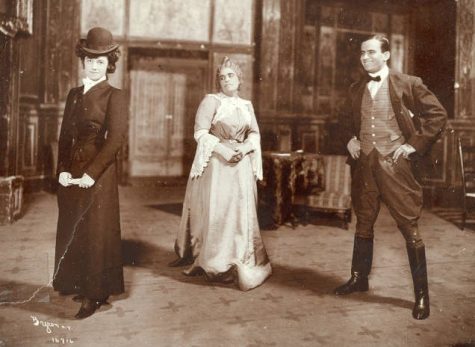
Young stage actor Douglas Fairbanks, right, ca. 1905. (Courtesy University of Washington Special Collections, Order No. 20445)
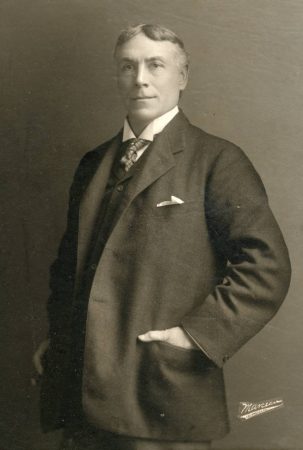
Stage actor Frederick Warde, ca. 1906. (Photo by Marceau Studios, courtesy University of Washington Special Collections, Order No. JWS29454)
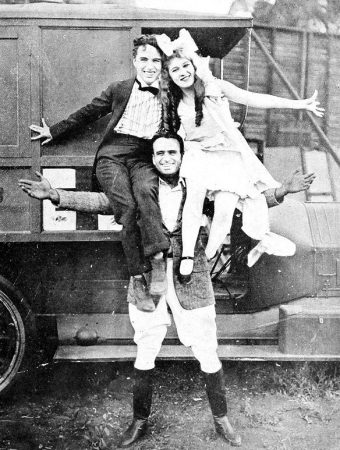
Publicity photo featuring Douglas Fairbanks supporting Charlie Chaplin and Mary Pickford, ca. 1919.
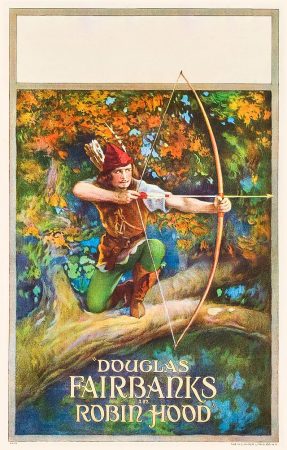
Film poster for Douglas Fairbanks' "Robin Hood" (United Artists, 1922).
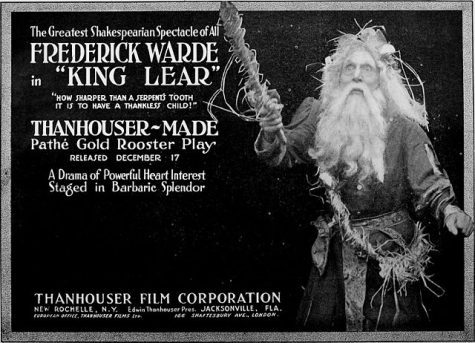
Advertisement for Frederick Warde in film version of "King Lear" (Thanhouser, 1916).
A Race Across the Continent: A Collection of Roadshow Engagements
Act V: Douglas Fairbanks
Most stage performers of the era weren’t as fortunate as William S. Hart, who eventually latched onto a trademark persona that made him a natural choice for western roles onstage and, later, onscreen. The typical actor spent an entire career looking for a combination of skill, a plum role and a little luck (not necessarily in that order) that would vault his or her name to the top of the marquee. Audacity was also a plus. Legend has it, for example, that when a teenaged Douglas Fairbanks decided to go into show business, he got himself recognized by scaling the outside of a theatre where actor Frederick Warde was engaged, breaking into his dressing room and pleading to be hired. It’s a highly suspect account – almost certainly a publicist’s effort to concoct an origin story using Fairbanks’ athletic screen image. More credible sources indicate that the influence of Fairbanks’ early drama teacher, Margaret Fealy, helped the young man get on with Warde’s company; Warde himself would recall that Douglas Fairbanks introduced himself after a lecture the actor had given.[1] But, regardless of the circumstances, the meeting with Frederick Warde provided a much-needed opportunity for the aspiring young actor.
Fairbanks was born Douglas Elton Thomas Ulman in Denver, Colorado, on May 23, 1883, one of two sons his mother Ella bore with her third husband. Douglas’ father abandoned the family when he was only five, after which Ella resumed using the last name Fairbanks, the name of her first husband, who had died from tuberculosis.
Fairbanks went through high school in the Denver area, acquiring a fondness for the stage, and after graduating embarked for the East Coast to begin a career in theatre. It was there that he linked up briefly – two seasons – with noted classical actor Frederick Warde. And it was during this apprenticeship that the future motion picture star put in two Northwest appearances, both at the Seattle Theatre in 1900, when Douglas Fairbanks wasn’t even 18 years old.
The English-born Frederick Warde would himself have a brief career in motion pictures, but at the time he was primarily known for his interpretations of Shakespeare.[2] Yet unlike other notables of the period, Warde’s fame did not rest solely on a handful of acclaimed performances in the East. Instead, by 1900 his reputation was at least partially based on his constant touring schedule, which found him a regular visitor to stages all across the country, particularly in the West. The visit to Seattle in 1900, for instance, was Warde’s 10th appearance there since 1877.[3] A notice from the Daily Times reflected the city’s admiration for Warde and his “annual” visits.
Year after year for the past two decades Seattle has been visited by the eminent actor Frederick Warde. Since his first appearance in this city there has been a constant improvement in the general excellence of his entertainment, brought about by his principle of progress.
During the early stages of his starring tours Mr. Warde traveled practically alone, and in this time established himself as the most favored actor of the West. But Warde is not a man to be satisfied with personal laurels. Probably no other actor has done so much for the advancement of his profession as has this scholar. Years ago he foresaw the time when the public would not be content to patronize a star alone and sit patiently through the rantings of an inferior company. Gradually he associated himself with companies and combinations which in their day stood in the first rank. Mr. Warde does not believe that the ordinary actor is a bad one, but does reason that so long as there are better actors, these persons should be selected to care for the details of the play, to make their individual roles a study and creation. This season he has culminated his ambition, and now stands at the head of an organization which is said to be the strongest got together since the days of the famous [Edwin] Booth and [Lawrence] Barrett combination.[4]
In addition to Douglas Fairbanks, Warde also brought along his daughter May as a member of the company, which arrived (according to their own publicity) with two railroad cars of scenery and four specialized mechanics to assemble it.[5] Though youth and inexperience limited Fairbanks to relatively insignificant roles within the troupe, at the very least he was learning from the likes of Warde, an old-school performer whom the Post-Intelligencer lauded as “America’s foremost actor in heavy plays.”[6]
On January 22, 1900, Frederick Warde began a three-day engagement of classic and romantic offerings with The Lion’s Mouth by Henry Guy Carleton, who had also written A Gilded Fool, a popular hit for comedian Nat C. Goodwin. On January 23rd the troupe gave Romeo and Juliet (with Fairbanks in the role of Balthazar), and closed the following day with The Duke’s Jester, playing in place of the announced Richard III.
Warde, based on his previous Seattle visits, was a favorite with local audiences. Accordingly the opening night reception to The Lion’s Mouth, a romance set against political intrigue in Renaissance Italy, was particularly enthusiastic, not the least of which because the actor – one of the more renowned members of the Elks Club (a member of the St. Louis chapter) – could count on a spirited response from fellow members wherever he played. Seattle was no exception. “Actor and audience struck warm palms of friendship across the footlights of the Seattle Theatre last night,” noted the Daily Times. “Frederick Ward [sic] and Mrs. Minnie Tittle-Brune presented a beautiful play, well mounted and finely acted; and the Elks of Seattle showered such an ovation upon them as our cozy theatre sees but once or twice in a season.”[7] The Post-Intelligencer also had positive comments about the show, though the audiences’ enthusiasm tended to color their review.
Mr. Warde has had reasons on his several visits to this city to appreciate the high esteem in which he is held here, not only as an actor, but also as a particular favorite of the local B.P.O.E. The high regard of the Seattle members of that organization was evidenced last night when at the close of the third act the curtain was raised in response to a prolonged burst of applause and Judge [William Hickman] Moore appeared upon the stage to present Mr. Warde an ornate silver loving cup on behalf of the local lodge. Judge Moore said:
“Brother Warde, the English speaking people and particularly those of the Pacific coast of the United States recognize you as a man of the highest literary attainments and one of the most capable exponents of your honorable profession. All Elkdom knows and appreciates the purity and devotion of your private and domestic life and also knows that the guiding star of your course on the broad field of human life has been the four cardinal virtues of the order, charity, justice, brotherly love and fidelity. In consideration of these virtues, and as a slight token of their love and esteem the members of Seattle Lodge No. 92, B.P.O.E., present you with this loving cup.”[8]
True to the Elks’ estimation of Frederick Warde’s character, the actor spent the morning after his appearance in The Lion’s Mouth at the Central School in downtown Seattle, giving a lecture to students titled “Eloquence as Illustrated by Shakespeare” – a talk very much like the one Warde recalled giving on the day he met Douglas Fairbanks.[9] His topic was especially fitting, since Warde would eventually become widely known as a Shakespearian scholar in addition to being a fine performer, with a number of published works (The Fools of Shakespeare in 1913, among others) on the subject. It was also fitting since he was to perform Romeo and Juliet that evening at the Seattle Theatre.
The Post-Intelligencer attended Warde’s lecture:
Shakespeare, Mr. Warde referred to as the great master of eloquence, and illustrated his lecture by examples from the works of the great poet, notably the speeches of Brutus and Anthony in the play of Julius Caesar. Anthony’s speech, he said, was a model of oratory on account of its simple language, its short sentences and freedom from all apparent straining for effect.
It was an oratory, he said, that he would advise his hearers to cultivate. He advised them against the use of polysyllables, rare words, obscure references and involved sentences.
Mr. Warde interspersed his lecture with bits of humor, aiming, as he said, to make a dry subject entertaining. It was noticeable that he was careful that any point he was desirous of particularly impressing was usually sharpened by some witticism. “A jest,” he remarked, “always sticks longer than a precept.”[10]
While the Bard may have been the subject of Frederick Warde’s lecture, the actor also encouraged the students to take more seriously the art of public speaking, a civic duty that if practiced more widely, he contended, would strengthen America’s business and social institutions.
That evening Frederick Warde returned to the stage as one of the doomed lovers in Romeo and Juliet, and was again enthusiastically received, despite the fact that he was (at age 49) more than twice the age of Shakespeare’s famous character. “Continued evidence of Frederick Warde’s popularity, personally and professionally was manifested last evening by the audience that filled the Seattle theater,” noted the Post-Intelligencer. “The play presented was Shakespeare’s Romeo and Juliet, a production that will ever be well received when rendered by competent artists such as appeared at last night’s performance. With the exception of the first [act] there were calls before the curtain at the close of each act and of many of the scenes.”[11] The Daily Times ran a much less descriptive notice on Shakespeare’s tragedy, noting merely that “(b)oth Mr. Warde and Mrs. Brune [as Juliet] won fervent praise for their work and the company proves itself a strong one.”[12] Unfortunately, in both notices the attention given to Warde and Brune accounted for the majority of the review, and the efforts of the supporting cast – including Douglas Fairbanks as Balthazar – seem to have barely registered.
On the final day of Warde’s engagement, January 24th, 1900, the company was to have given Richard III, although it was announced shortly before their visit that a four-act comedy entitled The Duke’s Jester would be presented in its place. The play was apparently a new one to Warde’s repertoire and had received considerable praise during earlier engagements in California – particularly noteworthy was a swordfight in which four combatants did battle under dimmed stage lights. The Daily Times did not review the play but did offer a considerable publicity piece on the show, which ran on the same day as their review for Romeo and Juliet and was almost four times as long. The play, credited to Esspy Williams, went as such: set in the 16th century, Warde played Cecco, a disgraced nobleman who schemes to reclaim his social standing by posing as a court jester to the Duke of Milan, the man responsible for stripping his family of their title and riches when Cecco was just a boy. By placing himself in the good graces of the court, Cecco thus manages to set into motion events that not only defeat the Duke and restore the wealth and power that was his birthright, but also win the hand of the lady with whom he has fallen hopelessly in love.
The Post-Intelligencer offered a brief review of the show the following day, noting that the cast, as a whole, was quite balanced. “As the jester,” they specifically noted of the leading man’s performance, “Mr. Warde showed himself a versatile actor. Amusing in the comedy roles, he was equally strong in the more serious parts and the enthusiasm of the audience showed how well he has intrenched [sic] himself in the hearts of Seattle theater-goers.”[13]
More interesting than the Post-Intelligencer’s review, however, was a particularly lengthy interview they conducted with Frederick Warde that appeared the same day.[14] While odd that the Post-Intelligencer ran the interview on the eve of the actor leaving town, one of their reporters nonetheless sat down with the actor in his suite at the Rainier-Grand Hotel to discuss the state of theatrics in America. There, Warde expressed his firm belief that drama was at no better point than at any other time in the nation’s history. His words have resonance with respect to young actors such as Douglas Fairbanks, then learning the trade from the ground up.
“I mean in making this statement that there never was a time when there were on the American stage so many earnest, conscientious, brainy actors. In times past there have been, and there are now, bright particular stars who have attained their position through natural genius for the dramatic art, but it is not of these I speak, but rather of the honest students who have risen by sheer hard work, added to natural aptitude. It is by the efforts of such men that the standard of the profession has been gradually raised to its present height.
“One thing I have to regret concerning the stage of today is the passing of the old-time stock company system. The stock companies were the great training schools for actors. There they learned to act by acting; and that is the only way to learn. A young man can no more become an actor in any other way than a boy can learn to swim on the hearth rug at home or to sail a ship on dry land.
“The only school for the stage is actual experience on the stage. The student who knows only the theories of the profession has learned practically nothing. He cannot graduate from college onto the stage or into any other profession. He must become acquainted with it by contact with its actual workings.”
Warde also took the opportunity to comment about the new diversity he saw on stages across the country. Gone were the days when theatre simply meant a tragedy, a comedy or a farce. New actors, new playwrights and the influence of variety/vaudeville were making stage entertainment much more varied and exciting for turn-of-the-century audiences.
“A great deal of change has resulted from the amalgamation of the turns of old-time variety theater, or as we used to call it, ‘concert hall,’ with the comedy in the form of various specialties. The result may not be a high class of entertainment, but it has its admirers, and its place on the stage.
“I have no hesitancy in saying that I enjoy a good farce-comedy myself. In fact, even negro minstrelsy appeals to me as a diversion from my hard work. A man who enjoyed only Hamlet, Othello and King Lear and similar plays, and who went to see no others would soon become a very disagreeable person to have about.”
Douglas Fairbanks, unmentioned in reviews during his first engagement in Seattle, also rounded out the year 1900 in the city, returning with Warde’s company for a scheduled four-day engagement beginning December 30 with, in order, Richelieu, The Duke’s Jester, and Othello (with Fairbanks in the role of Lodovico). On the final day, January 2nd, 1901, it was announced that the troupe was to have performed Hamlet, with Fairbanks playing Rosencrantz. However, as with Richard III during Fairbanks’ first Seattle engagement, the production was canceled for unidentified reasons.[15] The Duke’s Jester was repeated in its place.
As with the previous engagement, Seattle theatregoers once again embraced Frederick Warde and his troupe. Richelieu, a highly popular selection for its day, was a play by Bulwer Lytton portraying the rather notorious figure in a favorable light, as the discoverer of a plot against the King of France, which returns the Cardinal to a position of power after having been plotted against. According to the Post-Intelligencer, Warde’s version was so well presented that it more than deserved the thunderous applause greeting the players after the third act. The actor, “almost in self-defense,” was forced to respond to the ovation with a curtain speech in which he expressed his thanks to the citizens of Seattle.
While Warde’s performance was deemed by the paper as “faultless in every detail,” they were also keen to note the quality of his entire company, which only made the piece stronger. “[E]veryone of the cast played his or her part beautifully. So many tragedians travel with poor companies, relying upon themselves to carry the entire play, but Mr. Warde has gathered around him an aggregation of talent rarely seen.”[16] Unfortunately, only a handful of issues from the Daily Times and the Star remain from this period, so much of Seattle’s reaction to the engagement must be gleaned from the Post-Intelligencer – such was the case with Richelieu.
The Duke’s Jester (with Fairbanks now in the role of Florio – he played Count Savielli during the prior engagement) played the Seattle Theatre on New Year’s Eve, 1900, and was yet another triumph for the company, being dubbed by one paper as “one of the best productions of its kind ever seen here.” The Star was similarly impressed. “The performance was greeted by a fine audience and a very enthusiastic one. Mr. Warde’s great popularity in our city is shown by the repeated curtain calls which are tendered him every evening. His principal supporters have also become favorites, for the company is a good one throughout.”[17] The paper was quite enamored with the veteran actor’s talents, particularly his ability to weave comedy and pathos. They urged him to forego the classic plays on which his reputation was based and try his hand at a modern romance, which their reviewer felt Warde could pull off rather easily.
For its own part, the Post-Intelligencer again couldn’t find a single fault with the production, and although the reviewer for the Daily Times detected a slight weakness, he too couldn’t resist singing the show’s praises. “A sign of ‘Standing Room Only’ greeted the tardy ones at the Seattle Theatre last night,” the Times wrote. “Mr. Frederick Warde in The Duke’s Jester scored a triumph. The play is new, and there is one place in the first act which needs trimming and drilling to make it seem natural, but in spite of this defect, innumerable curtain calls rewarded the efforts of the company, and a speech was demanded of Mr. Warde. The play is a romantic comedy, just touched with drama. There is the flash and rattle of sword play and the convulsive laughter of rich comedy. Mr. Warde’s triumph was shared by Mr. [E.R.] Spencer as the Duke, the rest of the company serving as foils to the brilliant work of this well matched pair.”[18] Just after the final curtain had dropped Frederick Warde made a special appearance onstage to wish the audience a happy new year, on what was the official beginning of the 20th century.
The following night Warde and his company gave the only Shakespearian offering of their second engagement, with the actor essaying the title role in Othello. The Daily Times was quite enthusiastic about the performance.
It is a matter of congratulation and an evidence of the culture of the people that no high-class production of Shakespeare in this city goes begging for an audience. The crowded house that greeted the production of Othello at the Seattle Theatre last night by Mr. Frederick Warde and his able company was ample evidence of this fact. Mr. Warde’s rendition of the character which he assumed was a very excellent one, evincing a high appreciation of the genius of the master who created it and a long and intelligent study of the dramatic art. Nearly all of the minor parts were well taken, a statement which is particularly true of the Desdemona of [Isabelle Pengra-Spencer] and the Iago of Mr. Spencer. Altogether the performance was one of great merit.[19]
The Star felt likewise. “Mr. Frederick Warde and his company appeared to a packed house at the Seattle last evening in Othello. It is one of Mr. Warde’s strongest roles, and he was accorded splendid support last night.”[20] E.R. Spencer’s Iago was again acknowledged as an integral part of the play’s success. Othello garnered only brief comments from the Post-Intelligencer, which felt that Warde made a “forceful” Moor and that “his bursts of passion were well carried.”[21] However, as was noted of Romeo and Juliet on Warde’s previous visit, their critic felt the play dragged significantly when the principle characters (Warde, Mr. and Mrs. Spencer) where offstage.
After the show, local Elks again honored Frederick Warde, this time at their hall in the Colman Building downtown. Warde arrived just before midnight, but the festivities lasted well into the morning hours, with many of Seattle’s 600-plus members (in addition to Elks from other localities) on hand to honor the actor.[22]
On January 2, 1901, the last day of the Warde engagement, the company again presented The Duke’s Jester, as they had on New Years Eve, which played in place of the previously announced Hamlet. None of Seattle’s dailies reviewed the final performance, most likely due to its presentation only a few days earlier. Instead, each looked forward to the next engagement at the Seattle Theatre, comedian Harry Corson Clarke, scheduled to open the following day in What Did Tompkins Do?
As with his first engagement in Seattle, Douglas Fairbanks’ second visit saw his stage work go unmentioned in the city’s papers – not at all surprising considering the actor’s age and the breadth of the roles he was playing. And interestingly, Frederick Warde would have relatively little to say about these tours in his memoirs, despite the heights to which Douglas Fairbanks ascended in motion pictures. Writing in 1923, at the height of the movie star’s career, all the veteran actor could muster was a scant two pages, mostly polite reaction to his pupil’s motion picture success. “Douglas remained with me for two years,” Warde recalled, “and fully justified his ambition to become an actor. His work was earnest and sincere, his personality agreeable and his energy and ambition unlimited.”[23]
After his stint with Frederick Warde concluded, Douglas Fairbanks made brief detours to Harvard University and Europe before resuming a theatrical career in New York around 1903.[24] Over the next decade he would blossom into a moderately-successful leading man on Broadway before being lured into motion pictures by the Triangle Company in 1915. His rise to movie stardom was quick. His first film, The Lamb (1915), based in part on his stage success in The New Henrietta, was selected as D.W. Griffith’s contribution to the inaugural Triangle performance at New York’s Knickerbocker Theatre in September 1915. Rather surprisingly, The Lamb upstaged what was thought to be the strongest film on the bill that evening, The Iron Strain (1915), featuring popular stage veteran Dustin Farnum.
Yet despite being remembered today as a dashing, adventurous screen hero, this was not the persona Douglas Fairbanks cultivated in his early films. Originally, most of his Triangle releases (and later those of his own production company) were light comedies, many penned by Anita Loos and directed by her husband, John Emerson. These early films tended to skewer contemporary social trends and attitudes, all the while giving Fairbanks ample room to display his buoyant personality. It wasn’t until the 1920s, with lavish and skillful United Artists productions such as The Three Musketeers (1921), Robin Hood (1922) and The Thief of Bagdad (1924), that his reputation as a swashbuckling screen hero was cemented.
For all his popularity in the 1920s, though, Douglas Fairbanks made a rocky transition to sound. In his mid-40s at the time, he was no longer able to meet the physical demands of his earlier films, and this (together with the added burden of dialogue) exposed his limitations as an actor. Fairbanks was troubled by the loss of his youth, and many have speculated that his 1920 marriage to Mary Pickford disintegrated, in part, due to his inability to cope with his declining screen popularity. He died at age 56, in 1939, leaving behind a screen legacy remembered not just for magnificent production qualities he brought to his swashbuckling films of the 1920s, but because the famous characters he created where so obviously extensions of himself – charming, graceful, athletic and witty.
By Eric L. Flom – January 2026
Notes:
[1] Frederick Warde, Fifty Years of Make-Believe (Los Angeles: Times-Mirror Press, 1923), Pages 273–274.
[2] As a film actor Frederick Warde failed to achieve the type of acclaim that greeted his stage work, but at least one of his motion pictures holds a place of honor in early film history. A print of Warde’s five-reel version of Richard III (1912), thought to be lost, was uncovered by the American Film Institute in 1996 and stands as one of the earliest surviving American feature films in complete form.
[3] “Player Index,” J. Willis Sayre Collection.
[4] “The Drama,” Seattle Daily Times, 20 January 1900, Page 15.
[5] In addition to a daughter, Warde also had a son named Arthur who once served as a reporter for the Seattle Post-Intelligencer between 1890 and 1892. (“Babbling Brooks,” The Argus, 14 May 1904, Page 5.) Arthur later entered the theatrical business as a manager.
[6] “Richelieu at the Seattle,” Seattle Post-Intelligencer, 31 December 1900, Page 12.
[7] “Frederick Warde,” Seattle Daily Times, 23 January 1900, Page 7.
[8] “Warde in Lion’s Mouth,” Seattle Post-Intelligencer, 23 January 1900, Page 6. Judge Moore’s comments also figured prominently into the review for the Daily Times (see “Frederick Warde,” Seattle Daily Times, 23 January 1900, Page 7).
[9] “Actor Warde to Lecture,” Seattle Post-Intelligencer, 24 January 1900, Page 6. Frederick Warde was not the only member of the company to address students during their Northwest tour. It was announced that Warde’s daughter May, a graduate of the Visitation Academy in Georgetown, Maryland, would appear at the Visitation Academy in Tacoma when the troupe arrived for engagements there. (“Warde to Address Students,” Seattle Daily Times, 22 January 1900, Page 8.)
[10] “Mr. Warde an Optimist,” Seattle Post-Intelligencer, 25 January 1900, Page 6.
[11] “Romeo and Juliet,” Seattle Post-Intelligencer, 24 January 1900, Page 6.
[12] “Romeo and Juliet,” Seattle Daily Times, 24 January 1900, Page 7.
[13] “The Warde Company,” Seattle Post-Intelligencer, 25 January 1900, Page 6.
[14] See “Mr. Warde an Optimist,” Seattle Post-Intelligencer, 25 January 1900, Page 6.
[15] One of the oft-repeated stories from Douglas Fairbanks’ early stage work with Frederick Warde came from a performance of Hamlet given in Duluth, Minnesota. While Seattle critics would not single him out for individual notice during either of his two local engagements, the reviewer in Duluth (where Fairbanks played Laertes, rather than the Rosencrantz advertised for the Seattle performance) found his stage work uniformly awful. (See Richard Schickel, His Picture in the Papers: A Speculation on Celebrity in America, Based on the Life of Douglas Fairbanks, Sr. [New York: Charterhouse, 1973], Page 20.) Schickel also notes that the youthful Fairbanks, while playing Warde’s attendant in The Duke’s Jester, was apt to make rather comical (and unplanned) stage entrances – from the roof, or through a window, for instance – that horrified the veteran actor and kept members of the Warde company on guard for whatever the young man might pull next. If true, such antics were not reported for any of Fairbanks’ Seattle engagements.
[16] “Richelieu at the Seattle,” Seattle Post-Intelligencer, 31 December 1900, Page 12.
[17] “Frederick Warde,” Seattle Star, 1 January 1901, Page 3.
[18] “The Duke’s Jester,” Seattle Daily Times, 1 January 1901, Page 8.
[19] “Frederick Warde’s Othello,” Seattle Daily Times, 2 January 1901, Page 8.
[20] “Frederick Warde,” Seattle Star, 2 January 1901, Page 3.
[21] “Mr. Warde as Othello,” Seattle Post-Intelligencer, 2 January 1901, Page 10.
[22] “Honor Frederick Warde,” Seattle Post-Intelligencer, 2 January 1901, Page 10.
[23] Warde, Page 274.
[24] One of Douglas Fairbanks’ New York stage engagements led to a rather interesting notation in the J. Willis Sayre Collection. A pair of photos in the Collection are stills showing Fairbanks onstage in an adaptation of Frank Norris’ The Pit, a starring vehicle for actor Wilton Lackaye. Photo captions (which may have been written on the back of the pictures by J. Willis Sayre himself) imply that Fairbanks arrived at the Grand Opera House in The Pit beginning September 1, 1905. In fact, this is not the case. When Wilton Lackaye’s production began a two-night stand at the Grand Opera House that year, Fairbanks was not with the touring company. The stills, obviously, were taken during an earlier version of the show and circulated as part of the advance publicity for Lackaye’s tour. (See J. Willis Sayre Collection, Image Nos. JWS20445 and JWS23341.)
French movie poster, ca. 1928.
Stage comedian Max Dill, ca. 1911. (Photo by Hall Studios, courtesy University of Washington Special Collections, Order No. JWS16595)
Sheet music for "Don't You Want a Paper, Dearie," from the stage musical "The Rich Mr. Hoggenheimer." (Lyrics by Paul West; music by Jerome Kern)
Actor Lon Chaney in "The Penalty" (Goldwyn, 1920). (Courtesy University of Washington Special Collections, Order No. JWS33381)
Lon Chaney in one of his most famous roles, in "The Phantom of the Opera" (Universal, 1925).
A Race Across the Continent: A Collection of Roadshow Engagements
Act VI: Lon Chaney
Much like Douglas Fairbanks’ stage roles under Frederick Warde, another popular motion picture figure from the 1920s had an early stage career that was much different than the films for which he’s commonly remembered. Although his stage specialty was initially musical comedy and eccentric dancing (even playing, for a time, in a troupe opposite Roscoe Arbuckle), Lon Chaney would ultimately be noted for his intense dramatic characterizations and, to a lesser degree, his revolutionary application of make-up effects.
Lon Chaney was born in Colorado Springs, Colorado, on April 1, 1883, and more than a few writers observed that his pantomime talents were instilled at an early age with his birth to deaf parents. Lon’s father was a popular barber in town, while his mother taught at the Colorado School for the Deaf, which Chaney’s grandparents founded almost a decade before he was born.
As teenagers, Chaney and one of his older brothers, John, were both drawn to the theatre, and eventually became stagehands at a house in Colorado Springs. At the same time, however, both had to placate their disapproving father, who felt the boys should find more legitimate trades. Thus young Lon also picked up skills as a carpenter, giving him something to fall back on if (or, in his father’s opinion, when) a career in the footlights didn’t pan out.
Chaney began stage work in earnest just after the turn of the century, touring with small companies throughout the Midwest. It was on one of these tours that he met Cleva Creighton, a 16-year-old chorus girl who eventually became Chaney’s first wife and bore him a son, Creighton Tull, better known around Hollywood as Lon Chaney, Jr.[1]
Together, Lon and Cleva pounded the boards for several years, and shortly after leaving the Ferris Hartman company (where they played alongside Arbuckle, among others), both joined the troupe that would bring them to Seattle for their only known engagement. It was a production headlining Max Dill, the German comedian of Kolb & Dill fame, in the musical comedy The Rich Mr. Hoggenheimer, which began a weeklong engagement at the Seattle Theatre on November 5, 1911.[2]
The production centered on Hoggenheimer (Dill), whose son is slated to marry into English aristocracy, but the young man instead falls in love with a blue-collar American girl, sending his bumbling father “across the pond” to America so he can end to the lowbrow affair. Unfortunately, the fellow passengers on his voyage – most of them beautiful young women – manage to fleece Hoggenheimer during the crossing, and his comic misadventures in the United States fail to change his son’s mind.
The show had a threadbare plot and was played strictly for laughs, with several large musical numbers to punch up the action. The songs also provided an excuse to parade a bevy of young chorus beauties, a trademark for any Dill production. “No mention of the Max Dill company would be complete that did not contain a word for the chorus, probably the prettiest and most efficient aggregation of dancers and singers since the days of McIntyre & Heath,” J. Willis Sayre observed in the Daily Times.[3]
Contrary to research by Chaney biographer Michael F. Blake, which limited the Hoggenheimer run to engagements in Los Angeles and San Francisco, not only did Dill and his company tour farther up the coast with the production, but Chaney himself formed a larger portion of the show during the tour. Blake notes that in addition to directing the play, which Chaney was still doing in Seattle, the actor also played two roles onstage, that of a customs officer and a waiter.[4] In Seattle, however, Lon Chaney was living up to his eventual billing as “the man of a thousand faces.” He was no longer playing a customs officer, and although he still directed and played a waiter, Chaney was now tackling the additional characters of Lord Tyrone, Seldom Wright, and a cabman. Additionally, Cleva Creighton – who seems only to have played Lady Dedbroke in the Los Angeles and San Francisco productions – added the part of Mrs. Wadsworth to her repertoire by the time the Dill company played the Seattle Theatre. According to the program for the engagement, Lon and Cleva – together with Jack Pollard, essaying three roles – were the only performers tackling multiple parts, perhaps an indication of talent but quite possibly a consolidation of smaller roles to cut down on touring expenses. Even if this last scenario was the case, the production was not a small one by any means: the show carried almost 50 people and boasted a pair of 70-foot railcars to move scenery from engagement to engagement. (Lon’s brother, incidentally, served as the troupe’s transportation director for the Hogenheimer tour.)
Reviews from the Seattle Theatre were very positive; the Star went as far as point out that Max Dill’s comedy “is above criticism.”[5] Even so, J. Willis Sayre made an attempt in the Daily Times.
Some of the biggest and heartiest laughs let loose around the corner of Third and Cherry this season were emitted yesterday afternoon, when a large audience saw the first local performance of The Rich Mr. Hoggenheimer. In the title role is Max Dill, the same character comic as in the famous days of the allies, Kolb, Dill & Bernard, on O’Farrell Street in San Francisco, but a Dill who has now discarded the Weberfields stuff for the Sam Bernard brand [of comedy], in which he is equally at home and equally effective.
He has brought a very good dollar show to The Seattle. It pleases its audience all through; it is clean, lively and tuneful, and it is acted with a cast of capable people. There are a dozen song numbers, several dances, a half dozen each of broilers and show girls and personally-owned scenery that looks well.
Dill, in more ways than one, gives a well-rounded impersonation of Hoggenheimer. He is funny without resort[ing] to too much horseplay, scores a personal hit and is not afraid to let some of the other members of the company do the same.[6]
Reaction from the Post-Intelligencer was little different.
The Rich Mr. Hoggenheimer filled the Seattle theatre yesterday afternoon and made good from the start. Max Dill…the eccentric German comedian with oodles of money, a sensitive disposition and a weakness for bright eyes, was a constant sputtering delight and he has with him a supporting company well capable of taking up each item of entertainment where he leaves it off. The plot winds in and out through the performance, only appearing at intervals sufficiently close to prevent its existence from being forgotten, the remainder of the time being given over to the efforts of an effective and good looking chorus, with the Teutonic eccentricities of Mr. Hoggenheimer…
The Rich Mr. Hoggenheimer was put forward by Harry B. Smith and L. Englander when musical comedy was new and it has many points of merit that have not been equaled since. The music is all good and the humor never lags for a moment, so that it is altogether well worth seeing.[7]
Unfortunately, as was apparent from both reviews, working alongside a comic of Max Dill’s stature had its drawbacks, including the fact that the supporting performers were likely to go unnoticed on more than a collective basis, regardless of their polish. That’s exactly what happened to Cleva Creighton, Lon Chaney’s wife, despite playing dual roles in The Rich Mr. Hoggenheimer, and what almost happened to Chaney himself, were it not for J. Willis Sayre’s careful eye. At the very end of his Times review, Sayre briefly noted that “Lon Chaney, a utility man who works all over the cast, does all his little bits well and capably runs the stage in the bargain.”[8] Overall, it was Max Dill, together with the singing and dancing of the entire ensemble, that proved the most notable aspects of the show – although the announced marriage of cast members Alf Goulding (as Percy Vere) and Gladys Watson (unmentioned in the program but likely one of Dill’s chorus girls) managed to steal a bit of attention from the star himself.[9]
Although The Rich Mr. Hoggenheimer was Lon Chaney’s only known theatrical engagement in Seattle, he and Cleva continued to tour with Max Dill for the next few years. Family life on the road, however, proved difficult, and their marriage began to flounder when Cleva developed a predilection for alcohol. Roughly a year after their Seattle engagement, Chaney argued with his wife one evening before a Dill engagement at the Majestic Theatre in Los Angeles, and during the performance Cleva made a half-hearted suicide attempt. Chaney apparently stayed at her side during her recovery, but filed for divorce shortly thereafter.[10]
Chaney’s stage career suffered after the suicide episode. With a young son to support he eventually made his way to Hollywood and the Universal backlot, looking for work as a film extra. Although it took a number of years, when the versatile Lon Chaney finally established himself as a film actor in the 1920s – first with Universal and then with MGM (helped immeasurably by a good working relationship with producer Irving Thalberg) – he quickly became one of the industry’s most popular and respected actors. In films such as The Hunchback of Notre Dame (1923), He Who Gets Slapped (1924), The Phantom of the Opera (1925), and Laugh, Clown, Laugh (1928), Chaney distinguished himself by investing uncinematic and unsympathetic roles with psychological dimension – and in some of his lesser pictures, improving weak plots with the strength of his characterization alone. He was, in this sense, one of the silent screen’s oddest stars, as Jeanine Basinger noted:
What, after all, was Chaney’s appeal? The answer was simple: he was unique. There hasn’t been, and no doubt ever will be, anyone like him onscreen. He stands alone in film history. He brought the audience to himself on his own terms. He was not a woman’s romantic hero, a lover to dream of, nor was he a delightful, swashbuckling role model for male fantasies. He didn’t play slapstick comedy, and he didn’t present the lives of noble heroes for young people to emulate. Although in his long career he was versatile and essayed many kinds of roles, he came to be associated with flawed characters, and therein lay his magic. On behalf of the lonely and worried and frightened and ugly in the audience, he was willing to be an outsider, to be unloved, to be less than beautiful, and to be unrewarded by the joys of life. As it turns out, there were many less-than-perfect people out there to appreciate him.[11]
Lung cancer claimed the actor’s life prematurely in 1930, when he was only 47. James Cagney later portrayed him in the bio-pic Man of a Thousand Faces (Universal, 1957).
By Eric L. Flom – January 2026
Notes:
[1] Creighton, under his professional name of Lon Chaney, Jr., played Seattle’s Metropolitan Theatre for a week in March 1949, appearing in a touring production of Garson Kanin’s Born Yesterday. Chaney played the loutish millionaire Harry Brock, while Jean Parker played Billie Dawn, the role Judy Holliday would immortalize onscreen the following year. Calling the production “a rowdy riot” and “one of the best laugh shows to hit town in a long time,” J. Willis Sayre noted that Parker was excellent, and “Chaney also goes to the top as a roughneck millionaire; coarse, illiterate and given to using all known variations of plain and fancy profanity. The two characters, Lon and Jean, blend snugly in many scenes. Their gin rummy game is a masterpiece of pantomime.” (J. Willis Sayre, “Met. Comedy Hilarious,” Seattle Post-Intelligencer, 22 March 1949, Page 13.) Both Sayre and the reviewer for the Seattle Times, Richard E. Hays, were quick to recommend the three-act play, despite its “Rabelaisian humor” and “frank, sophisticated and profane dialogue.”
[2] See program, Seattle Theatre (5 November 1911), J. Willis Sayre Collection.
[3] J. Willis Sayre, “Showshop Talk,” Seattle Daily Times, 5 November 1911, Women’s Section, Page 4.
[4] Michael F. Blake, A Thousand Faces: Lon Chaney’s Unique Artistry in Motion Pictures (Vestal, New York: Vestal Press, 1995), Pages 17 and 334.
[5] “At the Seattle,” Seattle Star, 6 November 1911, Page 8.
[6] J. Willis Sayre, “Dill Brings Lively Show to the Seattle,” Seattle Daily Times, 6 November 1911, Page 8. The “Weberfields” reference is to the hugely popular team of Joe Weber and Lew Fields, knockabout comedians who portrayed Dutch characters. The reference to Sam Bernard, another stage comedian of note, was due to the fact that The Rich Mr. Hoggenheimer was originally a Bernard vehicle.
[7] “Musical Comedy at The Seattle Delights,” Seattle Post-Intelligencer, 6 November 1911, Page 5.
[8] J. Willis Sayre, “Dill Brings Lively Show to the Seattle,” Seattle Daily Times, 6 November 1911, Page 8.
[9] “Love God Spears Another Favorite,” The Argus, 4 November 1911, Page 6.
[10] Blake, Page 19.
[11] Jeanine Basinger, Silent Stars (New York: Alfred A. Knopf, 1999), Page 368.