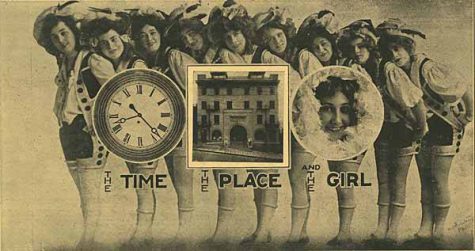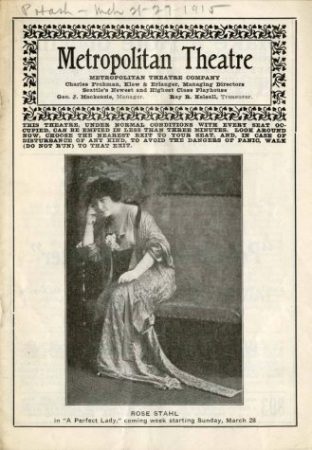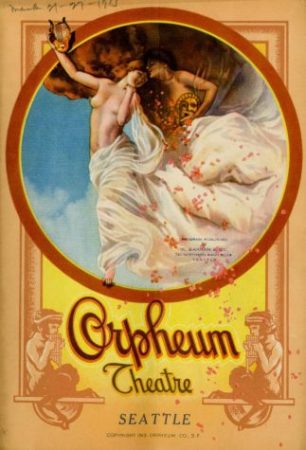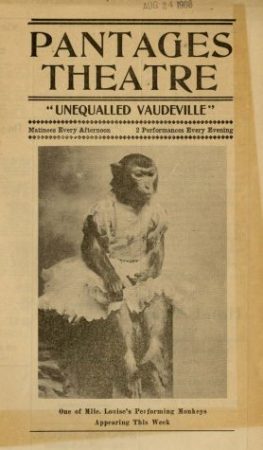
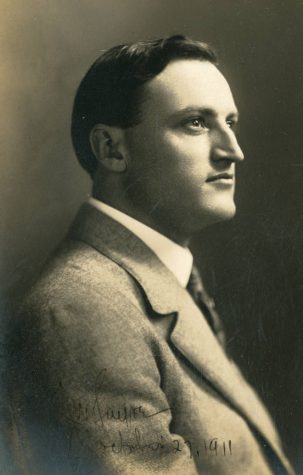
This work is somewhat of an accident. In February 1996 I had the opportunity to utilize the J. Willis Sayre Collection (sometimes known as the Sayre-Carkeek Collection) to further some research I was doing on a different subject. With that project in mind I reviewed these materials, an accumulation of programs and photographs chronicling 90-plus years of Seattle’s theatrical history, available on microfiche through the Seattle Public Library but housed in the Special Collections Division at the University of Washington. The Collection wasn’t that useful for the task at hand, but the materials were nonetheless intriguing: here was a detailed chronology of the city’s dramatic presentations, complete with indices giving the dates and venues where many of the era’s biggest theatrical stars had played. Even better, given my personal interest in silent film, that data included a lot of familiar names: Douglas Fairbanks, Charlie Chaplin, Buster Keaton and Mary Pickford, to name a few.
Since the Collection was so readily available (yet so little used), it seemed an excellent source for writing a short article on some of the notable silent stars who once traversed the stages of Seattle. It was, in my mind, an opportunity to combine film history with local history, and recount the early stage engagements for several performers who eventually rose to stardom in motion pictures.
Brevity, however, isn’t one of my strong points. My initial draft was filled with gaping holes, and I was still forced to cut several engagements to keep the work at a reasonable length. But what to remove? If I included D.W. Griffith’s three Seattle appearances, did I then have to cut the two made by Thomas Ince? And what about Cecil B. DeMille? He made two documented appearances in Seattle as an actor, but at least three of his written works were performed here on several occasions. And directors aside, the problem of inclusion/exclusion became even more difficult when considering dramatic actors or comedians, whose visits to Seattle were far more numerous.
So the fact that From Footlights to Photoplays exists is a testament to my own inability (or unwillingness – there’s an argument to be made) to focus my research, then stay on topic. Which stage engagements should I keep? That’s easy – I’ll keep all of them. Problem solved.
The more I learned about Seattle’s early theatrical history, the more colorful and interesting the project became. Rather than simply researching the life of Roscoe Arbuckle, I could instead venture to the Moore Theatre, one of the few period venues remaining in Seattle, where in 1932 the comedian played in Baby Mine, about a year prior to his death. Or if I was feeling less adventurous, my office building at the time looked down onto the Fairmont Olympic Hotel, the circular driveway of which used to be the Metropolitan Theatre, where figures such as Mary Pickford and Mary Miles Minter played at one time or another. And then if I swiveled my desk chair a little to the left, I could look across Fifth Avenue to the site of the old Hippodrome, where Rudolph Valentino made a promotional appearance in 1923. A few years after that visit, the Hippodrome was torn down and the Skinner Building erected in its place, which included the posh Fifth Avenue Theatre. Today the Fifth Avenue remains a Seattle fixture and regularly hosts touring shows, but it’s also where actresses Bessie Love and Blanche Sweet made stage appearances after sound invaded motion pictures.
There are plenty of books and articles on the lives of these screen personalities, but they frequently only concentrate on their motion picture work. Yet the fact remains that many silent film stars had long, if sometimes undistinguished careers onstage before achieving notoriety in film. Take the case of William S. Hart, who first played Seattle in 1893 and eventually became a credible stage actor, but didn’t become a “star,” in any sense of the word, until entering motion pictures in 1914, at nearly 50 years of age. Bits and pieces on the early careers of these celebrities can be found, but detailed accounts are few and far between.
From Footlights to Photoplays doesn’t purport to be an exhaustive analysis of any performer’s stage career, but it offers glimpses of these motion picture figures before they rose to prominence and, in some cases, long after their screen acting days were over. No one can judge the whole of Harry Langdon’s or John Barrymore’s stage careers on the basis of a few Seattle engagements, but these visits nonetheless showcased their early work for local audiences and occasionally foreshadowed their eventual careers onscreen. While commentary on a performer or production could vary from location to location, a look at these Seattle engagements offers an informative and sometimes unique perspective on their talents at a given moment in time.
To do this, the collective appearances for performers who established themselves as notable box-office draws during the silent era will be addressed. There are some limitations to this approach. Not all stage performers found themselves traveling through the Pacific Northwest during their early careers, and some arrived playing such minor roles that they weren’t going to get much recognition. Others were just too difficult to pin down. Mack Sennett (touring under his given name, Michael Sinnott) very likely performed in the chorus of a few stage productions known to have played Seattle. But that can’t be confirmed because his name doesn’t appear in the printed programs or in news accounts from those engagements. Trust me, I’ve looked. Many popular figures like Sennett go unrepresented here simply because I couldn’t verify that they actually appeared in a specific touring production.
In addition, one will note that most of the stars discussed typically rose to film popularity before World War I. This is because America’s most prolific era of stage entertainment occurred between 1900 and 1918, when the eastern theatrical syndicates regularly sent shows on the road to play the circuits. Through this arrangement thousands of relatively unknown actors got their professional starts, often playing small roles in productions headlined by more established dramatic figures. The growing popularity of film was yet another factor that limits this study to (mostly) early silent era figures. Growing patronage in movie houses across the country gradually decreased the audience for vaudeville and legitimate theatre, so fewer touring shows were out on the road in the post-World War I era. And as audiences went, so did the actors. Whereas Broadway had once been a lure for aspiring young performers, now the major film studios in New York and Hollywood allowed them to bypass the stage altogether in search of their big break.
Finally, an important aspect of this study is to consider the nature of period theatrical reporting, the obvious starting point for source material. Especially prior to 1910, more than a few reviews in Seattle’s dailies appeared to promote certain shows rather than actually critique them. Local dramatic critics (not to mention theatre managers) were quite aware that the Seattle’s continued access to top-quality stage attractions depended, in part, on maintaining the city’s reputation as “the best show town on the Pacific Coast,” as it was once labeled. As most booking for the Pacific Northwest was done through the theatrical powers in New York or San Francisco, newspaper reviews occasionally tempered their criticism of certain shows. Truly scathing reviews were uncommon; often only certain aspects of a production would be singled out for criticism, while the overall notice tended to emphasize the show’s more positive aspects. This was less obvious in vaudeville reviews. Each act on the vaudeville circuit existed as its own individual unit and performed under separate terms. For both critics and audiences, if one act was particularly bad there was likely something else on the bill that would merit praise. With all the disparate talents that went into the average vaudeville bill, reviewers often focused on the acts that went over well, giving scant coverage to (or ignoring altogether) those that didn’t.
J. Willis Sayre, a longtime critic and theatrical promoter in Seattle, commented on this practice early in his journalistic career while working as drama editor for The Argus, a weekly paper. The Seattle Daily Times, it seems, had given up (temporarily, at least) running advance notices in its weekday columns, as the material was so obviously publicity-oriented that their editors deemed it valueless as news. (Earlier the paper printed such notices under the heading “Views of Press Agents,” an obvious attempt to disclaim responsibility for the material.) Sayre understood the argument but felt a good dramatic editor could take that material and re-write it so the advance publicity could be better utilized by theatregoers. “Such [revised] notices would place the advance theatrical column on a par with other departments of a modern newspaper. They would tell playgoers just what is offered them in exchange for their money.”[1]
Previous writers on Seattle’s theatrical history have argued the value of contemporary reviews as source material. For my purposes, I’ve chosen not to overlook them. The historian of today can only attempt to recreate an event which occurred, in most cases, over a century ago, so therefore it’s crucial that he or she considers contemporary accounts, as critics of the day would have addressed a show in a style and manner consistent with the time it was presented. Contemporaneous reviews often capture observations and sentiments that differ from those that might be expressed today. Period accounts were often more audience-centered, with the quality of a show judged not simply by what happened onstage, but what happened to the audience during its presentation. Historian Richard Koszarski noted a similar characteristic with respect to film criticism in the New York Times during the 1920s. There, reviews often captured the total experience of going out for an evening’s entertainment and thus serve as an important tool for understanding past performances. “Not yet worthy of a byline, the generally anonymous reviews of the era tell us what happened when [the public] went to a picture show,” Koszarski observed. “They report not only on the film but on the theater, the audience, the stage performance, even the weather. It should be remembered that the film was not always the most significant element of this mix anyway, and that critical commentary was usually extracted from the sum of these parts.”[2] Indeed, on more than a few occasions between the 1890s and 1950s, the commentary of Seattle critics had less to do with the overall worth of a show than a momentary reaction to a particular evening’s entertainment. Sometimes these reviews focused only on the nature of the audience. Sometimes they were an emotional outpouring toward a particular star, or perhaps a performance momentarily deemed the greatest the city had ever witnessed. And, sometimes, a critic’s praise was simply a tip of the hat toward the theatrical powers-that-be – an occasional gesture necessary to ensure that Seattle continued to draw quality shows from New York, San Francisco or elsewhere.
The effort here is not to recreate the dynamics of turn-of-the-century theatrical journalism, but to get a glimpse at the stage lives for certain screen performers, providing a little-seen view of their early careers. For the actors themselves Seattle would have been just one stop in a long series of theatrical engagements. A favorable notice from New York, Chicago or San Francisco would have carried more weight than one from Seattle. But this work nonetheless offers a unique opportunity to view these particular individuals at a particular moment in their careers – sometimes before, and sometimes after the work that made them popular motion picture figures during the silent era.
By Eric L. Flom – January 2026
Notes:
[1] J. Willis Sayre, “Past Performances,” The Argus, 26 September 1908, Pages 6 and 7.
[2] Richard Koszarski, An Evening’s Entertainment: The Age of the Silent Film Feature 1915–1928 (Berkeley: University of California Press, 1994), Pages 191–192.