The Middle-Aged Man and the Sea:
William H. Harbeck and the Story of his Story

Preview

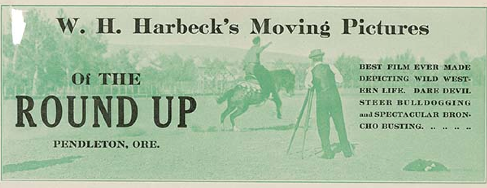
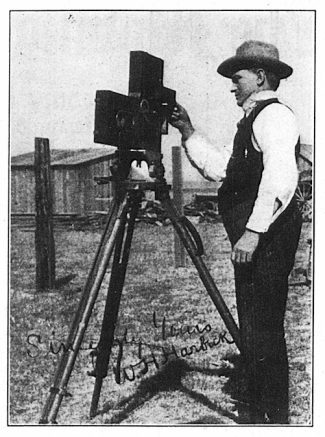
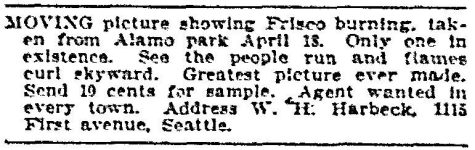
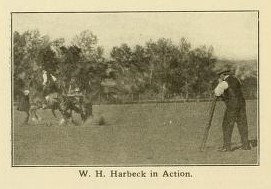
Every couple of years a Northwest legend gets resurrected in some shape or form. It involves William H. Harbeck, a Toledo native who came to Seattle and established himself as a motion picture cameraman, specializing in documentary and travel films. In 1912 he was shopping his most ambitious project, a film capturing the wonders of Alaska, which was beginning to generate some buzz in the industry. But then a tragic accident took his life, ending a promising career as well as the prospects for his Alaskan picture. Rather than take a prominent role in the early film industry, as he seemed on the cusp of doing, Harbeck instead suffered the fate of so many other regional filmmakers during that period, whose screen work has either been lost or forgotten. But fast forward to the 1990s, more than 80 years after his death, when the Harbeck story suddenly got a second wind. Not because his screen work was rediscovered, mind you, but because of the circumstances around his death. And that aspect took on such a life of its own that, before long, the only thing notable about William Harbeck, it seemed, was how he left this Earth.

What’s unfortunate about this “new” version of the Harbeck story is that it overlooks the man himself. Later writers picking up the subject rarely dwell on his life or his contributions to early cinema, offering a few cursory details before rushing headlong into the source of his enduring curiosity. With few exceptions these versions tell similar tales: they shoot right past the man to present the same set of facts, usually to draw the same set of conclusions.

So for nearly three decades William Harbeck’s story has been told and retold, but almost never in full. This is an attempt to do so – or at least it’s an attempt to highlight his actual accomplishments, while offering an explanation as to why he became a notable figure again. It helps resolve or explain a few mysteries, but not all of them. We’ll probably never know the full truth about William Harbeck, but at least we can get a little closer and put some context around the off-told legend.
The Middle-Aged Man and the Sea: William H. Harbeck and the Story of his Story

Reel 1: From Cop to Cameraman

The Middle-Aged Man and the Sea: William H. Harbeck and the Story of his Story

Reel 2: Across the Pond

The Middle-Aged Man and the Sea: William H. Harbeck and the Story of his Story

Reel 3: Tragedy Becomes Turmoil

The Middle-Aged Man and the Sea: William H. Harbeck and the Story of his Story

Reel 4: Beware the Ides of...April?

In June 1912, about eight weeks after the tragedy and a month before Brownie Harbeck started her letter-writing campaign, a book was published in London entitled The Loss of the SS Titanic: Its Story and Its Lessons. Its author was Lawrence Beesley, a 34-year-old English schoolteacher who was a passenger on Titanic. He was fortunate – Beesley survived after being ordered by a crew member to jump into a lifeboat as it was being lowered. A modern reader might expect the book to be a damning account of the White Star Line’s failures, but instead Beesley details what it was like to be aboard the ill-fated Titanic, with glimpses of the ship, the various passengers he met along the way, and how people spent their leisure time, before offering his personal account of the sinking. The Loss of the SS Titanic was quite popular in England since it was a detailed, first-person account of the event, which was widely regarded as a national tragedy.

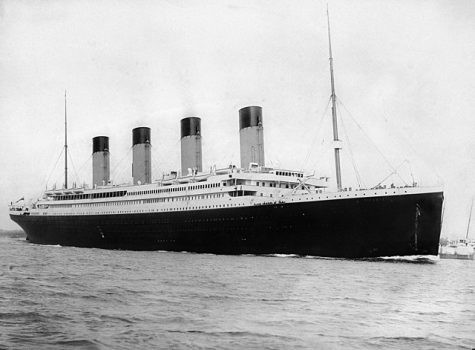
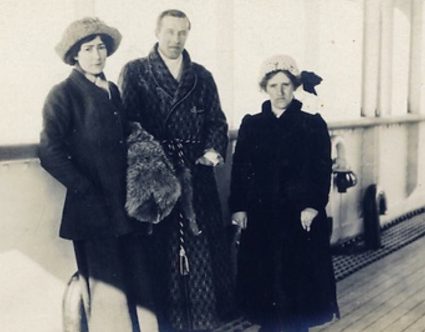
Lawrence Beesley was a 2nd Class passenger on the ship, as was William Harbeck, who makes two cameo appearances in the book – or, at least we presume it’s Harbeck. In both cases Beesley doesn’t mention the man by name because the two never formally met – the schoolteacher simply refers to him as “the American kinematograph photographer.” In the first mention Beesley was on deck and saw Harbeck filming just after the ship left Southampton, and wondered if he captured a near-collision Titanic almost had with a smaller vessel. In this case, Beesley observed, Harbeck “followed the whole scene with eager eyes, turning the handle of his camera with the most evident pleasure as he recorded the unexpected incident on his films. It was obviously quite a windfall for him to have been on board at such a time.” Later, the cameraman turned up a second time when the author witnessed him amongst a group of passengers playing a card game.[1]

For Lawrence Beesley, a few things stood out about William Harbeck. One was that he considered Harbeck to be young; in fact, he was in his mid-forties and slightly overweight. But because they never formally met, and because Beesley had just survived a traumatic incident, perhaps he could be excused for not getting that detail correct. But he distinctly remembered Harbeck because his motion picture camera made him memorable – well, that and his French wife. On both occasions Beesley observed William Harbeck, he was in the company of a young woman. She was by his side while he was filming on the deck of Titanic, and she was playing the card game when he observed them a second time. “I did not see them again,” Beesley wrote.[2]

While there were other passengers on Titanic with loose connections to the early film industry, only Harbeck travelled 2nd Class, like Beesley. So the cameraman may not have been as young as the author remembered, but there also wasn’t anyone else in Beesley’s orbit who fit the bill for being “the American kinematograph photographer.” They were never introduced, but it had to be William Harbeck.

Lawrence Beesley’s account is another piece of the puzzle, and it’s the second that places Harbeck in the proximity of a mysterious young woman. Beesley assumed they were husband and wife – or at least that’s the impression he got from afar. But sometimes appearances, and memories, are not correct; after all, Harbeck was a middle-aged man that the schoolteacher remembered as being young. So Lawrence Beesley’s account from aboard Titanic is notable, but hardly conclusive.

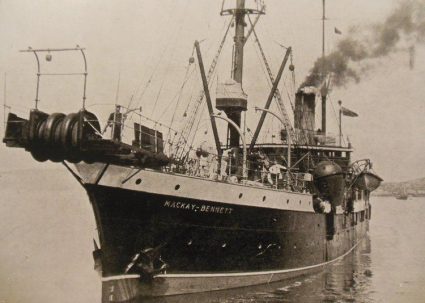
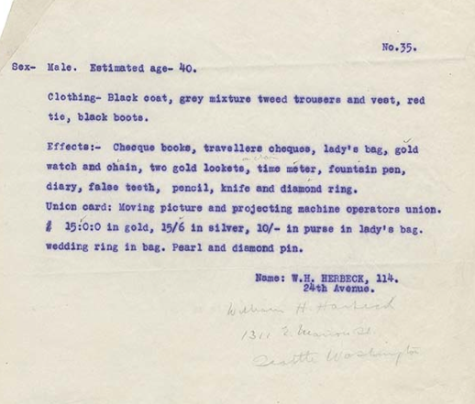
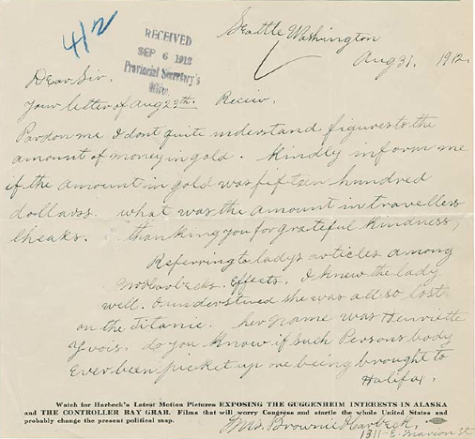
The events of April 20, 1912, help feed the fire. That was the day that William Harbeck was pulled out of the Atlantic Ocean by the cable ship Mackay-Bennett. He had several items in his pockets, including the union card that identified his remains and the money that had been Brownie Harbeck’s focus. But the money came from a small purse that was tucked inside a woman’s bag, which also contained a pearl and a diamond stick pin – the “ladies articles” Brownie mentioned in her August 31st letter. It also included a diamond ring, which sailors on the Mackay-Bennett catalogued as a “wedding ring.”[3] So when Catherine Harbeck took possession of her husband’s personal items at the end of May, it included the purse and its contents, including the so-called wedding ring. William Harbeck was holding it for someone – but for whom?

That’s impossible to know because nothing about the bag or its contents can be traced to any one person. Perhaps it belonged to the young French lady that Lawrence Beesley observed with William Harbeck. But there could be another explanation. As recalled by numerous survivors, after Titanic collided with the iceberg and the lifeboats began to fill, there was little sense of urgency. Many boats, in fact, weren’t at capacity when lowered, based on the notion that unsinkable ships tended not to sink. The women and children entering these initial lifeboats expected to row a short distance from the ship, receive a signal, then row back and continue their journey to New York, armed with a great story to tell. Under those circumstances there was no need to take one’s possessions, and with the men staying behind, fathers, husbands and shipboard acquaintances offered to hold purses or other items for what was certainly going to be a brief interlude. So the fact that William Harbeck was recovered with a woman’s bag in his pocket wasn’t that incriminating. With no way to trace the purse or its contents, it was just an interesting, though inconclusive detail about his final moments. And the so-called wedding ring? Sailors on the Mackay-Bennett were rifling through the pockets of a corpse – they made an assumption based on what they found.

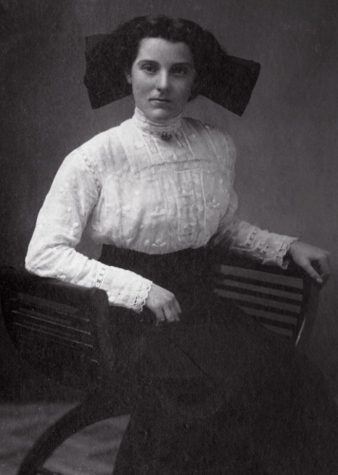
So on the one hand these “women’s items” explained nothing, except for the fact they may have explained everything. That’s because on April 9th, the day before Titanic was to sail, William Harbeck arrived in Southampton. There he presented himself at the White Star ticket office, purchasing a 2nd Class ticket on Titanic, which set him back £13. His ticket number was 248746, and before taking possession he provided some basic information about himself, which included listing his profession and his home address. This was standard procedure for passengers traveling by ocean liner – the information became part of the ship’s log. However, the very next ticket sold – ticket number 248747, also 2nd Class – was issued to a 22-year-old French woman named Henriette Yvois. She gave her profession as a model, with a home address of 5 Rue des Pyramides in Paris, a few blocks from the Louvre.

Henriette Yvois – the same woman mentioned by Brownie Harbeck in her letters. Very little is known about her. She was born in Paris on April 22, 1889; her father was a restaurant worker while her mother, from Brussels, was a florist. Yvois was illegitimate; her parents didn’t marry until 1891, when she was two, around the time they had a second child. And that’s all we currently know about Henriette Yvois, other than she was a model who also happened to be a 2nd Class passenger on Titanic.[4]

So we don’t know much about her personal history, but we can (albeit briefly) trace her movements. Obviously, she was in Southampton on April 9th, and purchased her 2nd Class ticket immediately after William Harbeck purchased his. But their timeline goes back further. When the cameraman arrived in London in early March, his first order of business was to embark on a networking tour, visiting friends and colleagues in the British film industry. One of the places he stopped into was the offices of The Kinematograph and Lantern Weekly, where he pressed the flesh and previewed some of his new pictures. The publishers were delighted to see him, and made note of that in their March 14th issue. “Mr. W.H Harbeck (accompanied by his wife), motion picture photographer to the Canadian Pacific Railroad, arrived from America last week,” they announced. “He had some remarkable [film] subjects for the British market, particulars of which we will give in a future issue.”[5] It wasn’t the only such reference, either. Equipment dealer Will Day not only met the couple during their London stay but received a letter from William Harbeck just before he departed on Titanic, a note that ended with “best wishes from Mrs. Harbeck…[6]

So there was a Mrs. Harbeck. It just wasn’t the real Mrs. Harbeck. The story wouldn’t end there.

By Eric L. Flom – November 2025


Notes:

[1] See Lawrence Beesley, The Loss of the SS. Titanic: Its Story and Its Lessons (Boston and New York: Houghton Mifflin Company – 1912), Pages 21 and 43.
[2] Beesley, Page 43.
[3] “No. 35,” an undated, typed note detailing the items retrieved from William Harbeck’s body, Titanic in Nova Scotia website (https://novascotia.ca/titanic/records.asp?ID=63&Lang=), accessed 5 February 2023.
[4] “Miss Henriette Virginie Yvois,” Encyclopedia Titanica (https://www.encyclopedia-titanica.org/titanic-victim/henriette-yvois.html), accessed 22 September 2018.
[5] “Mr. W.H. Harbeck…,” The Kinematograph and Lantern Weekly, 14 March 1912, Page 1111.
[6] “Dear Will…,” letter from William Harbeck to Will Day dated 10 April 1912, reprinted in Stephen Bottomore, The Titanic and Silent Cinema (Sussex, England: The Projection Box – 2000), Page 40.

The Middle-Aged Man and the Sea: William H. Harbeck and the Story of his Story

Reel 5: Infamous in the Afterlife

William Harbeck may have died on April 15, 1912, but his story kept getting more and more interesting. For part, if not all his European trip, he was not only traveling in the company of a woman half his age, but introducing her to others as “Mrs. Harbeck.” Lawrence Beesley saw the couple aboard Titanic and inferred that they were man and wife. When Harbeck’s body was recovered from the North Atlantic, he was found with a woman’s bag that contained a diamond ring, which was catalogued as a wedding ring by sailors on the Mackay-Bennett. And Brownie Harbeck – aka, Anna Garbutt – not only knew that the cameraman was traveling with another woman, but provided her exact name and claimed, without evidence, that she “knew her well.” All of which begs a question: what did Catherine Harbeck know about all of this?

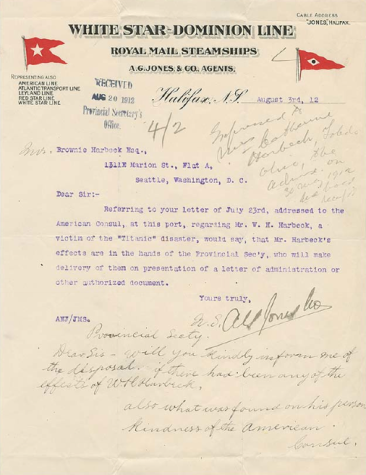
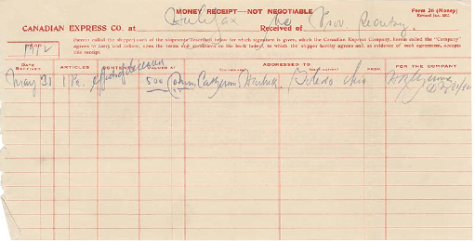
Unfortunately, we just don’t know. Catherine took possession of her husband’s belongings on May 31st, 1912, and that included the woman’s bag, the money inside and all the jewelry.[1] Was that surprising, or something she understood (or just suspected)? What on earth was discussed between her and Anna Garbutt when Catherine returned to Seattle later in 1912? Obviously, Anna pried into the couple’s affairs and possessed information that was unknown to others. William Harbeck’s diary may have held additional clues. Catherine claimed to need it so she could understand her husband’s business dealings, but did it contain other information she needed to see – or possibly shield from prying eyes?

It’s hard to know what Catherine did or did not know because the events in 1912 occurred over an eight-month span, involved sources and witnesses that were thousands of miles apart, and there’s little in the way of surviving evidence. Perhaps Catherine knew everything, or perhaps she herself was trying to connect the dots. Eventually those would, of course, be connected, but it would take about 90 years to do so. And that highlights the trouble with William Harbeck: his death was real, and it was spectacular.

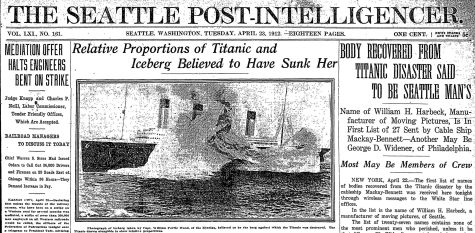
Consider, for a moment, an alternate scenario – one in which William Harbeck boards a steamship in Seattle that sinks off the coast of Vancouver Island. It’s still a tragedy, but a localized one. Even if the cameraman had a mistress in tow, it’s unlikely that would ever come to light, regardless of what items were recovered with his body. Local newspapers would cover the story for a short while and then, for the most part, the event would fade into memory. Not so with Titanic. This was the most luxurious ocean liner of its day – a ship marketed with an air of invincibility that just happened to sink on its maiden voyage. It’s one of the most notable events of the 20th century, and arguably the greatest maritime disaster in history. The media coverage, in the U.S. and Britain, was intense and unending. The newspapers made certain individuals into heroes, such as “The Unsinkable” Molly Brown or Titanic’s band, who continued playing for passengers aboard the ship, while making villains out of people like White Star Chairman J. Bruce Ismay, who fled the sinking liner when others could not. What’s more, the story kept turning up again and again through the years, in newspapers, magazines, books, films and, eventually, television. Academics and enthusiasts combed every inch of the tragedy, researching the most minute details of the ship and its fateful voyage.

Yet despite this sustained interest, William Harbeck’s story would have remained largely unknown if it hadn’t been for a pair of seemingly unrelated incidents in the 1990s.

The first was, curiously, the rise of the internet. An early version of the web had been developed years before for military and academic use, but by the mid-1990s the first commercially viable internet browsers became available to the general public. This was a massive technological advancement; by the end of the decade about one-third of all U.S. households had internet connectivity, a figure that rose exponentially with each passing year.

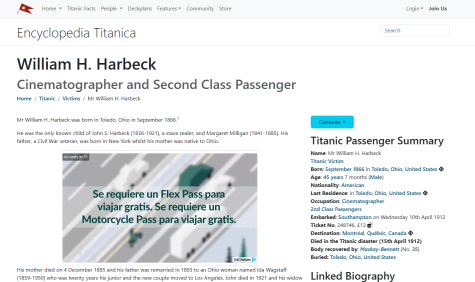
Of course, the internet was only interesting if there was something to connect to, and that’s where William Harbeck’s story got a significant boost. Before it was commercialized, the pages of Internet 1.0 were often just repositories of information. Users could log on and, with a few keystrokes, get connected with individuals and groups who shared similar interests, no matter how obscure. It was an arena that brought together the academic and the amateur, the expert and the ignorant – key in any topic, and away you go. One destination for new online users was Encyclopedia Titanica (www.encyclopedia-titanica.org), begun in 1996 with the goal of creating an online biography for each passenger lost on Titanic. It was an ambitious undertaking, but the web page offered a single place for gathering wreck information from sources that were spread across England, Canada and the United States, among other places. There was significant interest, and as worldwide internet usage continued to grow, so did traffic to the site. By 1999 Encyclopedia Titanica added a message board feature that allowed visitors to tell stories, share information, engage in dialogues and argue mundane data points.[2]

This process of collecting information on Titanic victims pushed the William Harbeck story back into the public eye. Sourced by users from various backgrounds, his history began taking shape in ways it never had while he was alive, or in the years since his passing. Bit by bit, slowly but surely, almost 90 years after his passing, William Harbeck was finally becoming famous. Just not for the right reasons.

Lawrence Beesley’s book, of course, had been a longtime resource for Titanic enthusiasts, and although Harbeck wasn’t mentioned by name, ticket details and other company records could be researched to pinpoint who he was. Researchers also combed materials in the Nova Scotia Archives in Halifax, where recovery information is housed, including the correspondence between Canadian officials and Catherine, John and Brownie Harbeck. So, over time, the William Harbeck story came together on a platform that allowed it to be shared freely with a global audience. And what wasn’t to like? A traveling filmmaker, a young French model, a wedding ring, the appearance (and disappearance) of a mysterious letter-writer, and a long-suffering wife who appeared to know nothing. That stuff was (and still is) tailor-made for the internet.

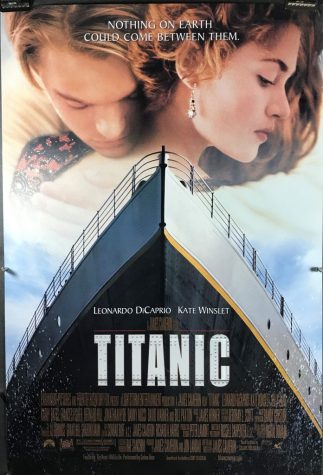
The second 1990s event impacting the Harbeck story was the release of James Cameron’s film Titanic, which premiered in December 1997. Rumored to be an expensive fiasco, the picture instead became a monstrous international hit and the top-grossing film of all time, for a time. And a byproduct of that success was increased interest in Titanic history.

Writers, in particular, were quick to capitalize on this attention. Any number of books and articles appeared in the wake of Cameron’s film detailing aspects of the ship’s history, and they were eagerly consumed by Titanic enthusiasts. One was Titanic: The Canadian Story, by Alan Hustak, published in 1998.[3] As the title suggests, Hustak (a reporter with the Montreal Gazette) took a specific view of the tragedy, focusing on how Canada and Canadians were impacted. William Harbeck, of course, wasn’t Canadian, but he made a guest appearance based on his film work for the Canadian Pacific Railway. Ostensibly. What Hustak probably knew was that he was sitting on a juicy story, the details for which he appears to have drawn, at least partially, from online resources like Encyclopedia Titanica. His account is colorful but lacks rigor, with so many perplexing details about William Harbeck’s life and work that it’s hard to know where the author pulled some of his information.

The merits of Hustak’s book are debatable, but what’s clear is that he got there first, putting the Harbeck story into print, after which it was picked up by Titanic enthusiasts. To a degree it created a feedback loop, since Hustak sourced at least some of his information online – material that was then grabbed by readers of Encyclopedia Titanica and funneled right back onto the site because, after all, they read it in a book. The Harbeck legend was growing.

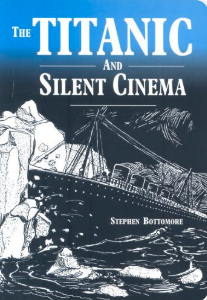
Not everyone, however, was taken in by this salacious story – some tried to situate it in more historical terms. In 2000 film historian Stephen Bottomore published The Titanic and Silent Cinema, devoting an entire chapter to William Harbeck the filmmaker, as opposed to William Harbeck the philanderer.[4] “[Harbeck] was one of that breed of highly enterprising travelling cameramen who were so important in the early period of the movies,” he concluded, “…often celebrated at the time, yet almost forgotten today…Yet the kind of films he made – scenic, industrial and educational subjects – were a mainstay of the early film business, and the direct ancestors of modern non-fiction film and television.”[5]

Bottomore’s book stands as the most thorough treatment of Harbeck’s film work, and is essential for understanding his full contribution to the industry. The problem was that The Titanic and Silent Cinema is a film history as opposed to a popular history, and was marketed to a niche audience by a small press in Sussex, England. So despite its value it wasn’t widely read, even by Titanic enthusiasts.

Yet another William Harbeck researcher was Seattleite Roy Kristiansen.[6] Kristiansen spent years immersed in aspects of Titanic lore, and offered a slightly different take on the Harbeck story – one that, unlike many, gives the cameraman the benefit of the doubt.

There’s no question that William Harbeck was traveling with Henriette Yvois for at least some, if not all, of his 1912 trip, but it doesn’t necessarily follow that he and the French model were a couple. Others were quick to draw that conclusion because Harbeck was recovered with a woman’s bag in his possession, and that there was a “wedding ring” in that bag. But we can’t know whose bag it was, nor how William Harbeck came to possess it. Some of the evidence, of course, is damning: on occasion he introduced Henriette Yvois as his wife, the two tickets on Titanic were purchased consecutively, and Lawrence Beesley observed, from afar, that the couple appeared to be married.

Of course, if this was an affair taking place under Catherine’s nose, why was it so easy for Anna Garbutt to find Yvois’ name among the papers in the Harbecks’ Seattle apartment, and how did she know that the young woman was traveling on Titanic? It seems likely that Yvois was a known quantity, and that Catherine Harbeck was fully aware that the two were traveling together. “Will and Katie seemed to have had an unusual marriage, to say the least,” Kristiansen told me in 2004. “I’m afraid I still haven’t figured that one out completely. He stopped living in Toledo [where Catherine continued to reside] sometime a little before 1900…I’m sure he still spent time back in Toledo, but his intensifying film work became increasingly centered on the West Coast and he would be away from his base of operations for long periods of time.”[7] It may be hard to fathom, but the couple was used to this. After less than 15 years of marriage they chose to live apart for at least a decade – William in the Pacific Northwest, Catherine in Toledo. They reunited in 1911, but even then she spent a lot of time alone, staying in their Seattle apartment while her husband filmed throughout the western U.S. and Canada. That’s a unique marital dynamic – one that requires a lot of trust, an understanding or, perhaps, a blind eye.

So what conclusion did Roy Kristiansen draw? He suggested that perhaps Harbeck and Yvois met in New York shortly after he arrived there in January 1912. We may never know for sure, but with Yvois working as a model and Harbeck moving in film circles, they may have crossed paths at some point during his business dealings. Kristiansen thinks they made the crossing to England together – hence she was present when the cameraman dropped by the offices of The Kinematograph and Lantern Weekly, and later when he visited Will Day. But Harbeck’s original plan was to encircle the globe, going from Europe to Russia and riding the length of the Trans-Siberian Railway, then crossing the Bering Sea to Alaska. Based on that itinerary, Kristiansen offered a different explanation of events. “Is it even conceivable that Harbeck intended to schlep the young and very cosmopolitan Mlle. Yvois with him on such a trip? My own inclination is to say ‘No way!’ And I feel the reason for Yvois’ presence was probably as simple as she knew Paris and the fashion industry, had reason to be there at Eastertime – and Harbeck probably didn’t know much French.” So it’s possible, in Roy Kristiansen’s eyes, that William Harbeck simply hired her to help him navigate parts of Europe. Not only could Yvois speak French, at the very least, but she worked as a model, something that would come in handy when he got down to shooting the spring fashion shows in Paris. The bonus for Yvois was that she’d not only be earning money (we can assume Harbeck was paying her), but also got a free trip home to visit the family.

Of course, the difficult part would have been making this arrangement look proper. In 1912 older men and young, unmarried women simply didn’t travel together, so it would have been important to maintain a certain appearance, both to casual observers like Lawrence Beesley and any business contacts Harbeck met along the way. The “wedding ring,” if that’s what it actually was, may have been a part of this ruse, since a father/daughter deception was out of the question – Yvois was too French and Harbeck too American. “The fact that he introduced her as his wife doesn’t bother me all that much,” Kristiansen continued. “No one in Europe knew Catherine Harbeck, or was ever likely to meet her, and it was an effective way to head off prying ‘questions’…I think the plan was for Harbeck to go on to Russia and for Yvois to return to New York in time for the spring fashion season [there]. When it turned out that Harbeck was going to be taking the Titanic, they decided to return together.”[8] As to the obvious question – whether Harbeck and Yvois shared a room aboard Titanic – there doesn’t appear to be any records verifying their accommodations. “I’d say it’s doubtful they shared a cabin, since they didn’t purchase their tickets as man and wife,” notes Kristiansen. “The White Star Line strikes me as being a little too prudish to have accommodated unmarried couples. Even some of the married couples I’ve read about were put up in separate rooms.”[9]

So perhaps Roy Kristiansen is right – maybe there’s less to the William Harbeck story than some have made. But it wasn’t a popular take; to read the Encyclopedia Titanica message boards circa 1999/2000, the cameraman was guilty as assumed. It would take a good many years before more balanced versions of the Harbeck story filtered through Encyclopedia Titanica. Still, the legend has persisted.

Catherine Harbeck gets us no closer to the truth. The Seattle city directory lists her as returning to the Northwest, settling into an apartment on East Jefferson, though she was back in Toledo for good by 1915. She never remarried, and eventually lived with her youngest son Stanley (John passed away in 1917). Catherine rarely spoke of the sinking, although the Toledo News-Bee coaxed her into an interview for a piece they ran on the 25th anniversary of the tragedy, in 1937. “‘We never saw anybody who had met my husband on board or who had spoken to him at the time…,’” Catherine said, suggesting she wasn’t familiar with Lawrence Beesley’s book. “‘He made a special point of taking the Titanic. You see, he was a motion picture producer. He’d gone to Russia on business and hurried back to take pictures of the Titanic leaving Southampton. He was going to take pictures, too, of the boat coming into New York…’”[10]

Then for Frederick Opper, writing the story for the Toledo News-Bee, she brought out a few old mementos. One was a pair of scissors that Harbeck used to own, but the others were items presumably on him when Titanic sank – a watch and chain, a fountain pen (which Stanley used for many years) and a light meter. Two things she didn’t produce during that interview: the diamond ring and William Harbeck’s diary, which had also among his personal effects. Back in 1912 Catherine insisted that the diary was the most important item for her to get her hands on. “I must go [E]ast on business soon and shall need the diary,” she noted in a hand-written letter to Halifax officials dated May 23, 1912.[11] But the question remains: did she have an ulterior motive for getting her hands on that? What would it say about William Harbeck’s trip in 1912, and what might it reveal about the relationship between himself and Henriette Yvois?

In the end, we’ll never know. Catherine took possession of the diary and no one knows what became of it. There’s a possibility that William Harbeck’s words revealed everything; there’s a possibility that William Harbeck’s words revealed nothing. And there’s the possibility that, after floating in the Atlantic Ocean for a week, nothing William Harbeck had to say was even legible.

Whatever the truth was, it didn’t weigh on either Catherine or Stanley. In the 1937 News-Bee article, for which Stanley was also interviewed, both spoke well of William Harbeck’s memory, something they might not have done if there was lingering resentment. And they were eventually buried alongside each other in Toledo’s Woodlawn Cemetery – Catherine passed away in 1940, Stanley in 1947. They now rest with the extended Harbeck family, which includes William, John and William’s mother, Margaret, who died in 1885.

So while the current facts around William Harbeck’s 1912 voyage are indisputable, the way those facts have been interpreted has been anything but. There’s a lot we still don’t know about pioneer Northwest cameraman William Harbeck, and we’re unlikely to ever know the full story. He may well have been the cheating husband he’s been made out to be. By the same token, his reputation may be unfairly tarnished by those who read far more into the surviving evidence than they should have. What is true, however, is that his entire career as a filmmaker has been shoved aside in light of the way he passed.

When I asked Roy Kristiansen why he thought the William Harbeck story had legs, decades after his death, I had to admit that the scandalous elements were what first attracted me. But after I had done some initial research, I was willing to give Harbeck the benefit of the doubt, even though some of the facts didn’t look very good. Kristiansen completely understood. “Naturally,” he said. “Villains are always more intriguing than heroes.”[12]

Indeed Mr. Kristiansen, they are.

By Eric L. Flom – November 2025


Notes:

[1] “Money Receipt – Not Negotiable,” Canadian Express Co. receipt dated 31 May 1912, Titanic in Nova Scotia website (https://novascotia.ca/titanic/records.asp?ID=73&Lang=), accessed 5 February 2023.
[2] “About Encyclopedia Titanica,” Encyclopedia Titanica (https://www.encyclopedia-titanica.org/introduction/), accessed 22 September 2018.
[3] See Alan Hustak, Titanic: The Canadian Story (Montreal: Véhicule Press – 1998).
[4] Stephen Bottomore, The Titanic and Silent Cinema (Sussex, England: The Projection Box – 2000), Pages 26-47.
[5] Ibid, Page 47.
[6] Roy Kristiansen, whom I corresponded with in 2004, passed away in Seattle in September 2022. I’m indebted to his kindness and saddened that I didn’t finish this during his lifetime. Like, a lot. I can’t thank him enough…
[7] Email from Roy Kristiansen to Eric L. Flom dated 23 April 2004; in possession of the author.
[8] Kristiansen email dated 21 April 2004.
[9] Ibid.
[10] Catherine Harbeck to Frederick Opper, “Ice More Titanic Than Queen of Seas 25 Years Ago Tonight,” Toledo News-Bee, 14 April 1937, Page 9.
[11] Letter from Catherine Harbeck to the Provincial Secretary’s Office, Halifax, Nova Scotia, dated 23 May 1912, Titanic in Nova Scotia website (https://novascotia.ca/titanic/records.asp?ID=65&Lang=), accessed 5 February 2023.
[12] Kristiansen email dated 23 April 2004.