The primary way movies were distributed in the silent era was through studio-operated exchanges, which also played key roles in the advertising and promotion of their pictures. Whether an exhibitor came directly to Film Row in Seattle or talked to a visiting salesman, business deals were negotiated to deliver films and materials to movie houses throughout Washington state, allowing these venues to offer patrons a steady stream of new and attractive picture bills. Contracts, of course, were the key component of that process, spelling out the number of films an exhibitor was to show, the time period in which they would screen, and the financial terms for each engagement. Every theatre, large and small, contracted for a variety of services. A house that changed bills twice a week, showing films from two different studios, would need at least two contracts for their features alone. But, if they also showed newsreels and/or comedies on each bill, then they’d have additional contracts, sometimes with entirely different exchanges, to provide those services. Not all contracts ran for the same length of time – one might run for six months, another for eight, and another for 10, and they would all be running concurrently. Some may be older contracts nearing completion, while others were just beginning. It was a complicated process that got even more complicated for houses that changed their bills more frequently than twice a week, or for the exhibitor who operated multiple venues.
Contacts put a legal framework around the distribution process and were the subject of intense scrutiny. Disputes arose between exchanges and exhibitors all the time, usually when one party claimed that the other wasn’t meeting their stated obligations. Some were misunderstandings, but others became so contentious that they ended up in a court of law – an unwanted and expensive step for exhibitor and exchange alike.
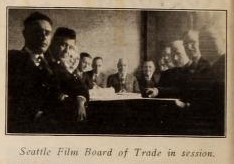
Contractual issues eventually became such a persistent headache that the industry created a mandatory arbitration process in the 1920s to help mitigate some of these problems. No one wanted to go into arbitration, but what happened there was a big deal for those in the industry, with decisions that impacted film exhibition throughout Washington and, sometimes, other parts of the country as well.
But while arbitration was created as a tool to help settle disputes, it also laid bare what went on behind the scenes at the local movie house. And sometimes it wasn’t pretty. Every dispute involved a legitimate business transaction, but that doesn’t mean the parties involved operated in good faith. These cases involved a spectrum of behaviors that ranged from innocent mistakes to small fibs to outright deception, almost always because someone thought the effort gave them a leg up in the business.
Much of this was out of the public eye; movie fans came to the theatre to see their favorite pictures and didn’t put much thought into what it took to get them there. A sampling of the arbitration cases heard in Washington during the 1920s, however, offers a vivid picture of how the local entertainment business could sometimes be anything but entertaining.