
A Matinee Idol: A Collection of Promotional Appearances
A Matinee Idol:
A Collection of Promotional Appearances
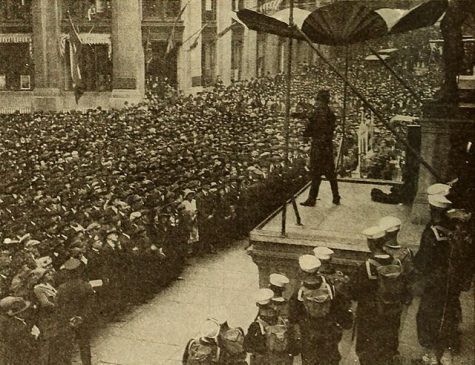
William S. Hart addresses crowds at an unidentified stop on his Liberty Loan tour, ca. 1919.
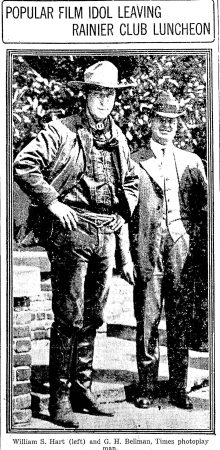
William S. Hart following a luncheon at the Rainier Club in downtown Seattle. (Seattle Daily Times, 6 June 1919, Page 9)
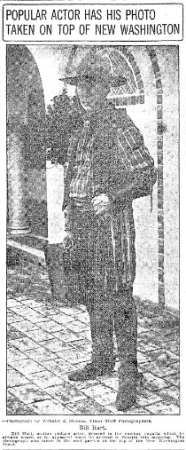
William S. Hart atop Seattle's New Washington Hotel, April 1918. (Seattle Daily Times, 19 April 1918, Page 8)
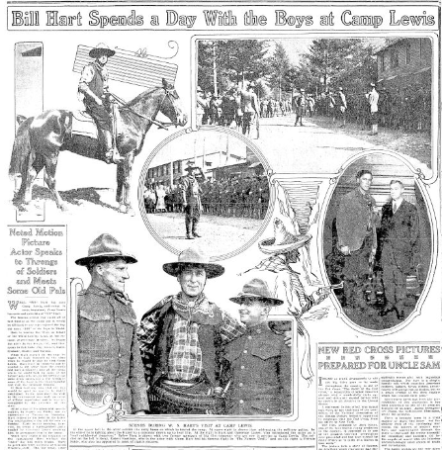
William S. Hart visits soldiers at Camp Lewis, April 1918. (Seattle Daily Times, 5 May 1918, Amusements Section, Page 8)
Act I: William S. Hart
With today’s obsession with celebrity culture, where the trivial details of a performer’s life are splashed across the Internet, it seems difficult to believe that the earliest film actors were virtually unknown to audiences. Until the evolving star system formally recognized the value of promoting certain actors and, in some cases, directors, audience identification rested not on the screen figures but on the producing companies – Vitagraph or Biograph denoting a particular type of motion picture product in the same way that Coca-Cola® distinguishes a type of soft drink. Screen credits were virtually unheard of prior to 1910 or 1911, so even though regular moviegoers might have been familiar with the faces, they were performers that lacked complete identities. Some picture fans supplied their own names for their favorite screen performers. In this way Florence Lawrence – one of the screen’s biggest draws at the time – was known to many as “the Biograph Girl.” Biograph, in fact, was one of the last companies to make use of their stars’ popularity, despite being the training ground for such talents as Mary Pickford, Blanche Sweet, and Lillian Gish, not to mention D.W. Griffith. The company felt (with some justification) that promoting individual actors left them open to being hired away by other motion picture units, as was the case when Carl Laemmle’s IMP nabbed Florence Lawrence from them in 1909 and Mary Pickford the following year. Alternatively, the actors themselves might demand higher salaries as a result of their name recognition.[1]
But other companies such as Vitagraph realized that the public’s infatuation with screen personalities was a considerable drawing card. Promotional photographs or other giveaways helped increase patronage for their films and draw the audience closer to the performers onscreen. They could even be sent out on personal appearance tours, giving film fans the opportunity to see their favorite personalities in the flesh. These initially took the form of afternoon jaunts – screen actors making brief appearances in and around the movie houses of New York and Los Angeles, where the production companies were located – but a few embarked on regional or national tours.
For the most part, stars that arrived in the midst of their professional success were greeted with enthusiasm across America. But in some respects these tours resembled the old barnstorming days of one-night theatrical stands, with their hectic scheduling and constant travel. Such was the price of film fame; even when a given performer had nothing more to do than say a few words to a gathered crowd, the opportunity to see a popular film star up close and personal was a huge audience draw.
This was certainly the case when William S. Hart made a brief appearance in Seattle, a one-day stopover on June 5, 1917. His arrival found him honored with a press luncheon at the Rainier Club before making several visits (between photoplay screenings) at the Liberty and Coliseum Theatres, two of the city’s largest motion picture houses. Appearing “courtesy of Thomas H. Ince” (at the time Hart’s employer), the tour was part of a grueling promotional trek to support the Triangle Film Company, which was releasing Ince’s films at the time – Seattle was the 34th city, it was reported, that the actor had visited in 30 days. “Hart has appeared in all the larger cities of the East in the course of his present tour,” reported The Argus, “and not even in New York City did he remain longer than one day. Owing to the short time allowed for his personal tour, Hart has, in many cases, omitted cities from his itinerary, which were no larger than Seattle, but statistics show that this city has a greater number of ‘Hart’ fans proportionally than any other city in the country.”[2] Advance publicity indicated that the grind of the road was wearing on the actor. “I never felt homesick until the other night,” Hart was claimed to have said. “Just as I was going into the theatre there flashed on the screen a picture of my horse Fritz. You remember him, don’t you, the pie-bald, Injun-broke pony who jumped through a plate glass window in Truthful Tolliver [1916]? Well, honestly I got homesick right there and then. His name is Fritz, but he is Irish. He is the fightiest horse that ever lived. He and I are real pals. Why he won’t let me mount any other horse if he can prevent it. He will kick and bite and make an awful fuss.”[3]
To help satisfy the “proportionally” large numbers of Seattle fans, patrons at the Coliseum and Liberty were treated to a special motion picture short in which William S. Hart demonstrated his methods for portraying screen cowboys. Additionally, the actor performed a handful of these tricks live, during his brief stage appearances.
William S. Hart arrived in Seattle early on the morning of June 5th, four hours later than expected, and was whisked directly from the train station to the New Washington Hotel; dramatically, the Star reported that Hart was “almost in a state of nervous collapse.” Owing to the delay, a scheduled appearance at City Hall was canceled – the Post-Intelligencer reported that Hart was scheduled to apply for a permit to carry firearms within city limits. A motor tour of the city was also dropped from the star’s itinerary.
All three of Seattle’s daily papers featured the motion picture star during his visit. The Star, for one, made efforts to note William S. Hart’s supposed childhood experiences in the West (“hence his wonderful ability to mimic the red man and his ways”), in addition to his quiet, modest nature. “He certainly cannot be accused of being conceited,” the paper noted of his arrival. “He shied at a camera, saying he feared those who see him posing might think he was ‘putting on airs.’”[4] If William S. Hart was shy, however, his fans were certainly not. The actor appeared to packed houses three times at the Liberty and the Coliseum, with hundreds of fans crowding into the roadway hoping to catch sight of the actor as he came and went. The Post-Intelligencer gave perhaps the best account of Hart’s visit.
Bill Hart, he calls himself, and he is just that. If this famous gunman of the screen were to call for volunteers to follow him to France there might be no need for a selective draft. At least that’s the way it looked yesterday about the Liberty and Coliseum theaters, where he appeared in person. Mr. Hart is not only the idol of the boys. People of every age and nationality crowded the streets for blocks before the theaters striving for admission, or failing that, to get a glimpse of the wild-riding hero of Inceville.
Hart, in person, is just what one would expect him to be from his acting in the pictures. Standing before an audience, he seems the embodiment of bashful strength. Uncovering in response to the big welcome as he stepped before the curtain at the Liberty, he stammered a few words of embarrassment, then quickly clapping on the sombrero, he said, “I can talk better with my hat on if you don’t mind. I guess, maybe, my brains are in it.”
Hart wears the plainsman’s togs, plaid flannel shirt, khaki trousers and leather boots, wide sombrero and bright yellow silk handkerchief around his throat. He walks with the gait of a rider and has a big voice and the accent of a man who has lived much among men.
The primal man likes poetry. Hart is no exception. Like most mountain and desert men he has a number of homely poems that he likes to recite. Yesterday he gave “Rags,” a rhymed dog story of the sentimental kind, and Ben King’s homely classic, “Jane Jones.” The latter he or somebody has mutilated by giving the final line a twist to suit the occasion. Remembering Ben King and his quaint reading of these lines, one is tempted to suggest that even Mr. Hart attempt no improvements.
Bill Hart grew up in North Dakota and had the Indian for his model in riding and expression of sentiment. He gave a fine example of Indian hand reading to illustrate a story of his father. He is as eloquent with his hands in this way as when he uses them for pistol practice or feats of strength and agility in the pictures. There is something romantic, and vitally so, in this rugged son of the plains recreating in the everlasting films this phase of American life. Bill Hart is writing history. When they take out one of these films 500 years hence they will get a livelier sense of the breaking in of America than from tomes of dry chronicles.
Good-by [sic], Bill! We’re glad you came.[5]
The Daily Times also gave the William S. Hart visit generous coverage, much to the delight of photoplay editor G.H. Bellman, who got his picture taken with the actor outside the Rainier Club following the press luncheon.[6] The Times also caught up with Hart later in the day, as he was winding down his promotional activities. At his final appearance before a live audience, he delighted the crowd – and particularly the young boy who requested the trick – by rolling a cigarette with one hand while lighting a match with the fingers of his other, as he had done numerous times onscreen. He also related how difficult his promotional tour was. Not only did he miss his horse Fritz, but he rarely stayed anywhere long enough to get his bearings. “I am so tired that I do not know whether I am up on the Saskatchewan or down on the Rio Grande, and sometimes the top of my head feels numb,” Hart told the gathered crowd. “[This] trip has been a constraint strain and I shall never make another like it.”[7] Although some press notices had the actor leaving Seattle for Portland via a midnight train on June 5, according to the Times Hart managed to wrangle at least one night of rest at the New Washington Hotel, and did not embark southward until the following morning.
William S. Hart’s visit came in the midst of a busy six weeks for Seattle photoplay patrons, who saw a number of their screen favorites making the trek to the Pacific Northwest. J. Warren Kerrigan spent three days at the Clemmer Theatre in mid-May 1917, and enjoyed, among other things, a press luncheon similar to the one given for Hart. Kerrigan’s appearance, like Hart’s, wasn’t in conjunction with any particular show (the Clemmer was screening Vitagraph’s Sally in a Hurry [1917], with Lillian Walker), though no one seemed to mind. This was particularly true on the day of the actor’s debut, when owner James Q. Clemmer announced his appearance (Kerrigan’s only known visit to Seattle) in conjunction with “Ladies Day.” Less than two weeks later, Mutual star Margarita Fischer was making personal appearances at the Strand Theatre, while at the same time, a few blocks away at the Liberty, audiences were cheering for Thomas Ince star Dorothy Dalton, who was in town to promote her Triangle release Wild Winship’s Widow (1917).[8] Finally, in late June, singer/actress Myrtle Stedman arrived at the Coliseum with her film The World Apart (1917), a Paramount release that co-starred Wallace Reid.
A little more than 10 months following William S. Hart’s June 1917 visit to Seattle, the actor returned for another series of personal appearances, this time on behalf of the United States government. Hart had been asked by President Woodrow Wilson’s Secretary of the Treasury, William G. McAdoo, to tour on behalf of the Liberty Loan drive, helping promote the government’s third major bond-selling effort of World War I. Hart was one of several Hollywood notables – Charles Chaplin, Douglas Fairbanks, and Mary Pickford, among them – who openly traded on their celebrity by making personal appearances and patriotic speeches on behalf of the fundraising drive.
As with the 1917 tour on behalf of the Triangle Company, Hart’s schedule was grueling – the actor making daylong visits in cities up and down the West Coast. Touring with him was Major Charles W. Gordon of Canada, better known as the adventure novelist Ralph Connor (author of The Man from Glengarry, among other works). Publicity for the Seattle stopover claimed that Hart, who had only begun his tour a week earlier, had thus far helped raise nearly one million dollars in contributions, not to mention another three to four million dollars in pledges for the Liberty Loan effort.[9]
William S. Hart swept into Seattle on the morning of April 19, 1918, arriving early after an appearance the previous day in Spokane.[1o] Once again staying at the New Washington Hotel on Second Avenue, he immediately began an exhausting workday. Reporters from the Star and the Daily Times were on hand to greet him at the hotel, both newspapers running “exclusives” on his visit in their evening editions. Hart also posed for press photographs on the roof of the New Washington, decked out, as always, in western garb.
It was this style of dress that captured the fancy of the reporter for the Daily Times.
Bill Hart arrived in Seattle wearing a cowboy suit. He said he hasn’t known what it was to wear civilian clothes for so long that he laughs at his friends who talk about stiff white collars and tight-fitting vests. The kerchief he wore today around his neck was old and frayed, but Bill clings to it, though it had already seen twelve years of service.
“It’s sort of like a mascot,” he said this morning. “Lots of people have sent me new silk ones, but I don’t like to wear them. The old sombrero that I have also worn for twelve years I gave to the Red Cross recently. But I don’t like to give things up. I suppose that a wife would make me do so, for she wouldn’t stand for the rags…”
Hart…plays Western parts because he thought they were played so atrociously before he started playing them. The [movies] which he saw in the East, which were supposedly portraying life on the plains, were not realistic, he felt, and in spite of advice given him by booking companies that the public was “fed up” on Wild West movies, he made two films anyway. From that time on a clamoring public has never let him don anything but cowboy regalia, he says.[11]
At approximately the same time that William S. Hart was being interviewed by the Daily Times, the Seattle Star was putting together their own piece on the actor’s visit. Their female reporter doesn’t seem to have spoken much with him but spent time observing his personality and mannerisms from afar. Noticing that he spoke softly, with a bit of a drawl, Hart struck her as not only a picturesque figure, but also quite warm and genuine. He spoke sincerely about his love for the West – particularly the Sioux Indians, whose language the actor claimed to be “the most expressive tongue in the world.”[12] Following his time with the reporters, William S. Hart was whisked from the New Washington Hotel to a gathering at the Arcade Building where he, Major Gordon, and Dr. Charles Upson Clark, from the American Academy in Rome, were guests of honor at a Chamber of Commerce luncheon. All three men addressed the gathering, Hart drawing the loudest response when he rose to the podium, exclaiming, “Friends, I am here to urge you to buy liberty bonds until it hurts. No American must ever say, ‘We hope to win this war,’ but we must say instead, ‘We have to win this war, and take the toot out of the Teuton!’”[13]
Following the luncheon, William S. Hart made time to meet briefly with Seattle’s Chief of Police, Joel Warren, both men posing for local newsreel cameraman Frank Jacobs. (Jacobs’ handiwork later turned up the Coliseum and Liberty Theatres following Hart’s visit.) The actor then made afternoon appearances at a pair of Seattle high schools, Queen Anne and Franklin, addressing students at each. But, unfortunately, Hart’s appearances at both events would be marked less by patriotism than by acts of mischief.
Following his remarks at Queen Anne High School, the motion picture actor delighted the crowd by inviting a young girl to the podium and giving her a small piece of his treasured yellow kerchief, his “mascot” for some 12 years. But then, as he made his way out of the gathering, he was mobbed by fans and well-wishers, which included a group of boys who snatched the remaining kerchief from William S. Hart’s neck, making off with about half of it before the actor could get it back.
With his neckwear smaller, but apparently still wearable, the actor then moved on to Franklin High School, only to have the kerchief again stolen and torn apart for souvenirs at the conclusion of his remarks. The Daily Times, who followed Hart throughout his daylong schedule, suspected that news of the earlier incident had reached Franklin students and thus it became a target for another bunch of boys.[14]
Crowds at the evening Liberty Loan rallies, however, were better behaved. Originally, they were to have taken place in a single space, but heightened interest necessitated a split-venue format. One was held at the Masonic Temple, at the corner of Harvard and East Pine, while the other took place at Seattle’s First Presbyterian Church, located just a short distance away.[15] Gordon and Hart got equal billing at both events, the author speaking at one venue while the actor addressed the other. Midway through the evening, they switched halls.
William S. Hart began his evening at the Masonic Temple, where he was introduced by Carl E. Croson before making his pitch to the crowd. Appearing in his famous film costume (with a new silk kerchief, observed the Daily Times), Hart made a vigorous (albeit blunt) appeal on behalf of the Liberty Loan campaign. In fact, according to the Daily Times – which quoted Hart at greater length than the city’s other dailies – the actor’s quiet, humble image seems to have gone out the door when addressing the crowd on patriotism.
“There is another thing, my friends, that we have got to look out for – that we have got to stamp out, that’s all – that is a certain class of people, no matter how well they mean; we can’t stand for the people who call themselves Pacifists. My friends, as far as the government is concerned they are pro-Germans and nothing else because every American on this continent that is not behind this war heart and soul is pro-German. This is no time for fooling; it is time for plain talk. When our boys are over there dying for us it is no time for mincing words. Anybody that doesn’t get behind [the war effort] right now, let’s put them in jail or line them up before a wall and a firing squad. You should love this country as the lion loves blood…You should love it as the sea bird loves the ocean and as the eagle loves the sun. The greatest thing you can do now is to put over this Liberty Bond drive in such an overwhelming manner as to stagger the Kaiser.
“I have no use for the man who has dollars in his pocket and will not subscribe to this loan. He is a pro-German wherever he was born or whatever he calls himself. The man who is a German in this country today should be – taken care of. And I want to be there with my own two hands to help take care of him when he is found.”[16]
A group of Boy Scout volunteers worked the room during Hart’s speech at the Masonic Temple, handing out pledge cards. A mere 20 minutes following his remarks, it was announced that a total of $17,750 dollars had been raised for the Liberty Loan effort, and that the actor had personally signed almost 200 Liberty Loan applications. Donors of $100 or more were promised a photograph of William S. Hart taken earlier in the day by a local photographer.
The actor made his second appearance of the evening at Seattle’s First Presbyterian Church, whose congregation was headed by the controversial Dr. Mark A. Matthews. Matthews, who headed the First Presbyterian for nearly four decades, was an outspoken reformer who came to the city in 1902, raising the church’s membership from 400 to over 8,000 during his lifetime. He took a degree in religion at the University of Tennessee, later studying law at Whitman and Huron Colleges; he claimed to be the only ordained minister in the country who was also qualified to argue before the United States Supreme Court. Long an activist on a variety of local issues, he even led two separate crusades against vice in Seattle, one of which resulted in the jailing of Seattle’s Chief of Police and the recall of its Mayor. He remained a spiritual and civic leader in the community until his death in 1940.
Matthews must have found a kindred spirit in William S. Hart, at least on the subject of Germany and the conduct of the war. While the actor’s remarks at the First Presbyterian meeting aren’t as thoroughly documented as his speech at the Masonic Temple, the Post-Intelligencer was quick to note that Matthews, at least, was none too shy about expressing his own views. Matthews recalled for the gathered crowd that during a recent conference in Washington, D.C., he had openly advocated that any peace process following the end of the war should not involve the German government – Germany’s place wasn’t at the negotiating table, but underneath it, begging for mercy. He also shared William S. Hart’s disdain for anyone showing the slightest bit of sympathy for America’s foe. “…I don’t want any damnable pro-German to buy a bond,” Reverend Matthews remarked loudly to the gathering.[17]
No actual Liberty Loan subscriptions were taken during William S. Hart’s appearance at the First Presbyterian Church, though it was announced that anyone purchasing a bond of $100 or more at any area bank the following day could, just by mentioning the First Presbyterian gathering, be rewarded with a copy of the actor’s picture.
Following William S. Hart’s whirlwind Seattle appearance on April 19, 1918, the motion picture actor appears to have traveled southward to Tacoma the following day, making similar appearances and speeches in that city. On Sunday, April 21st, however, Hart took a day off from stumping and made a daylong appearance at Camp Lewis, the Army base located just outside of Tacoma. In an article appearing some two weeks after the actor left Seattle, a reporter for the Daily Times documented Hart’s time at the camp, where he was enthusiastically received by hundreds of new recruits in the midst of basic training exercises. Accompanied on his tour by Washington Governor Ernest Lister, the article reported that William S. Hart “loves the outdoors and…wanted to get away from the crowds and have a leisurely time at the camp, where he could look up some of his former pals who are in the service, eat some army meals, say a few words to some of the boys in the camp hospital and visit the Remount Station.”[18]
Among the soldiers Hart met with personally were Sgt. Robert Kortman and a Pvt. Noble, both stationed at Camp Lewis and both of whom had previously appeared in some of Hart’s films. Kortman, in particular, had a notable fight scene with the actor in The Narrow Trail (Triangle, 1917), and had also appeared in the Hart classic Hell’s Hinges (Triangle, 1916).
Together with Sgt. Kortman at his side, William S. Hart toured parts of Camp Lewis on horseback, spurning the motorcade that had been arranged for a VIP tour. The servicemen, most of whom did not know in advance that the actor was visiting, fondly greeted the star. As word leaked out Hart made several impromptu stops to greet enthusiastic recruits, although he also managed to visit Hostess House, the Camp library, and the local YMCA headquarters.
The actor was particularly taken with Remount Station, where the cavalry horses were kept, and wondered aloud whether Americans appreciated how much animal labor was contributing to the war effort at home and abroad. The one thing he vigorously opposed, however, was being labeled a “hero” by some of the men, even though he frequently played one onscreen. “I never want anyone to call me a hero again,” the actor explained to a crowd at one point. “Why, any man who can go through this encampment, that is, any civilian, and then allow himself to think that he is a hero is more than I can imagine. No man today is a hero unless he has on the uniform of the United States fighting forces. You boys are the real heroes.”[19]
Although no itinerary was given for William S. Hart’s travel schedule, he appeared to leave Tacoma for points southward, including Portland, following his visit to Camp Lewis. The Liberty Loan tour would be the actor’s last known appearance in the Pacific Northwest, whether onstage or as a major screen figure.
By Eric L. Flom – January 2026
Notes:
[1] Before Biograph formally reversed its policy on identifying their performers, MP Sales, their distributor in England, assigned fictitious names to Biograph actors for promotion to the British public; Blanche Sweet, for one, remembered hers as being “Daphne Wayne.” (Blanche Sweet to William M. Drew, Speaking of Silents: First Ladies of the Screen [Vestal, New York: The Vestal Press, 1989], Page 242.) Simon Louvish’s Keystone: The Life and Clowns of Mack Sennett, includes a promotional photo from Sennett’s Biograph days clearly identifying him as “Walter Terry.” According to Louvish, similar Biograph items identified Mabel Normand as “Muriel Fortescue.” (See Simon Louvish, Keystone: The Life and Clowns of Mack Sennett [New York: Faber and Faber, Inc. – 2003], Page Pages 51–52.)
[2] “Flora Bella Tomorrow,” The Argus, 2 June 1917, Page 4. According to an account of Hart’s tour in Moving Picture World, the star’s layover in New York was actually four days, not the one reported by The Argus. (See George Blaisdell, “Bill Hart Hits the Great White Trail,” Moving Picture World, 2 June 1917, 1422.) Nonetheless, Hart’s tour was indeed arduous: during the first half of his journey, the actor had already toured the Southwest and Midwest, finally making his way to New York. Hart was then due to head westward again on May 21, heading through the upper Midwest to Seattle, then down the coast to California.
[3] “William S. Hart Coming Tomorrow,” Seattle Daily Times, 4 June 1917, Page 5.
[4] “Bill Hart is Here, Tho [sic] Late,” Seattle Star, 5 June 1917, Page 2.
[5] “Crowds Out to See Bill Hart,” Seattle Post-Intelligencer, 5 June 1917, Page 11. Interestingly, that William S. Hart’s appearances were staged affairs is perhaps evidenced by a notice that ran in the Daily Times some three weeks following his local visit, which recounted the actor’s arrival back in Los Angeles. Elements of Hart’s return sound quite familiar to his time spent in Seattle, and likely other cities on the tour as well. “His pony, Fritz, saddled with a blanket of flowers, had been brought to the [train] station, as well as his dog Rags. Mounted on Fritz and escorted by a great company of Triangle [Company] players, and several hundred citizens Hart made a triumphal journey to The Auditorium. When the popular star appeared on the stage the house went wild with enthusiasm, and Hart was so affected that he was unable to voice his appreciation for many minutes. Finally he put on his hat, which seemed to make him feel more at home. After a little speech he recited a selection or two, and capped the climax by bringing the entire troupe of cowboys and cowgirls as well as the horse and the dog onto the stage.” (“Big Bill Hart Welcomed Home,” Seattle Daily Times, 29 June 1917, Page 12.)
[6] See “Popular Film Idol Leaving Rainier Club Luncheon,” Seattle Daily Times, 6 June 1917, Page 9.
[7] “Seattle Admirers Give Bill Hart Ovation,” Seattle Daily Times, 6 June 1917, Page 9.
[8] See “Dorothy Dalton to be at Liberty,” Seattle Daily Times, 31 May 1917, Page 14; and “Mutual Star Will Appear on Stage at Strand This Evening,” Seattle Daily Times, 31 May 1917, Page 18.
[9] “Bill Hart Says He’s Looking for the ‘Right’ Girl,” Seattle Daily Times, 19 April 1918, Page 8.
[10] In a booking likely made to coordinate with the actor’s visit, Seattle’s Rex Theatre was concluding a revival of the William S. Hart feature The Primal Lure (1916) on the day of his arrival.
[11] “Bill Hart Says He’s Looking for the ‘Right’ Girl,” Seattle Daily Times, 19 April 1918, Page 8.
[12] “Bill Hart Says, ‘Keep Women Away,’” Seattle Star, 19 April 1918, Page 15.
[13] “Dr. Clark and Maj. Gordon Divide Honors at Luncheon,” Seattle Post-Intelligencer, 20 April 1918, Page 9. See also “U.S. Must Kick Toot out of Teuton, says Hart,” Seattle Daily Times, 20 April 1918, Page 2; and “Thing We Fight for is Dearer Than Sons,” Seattle Star, 20 April 1918, Page 4.
[14] “U.S. Must Kick Toot out of Teuton, says Hart,” Seattle Daily Times, 20 April 1918, Page 2. The incident was also reported in “Thing We Fight for is Dearer Than Sons,” Seattle Star, 20 April 1918, Page 4.
[15] Originally built in 1915, the Masonic Temple at Harvard and East Pine Street was eventually converted to a movie theater in the mid-1980s. Until recently known as the SIFF Cinema Egyptian, the house regularly showed smaller, independent films. SIFF (the Seattle International Film Festival) also used the venue for one of its main festival locations each spring.
[16] Hart, as quoted in “U.S. Must Kick Toot Out of Teuton, says Hart,” Seattle Daily Times, 20 April 1918, Page 2. It should be noted that although the Daily Times was the most liberal in quoting the actor’s comments, they may also have been guilty of coloring his words with even more anti–German rhetoric than was spoken. For example, both the Post-Intelligencer and the Star quoted Hart as stating that those who didn’t support the war effort should be given jail time or lined up “before a wall.” However, only the Daily Times added “and a firing squad” in quoting the actor – it was simply implied elsewhere. Although the Daily Times captured the gist of William S. Hart’s remarks, on the whole their version was more aggressive than similar accounts quoted in the city’s other dailies. (See “Loan Workers Urge More Aid for War-Fund,” Seattle Post-Intelligencer, 20 April 1918, Page 1; and “Thing We Fight for Is Dearer Than Sons,” Seattle Star, 20 April 1918, Page 4.)
[17] “Rally is Held at First Presbyterian Church Also,” Seattle Post-Intelligencer, 20 April 1918, Page 9.
[18] “Bill Hart Spends a Day with the Boys at Camp Lewis,” Seattle Daily Times, 5 May 1918, Amusements Section, Page 8.
[19] Ibid.
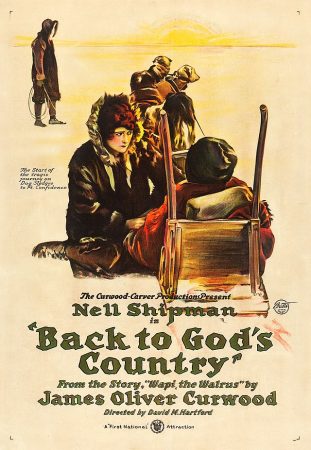
Film poster for "Back to God's Country" (First National, 1919), starring Nell Shipman.

Film poster for "The Girl from God's Country" (Nell Shipman Productions, 1921).
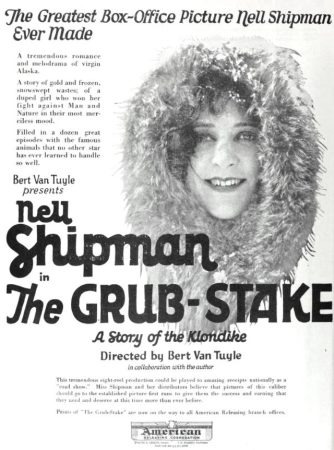
Trade advertisement for Nell Shipman's "The Grub Stake" (Nell Shipman Productions, 1923). (Film Daily, 7 January 1923, Page 4)
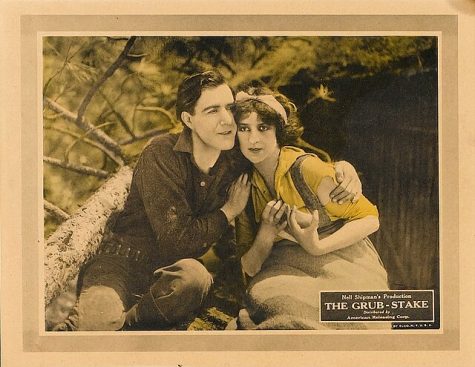
Lobby card for the film "The Grub Stake" (Nell Shipman Productions, 1923).
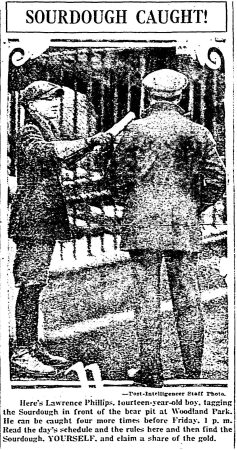
Lawrence Phillips apprehends the Sourdough at Seattle's Woodland Park Zoo. (Seattle Post-Intelligencer, 5 March 1923, Page 3)
A Matinee Idol: A Collection of Promotional Appearances
Act II: Nell Shipman
There was no war effort to promote in March 1923, but the Northwest was worked into a similar publicity frenzy when “Seattle’s own” film actress, Nell Shipman, brought her latest picture The Grub Stake to the Blue Mouse Theatre. Much like William S. Hart in his western films, Shipman, too, specialized in outdoor adventures, with the added twist of playing strong female characters who often struggled against odds – not unlike the role she played in real life making independent pictures in a male-dominated, increasingly corporate film industry.
The plot of The Grub Stake centered upon Faith Diggs, a Seattle girl who is befriended by a shifty Alaskan gambler named Mark Leroy. Leroy entices both the girl and her ailing father to the Klondike where they can seek their fortune but eventually discovers that his intentions are much more than charitable.
Following a mock marriage and a revealing look at Leroy’s true character, Faith and her father escape into the Alaskan wilderness, and (after a series of perilous adventures) are saved by the son of a dance hall woman from Dawson. A romance develops between Faith and the young man, and together they find a prosperous mine, only to have Leroy suddenly re-enter the picture to complicate matters.
Although Nell Shipman would eventually make films at her “studio,” Lionhead Lodge on Priest Lake, Idaho, The Grub Stake was shot on a shoestring budget at Minnehaha Studios in Spokane, with much of the film’s cost raised from within the local community. Because she was releasing her work independently, Shipman’s project played David to the Goliath of the major Hollywood studios, with their extensive resources and control of major distribution outlets. It was perhaps only natural, then, that Shipman would use her local ties to generate interest for The Grub Stake throughout the Pacific Northwest. In her memoirs, the actress recalls specific appearances in Portland, Tacoma, and her old hometown of Seattle to promote the film.
The announcement of Shipman’s Seattle appearance came in the Post-Intelligencer shortly before her arrival, in an article that also outlined her personal background – a slightly modified version that nicely matched her rugged screen image. Although she still claimed to have been born in Victoria, the article noted that she had spent much of her childhood traveling throughout British Columbia and the Yukon Territories, where her father pursued interests in fishing and mining. Shipman claimed, in fact (much as William S. Hart did), to have developed intimate friendships with many native peoples, learning to speak Siwash – a language she mastered more quickly than English, the article claimed. She also picked up handy outdoor skills such as how to “paddle a canoe like a native, swim like a fish, ride like an Indian and handle the fierce husky tribe dogs as if they were house pets.” After returning to civilization at age eight, it was discovered that she was a musical prodigy; nonetheless, she was lured into the footlights for a career as a writer and actor instead. Yet rather than scoring her first professional engagement in Paul Gilmore’s At Yale, her publicity noted that she first took to the stage as a dancer, her success leading to stage roles later on.[1]
Nell Shipman brought The Grub Stake to Seattle on March 3, 1923, the day the film was to premiere at the Blue Mouse Theatre, located between Pike and Union Streets on Fifth Avenue. Upon arrival, she sat down with reporter Cynthia Grey; their interview would grace the front page of the Star the following day under the title “Seattle Movie Star Comes Home.”
Helen Barham – that name is ever so familiar to Seattle residents. To many it brings recollections of a rosy-cheeked, bright-eyed, enthusiastic young miss, who rowed across the Sound from Eagle Harbor [on Bainbridge Island] each morning in a flat-bottomed boat to school.
“How I loved that dear old boat!” said Helen Barham Saturday morning. She is now known thruout [sic] the country as Nell Shipman, only woman author, star, director and producer in the motion picture industry.
“My daddy made it with his own hands for brother and me, and it was in this old skiff that I first developed a passionate love for outdoor life,” she continued, as she prepared to make herself at home in “the old home town” for a brief week…
Miss Shipman was a musical protégé of Mrs. Louise M. Beck and studied dramatic art at the Egan Dramatic school; she made her first stage performance at the old Grand Opera house and embarked on her stage career from Seattle at the age of 12.
It was during her stage career that she began writing, having many books, stories and scenarios to her credit.
She won the first prize scenario contest ever held. She wrote one of the first serials ever produced. It was while writing stories for J. Warren Kerrigan that she entered picture work, both acting and directing. She starred in the first big outdoor snow story of the Northwest in the open woods.
By ability and hard work she has attained the unique and enviable distinction of the only woman author-star-director-producer in the motion picture industry.
Helen Barham – Seattle welcomes you – she’s mighty proud of her little girl who successfully climbed the ladder and tipped the scales of fame.[2]
Cynthia Grey’s article also announced what seems to have been Nell Shipman’s only formal public appearance outside of the Blue Mouse Theatre, where she offered herself to adoring crowds four times a day before screenings of The Grub Stake. On Friday, March 9th, Shipman planned to appear at the Star offices at 11:00 a.m. and give a presentation to young girls on how to break into movies. In Grey’s words, it was “a real opportunity for girls interested in this profession to obtain some constructive advice from one who has grown up with the motion pictures.” Recognizing that many could not make the Friday afternoon gathering, the actress also agreed to write a series of four articles summarizing her remarks, which would run in the Star throughout the week of her Seattle visit.
Although The Grub Stake opened at the Blue Mouse on March 3, 1923, with the added benefit of personal appearances by its star, Shipman was up against some unusually stiff competition amongst the other downtown entertainment houses. At the Strand, for instance, the bill was headed by the Bessie Love film Forget-Me-Not (Metro, 1922), coupled with Buster Keaton’s The Ballonatic (First National, 1923); the Liberty was beginning its second week of Douglas Fairbanks’ Robin Hood (United Artists, 1922); My American Wife (Paramount, 1922), starring Gloria Swanson, was at the Coliseum; the Winter Garden was showing Conquering the Woman (Associated Exhibitors, 1922) with Florence Vidor; and the Colonial was finishing a run of Sherlock Holmes (Goldwyn, 1922), with John Barrymore as Sir Arthur Conan Doyle’s famous detective. After a brief run of My Wild Irish Rose (Vitagraph, 1922), the Colonial ended the week of Shipman’s visit with a return engagement of Harold Lloyd’s Grandma’s Boy (Pathé, 1922), which began on Thursday, March 8.
On the stage, too, choices abounded. Among the city’s legitimate theatres, Fritz Leiber was headlining the Metropolitan in a series of Shakespearian offerings, while Seattle’s many vaudeville houses were topped by the appearance of Harry Houdini at the Moore, where he was performing, among many other feats, his infamous escape from the Chinese Water Torture Cell. And beyond the city’s entertainment houses, ongoing details from the excavation of King Tutankhamen’s tomb in Egypt and the introduction of the new-fangled “automatic” (or, more precisely, rotary) phone system in Seattle were all vying for the public’s attention.
Nonetheless, Nell Shipman held her own against the competition. She appeared religiously onstage at the Blue Mouse for matinee and evening performances, each time bringing her “famous Alaskan dogs” along with. The actress shared stories about the film and the difficulties of location shooting, usually concluding her talk with a few stanzas from the Robert W. Service poem “The Spell of the Yukon.” Appearing on each bill with Shipman were Leon Greenman and the Blue Mouse Orchestra (featuring the song “Carmen Polka”), an organ novelty song by Henri C. Le Bel called “Classical Jazz,” and the singing of Adele Walker and Jas. R. Harvey.
The actress received a warm reception from Blue Mouse audiences. “Nell Shipman, beautiful and versatile screen star, is scoring a triumph at the Blue Mouse this week,” reported the Post-Intelligencer. “…Authoress, actress and producer, Miss Shipman combines personal charm with genuine ability in all three roles, and The Grubstake [sic] is sure to add greatly to her popularity. The picture possesses special interest for local audiences, inasmuch as many of its important incidents have a Seattle background.”[3] The venue did more than just rely on star power to pull in the crowds. Manager Hal Daigler pulled out the stops when decorating the Blue Mouse for Shipman’s visit – the lobby was transformed into an elaborate snow scene, for example, with large, illuminated rainbows at either end. The winter and rainbow themes were picked up again inside the auditorium, with electrical displays on both sides of the screen. In addition, Daigler arranged for a falling snow effect that ran for most of Shipman’s stage appearance, the orchestral overture and into the opening of the film.[4]
The same Post-Intelligencer article was also keen to note the collection of wildlife populating The Grub Stake, an outgrowth of her affection toward animals and the mistreatment of them she had witnessed on early film sets. “Together with the story and its remarkable star there is an additional attraction in the presence of scores of wild animals of the Northwest. Bears, cougars, porcupines, mountain lions, coyotes, beaver, badgers, skunks, deer, eagles and ducks and owls [play in the film]…They are not trick animals in any sense, and the picture shows them living their natural life in the woods, with Miss Shipman as their trusted companion, a thing of the wilds like themselves.”[5]
While Nell Shipman’s series of articles on motion picture acting ran on the pages of the Star, on Friday the actress met with a group of aspiring performers in the paper’s offices. Reporter Cynthia Grey had promised the event would take place in her own corner of the newsroom, but the large number of young girls in attendance necessitated the event be held in the editor’s office instead. Following introductions and pleasantries, Nell Shipman soon got down to the business of addressing the overflow crowd on secrets of the trade, which Cynthia Grey dutifully recorded.
“Next to photographing well, I consider grace the most necessary [personal] quality,” said Shipman. “Not only bodily grace, but grace of spirit or soul that reflects in a girl’s eyes and the expression of her face. The rumor that only beautiful girls ever make good in Movieland is perhaps the most untrue statement ever given out in this connection. Beautiful girls – that is the tragedy of Hollywood. They seem to have the impression that all they need to do is appear before a director and he will immediately fall down upon his knees and exclaim, ‘You are wonderful – I will make a great star out of you.’
“On the contrary, directors seldom see the girls who are employed. That is left to the right-hand man who catalogs the photographs of applicants. He goes thru [sic] these pictures carefully when a girl is needed. In this connection I wish to warn you that good photographs are an absolute necessity – not only one, but a number – one full face view, a profile, pictures in various attire. And never forget to write your name and address, correct age, weight and height on the back. If you are 26 do not write 19, because the man who makes a coldblooded business of selecting types knows that it is a lie and then you haven’t a chance.
“If you can swim, ride horse-back, dance, etc., say so, as one of these accomplishments might get you a part, minor tho [sic] it be. If you are lucky enough to be called to the studio, look your best and when you get there, [and] pay attention to what is going on about you. If you have the ability that will enable you to break in, your whole heart and soul will be in your work – it must be so in this as in all other work in order to be successful.”[6]
Perhaps even bigger than Nell Shipman’s personal appearances at the Blue Mouse or at the offices of the Star, however, was a promotional contest organized by the Seattle Post-Intelligencer. Co-sponsored by the Blue Mouse Theatre, the competition took its theme from the picture itself, offering as prizes an authentic gold nugget and four $20 gold pieces, provided courtesy of the Friedlander Jewelry Store on Second Avenue. All were to be given out by a secret individual known only as “the Sourdough,” as explained by the Post-Intelligencer:
Here’s the story in a nutshell: The Sourdough, a very mysterious man, will be on Seattle streets and in her public places every day beginning today [March 3, 1923] until next Friday noon…
If you can find and identify the Sourdough ANYWHERE you may see him, hit him with a copy of the Post-Intelligencer and say to him: “At the End of the Rainbow, Wuz It?”
The first man, woman or child to find the Sourdough will receive a gold nugget. The second person a $20 gold piece. There are three other $20 gold pieces and so the first person who catches the Sourdough will receive the nugget and the next four $20 each.
The Sourdough, if he is struck by a Post-Intelligencer in the hands of a citizen who says: “At the End of the Rainbow, Wuz It?” will give that person an order good for $20 or the nugget as the case may be. If only one person finds him that person gets all the gold himself.
But remember – the conditions are absolutely to be fulfilled. You must have a complete copy of any edition of the Post-Intelligencer in your hand. You must strike him with it and at the same time say these EXACT words: “At the End of the Rainbow, Wuz It?” If you make any mistake the Sourdough will not pay you the gold.[7]
If the contest announcement in the Post-Intelligencer, penned by writer “Barkus B. Woof,” wasn’t forceful enough in presenting the rules, they were also reprinted in an accompanying piece, adding the extra stipulation that the Sourdough could be caught only once within 30 minutes or within 300 feet of any spot where he was previously identified – a rule added for the safety of both the Sourdough and potential contestants, the article warned. “To win, these rules must be followed TO THE LETTER,” the paper added. “Failure in a single instance is your loss.”
Since the Sourdough was required to remain anonymous, the Post-Intelligencer helped contestants by printing an itinerary of his travels each day: on Saturday, March 3, the opening day of the contest, he was slated to lunch at Rippe’s Café around noon; shop along Second Avenue from 1:00 p.m. to 3:00 p.m., which would include 15 minutes of window shopping at the Friedlander Jewelry Store; purchase a musical instrument, a kitchen utensil, and an article of clothing from local merchants; and, finally, travel on at least two of the city’s streetcars with his packages. On day one, however, the Sourdough managed to make his rounds without being detected – largely, one suspects, because the contest had just been announced that morning.
The next day, Sunday, March 4, Barkus B. Woof ’s column included a picture of the Sourdough (back to the camera), along with his general description: medium height, over 40 years old, sturdy built, a prosperous look and well-dressed. The article also gave the Sourdough’s itinerary for Sunday. At 10:00 a.m. he was to have breakfast at one of several Boldt’s café locations, followed by 11:00 a.m. services at the First Presbyterian Church, where he was to hear a sermon by Dr. Mark A. Matthews. Following the service, he was to wander throughout downtown until 2:00, when he planned to take a streetcar north to Woodland Park and spend the afternoon at the zoo. After returning downtown for dinner, he was slated to walk about until 8:00 p.m.
Barkus B. Woof ’s contest update for the Post-Intelligencer also included the Sourdough’s own account on his first day as Seattle’s mystery man. “I’m having a good time fooling folks,” he wrote. “Several times yesterday I was afraid I might be caught, but thus far I’m free and I have all my gold.”
On Sunday, however, the Sourdough was identified for the first time after several close calls. While leaving services at the First Presbyterian Church, where he spied an unusually large number of the congregation holding copies of the Post-Intelligencer, he was assaulted by a pretty young woman who screeched “AT THE RAINBOW’S END IT WAS, WASN’T IT?!,” while battering him repeatedly with a newspaper. “I was sorry she had made a mistake in the winning phrase ’cause she tried hard, but I had to say she was mistaken and pass along.” After lunch, he jumped the Phinney Ridge streetcar bound for the city zoo, where he observed Conductor 1069 clutching a copy of the Post-Intelligencer as he drove.
Eventually Lawrence Phillips, a 14-year-old student at the B.F. Day School in Seattle, spotted the Sourdough in front of the polar bear cage at the Woodland Park Zoo, tapped him on the shoulder with his paper and repeated the winning phrase word-for-word, earning him the gold nugget prize. Barkus B. Woof, tailing the mystery man on his zoo trek, talked to Phillips afterward about his strategy.
“How did I do it?” said Lawrence, “Easy! I looked at the guy’s picture in the Sunday Post- Intelligencer and I noticed his hair was pretty thin around the back. So I figured he’d notice this in the picture, too, and hide his neck.
“So, while the rest of the gang were hitting everybody in sight, I laid for a fellow with his coat collar turned up. Then I spotted the real Sourdough and I watched him a few minutes and took a chance. I’ll bet my dad will be surprised.”[8]
Before a crowd developed at the scene, a Post-Intelligencer photographer managed to quickly re-create the event, snapping a picture of Phillips with the Sourdough (again, back to the camera…and collar upturned) before hustling the mystery man into a nearby car, where they attempted to drive off before being identified again. But as they were pulling away, a man jumped onto the running board, yelling excitedly “You’re the Sourdough, aren’t you?!” But, because the man didn’t have a newspaper and hadn’t recited the appropriate phrase, the party denied knowing anything and sped off.
On Monday, March 5, the Sourdough had yet another full day planned. Following a 10:00 a.m. breakfast at the Gowerman Hotel Café, he planned to make an appearance at the Bon Marché department store, where he promised to buy an article of light color from a saleswoman with dark hair. He was then to reverse the process at Frederick & Nelson’s department store, purchasing an article of dark color from a blonde saleswoman. In the afternoon, the Sourdough planned to wander the streets of downtown, making at least two lunchtime passes on the Pine Street side of the Post-Intelligencer building, followed by an evening at the Moore Theatre to take in some Orpheum vaudeville.
Again, the Sourdough went unnoticed throughout the day, but made his presence known to an unwitting audience at the Moore, when he was “volunteered” to come onstage as part of Harry Houdini’s act. As was the illusionist’s practice, a committee of audience members was brought onto the stage to inspect the ropes and restraints that would hold him in place for one of his escapes; without revealing his identity to the house, the Sourdough left his female companion, taking to the Moore stage with seven others for the job. After the show, he slipped out of the theatre unnoticed, and it was only discovered in the next morning’s Post-Intelligencer that the Sourdough had actually appeared in front of a packed house, only to walk away a free man.
The highlight of the Sourdough’s third day came in front of the Post-Intelligencer building. Upon his arrival, it seems, he overheard a pair of young men plotting to impersonate him. “Here I found two allies,” the Sourdough wrote the following morning. “They did their ‘stunt,’ and for two hours I followed the crowd that followed them, hitting the ‘fake’ Sourdough with newspapers.”[9]
On Tuesday, the fourth day of the contest, much of the Sourdough’s itinerary consisted of simply wandering the streets of the city, with only a visit to the office of Mayor Edwin Brown (where he promised to get himself arrested) and a handful of other appointments being announced in advance. Even so, the Sourdough was caught not once, but twice. The first was shortly before lunchtime as he was heading toward the intersection of Second and Pike, where he was to stand on one of the corners for a minimum of five minutes at some point during the day. As he ducked into the post office to run a quick errand, however, he was nabbed by Alice Bevins of San Francisco. Miss Bevins, it seems, had attended the Moore Theatre on Monday evening and recognized the Sourdough as one of the audience members invited onstage by Harry Houdini. After receiving the order for her $20 gold piece, Miss Bevins and a companion accompanied the Sourdough to Second Avenue and Pike, where they stood amongst pedestrians on three of the four street corners (15 minutes total), going completely unnoticed.
Yet as the Sourdough turned to leave the scene altogether, another young woman, a Miss Boucher, tapped the Sourdough on the shoulder, repeating “At the End of the Rainbow, Wuz It?” No one else in the vicinity, however, saw the woman receive her voucher for a $20 gold piece, and the Sourdough managed to bid her farewell and slip away without getting caught again.
Part of the reason the Sourdough was caught twice, he noted in his Post-Intelligencer article the following morning, was that he spent much of the day looking out for one man in particular – the same one who had jumped on the running board of the Sourdough’s automobile in Woodland Park. The man had found and identified the Sourdough twice since the contest began (the other being in front of the Moore Theatre on Monday evening), but both times didn’t adhere to the contest rules and walked away empty handed. Siding with the underdog, the Sourdough’s column encouraged his pursuer to remain tenacious.
Whew! Yesterday was busy. I fully expected that one man in the city would catch me, and I had an eye out for him, but instead two young ladies identified me. Well, that’s only two gold pieces left. I do hope this chap is able to find me tomorrow because he has worked hard. He’s seen me twice and identified me.
But each time he has failed say the words: “At the End of the Rainbow, Wuz It?” I heard yesterday he wants the money to pay rent, so I’m for him.[10]
Not satisfied with the Sourdough’s appearances onstage at the Moore, the Blue Mouse contest organizers felt that an even larger public gathering was in order. Although much of Wednesday was to be spent simply wandering about the streets of the city, it was announced that during the noon hour the Sourdough would appear atop one of the buildings at the intersection of Second and Union. The public was encouraged to gather at the intersection to get a good view, observe him from adjacent buildings using spyglasses, and perhaps even stake out the building exits in order to nab him as he left the scene. After this lunchtime gathering, the Sourdough had an afternoon appointment at office of Dr. H.L. Willson, who would tend to his ailing feet – the rigors of walking, dodging, and darting had begun to wear physically on the mystery man.
At lunchtime on Wednesday, March 7, a crowd of 500 lined the sidewalks at Second and Union to see the Sourdough appear on the roof of the Arcade Building; many more gathered in the windows of adjacent buildings, either to catch a glimpse of the mysterious man or simply to watch the crowd. The Sourdough appeared on the rooftop with L.O. Lukan of the Blue Mouse Theatre and an unidentified young lady, staying for approximately 30 minutes before attempting his getaway.
Obviously, with hundreds of people looking out for his appearance, getting into and out of the Arcade Building was something akin to a Houdini escape, but in this respect the Sourdough was quite resourceful. “Just by luck I found a man who knew a policeman,” the Sourdough remarked of the incident in the Post-Intelligencer. “This chap (hope he doesn’t read this) asked his copper friend for the loan of a policeman’s uniform for a fancy dress ball.” With a number of policemen already on hand to keep the crowd under control, the Sourdough’s entry and exit were easily concealed with the borrowed uniform. After receiving the signal to leave the rooftop, in fact, the Sourdough blended nicely into all the street commotion. “On the run I tore off my overcoat and put on my policeman’s cap. Once in the Arcade Building I slowed my steps to a walk and left the building. I spent fifteen minutes ‘helping’ the special police Chief Severyns had sent to keep the crowds back, and then I faded away.”[11]
The police uniform also came in handy later that day when the Sourdough was slated to arrive at Dr. Willson’s. The office, of course, was overflowing with people, and the Sourdough used the disguise to move through the gathering so he could cite Dr. Willson for instigating a ruckus. But before he could get very far, the Sourdough was hit from behind by a man with a Post-Intelligencer who shouted the correct phrase – an auto mechanic named Jack Woods, and the very man who had cornered him unsuccessfully on two previous occasions. “Going to pay the rent now?” Woods beamed as the Sourdough turned to face him. Without giving his identity away, the Sourdough cuffed Woods for assaulting a police officer, then led him away from the scene. It was only when they were out of the crowd that Jack Woods received his order for the $20 gold piece, got his picture taken for the morning paper and exchanged a few friendly words with the elusive Sourdough.
With hundreds of folks having seen him atop the Arcade Building on Wednesday, and with only one gold coin left to give away, the Sourdough announced that for the remaining two days of the contest “I don’t dare show my face except in front of the Blue Mouse Theatre.” With this, the Post-Intelligencer ceased printing his daily itinerary. Even so, the fifth capture occurred almost immediately, early on Thursday morning as the Sourdough exited Kelly’s Café on Third Avenue. There, George W. Normoyle lay in wait, tapping him on the shoulder with a newspaper and repeating the proper phrase to claim the final prize.
Despite the fifth capture, however, the contest was extended to cover the remainder of The Grub Stake’s Seattle run. The Sourdough dropped out of sight for the rest of Thursday, but reappeared onstage at the Blue Mouse before a capacity house later that evening, following Nell Shipman’s personal appearance. As a testament to the sleuthing abilities of Seattleites, he announced an extra prize lay in store for the next person to catch him. Needless to say, that statement created pandemonium in the theatre. “At once,” the Sourdough wrote later, “I made a bee-line for the alley entrance. Opening the door and peeking out I saw that a crowd had gathered…Quietly, I climbed a flight of stairs and into the room which houses the gigantic fans which ventilate the Blue Mouse Theatre. Here I lay until after 11 o’clock.”[12]
On Friday morning, March 9, the Sourdough’s final challenge was formally laid out in the Post-Intelligencer:
I will appear in front of the Blue Mouse Theatre on Fifth Avenue, between Pike Street and Union Street, between 12 noon and 1 p.m. today.
In spite of the fact that I have been caught five times in the week and have fulfilled in every way my agreement with the Post-Intelligencer and the Blue Mouse Theatre, out of my own pocket I will pay $20 to the man or woman, boy or girl, who identifies me, strikes me with a copy of the Seattle Post-Intelligencer and says: “At the End of the Rainbow, Wuz It?” at the above specified place.
The Sourdough[13]
By 12:30 p.m. on Friday, a crowd of over 500 stood in front of the Blue Mouse waiting for their final opportunity to earn a free $20 gold piece. Again, however, the Sourdough used a disguise to mask his appearance. Exiting the nearby Hotel Sheldon via a back alley, he was dressed as a disheveled laborer, with overalls, a canvas jacket and cap, and staggered toward the Blue Mouse feigning drunkenness. The idea was to get himself arrested and led away from the scene before being detected.
The ruse worked in attracting the attention of local authorities, though not well enough to save him from getting captured. Patrolman L.P. Applequist, one of many officers dispatched to the Blue Mouse to monitor crowds, quickly rousted the flailing man from the sidewalk and, after sizing up the situation, took a rolled up Post-Intelligencer from his back pocket and made his “arrest.” When questioned later about the incident, the patrolman noted “I’ve been a police officer seventeen years, and this was the first ‘drunk’ I had ever seen who hadn’t the odor of liquor on his breath. I was wise and instantly hit him…”[14]
The problem with the arrest was that, at almost the same instance, bystander Charles Flint came to the same conclusion about the supposed drunk, hit the Sourdough with his own copy of the Post-Intelligencer and raced Officer Applequist to finish the magic phrase. Fortunately, L.O. Lukan of the Blue Mouse staff, on hand to take in the commotion outside the theatre, stepped in to assure both men that they would receive $20 for their efforts. “How did I know?” remarked Flint to a nearby reporter. “Because I watched the Sourdough with a telescope when he appeared a few days ago on the roof of the Arcade Building. I had a good mental picture of him. I even knew he was lacking one tooth and wore a large flat ring. I was sure of my man.”[15]
Later that evening, at the Blue Mouse’s final screening of The Grub Stake, all the winners in the hugely successful Sourdough contest were on hand to receive their prizes from Nell Shipman – the top prize, the actual gold nugget, going to Lawrence Phillips, the 14-year-old who first identified the mystery man at the Woodland Park Zoo. Interestingly, it appears that neither the Blue Mouse nor the Post-Intelligencer ever revealed the identity of the Sourdough himself – although he posed for pictures following his capture in front of the Blue Mouse on Friday morning, his name was never printed. Beginning March 10, 1923, The Grub Stake was replaced on the Blue Mouse bill with My Friend the Devil, which was paired with the Lupino Lane comedy The Reporter (both Fox, 1922).
Writing her memoirs almost a half century later, Nell Shipman held fond memories of promoting The Grub Stake in the Pacific Northwest. “In Tacoma we had other performers to round out the Bill. One was a soprano who sang ‘The Rosary.’ Unfortunately, at the opening matinee, I was bringing the Malamutes in by the stage door just as the lady hit a high note. Up went both chins and out came a loud, long-drawn unmistakable howl. I made apologies but never got very close to the soprano. Seattle proved the most fun. My old hometown. Folks called to say nice things, leave flowers. The local Elks honored the sister of a member. There was a newspaper stunt wherein a man walked the street at noon in the vicinity of the Bon Marché and, if you tapped his shoulder with their newspaper and said: ‘At the end of the rainbow, wuz it?’ you won a big fat gold nugget. More people got batted with folded newspapers and lots of them had the line wrong, but it was a near riot. The caption was from the picture…On the last night of the engagement I gave away quite a fistful of nuggets.”[16] Unfortunately, the promotional tour would be the high point for the movie. Distribution of The Grub Stake outside a select few Northwest cities was spotty and, according to Shipman biographer Kay Armatage, the $1,500 per week she earned from the personal appearances was the only money the actress ever saw on the film.[17]
Following The Grub Stake engagement in Seattle, local papers reported that Shipman was headed back to her Priest Lake, Idaho, compound. However, she in fact traveled south to Tacoma for a week of personal engagements there, which included a recreation of the Sourdough contest, this one sponsored by the Tacoma News Tribune.
By Eric L. Flom – January 2026
Notes:
[1] “Screen Star Writes Own Dramas,” Seattle Post-Intelligencer, 25 February 1923, Editorial Section, Page 8.
[2] Cynthia Grey, “Seattle Movie Star Comes Home,” Seattle Star, 3 March 1923, Page 1.
[3] “Nell Shipman Wins Favor in New Film,” Seattle Post-Intelligencer, 4 March 1923, Editorial Section, Page 10. Some waterfront scenes in The Grub Stake were reportedly shot in Seattle, a fact that was played up in advertising the show during its run at the Blue Mouse Theatre.
[4] “Elaborate Presentation Given The Grub Stake Run,” Motion Picture News, 21 April 1923, Page 1907.
[5] “Wild Kindred Like Nell Shipman,” Seattle Post-Intelligencer, 1 March 1923, Page 7.
[6] Cynthia Grey, “Seattle Girls Interview Nell Shipman – They Get Some Sound Advice on Movies,” Seattle Star, 9 March 1923, Page 12.
[7] Barkus B. Woof, “Gold Nuggets Glitter in City – Sourdough Wanders Abroad – Watch for Him on the Street Today,” Seattle Post-Intelligencer, 3 March 1923, Page 11. “At the end of the rainbow, wuz it” was a line of dialogue lifted directly from a title card in The Grub Stake.
[8] Lawrence Phillips to Barkus B. Woof, “Boy, 14, Finds Sourdough in Woodland Park,” Seattle Post-Intelligencer, 5 March 1923, Page 3.
[9] “The Sourdough,” “Seattle’s Most Sought After Man Tells Story,” Seattle Post-Intelligencer, 6 March 1923, Page 13.
[10] “The Sourdough,” “Girls Capture Sourdough as He Dodges Men,” Seattle Post-Intelligencer, 7 March 1923, Page 12.
[11] “The Sourdough,” “Man Catches Sourdough on Third Attempt,” Seattle Post-Intelligencer, 8 March 1923, Page 5.
[12] “The Sourdough,” “Sourdough Relates His Fifth Seattle Capture,” Seattle Post-Intelligencer, 9 March 1923, Page 11.
[13] “The Sourdough,” “Sourdough to Give Seattle One More Try,” Seattle Post-Intelligencer, 9 March 1923, Page 11.
[14] “Man of Gold Falls Victim to Patrolman,” Seattle Post-Intelligencer, 10 March 1923, Page 3.
[15] Ibid.
[16] Shipman, Silent Screen, Page 126.
[17] Kay Armatage, The Girl from God’s Country: Nell Shipman and the Silent Cinema (Toronto: University of Toronto Press, 2003), Page 222.
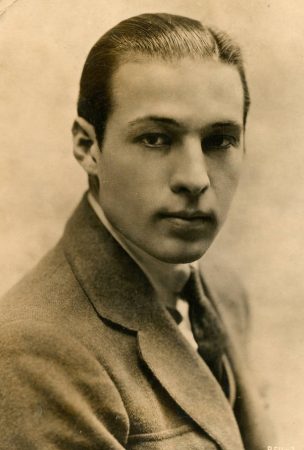
Screen heartthrob Rudolph Valentino, ca. 1924. (Courtesy University of Washington Special Collections, Order No. JWS20048)
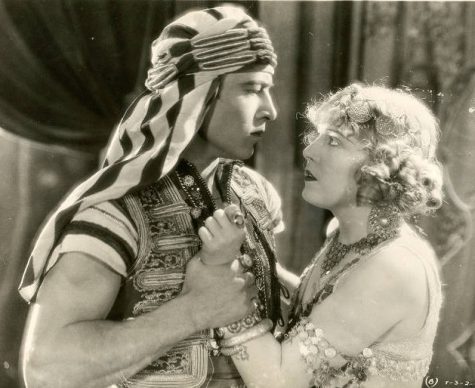
Rudolph Valentino and Agnes Ayers in "The Sheik" (Paramount, 1921). (Courtesy University of Washington Special Collections, Order No. JWS20032)
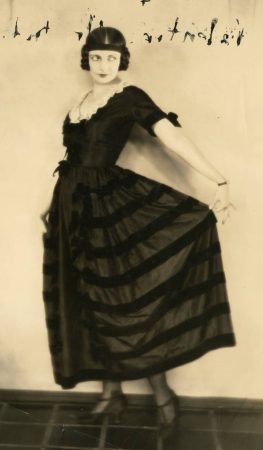
Actress Natacha Rambova, ca. 1922. (Courtesy University of Washington Special Collections, Order No. JWS13649)
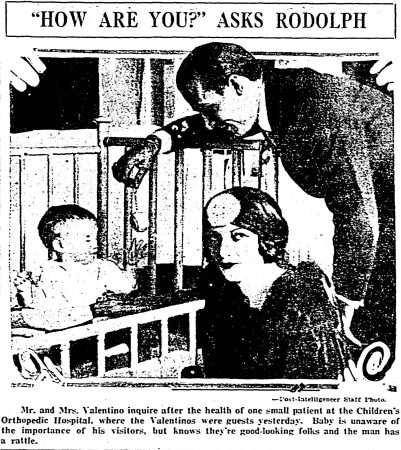
Rudolph Valentino and Natacha Rambova tour Children's Orthopedic Hospital in Seattle, June 1, 1923. (Seattle Post-Intelligencer, 2 June 1923, Page 3)
A Matinee Idol: A Collection of Promotional Appearances
Act III: Rudolph Valentino
Like Nell Shipman, Seattle saw numerous other stars make personal appearances in support of their latest motion picture efforts. Sydney Chaplin, for instance, Charles’ older half-brother who himself forged a modest film career during the silent era, visited twice – once in 1918 and again in 1925, when he arrived in town along with director Charles Reisner. Many of the era’s other known visitors are little remembered today – figures such as Anna Q. Nilsson, George Beban, Hoot Gibson, and child actor Wesley Berry (who, incidentally, appeared at the Coliseum the week following Nell Shipman’s visit), among others.
Yet at least one other solo appearance by a silent star is worthy of detail, since it was his only such visit to Seattle, and was made in the midst of a dispute the star was having with his studio: Rudolph Valentino, very near the height of his popularity as a screen artist, who arrived in June 1923 on a dance tour that gave local audiences a glimpse of his famous Argentine tango. During his stay, “the Sheik,” as he was referred to by enthusiasts (and detractors), also lent his persona for a fundraising effort on behalf of Children’s Orthopedic Hospital.[1]
Born on May 10, 1895, in Castellaneta, Italy, Rodolpho Gugliemi – not an academically-inclined young man – flunked out of an Italian military academy and, after briefly entertaining thoughts of becoming a farmer, fell into the easygoing café lifestyle of Paris. Seemingly without ambition, the relocation to Paris was a brief and unpromising time, where the young Rodolpho often teetered on the brink of poverty. In December 1913, looking for new opportunities, he took leave of Paris for New York City.
Once in America, the young man took several odd jobs in order to pay the bills – for a short time he was a gardener on Long Island – though he was eventually drawn back into the world of bohemia, this time in New York. Returning to café life, he had the opportunity to show off his dancing skills, particularly the tango, a talent that landed him a job as a dancing partner for Bonnie Glass. Though a friendship with actress Alla Nazimova, Rodolpho eventually secured his first stage work in the late teens. Soon after he was introduced to the film business, moving to California and taking a number of small supporting roles, but earning little recognition for his work.
Someone who did take notice, however, was scenarist June Mathis, at the time working on the script for the World War I epic The Four Horsemen of the Apocalypse (Metro, 1921); after seeing Valentino onscreen, she felt the actor would be ideal for the central role of Julio.[2] Director Rex Ingram agreed to take a chance on the young actor, and following its overwhelming popular success, Valentino – the actor had changed his name shortly before arriving in California – was a star of considerable magnitude. With the release of The Sheik (Famous Players-Lasky,1921) later that year, Valentino’s reputation as an exotic screen lover was set.
Interestingly, Rudolph Valentino arrived in Seattle with his second wife, Natacha Rambova, a woman who would have a major influence on his screen career. Born Winifred Shaunessy, Rambova too was a dancer, and a woman who cultivated exotic tastes – working as a set designer for Alla Nazimova, she helped create the actress’s stylized sets for 1923’s Salome and costumed several of Valentino’s own films. Believers in the occult, she and Valentino married despite lingering questions about the formal end of Valentino’s first marriage to actress Jean Acker, whom he had wed in the late teens. (Valentino, in fact, was subjected to court proceedings for his alleged bigamy.) During their marriage Rambova asserted a good deal of influence over Rudolph Valentino’s film projects and his screen image, such that she was passionately disliked by both directors and studio executives who resented her interference.
During their Seattle visit in 1923, Rudolph Valentino and Natacha Rambova had only been legally married for about 10 weeks and were in the midst of a dispute with the actor’s studio, Lasky-Paramount. Valentino was formally protesting the cheap program films to which he had been assigned and the distribution practice of block booking, resisting the studio efforts to force him into work. Lasky-Paramount eventually had Valentino suspended, even obtaining a court injunction preventing the actor from appearing onscreen until his contract officially expired in February 1924.
The studio felt they had called Valentino’s bluff, since he and Rambova were heavily in debt at the time, but the couple instead chose to mount a personal appearance tour organized by George Ullman (later Valentino’s business manager) and sponsored by the Minerlava beauty clay company. For 17 weeks the pair gave dance exhibitions across the United States for a reported $7,000 per week, keeping Rudolph Valentino in the public eye and based on their commercial pitches for Minerlava, providing the company with invaluable exposure. The tour began early in 1923 in Wichita, Kansas, and proved a resounding success in most locations.[3]
Despite the genuine excitement that Rudolph Valentino brought to almost every stop on his itinerary, the star’s arrival in Seattle was relatively low-key. The Valentinos arrived late on May 30, 1923, traveling from Spokane in the star’s private rail car. From the station, where the couple was to arrive at 9:40 p.m. in the evening, they were whisked directly to the Hippodrome at Fifth and University, where Valentino was to help judge a combination dance contest and beauty pageant scheduled for 10:00 p.m. According to publicity for the event, the pageant served as a national search to help find the star’s next leading lady (a role that eventually went to veteran screen actress Bebe Daniels).
Unfortunately, because their train arrived later than expected the Valentinos entered the Hippodrome well after the dancing competition had concluded, then sat with other judges behind a curtain throughout the beauty pageant, concealing the actor from most of the audience. When all was said and done, Valentino personally selected Katherine Cuddy, a stenographer, as the contest winner, turning down Mayor Edwin J. Brown’s tongue-in-cheek challenge on behalf of an unidentified contestant. (Hopefully the girl didn’t know that the Mayor was championing her cause, for the next day it was widely reported that Valentino rejected Brown’s candidate on the grounds of having poor teeth.[4])
While they missed the dance contest, the Valentinos followed the beauty judging with an electrifying demonstration of their Argentine tango, recreating the famous dance scene from The Four Horsemen of the Apocalypse. Both were dressed for the part; as one account put it, “(i)t is in Rodolph’s [sic] blood to wear black velvet pantaloons and stamp his black patent leather boots and click castanets. His manner was quite Argentine; his hair quite brilliantine.”[5] For her part, Mrs. Valentino was also clad in black velvet, offset with a red, Carmen-like shawl. “[She] is very brave to put on a ten-dollar pair of black silk stockings so close to her partner’s three-inch silver spurs,” noted Times reporter Dora Dean.
Dean managed to sneak backstage after the exhibition and take a spot in Rudolph Valentino’s dressing room, where the actor was quite blunt with guests about the attention he had been garnering. At the Hippodrome, for instance, the moment the Valentinos arrived at the venue, a large crowd of girls (“starving for romance,” the actor noted with disdain) surged toward the stage. Adoration of the type was wearing on Valentino, as it overshadowed his attempt to be taken seriously as a performer.
“From persons who saw the Four Horsemen I have received intelligent letters of appreciation,” [Valentino] said. “I like them better than the adoring notes from little girls who want me for their sheik.”
“But what are you going to do, when all those darling girls want to see you ride on the desert and gnash your teeth?” he was asked.
“Ah, they should stay at home with their husbands,” said the slick-haired actor.[6]
Wanda Von Kettler, writing for the Star, also managed to get herself into Valentino’s dressing room at the Hippodrome, which, from her account, was a crowded place indeed. Mingling amongst a sea of fans were Seattle Mayor Edwin J. Brown and Washington Lieutenant Governor “Wee” Coyle.
Beside Rodolph [sic] sat Mrs. Valentino, his tall and slender brown-eyed wife, in her Argen- tine dancing costume…
He surveyed his guests. Then told them that he wasn’t a “sheik.”
“Of course,” he declared, with a somewhat resigned laugh, “I’ve gotten considerable publicity because of the name. But I don’t know if it’s been the right kind of publicity. The very sentimental girls think I’m all right. They like me. But what about the intelligent women – and the men? Don’t they think I’m a mollycoddle? They do. When I go back in pictures, after the fight with the movie concern is over, I’m going to prove that I’m not the type they think I am…”[7]
Valentino plans to write a book. He confided so to some of us Wednesday night.
“It’s going to be a book on the tango,” he declared. “I’m going to teach all America to dance that dance. Everybody seems to like it, so why not help them learn it. Dancing,” he added, “is the greatest stimulant of the day, and is more and more being recognized as such. Since the event of prohibition it has increased 50 per cent.”
Valentino doesn’t “mind” the letters he receives from admiring ladies.
“I’m very glad to know,” he explained Wednesday night, “that I’m being appreciated. I like to hear the opinion of the public, whether it’s for or against me. But I know the ladies aren’t ‘in love’ with me. They’re in love with an ‘ideal’ and they sometimes write to me as a result.”
As for Mrs. Valentino – being a sheik’s wife doesn’t bother her at all. When asked about her stand on the matter, she laughed and replied, “I want him to be popular. The more popular he is, the better I like it.”[8]
Following the Hippodrome contest (during which, interestingly, press reports made no mention of the couple promoting Minerlava or any other product), the Valentinos traveled northward for scheduled appearances in Vancouver, British Columbia. But they returned to Seattle two days later for a visit to Children’s Orthopedic Hospital, where the couple were guests of honor at the institution’s annual “Pound Party.” A fundraising event, the benefit took its name directly from its open request: in lieu of donations, the Hospital would accept of pound of anything – food, clothing, etc. – which could be used to help those in need.
Although the Seattle weather didn’t cooperate with the outdoor portion of the Pound Party, the Valentinos were certainly the hit of the function. A spokesman later declared the event as the most successful in the history of Children’s Orthopedic, netting a record amount of food and clothing and almost $400 in donations, $10 of which came from the actor himself. Credit for the success was given solely to Rudolph Valentino’s appearance, which garnered much more interest than past charity drives. It also attracted hundreds of fans, mostly young women, to the front lawn of Hospital, hoping to get even a quick glimpse of the actor as he came and went from the gathering. Thankfully, however, the throng outside conducted themselves in an orderly fashion and the Party went off without a hitch.[9]
After participating in an afternoon tea and reception, the Valentinos went from bed to bed throughout the Hospital, visiting almost every child and showing a sincere concern for the work being done at Children’s Orthopedic. “A few of the sheik’s queries concerning child culture demonstrated a decided lack of knowledge on the subject but a willingness to learn,” the Post- Intelligencer got several nurses to admit afterward. “He was quite exercised over the lack of teeth in the mouth of one baby, age eight days.”[10] After the Pound Party concluded, the Valentinos managed to slip quietly out of the city, making their way first to Tacoma, then back down the coast toward Hollywood.
The last word on Rudolph Valentino’s only appearance in Seattle was left to the Star, which regularly ran a column entitled “Letters from Chief Seattle,” after the city’s Indian namesake.
Dear Rudy:
I have met many movie stars, and most of them were painfully conceited. I am glad to see that egotism plays but little part in your character. It is more or less evident that you have been grossly caricatured by envious persons. Come back to Seattle soon and stay longer.
CHIEF SEATTLE[11]
Although Rudolph Valentino’s lone Seattle appearance was spurred by his prohibition from appearing onscreen, the star eventually came to an agreement with Lasky-Paramount about six weeks after his visit, allowing the actor to return for an additional two films at $7,500 per week. More importantly, however, the agreement gave the Valentinos creative control over both projects.
The triumph for the actor, however, was short-lived. After finishing his Lasky-Paramount contract, Rudolph Valentino jumped to United Artists, where studio executives were adamant that Natacha Rambova could not interfere with their pictures. Valentino agreed to that stipulation, but it led to conflict within the marriage and helped bring about its demise. The actor made two of his better films with United Artists, The Eagle (1925) and The Son of the Sheik (1926), a sequel to his monster 1921 hit. But, in August 1926, Rudolph Valentino was suddenly hospitalized in New York, suffering from a perforated ulcer. There, unexpectedly, the actor died in the midst of a fairly routine operation.
His death created a hysteria of legendary proportions. Crowds swarmed the streets near the funeral home, with unconfirmed reports that several young women had committed suicide out of grief. Even to this day Rudolph Valentino has remained a popular figure, despite the fact that his pictures are not widely shown and, to modern audiences, his performances in films like The Sheik (where Valentino deliberately played in an exaggerated manner) appear ludicrous. How could audiences have ever seen Valentino as a romantic archetype when his seduction methods involved bulging eyes and flared nostrils? (The actor’s friend, journalist Adela Rogers St. Johns, once provided her own view: Valentino’s onscreen stare had less to do with acting than his poor eyesight. “He didn’t want to sweep you into a mad embrace,” Rogers noted, “he just wanted to know who you were.”[12])
Nonetheless, Rudolph Valentino’s continued popularity has led more than a few commentators to wonder what would have happened had the actor lived, particularly with the coming of sound film, only a few years away. Author Kalton Lahue was one who speculated on the actor’s fate.
[Rudolph] Valentino was a product of the age in which he lived, and historians have often speculated as to how Valentino’s career might have gone had it not been for the tragedy of a gallstone operation that proved fatal. There’s little doubt in my mind that the Great Lover would have faced the same fate that awaited Jack Gilbert, who lived to see his own career slowly dissipate beneath his capable feet as the vogue that had swept him to the top disappeared. Rudy might well have pushed into the sound era, but changing public tastes would certainly have ended his reign, regardless of the quality of his voice. And which is the greater burden to carry – death at the peak of a career that insures immortality among the greats of the screen, or the living death of a career which crumbles about the feet of its creator, rendering him a pitiful impotent remnant of a legend destroyed and an era passed by?[13]
Regardless of whether Rudolph Valentino would have made the transition to sound, the fact remains that his mystique as an exotic lover has remained with us for decades and is known even to those who have never seen his films. As with Theda Bara, he’s a figure whose popular screen persona became much larger than any one of his motion pictures. The subject of two poorly received screen biographies (in 1951 and 1977), Rudolph Valentino to this day remains stands as a symbol of silent cinema and of America during the Jazz Age.
By Eric L. Flom – January 2026
Notes:
[1] In 2000 an early version of this section, detailing Rudoph Valentino’s visit to Seattle, appeared as Eric L. Flom, “Screen heartthrob Rudolph Valentino makes personal appearance in Seattle on May 30, 1923,” HistoryLink (https://www.historylink.org/File/2605), accessed 27 April 2025.
[2] Prior to becoming one of the silent screen’s most respected scenarists, with credits that included director Rex Ingram’s The Four Horsemen of the Apocalypse (1921), Blood and Sand (1922), and MGM’s massive silent production of Ben Hur (1925), June Mathis plied her trade as an actress. She is known to have played Seattle at least four times, once each in 1908 and 1909 in the touring production of Brewster’s Millions, and again in 1912 and 1913 while supporting female impersonator Julian Eltinge in The Fascinating Widow. In Eltinge’s company, Mathis was one of the play’s few female characters that wasn’t actually a man in drag.
[3] Interestingly, while Valentino’s opening engagement in Wichita was a success, a stopover in Kansas City appears to have gone in the opposite direction. As would be the case in Seattle, the Valentinos arrived in their own private train car and made little more than a cameo appearance at the planned festivities. “[Valentino] appeared before the crowd of spectators for fully ten minutes, five minutes of his time in an attempt to impress the public with a speech. The other five minutes he and Winifred Hudnut danced. Then Rodolph [sic] vanished and the crowd went on dancing, very much disappointed.” (“The Sheik and the Shekels,” Moving Picture World, 7 April 1923, Page 630.) At the very least Rudolph Valentino learned how to better handle the press during his tour. In Seattle he held court with several reporters after the show, whereas during his earlier appearance in Kansas City he was specifically chided for being inaccessible.
[4] “Rodolph [sic] Picks Stenographer Beauty Queen,” Seattle Post-Intelligencer, 31 May 1923, Page 3. Later that fall, Katherine Cuddy traveled east to represent Seattle in the final beauty contest and possibly earn herself a role in Rudolph Valentino’s next film. (“Seattle,” Motion Picture News, 17 November 1923, Page 2391.)
[5] Dora Dean, “Rodolph [sic] Valentino, Here to Dance, Urges Sheik Hunters to Stay at Home,” Seattle Daily Times, 31 May 1923, Page 4. “Valentino was the inventor of greasy hair,” a columnist from the Seattle Star kidded. “He put it on a paying basis and made the manufacture of goose grease the fourth largest industry in the United States…The barber supply companies are now negotiating with Valentino to popularize dandruff. They estimate that if this celebrated actor will appear in a play called The White Collar they can put a patented dandruff powder on the market and inside of two months 19,789,028 youths will appear on the public streets with a pound of dandruff sprinkled over their collars.” (“‘The Sheik’ is Coming! Tremble, Little Shebas,” Seattle Star, 30 May 1922, Page 9.)
Incidentally, Valentino was quite sensitive to comments about his image. Shortly before his premature death, the actor was incensed by an editorial in a Chicago newspaper titled “Pink Powder Puffs,” in which the writer asserted that Valentino’s popular screen image had done much to “femininize” American men. The actor was so enraged that he openly challenged the journalist to a fistfight to settle the score.
[6] Dora Dean, “Rodolph [sic] Valentino, Here to Dance, Urges Sheik Hunters to Stay at Home,” Seattle Daily Times, 31 May 1923, Page 4.
[7] Rudolph Valentino expressed similar sentiments (though likely through the pen of a ghost-writer) in a syndicated article that appeared in the Daily Times three months prior to his Seattle visit. Emanating from Chicago, the article responded to a number of comments attributed to him that he claimed never to have made. Part of the article, however, dealt with the nature of his evolving fame. “Until I appeared in The Sheik, I enjoyed the homage of men and women alike. Everybody seemed to be pleased with my work in The Four Horsemen, but the men began to turn against me when the newspapers, urged on by the press agents for The Sheik, began calling me “Rodolph [sic] the Heartbreaker,” and similar terms. I played the part exactly as I was directed. I have never ceased to regret that I ever played The Sheik because the additional friends that it made for me among the women do not compensate me for those it lost for me among the men.” (Rudolph Valentino, “Valentino Denies He’s a Sheik; Not Playing Part in Daily Life,” Seattle Daily Times, 4 March 1923, Page 3.) Interestingly, following Valentino’s return to the screen his first release was Monsieur Beaucaire (1924), a costume drama championed by Natacha Rambova that presented her husband in a very effete manner.
[8] Wanda Von Kettler, “Valentino Tells Guests That He is Not a Sheik,” Seattle Star, 31 May 1923, Page 20.
[9] “Valentino and Wife Attend Pound Party,” Seattle Daily Times, 2 June 1923, Page 2.
[10] “Tots Visited by Valentinos and the Nebbs,” Seattle Post-Intelligencer, 2 June 1923, Page 3.
[11] “Letters to Chief Seattle,” Seattle Star, 4 June 1923, Page 3.
[12] Adela Rogers St. Johns, The Honeycomb (Garden City, New York: Doubleday, 1969), Page 196.
[13] Kalton C. Lahue, Gentlemen to the Rescue: The Heroes of the Silent Screen (New York: A.S. Barnes and Company, 1972), Pages 216–217.
Promotional playing card of actress Beatriz Michelena, ca. 1916. (Movie Souvenir Card Co., Cincinnati, Ohio)
The dashing Wallace Reid, ca. 1921. (Courtesy University of Washington Special Collections, Order No. JWS19630)
Pathé star Frank Keenan, ca. 1919. (Courtesy University of Washington Special Collections, Order No. 20167)
Comedienne Fay Tincher, ca. 1922. (Photo by the Evans Studio, courtesy University of Washington Special Collections, Order No. JWS21473)
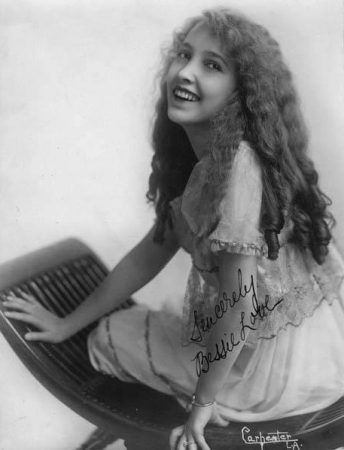
Actress Bessie Love, ca. 1916. (Photo by the Carherter Studios, courtesy University of Washington Special Collections, Order No. SOC4072)
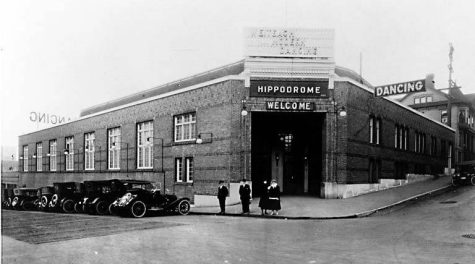
Undated photo of the Hippodrome at 5th and University in downtown Seattle. (Courtesy University of Washington Special Collections, Order No. SEA0993)
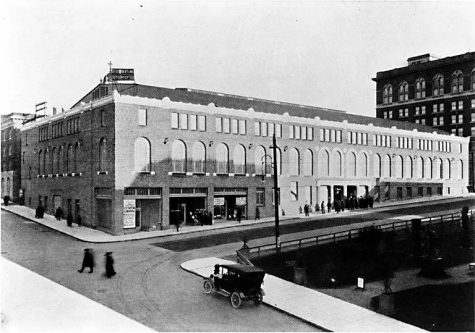
The Arena on 5th Avenue, just across the street from the Hippodrome, ca. 1930. (Courtesy University of Washington Special Collections, Order No. SEA1354)
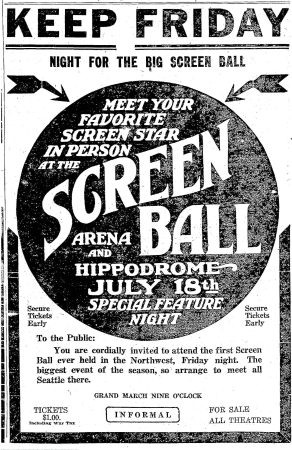
Screen Ball advertisement, July 1919. (Seattle Daily Times, 16 July 1919, Page 12)
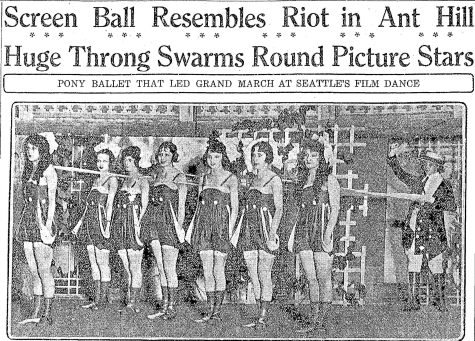
Grace Oswald and her Pony Ballet kick off the 1919 Screen Ball. (Seattle Daily Times, 19 July 1919, Page 4)
A Matinee Idol: A Collection of Promotional Appearances
Act IV: The Screen Ball of 1919
Appearances such as William S. Hart’s or Rudolph Valentino’s demonstrated the power of celebrity as a drawing card, whether for patriotic or commercial purposes. Yet perhaps the largest and most elaborate set of personal appearances in Seattle by any silent film stars occurred in July 1919, in conjunction with the annual meeting of the Allied Film Board of Trade of the Northwest. The Board was an exhibitors group that included motion picture men from Washington, Oregon, Idaho, Montana, western Canada and Alaska; their intent, according to the trade magazine Motion Picture News, was to develop a coordinated system of booking special feature films on the open market.[1] Only recently formed, the Seattle gathering served as the organization’s first annual convention. Although much of the meeting was taken up with official business, which in itself wasn’t all that notable, the week concluded with Seattle’s first-ever “Screen Ball,” a public celebration that promised to attract several famous Hollywood figures.
The idea of a public ball with appearances by well-known screen stars wasn’t altogether new, for as Eileen Bowser has pointed out, such dances – frequently associated with industry meetings or gatherings – played an important role in the developing star system in the early teens, continuing for many years thereafter.[2] Such gala affairs generated tremendous enthusiasm from motion picture fans, not to mention loads of free publicity for the stars and their studios. Seattle held to form, particularly once the list of confirmed attendees was announced: former opera singer and Mutual leading lady Beatriz Michelena, Christie comedienne Fay Tincher, Pathé dramatic star Frank Keenan, Vitagraph’s Bessie Love, and Famous Players-Lasky heartthrob Wallace Reid.
The actual convention began on Wednesday, July 16, 1919, with a general open house for attendees amongst Seattle’s various film exchanges and motion picture houses. A day of travel for most, virtually the only task for conventioneers was to register at the Crary Building at Fifth and Union, after which they had free run of the city for the rest of the day. The following morning, July 17th, at 10:00 a.m., the gathering hunkered down in the Frederick & Nelson auditorium to begin in earnest, with early morning reports on credentials, activities and finances, followed by a luncheon with remarks from Seattle Mayor Ole Hanson and Washington Governor Louis F. Hart. Following the afternoon business session, a stag dinner was planned and hosted by several local exhibitors. On Friday, July 18, the second and last day of the convention, official business consisted of electing new officers to the Board and identifying a site for the 1920 gathering. On Saturday, those conventioneers remaining in Seattle were scheduled to travel by boat to nearby Bremerton, where they would be entertained at the Puget Sound Naval Station.
For the filmgoing public, however, most of the attention focused on Friday night’s finale, the Screen Ball, which was thrown open to all Seattle at a cost of one dollar per person, which included the war tax then in effect. The affair was a large one: two of the city’s largest halls were rented for the occasion, the Arena and the Hippodrome, with the portion of University Street separating them closed to traffic. A parade, featuring not only the film stars but conventioneers and dignitaries as well, was scheduled to begin promptly at 9:00 p.m., and would wind through both halls. Paramount on most people’s minds, however, was the opportunity to spend a few private moments on the dance floor with the likes of Bessie Love or Wallace Reid; at least one local dance teacher, Estelle Bright, took out newspaper ads encouraging Seattleites to drop in for some last-minute instruction prior to the gala event.[3]
Predictably, throughout the week of the convention Seattle newspapers focused not on the business of the Allied Film Board of Trade, but the comings and goings of the various celebrities connected with the Screen Ball. And ironically, though convention organizers and studio publicists devised a number of attention-grabbing events throughout the week, their plans were initially undone. The first of the stars to arrive was Beatriz Michelena, traveling north from San Rafael, California, who managed to slip into Seattle completely unnoticed on Monday, July 14th. Michelena, whose father Fernando had been an operatic tenor of note, was attempting at Mutual to jump from the opera stage to the motion picture screen. Her film career never really amounted to much, Salomy Jane (California Motion Picture Corporation, 1914) being one of her few notable accomplishments. Michelena worked on both stage and screen until her retirement in 1927, often under the direction of her husband, George Middleton. She died at age 52 from complications following surgery.
Beatriz Michelena, it seems, was still learning the art of being a celebrity, for she slipped into Seattle with no fanfare and – unlike the stars that would follow her – without a publicity man in tow. Convention organizers, in fact, didn’t even realize she had arrived until they received a telephone call from the actress asking where she was supposed appear.[4] This apparently set officials scrambling for some sort of impromptu welcome ceremony, though their harried efforts seem to have met with some resistance from Michelena, who didn’t really want to make a fuss.
Still, she acquiesced, and on July 17th, three days into her Seattle visit, organizers re-staged her arrival, this time with the appropriate pomp and circumstance. “Amid the cheers and applause of hundreds of enthusiastic and curious lovers of the silent drama and the din of automobile horns Beatriz Michelena, the singing star of the screen, arrived in town Thursday noon,” wrote the Post-Intelligencer, after previously reporting her arrival a few days earlier. Without her own entourage, convention officials accompanied the actress as she rode in an open car up Second Avenue, tossing roses into the gathered crowd. As motion picture cameras cranked away – cameramen were on hand to capture almost all of the week’s events – the parade continued up to the Masonic Temple at Harvard and East Pine, where Michelena was treated to a large banquet and received a key to the city, an honor shared by none of the other visiting celebrities.[5] Pathé star Frank Keenan, by then having arrived in Seattle himself, was an unobtrusive presence at Michelena’s banquet, though he did rise at one point to toast her as “one of the foremost emotional actresses of the screen.”
Keenan, in fact, was the second screen idol to make an appearance, arriving at noon on July 15th along with Fred C. Quimby, national manager for Pathé’s film exchanges. Prior to entering motion pictures, Keenan had been a successful stage actor, having worked with Sol Smith Russell and, later, David Belasco. He came to the film world via the Triangle Company, with his first release The Coward (1916) becoming one of the few truly notable films turned out by that organization. Keenan emerged as one of Triangle’s more visible box-office attractions (enough to be lured away and start his own production company), but his appeal as a screen actor was limited, with his career as a popular star on the wane by the early 1920s. Keenan died on February 24, 1929, his last public appearances spent performing onstage, typically in vaudeville.
Even though Frank Keenan managed to arrive rather casually, without a host of fanfare at the train station (barring convention representatives), his itinerary was booked solid. He had little time, for instance, to situate himself at the New Washington Hotel before rushing out to the Duthie Shipbuilding Company, where the actor was one of the many figures on hand to launch the steamship Seattle Spirit. At this event Keenan was slated to raise a ceremonial flag, given to the city following an extremely successful Liberty Loan drive to raise funds for the war.[6] (That drive, incidentally, was the same one that brought William S. Hart to Seattle the previous year, when he made his “patriotic” speech at the Masonic Temple – the same location where Beatriz Michelina had her arrival banquet in 1919.)
The launch, delayed almost two hours by guest speakers and the introduction of various luminaries, was quite impressive. The first speaker was the Rev. Mark A. Matthews, who had introduced William S. Hart at Seattle’s First Presbyterian Church the year before, and who apparently caused “gasps of astonishment from the feminine members of the assemblage by the emphasis of his remarks.” (Press accounts failed to report the nature of Reverend Matthews’ comments.) He was followed by Seattle Mayor Ole Hanson, who, “in his customary manner,” the Post-Intelligencer reported, “flayed the Bolsheviki.”[7] Hanson was followed immediately by Frank Keenan, who seemed quite impressed by the entire ceremony, and who “addressed the gathering on the significance of ships.”[8] As tedious as that sounds, the actor apparently made a favorable impression with his observations.
A far more elaborate arrival was given shortly after Frank Keenan’s initial appearance, when the train carrying Christie comedienne Fay Tincher pulled into Seattle. Born in 1884, Tincher – formerly in musical comedy on Broadway – was, like Keenan, a graduate of the Triangle Company, having worked previously with the likes of D.W. Griffith (during the director’s post-Biograph stint with Reliance-Majestic), Sir Herbert Beerbohm Tree and DeWolf Hopper. Tincher was readily identifiable in her early comedies by the characteristic black and white striped outfits she wore, a holdover from an early Komic comedy series she made prior to her stint with Triangle. Although she worked onscreen for much of the silent era, her greatest successes came in the teens, and she left Hollywood altogether toward the end of the 1920s. She died in New York in 1983.
As had been announced for several days prior to her arrival, Fay Tincher disembarked her train at the King Street Station dressed in the western costume she had worn in her most recent Christie release, Rowdy Ann (1919), and was met at the station by about 20 mounted cowboys and Indians, most of whom were police officers dressed for the part. The entourage included not only “Teddy” Hanson, the Mayor’s son, but also Chief of Police Joel F. Warren, who dressed in a rather infamous Buffalo Bill outfit that he was known to drag out on occasion. Tincher immediately vaulted onto a spirited horse, proving herself an excellent rider, and lead the group up Second Avenue to the New Washington Hotel, where most of the screen stars stayed while in Seattle.
If the sight of 20 or so mounted riders in the middle of a busy street wasn’t enough to grab people’s attention, Tincher saw to it that no one within earshot missed her arrival. “Arrangements were made by Chief Warren to have a gun of generous size for Miss Tincher so she could ‘shoot up’ 2nd Avenue.”[9] Tincher was not alone in her fun; all the way up the street the horsemen apparently engaged in a mock battle between the cowboys and Indians, and the ringing sound of blank cartridges could be heard for blocks. “The program called for a noisy reception,” noted the Post-Intelligencer, “and the chief lived up to his part of the bargain. In fact, a number of spectators inquired if it was Bill Hart who was kicking up all the rumpus.”[10]
Although the event was fun and games to the Daily Times and the Post-Intelligencer, the writer for the Star (which ran Tincher’s stunt under the sensational front-page headline “Girl Kidnapped in Broad Daylight on Streets of Seattle!”) found the racket a bit disconcerting. “[Mayor Hanson] supposedly appointed [the] chief of police for the purpose of preserving law and order. Warren flourished a pistol in a most reckless manner and fired round after round of shots into the air…It made me sore to think that all that crowd lined the streets like a lot of goofs and let
Warren and his gang get away with stuff like that. If any other gang shot up the street like that, I’ll bet Warren would put ’em in jail.”[11]
Just one day after her arrival, the Star ran a second piece on Fay Tincher. The story had the comedienne publicly challenging boxer Jack Dempsey for the world heavyweight title – a photo still provided by Tincher’s handlers even showed Dempsey visiting the actress on the set of one her films (most likely Rowdy Ann). Tincher can be seen clocking the champion upside the head, much to the delight of a group of extras in the background. The article also included a tale of the tape, which showed Jack Dempsey holding a slight advantage: he was over a foot taller, had a reach 14 inches longer and outweighed Tincher by 85 pounds.
After explaining her interest in boxing in some detail – which predictably included references to some fights scenes in one of her recent films – she demonstrated some of her moves for the Star’s reporter.
After a left cut at the atmosphere, she chortled and remarked that it was a blooming good thing she hadn’t combed Alexander Pantages Thursday evening.
“You see, we were dancing and I had a desire a couple of times to clip him one in the jaw,” she said in explaining the affair. “But he was such a dear I just couldn’t. But I do want a crack at this bird Dempsey. I hope he doesn’t run out on me, because I’m in the pink.”[12]
Thank fully the Star reassured readers that the feisty actress wasn’t a threat to the public. “Miss Tincher promises she will refrain from the heavy stuff at the dance tonight.”
Perhaps even splashier than Fay Tincher’s arrival in Seattle was the one devised for Wallace Reid. Reid, of course, had become a considerable box-office draw at Famous Players–Lasky, what with his adventuresome spirit and dashing good looks, yet like Roscoe Arbuckle he is now more famous for his downfall than for his actual motion picture work. Born in 1891, Reid was the son of Hal Reid, an actor and playwright of some accomplishment. When the elder Reid went into motion pictures around 1910, first writing scenarios for Selig, his son Wallace managed to break into the movies as an actor. Although he had appeared in numerous films and with various companies by 1915, his small part as Jeff the blacksmith in D.W. Griffith’s The Birth of a Nation got him noticed. Soon afterward he was engaged by Famous Players–Lasky as a leading man, playing opposite, among other actresses, Geraldine Farrar, notably in a version of Carmen (1915) and Joan the Woman (1917), both directed by Cecil B. DeMille. Eventually he became a box-office draw in his own right in a variety of dashing leading man roles, and though very few of his films stand out now as being as notable, the quality and frequency of his screen appearances was impressive. As Richard Koszarski has pointed out, between 1916 and 1922 Wallace Reid made more films than many of his contemporaries (sometimes averaging a new release every seven weeks), a staggering pace for a star of his caliber.[13]
Tragedy, however, brought an end to Wallace Reid’s life, and the scandal surrounding his death subsequently tarnished his name. During the making of The Valley of the Giants (Paramount, 1919) which Reid was shooting a mere four months before his Seattle appearance, a studio physician administered morphine to the actor following an on-set injury. Reid was soon taking morphine for more than just his recovery – and, coupled with a predilection for drink, was soon balancing his hectic shooting schedule with a pair of addictions. Though the downward spiral was slow, Reid eventually collapsed on the set of one of his films and lapsed into a coma. He died on January 18, 1923, at the mere age of 30.
Revelations about Reid’s death could not have occurred at a worse time. Hollywood, then reeling from not only the Roscoe Arbuckle trials but also the unsolved murder of director William Desmond Taylor, was faced with the drug-related death of one of its brightest talents. With headline-making events such as the Arbuckle and Taylor cases already casting the motion picture industry in a negative light, Reid’s death was swept aside as quickly and as quietly as possible. “Those inside the industry who knew the truth collectively repressed the whole affair,” Richard Koszarski has noted. “Within a few years, it was as if Wallace Reid had hardly existed.”[14]
While in Seattle, however, Wallace Reid wasn’t yet the tragic figure he would become, and he was arguably the star most eagerly anticipated by local movie fans, or at least those of the female persuasion. And true to his dashing screen image, he (like Fay Tincher) arrived in the city in his own characteristic style.[15] Rather than disembark the train in Seattle, as all the other film stars had, Reid was instead scheduled to make neighboring Tacoma his destination, allowing him to put in a few quick appearances there. From Tacoma, Reid commandeered a Stutz Bearcat roadster for the drive up to Seattle, making promotional stops in the cities of Auburn and Kent along the way. Reports claimed the car was not unlike the one used in The Roaring Road (Paramount, 1919), one of Reid’s most recent motion pictures, where he played a racecar driver attempting to set a speed record between San Francisco and Los Angeles.[16] Northwest racing figure Jim Parsons – who, perhaps not-so-coincidently, was also a Stutz dealer in Seattle – provided the car for Wallace Reid’s journey northward and accompanied him on the drive.
The actor, however, doesn’t seem to have been informed that his destination was Tacoma, for he continued on the train all the way to Seattle, arriving several hours earlier than expected. When informed of the mistake, Reid put in a quick appearance in front of the offices of the Daily Times (where he posed for photographs with female staff members) before he and his handlers hustled themselves into a different car, sped out of Seattle and down to Tacoma, where hundreds of fans were waiting for the actor at the train station, the Pantages Theatre, and several area movie houses. Somewhere along the way, Wallace Reid changed from his dress suit to the auto racing costume he wore in The Roaring Road, met up with Parsons (also in a racing uniform), made his personal appearances and doubled back for Seattle.
Lawlessness ruled during Fay Tincher’s arrival in Seattle, and so it was for Wallace Reid’s motor tour. “County and city officials let down the bars as to exceeding the speed limit, and ‘Wally’ was scheduled to ‘burn up the road,’” noted the Daily Times of Reid’s arrival.[17] Similarly, the Post-Intelligencer, after the actor reportedly attempted some sort of speed record between Tacoma and Seattle, later observed “were the speed cops present, Wally would be out a neat sum in fines.”[18]
Unlike other film stars present for the Screen Ball, Wallace Reid also had a gimmick to promote during his visit: he was publicly advertising for a new leading lady for his upcoming film Hawthorne of the U.S.A. (Paramount, 1919), and was encouraging young women to submit a photograph of themselves with a detailed list of their “qualifications” for the position. Applicants had but 36 hours after Reid’s arrival to submit their entries.[19] (Though hundreds of girls applied, the contest – much like the one Rudolph Valentino would promote in Seattle four years later – was more of a publicity ruse. Actual leading lady honors for Hawthorne of the U.S.A. went to Lila Lee, a Famous Players–Lasky regular.)
The last of the motion picture figures to arrive in Seattle for the Screen Ball was Vitagraph star Bessie Love. Born in 1898 in Midland, Texas, Love – like Wallace Reid – got her big break in motion pictures via her connection to D.W. Griffith. Although not as one of his featured actresses (despite having a bit role in Intolerance), she starred or co-starred in a number of releases through the Fine Arts Studios, the Griffith arm of the Triangle Company. While never a major star with Triangle (early on, her fame stemmed from appearances opposite William S. Hart and Douglas Fairbanks), she was nonetheless a reliable leading lady, and unlike many actresses stayed onscreen through the sound era, and even acted into the 1980s. Interestingly, from a historical standpoint, one of her showy roles from the early twenties would be in Human Wreckage (T. Ince Film Corporation, 1923), an anti-drug film made by Mrs. Wallace Reid shortly after her husband’s death.
At barely 21 years of age, Bessie Love had already established herself as a dependable box-office attraction. Upon arriving in Seattle on the afternoon of Thursday, July 17, the day before the Screen Ball and long after many of the early publicity stunts had already been staged, the actress forewent an extravagant welcome and got right down to business. In what seems to have been one of only two pre–Ball appearances, Love deposited her luggage at the New Washington Hotel then headed for the offices of the Daily Times, a few blocks east, where she posed for pictures and pledged to “help make the motion picture convention and ball a huge success.”
The varied comings and goings of the motion picture stars seems to have put a crimp into the plans of convention organizers, who apparently promised them to a number of functions prior to the Screen Ball. All five stars, for instance, were scheduled to attend a Chamber of Commerce luncheon at the Masonic Club on Friday, July 18. In fact, only two – Bessie Love and Frank Keenan – made the event.[20] Beatriz Michelena, Wallace Reid, and Fay Tincher went missing, and they appear to have been the smarter of the group: the highlight of the meeting was former United States Senator Samuel H. Piles, whose keynote address was to have been “The Motor Truck as a Medium for Commercial Transportation.”[21]
A similar predicament may have occurred that evening, when convention attendees were split apart by gender for separate events. The wives of the motion picture men were to attend a special dinner at the Boulevard Inn, where the guests of honor were to have been Michelena, Tincher, and Love. The men, meanwhile, had a steak dinner organized by exhibitor John Hamrick in the garage of Augustine & Kyer, a Seattle grocer. Keenan and Reid, obviously, were to have been the special guests at this event. Washington Governor Louis F. Hart and Police Chief Warren were the guest speakers at the event, with the evening capped by some entertainment of a local flavor organized by theatre manager Carl Reiter, which included log sawing and nail driving contests.[22] Although both events were held, they were private affairs that went unreported in Seattle’s dailies.
Once the celebrities had arrived in Seattle, however, most eyes looked toward the actual Screen Ball, scheduled to begin promptly at 9:00 p.m. on Friday evening. Because the event was split between two separate halls, across the street from each other, the march of dignitaries, scheduled to kick off the event, was to start in one venue and continue across University Street to the other, where the pomp and circumstance would be re-enacted for the new crowd. “The grand march will start in the Arena and wind thru [sic] the archway that will connect the two large dance halls together into the Hippodrome so that the public will have a chance to see all that happens no matter in what hall they are located,” assured the Star. “This will also hold true with the large number of novelty stunts that are scheduled for the evening.”[23]
For all its precision, however, the evening did not go off without hitches, some of which threatened to ruin the event altogether. The Ball seems to have attracted far more guests than anticipated – crowds were estimated at anywhere from 7,000 to 12,000, with both halls becoming so full that late arrivals couldn’t enter either venue. Large crowds were stuck outside on University Street for a good portion of the evening. “There was a mob,” reported Dora Dean in the Times the following day. “All the people couldn’t get in and a lot of them hung around on the outside. From an airplane with the lids of The Arena and Hippodrome off, it would have looked like a riot call in an ant hill.”[24]
The first of the motion picture stars to arrive at the Ball was Bessie Love, clad in a stunning gown of salmon and turquoise, a ribbon hat, and blue satin shoes; she received a standing ovation from the Arena crowd upon her entrance. Slowly, one by one, the other stars arrived for the opening march – Michelena and Tincher, followed by Keenan. But when the time came for the festivities to begin, Wallace Reid was nowhere to be found. And by the time he arrived, over a half-hour after the grand march was to have begun, the actor didn’t seem to care the least bit about holding up the event. Worse, during the march he looked completely unenthused. “It was as though he knew he was going to have some strenuous work to do…” reported Walter Anthony in the Post-Intelligencer, somewhat annoyed by Reid’s tardiness.[25]
Once the Ball was underway, socialite Grace Oswald, who helped organize the grand march, led the procession. Along with arranging the parade, which featured nearly all of the significant conventioneers in addition to numerous local politicians, she herself was pulled, as it were, by an array of “horses” around the venue. They weren’t really animals, of course, but several young women supposedly dressed as such; photographs from the event show that their costumes had less to do with replicating an animal than displaying the girls’ physical charms. Dressed in strap miniskirt dresses and mid-calf boots, the “dancing ponies,” as they were called, were lashed together and driven by Oswald, who dressed in equestrian gear and sported a riding crop for effect. To the modern eye, it looks to have been a semi-humiliating experience for the young women involved.[26]
Nonetheless, once the grand march had made the rounds from the Arena to the Hippodrome, Denny Gleason, the master of ceremonies for the Screen Ball, was cut short in his opening remarks by Seattle Mayor Ole Hanson, who wanted to dispense with formalities and begin dancing. Unfortunately, the Mayor’s exclamation led to pandemonium, as frantic motion picture fans rushed forward looking for the opportunity to dance with the star of their choice. Mayor Hanson quickly paired up with Fay Tincher for a fox trot, while Wallace Reid turned to Beatriz Michelena. But things quickly got out of hand, causing Frank Keenan and Bessie Love to retreat to the higher ground of the Hippodrome stage, where they could wait out the initial surge of people.
The excitement didn’t subside quickly, and the stars themselves bore the brunt of the enthusiasm they helped create. After dancing with the Mayor, for example, Fay Tincher willingly turned herself over to the hundreds of young men in the crowd and paid the price for doing so. “Fay Tincher was putting in a busy time dancing with as many of the 10,000 wrap holders as could get near her. She estimates that she changed partners every ten feet. She would have changed gowns at the end of the first dance, but she had none on hand to change to,” reported the Daily Times, who noted that Tincher was pretty much exhausted after only a few songs. “Fay was the one who went home first.”[27]
Tincher wasn’t the only one who faced a bit of peril during the event. Shortly after her first dance with Wallace Reid, Beatriz Michelena, mobbed by a host of well-wishers, fainted from the onslaught, setting the stage for the most dramatic moment of the evening, or at least the moment most dramatically recounted in the papers the following day: Wallace Reid, seeing Michelena’s condition, swept the singer into his arms, carried her through the crowd and outside the Hippodrome, where an ambulance was called. “Standing up on the balcony a few of us saw the near tragedy and wondered what Wallace Reid could do against that engulfing current of unthinking, unknowing humanity,” remarked Walter Anthony. “He showed us. He leaned over his wilting partner and then, as in the thrilling scene of some fine film adventure, he lifted his unconscious burden and started for the door. There wasn’t any shouting, nor any undue excitement. He put his six-foot-two personality back of the job and went through the mob like a gridiron hero through a boy scout squad Wallace deposited his still unconscious burden outside the Hippodrome doors, in the cool air, kept the crowd at bay while a hurry-up call for an ambulance was made and the star of Just Squaw [Robertson-Cole, 1919] recovered her consciousness enough to discover, I hope, nothing worse than the fracture of what might have been for her a merry evening.”[28] Michelena, after recovering to a sufficient degree, returned to the festivities inside the Hippodrome, but took a cue from Bessie Love and declared that she would not leave the stage for the remainder of the night.
The “rescue” of Beatriz Michelena was only one of Wallace Reid’s accomplishments during the Screen Ball. After the fainting incident, Reid returned to the dance floor and himself faced a mob scene, but quick thinking on his part managed to stave off the crowd. After nearly all the buttons and small patches of his suit coat has been torn away as souvenirs, Reid made his way to the orchestra at the Hippodrome, where he snatched a violin and began playing, appropriately enough, “Can You Tame Wild Women,” the first of several numbers that held his admirers spellbound. Dora Dean of the Times commented “(h)alf the feminine mouths in Seattle are loose at the jaws today from too much hanging open while he played the violin right in the middle of the ball last night. At home Wallie [sic] has a pipe organ. He and his wife both play it. But his favorite weapon is the violin. When his clothes had reached the nail stage and Reid was afraid to dare disaster by stepping down onto the dancing floor, where he was mobbed the minute he touched the wood, he seized the violin from the head jazz violinist and operated it himself. For half an hour he kept the girls thrilled to their pink finger nails.”[29]
Though hardly the sex symbol that Wallace Reid was, Frank Keenan apparently had his own hands full with the crowd as well. Like Bessie Love, Keenan himself didn’t venture onto the dance floor, but eventually took a position outside a booth at one end of the Hippodrome where he served punch to the crowd. Inadvertently, Keenan’s stand also became the venue’s first aid station. “Frank Keenan put in a frantic evening relieving the unconscious women from his private ‘dry state’ punch bowl. No less than ten women were resuscitated from the bowl in the course of the ball. The punch was originally provided for Keenan to serve his admirers. This he did with a grace and graciousness that was fast making him the most popular person in the ballroom. And then women began to faint. Whether it was a ruse to bring them speedily to the receiving booth of the star, or whether, as appearances indicated, they were really overcome with excitement, the crush and the heat, Keenan revived them like a gallant and a gentleman. Water being unavailable, a dash of punch in the face proved as efficacious.”[30]
After barely two hours at the Ball, the stars began to make their individual exits. By midnight the last had left the halls, and the crowd began to disperse. At no time, it appears, did any of them make an appearance in the Arena, save for the parade that kicked off the event.
The following day, newspaper accounts downplayed the unruly side of the crowd, noting that frayed nerves appeared to have been the only thing suffered throughout the evening. Still, with such a large event unfolding, no two reporters saw the same thing. Dora Dean of the Daily Times focused much of her article on Wallace Reid, who seemed very much at home as the center of attention.
The grand march, which circled The Arena first and later made the round of The Hippodrome was led by a pony ballet, driven tandem. The grand march was a long series of features. Mayor Hanson was in it, looking as beaming as Wallace Reid looked bored. The stars took the march calmly and beamed or bowed sedately as befitted their temperaments. Not until the rescue episode did Wallace Reid register any interest in the ball. He entered half an hour late with a “Well-I’m-here” attitude. But he left in a state of intoxication although he hadn’t had a thing to quench his thirst, but Frank Keenan’s harmless punch.[31]
Walter Anthony over at the Post-Intelligencer, too, focused on Reid and his “heroics,” but questioned whether he – a serious journalist – was cut out for reporting such an event to the public. Moreover, Anthony discovered that the crowd could prove as perilous for newspaper men as it was for the stars themselves.
Writing up balls just simply isn’t being done by persons addicted to the truth. They require the imagination of a society editor, a memory for names and a shameless imagination in the presence of things sartorial. When I unwittingly approached a gentleman wearing a red or a white ribbon and admitted coyly who I was, he invariably assured me he had been looking for me, his pockets bulging formidably with “copy” extolling the merits of some fabulously gifted screen divinity who was or was not present, as the case might be. If present, that was the story; if absent, that was a story too, he urged; as indeed it was. Everybody that could get past the gates was surely at the motion picture ball last night to pay the tribute of attendance at a function honoring the art that appeals to more people every day than any other, not excepting journalism.[32]
Perhaps the most creative account of the 1919 Screen Ball came from J.E. Boyden of the Seattle Star, who was assigned to cover the event but, in a major blunder, arrived too late to get in. “It is alleged that five motion picture stars attended the Screen ball at the Hippodrome and Arena last night,” Boyden began his account of the evening. “They may have been there. I’m not saying they were not there, but I didn’t see them – I couldn’t get in to either dance pavilion…Had I arrived earlier I might have lamped these stars, but thoughtlessly I waited until a fashionable hour – a little after 10 p.m. – and I had about as much chance to get in and get a close-up of these screen demons as you will of finding an empty, or full, whiskey bottle in Seattle along about 1950.”[33] (Little did Boyden know…)
Luckily, the enterprising reporter parked himself underneath one of the Hippodrome windows and gathered intelligence from one of the revelers inside (he called the man his “little bird”), who relayed all the happenings down to the reporter. Although Boyden saw the ambulance called for Beatriz Michelena first hand, he was out of luck when it came to witnessing anything of substance. His lookout, however, spotted what appears to have been the evening’s most scandalous moment, which both the Daily Times and Post-Intelligencer were also keen to note: suave and sophisticated Wallace Reid had trouble keeping the correct dance steps with Beatriz Michelena.
The morning after the Screen Ball, Seattle seemed to have regained its composure. Bessie Love returned to Los Angeles after little more than a day in the city, while Beatriz Michelena quietly slipped out of town, in much the same fashion as her (first) arrival.
Meanwhile, an unnamed female reporter for the Seattle Star managed to gain entrance to Wallace Reid’s suite at the New Washington Hotel for an exclusive interview. Although arriving at 10 a.m., Reid, who claimed to be a night owl, was barely dressed, having just emerged from the tub. Clad in a silk bathrobe and no slippers, the actor lazed about his suite while his entourage scurried about attempting to organize his activities for the day. It was an awkward moment, the reporter admitted, but Reid got the ball rolling by commenting on the numerous applications he had received from young Seattle women looking to become his leading lady in Hawthorne of the U.S.A.
“Since it’s been announced that I’m looking for a leading lady for my next play, Hawthorne of the U.S.A., and that she doesn’t need to be a professional, I’ve gotten sheafs of applications every day,” said the star, with just a shade of weariness in his voice. “Here’s some of the most promising – all Seattle girls,” he explained, handing us a half dozen, and “breaking the conversational ice,” as it were, thus relieving us of the horrible necessity of asking the first question…
We asked him what kind of parts he liked to play and what kind of parts he would take in the future. He couldn’t say definitely, but probably would continue to do light comedy for a while, as the public seemed to like him best in that.
“I like character roles the best, myself,” he admitted, “one which requires some real acting, and I have to do something more than be and look like a young American of the well-to-do class…”
“I’d like to direct plays again sometime,” confessed the star. “I used to do it…” A knock on the door interrupted him. “Guess it’s the waiter with my breakfast,” he said, “but don’t go.”
Mr. [Carl] Jessen opened the door – but it wasn’t the waiter – it was two ladies. The younger was a very pretty girl with auburn hair.
“I have brought my daughter here to see about putting in an application for her as leading lady for Mr. Reid,” said the elder one, while the daughter looked perhaps 19.
“Yes, come in,” said Wally cordially.
It was time for us to get back to the office and write our copy, so we made our adieus to Mr. Jessen – at his regular post at the phone – and took our leave of the charming Wally, who was listening with kindly interest to the mother’s dissertation on the talents and dancing grace of her daughter.[34]
While Bessie Love and Beatriz Michelena abruptly left Seattle after the Screen Ball, Wallace Reid, Fay Tincher, and Frank Keenan stayed for an additional round of personal appearances at motion picture houses throughout the downtown area. Tincher began her Saturday at the Clemmer Theatre, where her newest Christie comedy, Mary Moves In (1919), ran alongside the feature The City of Comrades (Goldwyn, 1919), starring Tom Moore and Spokane-born Seena Owen. Wallace Reid turned up at the Coliseum, where his latest Famous Players–Lasky release, The Love Burglar (1919), was set to begin a first-run engagement, while Frank Keenan headed for the Colonial, where his release Gates of Brass (Pathé, 1919) was opening. Reid seems to have made appearances for only Saturday and early Sunday before heading back to Hollywood via Portland, where he visited the Columbia Theatre there.[35] Tincher and Keenan, on the other hand, lingered an extra day or two after Reid’s departure.
If promoting their own films wasn’t enough, Tincher, Reid, and Keenan all appeared on the automotive pages of the Seattle Daily Times on Sunday, July 20th. Keenan seems to have been snapped while on a motor tour through the city, while Reid posed with the Stutz Bearcat he drove on his journey from Tacoma to Seattle. Fay Tincher was the only star to do outright promotion work; Arthur Cohen, manager of the Greater Motors Corporation, a distributor of Daniels motorcars, got Tincher to plug his wares. “To hear Fay describe the loveliness of this sedan is worth going miles to hear,” assured the accompanying Times article. “‘Believe me,’ says Fay, ‘just wait until I get back to Los Angeles. I will have a Daniels sedan if it takes every dollar I’ve got and gee, won’t the bunch be jealous. Well, I’ll say so.’”[36]
Automobiles didn’t provide Fay Tincher’s only thrill following the Screen Ball. On Sunday, July 20, Tincher and her party were guests of the Boeing Company, visiting a hangar on Lake Union for a flight in their open cockpit C-709 seaplane. It was Tincher’s first time in the air, and she made the most of her maiden voyage. Before takeoff, her pilot, Eddie Hubbard, assured the actress that no woman passenger had ever before completed a full loop, which of course fired her interest in performing the stunt. The Daily Times accompanied Tincher for the outing.
Then the pilot told the young woman that he would not loop the seaplane unless, after they were up, she concluded that she wanted the experience of standing on her head at 2,000 feet in the air. She was directed to wave her right arm in a circular motion if she wanted to loop, it being impossible, of course, for her vocally to express the wish amidst the roar of the motor and the wind.
[Hubbard] laughed heartily when he told of getting the signal for the loop. He said: “We had not risen twenty feet off the water when she began whirling her arm above the cockpit. Of course, we had to get to not less than 1,500 feet before turning over and while we were making the climb she kept whirling her arm, apparently believing that I hadn’t received the signal.”
At an altitude of 1,300 feet, directly over Volunteer Park, around went the wheel and up went the airplane’s nose, and a moment later Miss Tincher was looping.
“Then she kept frantically signaling for more of the same treatment,” said Hubbard, “but I concluded she had had enough.
“And you’re sure I’m the first woman to loop?” she asked earnestly when the seaplane returned to the hangar. When assured that was the case, she declared that she would be the first, next time up, to make a whole series of loops.[37]
Fay Tincher departed Seattle on the Monday following the Screen Ball for personal appearances in Tacoma, Portland, San Francisco and Sacramento, with Frank Keenan leaving town shortly thereafter. Their exodus coincided with an addition to the Coliseum bill, which was still showing Wallace Reid’s The Love Burglar as a feature attraction. A new edition of the Coliseum News, their local newsreel feature, debuted on Tuesday, July 22nd, and purported to capture not only the stars who had visited during the week of the motion picture convention, but also gave citizens the opportunity to see themselves at the Screen Ball.
By Eric L. Flom – January 2026
Notes:
[1] See “Northwestern Exhibitors Form a Body,” Motion Picture News, 12 July 1919, Page 492; and “Movie Men Convene in Seattle,” Moving Picture World, 9 August 1919, Page 787–789.
[2] Bowser, 117. The popularity of these dances was such that they even inspired a song – a ditty called “At the Moving Picture Ball” (Leo. Feist, Inc., 1920, music by Joseph H. Santly and words by Howard Johnson). Lyrics for the song include references to Wallace Reid, Douglas Fairbanks, Theda Bara, Mary Pickford, Charles Chaplin and Blanche Sweet.
[3] See “Screen Ball,” Seattle Post-Intelligencer, 17 July 1919, Page 2.
[4] “First Film Star of Ball Arrives,” Seattle Post-Intelligencer, 15 July 1919, Page 8.
[5] “Screen’s Singing Star is Given Keys to City and Banquet Royal,” Seattle Post-Intelligencer, 18 July 1919, Page 8. An account of Michelina’s arrival in Seattle – complete with liberal quotes from the Post-Intelligencer’s coverage – later ran in the trade magazine Motion Picture News. (See “Seattle ‘Adopts’ Actress,” Motion Picture News, 16 August 1919, Page 1470.)
[6] “Film Ball Guest to Launch Ship,” Seattle Post-Intelligencer, 16 July 1919, Page 9.
[7] Curiously, not mentioned throughout Frank Keenan’s Seattle appearances was that his latest Pathé film, The World Aflame (1919), was based in part of Mayor Ole Hanson’s handling of the Seattle General Strike only six months earlier. Hanson gained national acclaim for his leadership during a 65,000-strong sympathy strike on behalf of the city’s shipyard workers, a massive effort by organized labor that virtually shut Seattle down for an entire week. The major media services latched on to Hanson’s tough rhetoric, including his threat to use soldiers and machine guns to keep order, as well as his bold pronouncements that he was putting down a “Bolshevik” revolution in Seattle. In actuality Hanson was dealing with the Strike while unashamedly using the media spotlight to further his own political interests. Just a month following the Screen Ball, in August 1919, Hanson would resign as Seattle’s mayor and go onto the lecture circuit, railing against the dangers of “red” organizers. Later, Ole Hanson’s 1920 book Americanism Versus Bolshevism outlined his beliefs in print form. Both efforts were designed to position him for higher office, including a possible Vice-Presidential slot on the 1920 Republican ticket.
In The World Aflame, Frank Keenan plays a wealthy businessman turned mayor who turns back a large city-wide general strike organized with the help of Bolshevik agitators. The film, which Kennan had a hand in writing, took the basics of the Seattle General Strike and padded it with a good amount of Hollywood hokum, such that it barely resembled the actual event. Most moviegoers, however, would have understood the parallels between The World Aflame and the Seattle General Strike, and certainly would have viewed Keenan’s screen character as modeled after Ole Hanson, given his media notoriety following the event. The resulting picture, however, ended up being a silly mish-mash of ideas that many exhibitors were reluctant to book given ongoing labor unrest around the country in 1919.
[8] “Stirring Scene Marks Launching of Liberty Ship,” Seattle Post-Intelligencer, 17 July 1919, Page 5.
[9] “Cowboys Meet Noted Film Star,” Seattle Daily Times, 16 July 1919, Page 12.
[10] “Two Noted Screen Stars in Seattle,” Seattle Post-Intelligencer, 17 July 1919, Page 9.
[11] “The Office Boy,” “Girl Kidnapped in Broad Daylight on Streets of Seattle! Cowboy Chief and Indians Pull Off the Bold, Bold Stunt,” Seattle Star, 17 July 1919, Page 1.
[12] “Fay Tincher Wants to Battle Jack Dempsey Before Movies in the South,” Seattle Star, 18 July 1919, Page 21. The reference to Alexander Pantages comes from an impromptu party given for the actress on July 17, apparently onstage the Pantages Theatre. (See “Fay Tincher Leads Seattle Parade,” Moving Picture World, 2 August 1919, Page 674.)
[13] Richard Koszarski, An Evening’s Entertainment: The Age of the Silent Feature Picture, 1915-1928 (Berkely, CA: University of California Press – 1990), Page 278.
[14] Ibid.
[15] Although Wallace Reid’s visit in 1919 appears to have been his only one in Seattle, local newspapers reported in early 1918 that the actor, pressed into military service, had begun training at Camp Lewis in Tacoma. (See “Big Film Star Has New Role,” Seattle Daily Times, 3 April 1918, Page 12; and “Movie Star with New Draft Quota,” Seattle Post-Intelligencer, 3 April 1918, Page 8.) However, according to Alan H. Archambault, director of the Fort Lewis Military Museum, it appears that while Reid was reported to have been drafted, he never actually arrived at Camp Lewis. (E-mail from Alan H. Archambault to author, 11 September 2007.)
[16] The Roaring Road proved popular enough that Reid made a sequel the following year, Excuse My Dust (1920).
[17] “Fans Welcome Wallace Reid,” Seattle Daily Times, 17 July 1919, Page 2.
[18] “Wally Reid Pilots Stutz from Tacoma,” Seattle Post-Intelligencer, 20 July 1919, Automotive Section, Page 11.
[19] “Star of Many Screen Plays Comes to Seattle; Seeks Leading Woman for Coming Production,” Seattle Daily Times, 17 July 1919, Page 14.
[20] For Bessie Love and Frank Keenan, the Screen Ball would not be their last personal appearances in Seattle – nine years later, in 1928, the pair would return to Seattle within one week of each other. Love appeared in a Fanchon and Marco stage revue Merry Ann at the Fifth Avenue Theatre, beginning July 29, followed by Keenan the week after headlining at the Moore in a vaudeville sketch called The Second Performance. Keenan’s act, which gave the bill “a delightful touch of dramatic comedy,” concerned a famous actor whose wife suddenly returns to him seeking forgiveness after a 10-year absence.
Love, on the other hand, was a literal one-woman show during her engagement, which highlighted her versatility as a performer. “Blonde, pretty and effervescent,” noted the Daily Times, “Miss Love makes an instantaneous hit in the captivating role of Merry Ann, the model student of the country music school. Between dances she gives an imitation of a ventriloquist’s dummy and strums on a ukulele. While her dance costumes are not calculated to hamper her movements, she also wears a stunning blue gown and warbles some ditties of the same hue.” (“Bessie Love, at 5th Avenue, Has Dance Offering,” Seattle Daily Times, 30 July 1928, Page 4.) Love’s 1928 stage tour may have been a public “voice test,” an effort to polish her skills for an eventual jump into talking pictures. If so, it worked – she scored a significant hit with her work in MGM’s The Broadway Melody (1929).
[21] See “Meet at Luncheon,” Seattle Daily Times, 18 July 1919, Page 9. See also “Movie Stars Guests,” Seattle Post-Intelligencer, 17 July 1919, Page 8.
[22] See “Movie Men Convene in Seattle,” Moving Picture World, 9 August 1919, Page 788; and “Bessie Love Here for Screen Ball,” Seattle Daily Times, 18 July 1919, Page 12.
[23] “Screen Dance is a Big Affair,” Seattle Star, 18 July 1919, Page 11.
[24 Dora Dean, “Screen Ball Resembles Riot in Ant Hill; Huge Throng Swarms Round Picture Stars,” Seattle Daily Times, 19 July 1919, Page 4.
[25] Walter Anthony, “Seattle Women Crush Film Star in Mad Rush To Be First to Dance with Idol at Movie Ball,” Seattle Post-Intelligencer, 19 July 1919, Page 8.
[26] See “Pony Ballet that Led Grand March at Seattle’s Film Dance,” Seattle Daily Times, 19 July 1919, Page 4; and “Dancing Ponies Led Screen Ball March,” Seattle Star, 19 July 1919, Page 5.
[27] Dean, Page 4.
[28] Anthony, Page 1.
[29] Dean, Page 4.
[30] Ibid.
[31] Ibid.
[32] Anthony, Page 8.
[33] J.E. Boyden, “Can Anyone Tame the Wild Women?” Seattle Star, 19 July 1919, Page 1.
[34] “He Has Cupid-Bow Mouth, But Oh, Girls, Wally is Married,” Seattle Star, 19 July 1919, Page 2. Moving Picture World later reported that Reid made a work offer directly to Marguerite Motie. (See “Movie Men Convene in Seattle,” Moving Picture World, 9 August 1919, Page 789). Motie, an elocution teacher and a tireless promoter of the city, met the actor at the Screen Ball in the midst of her duties as the reigning Miss Spokane. (This was a title Motie held officially from 1912-1920, then unofficially for another 19 years.) When the trade magazine reported the offer, she was said to have been considering her options.
[35] “Wally Reid and Jessen Entertain Portland,” Motion Picture News, 9 August 1919, Page 1228.
[36] “Fay Tincher Enjoys Seattle’s Finest Car,” Seattle Daily Times, 20 July 1919, Automotive Section, Page 8.
[37] “Film Star Loops Loop Above City,” Seattle Daily Times, 21 July 1919, Page 11.