
Best Foot Forward: A Collection of Sound Era Engagements
Best Foot Forward:
A Collection of Sound Era Engagements
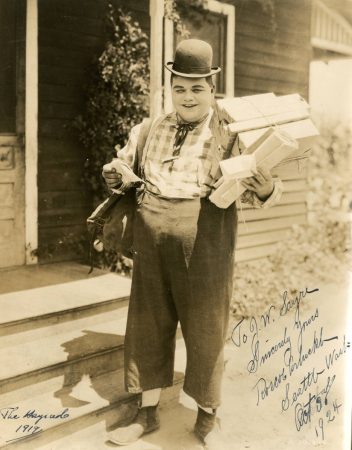
Roscoe Arbuckle in "The Hayseed" (Paramount, 1919), autographed to J. Willis Sayre in 1924. (Courtesy University of Washington Special Collections, Order No. JWS16776)
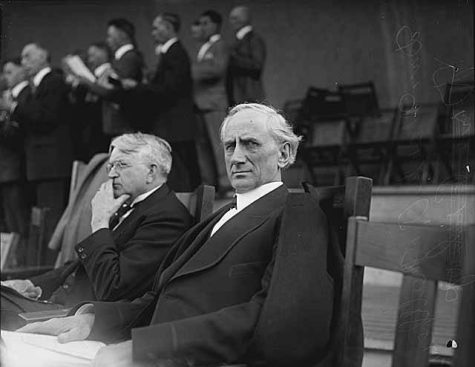
Reverend Mark A. Matthews, as usual, disapproves, ca. 1927. (Courtesy of the Seattle Post-Intelligencer and Museum of History and Industry, Image No. 1986.5G.1886)
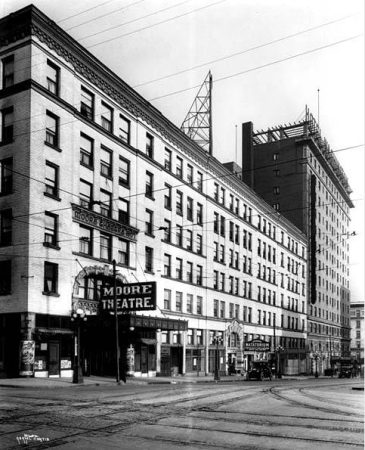
Seattle's Moore Theatre at 2nd and Virginia, ca. 1915. (Photo by Asahel Curtis, courtesy University of Washington Special Collections, Order No. CUR1295)
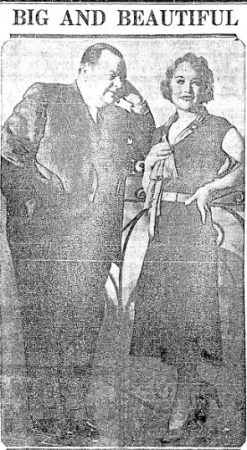
Hollywood visitors Roscoe Arbuckle and Betty Compson atop the Camlin Hotel roof in Seattle, March 1932. (Seattle Daily Times, 14 March 1932, Page 14)
Act I: Roscoe "Fatty" Arbuckle
By the mid-1920s nearly all forms of stage entertainment in America were declining in popularity, at least in relation to the size and diversity of shows that had drawn theatergoers 15 and 20 years previous. The elaborate road shows that had once come through the Northwest on a weekly basis were dwindling in numbers – costly productions mounted with decreasing frequency from 1912 on. The decline was swift, measurable and not altogether caused (as one might expect) by the popularity of motion pictures. Everhardt Armstrong, writing early in the 1928-1929 theatrical season, lamented the situation in the Seattle Post-Intelligencer.
Those who argue, with a superficial show of plausibility, that thanks to the movies there is no popular demand in the Pacific Northwest for first class productions of legitimate drama, were brilliantly refuted by the attendance at the Metropolitan during the recent engagement of The Trial of Mary Dugan.
The engagement was a financial success. It proved beyond cavil that the Seattle public is willing to pay high prices to see high grade productions of interesting plays. When business languishes and the boys in the box-office find plenty of time for the exchange of anecdotes and persiflage, there is usually a sound reason – the show isn’t worth the money. Many of us have sour memories, for example, of the glaring way in which a California manager endeavored to “cash in” on the reputation of Hit the Deck by sending a grossly inferior troupe to the Northwest, while a competent company continued to present the same brightly amusing musical play in Los Angeles. The production we saw was not worth the price of admission – at least not to the discriminating, and those who can afford to pay $2.50 or more for a theatre ticket are, in most cases, sufficiently discriminating to recognize a “ham” company when they see one. It would be easy to adduce other instances in which we have been offered, at high prices, inferior productions of plays that have achieved popularity in New York and elsewhere. Unfortunately, it often happens that a worthy production, following a poor one, is made to suffer by the bad impression the latter leaves. Every manager who sends third and fourth rate companies on tour thus becomes an enemy of the more scrupulous man of the theatre who aims to give his audiences what they pay for. The opportunist does his bit to shake public confidence in all “road shows.”[1]
Stock theatre’s decline was even more rapid in Seattle. Despite a handful of troupes operating during the early 1920s (including the venerable Wilkes company out of Portland, which eventually folded in 1922), stock hadn’t enjoyed wide-scale popularity since the early teens. Indeed, in his Post-Intelligencer article Everhardt Armstrong also pointed out that after the demise of the Wilkes troupe, the same cry that “movies killed stock” had been raised, but flourishing organizations in other cities offered proof that audiences were still willing to patronize stock companies of merit.
Vaudeville, the last formal stage entertainment to achieve popularity in Seattle, was also the last to see a significant decline in audience favor. But by 1925, even though many of the old vaudeville houses in Seattle continued playing to sizable audiences, the headline attraction wasn’t always the live acts. Rather, motion pictures were now taking up almost half the spotlight at many of these venues, which were now offering a shorter bill of stage presentations. This trend began around World War I in some of the city’s smaller vaudeville theatres but gradually expanded to the larger ones as well. By the 1920s, when many of the city’s downtown motion picture houses were engaging large orchestras and live acts to better diversify their bills, the effort somewhat blurred the line between Seattle’s film and vaudeville establishments.
Although stock, vaudeville, and road show productions couldn’t pin their decline solely on the rise of motion pictures, as each continued well into the 1930s and beyond, the popularity of film certainly had a negative impact on the “theatre proper” in Seattle. Motion pictures had been presented in the city as far back as 1894, and by 1907 small nickelodeon theatres began invading the Pacific Northwest, though many were short-lived commercial enterprises. The first more or less permanent movie houses began appearing around 1912, with several large houses showing films at popular prices (some of them converted from legitimate theatres, such as the Grand Opera House), with a few being large and ornate enough to compete with the city’s more established entertainment venues. It was a trend occurring throughout the country. By the time The Birth of a Nation premiered at the Clemmer Theatre in June 1915, motion picture entertainment was firmly established as a big business in Seattle, not only in the downtown area but also in the city’s growing neighborhoods, where smaller second-run venues were cropping up at an exponential rate.
Still, theatre did not disappear altogether. Throughout the 1920s and 1930s the stages of Seattle remained active, even if on a reduced scale. It was, for instance, a period that saw the local debuts for a new generation of future motion picture stars – stage performers such as the Marx Brothers, Bob Hope and Orson Welles, to name a few. But these years also saw appearances by a number of silent screen actors looking to expand their talents or, as the case may be, recapture the notoriety they had once known. In this latter category one is likely to include such personalities as Sessue Hayakawa, Charlie Murray, Juanita Hansen, and Enid Markey, among others, all of whom were greeted by enthusiastic Seattle crowds even if, at the time, their days of important film work had largely passed. Other silent era performers moved onstage following the introduction of sound – theatre affording the opportunity to prove that their voices were adequate for talking films.
By and large, Seattle audiences were warm and generous toward performers that had once been their screen idols, greeting them with tremendous affection. This must have been a particularly gratifying to Roscoe “Fatty” Arbuckle, who returned to Seattle for the first time in 16 years to play a weeklong vaudeville engagement at the Pantages beginning September 29, 1924.
Arbuckle had seen his motion picture career disintegrate in 1921 when he was charged with rape and manslaughter following the death of Virginia Rappé, a film extra who died following a party the comedian had given in San Francisco. Though the evidence against Arbuckle was thin, an eager press sensationalized the crime, exploiting the charges against the comedian. Two full trials (both ending in hung juries) concluded with a third – an acquittal on all charges and an apology to Arbuckle from the jury. But while the comedian may have been vindicated in court, the damage to his screen career was irreparable. Will Hays, head of the newly created Motion Picture Producers and Distributors Association of America (eventually known as the Hays Office), the self-policing moral authority established to combat Hollywood’s negative image, was under tremendous pressure to take a hard line in the Arbuckle case. Almost immediately Hays banned Arbuckle from the screen, as local censors had done around the country following the initial charges, using the comedian’s plight as an example of the film industry’s commitment to clean up.
Hays was not the only one to use the Arbuckle case to his advantage. While the comedian’s life and career teetered in the balance, many people, with wildly different agendas, used the scandal to suit their own purposes. High-minded civic groups used the trials bolster their contention that Hollywood was too decadent and a poor influence on American youth. Obviously, the comedian’s troubles were a gold mine for the yellow press. Arbuckle friend Buster Keaton recalled that William Randolph Hearst, whose newspapers were among those gleefully exploiting the scandal, sold more daily editions on the murder story than when the Lusitania was sunk.[2] Arbuckle’s name may have been cleared, eventually, but his comedic star was permanently dimmed. He was made to pay for what many felt was wrong with all of Hollywood.
Sporadic directing jobs (under assumed names such as “William Goodrich”[3]) came his way, but they were few and far between, and it was only late in life that Roscoe Arbuckle got to once again step in front of the camera. With his screen prospects in the mid-1920s virtually nil, vaudeville offered an opportunity for the comedian to put himself back in the public eye, this time in a much more favorable light. Alexander Pantages – the man who had given 15-year-old Roscoe Arbuckle his first break in show business, way back in 1902 – certainly wasn’t deterred by scandal. The showman offered Roscoe Arbuckle a chance to tour his circuit, which (as the showman well knew) was also an opportunity to pack his houses with the curious. “Arbuckle has been breaking all house records where he has appeared, it is said, and the local Pantages management is expecting an unusually large attendance during his engagement here. Arbuckle is appearing in an act specially written for this tour of the Pantages circuit, which, according to reports, is very entertaining.”[4]
The comedian’s tour was essentially a series of personal appearances designed to put him back in the role of an entertainer. It began with a film clip of himself in a comic bit with Buster Keaton (which, based on descriptions, was probably from their two-reeler Back Stage [Paramount, 1919]) – not only an association with one of the biggest film stars of the day but a reminder to the audience of Arbuckle’s comic brilliance. The clip was brief, and Arbuckle himself soon took to the stage dressed in one of his typical comic get-ups. The remainder of his act was simply the comedian flying solo: he gave a brief monologue, performed comedy tricks old and new, and shared some of the amusing stories he had gathered from his days as a stage and screen performer.
Audiences flocked to the Pantages for the venue’s headline attraction, but more likely than not the scandal had more to do with the public’s response to Roscoe Arbuckle than his status as a motion picture star. The crowds greeting him were warm and enthusiastic, and the actor received several ovations throughout his opening performance.
Reviews of the bill, where Arbuckle headed a stage show that supported the motion picture Torment (First National, 1924), with Owen Moore and Bessie Love, were uniformly good, though press coverage was fairly light with less and less column space being devoted to stage entertainment at the time. The Daily Times gave only a brief description of Arbuckle’s antics, noting that the house was “filled to capacity” and that “the crowd gave the former slapstick comedian of the screen a noisy welcome.”[5]
Unfortunately, their coverage was thorough by comparison to the Post-Intelligencer, whose account of the Pantages bill for the week of September 29 bore the tone of a publicist’s pen. “‘Fatty’ Arbuckle, round and able comedian” went their only mention of the headline act, “is scoring an emphatic success with his clever chatter, amusing anecdotes and eccentric antics at the Pantages where he is the featured attraction of a diverting vaudeville program. Arbuckle is playing to capacity houses and receiving personal ovations at each performance.”[6] The Star didn’t even chime in until several days after the new bill had debuted. “Deafening and protracted applause is greeting [Roscoe] Arbuckle upon every appearance at the Pantages theater, where he is headlined this week,” it was observed. “The house is being packed at every performance, the huge audience crowding every available foot of space. Never in the history of the local Pantages theater has there been such an attendance for any attraction it has offered.”[7]
Late in the week, on Friday, Roscoe Arbuckle made a personal appearance at the Butler Hotel following his Pantages shows, where he presented the top prize in a dance contest. Former Keystone comedienne Ora Carew, then appearing at the Pantages Theatre in Tacoma, was also on hand for the festivities.[8]
Interestingly, throughout the limited coverage of Roscoe Arbuckle’s 1924 “comeback” tour, only the Seattle Star brought up the murder charges that had literally ended his motion picture career. Whereas the Daily Times and the Post-Intelligencer tactfully omitted even mentioning the issue, the Star was quite open in addressing it. And surprisingly, the paper even managed to get Arbuckle himself to talk about the Rappé case, in apparently the only one-on-one interview he gave while in Seattle. Penned by Star reporter Lucille Butler, the resulting article is a notable one.
Mr. Roscoe Arbuckle is here! Not the laughing “Fatty” Arbuckle of yore, but Mr. Roscoe Arbuckle, salesman!
Mr. Arbuckle is here, thru [sic] the medium of Pantages headline number this week, to sell Seattle something. That “something” is himself. He wants Seattle to believe him when he says he was the victim of circumstances; when he says that the unfortunate death of Virginia Rappe, screen actress, in San Francisco, three years ago, was due to a series of circumstances over which he had no control.
Mr. Arbuckle, after three trials covering a period of eight months, and ending in a final three-minute acquittal, has this to tell Seattle: “They said I spent recklessly – gave wild parties. True, I had a beautiful home bought from me after my misfortune by [Joseph] Schenck, Norma Talmadge’s husband, and incidentally one of my most loyal friends. I DID give parties. Two a year. New Year’s and on my birthday. But I was good-natured; too much so. I used to keep open house for everybody – let them use my house or rooms whether I was there or not. That’s where I made a mistake.
“You see,” he mused, half to himself, “I had risen from the ranks. I think a person often becomes famous without sort of recognizing it. Take old players with whom I had worked before I was recognized as a famous comedian – I had a great desire to make them feel I was not upstage; I threw my home open to them and made everybody welcome. Had I been slower to make friends I would not be here today.
“I was in no wise [sic] responsible for Miss Rappe’s death. I have been found innocent by a jury of 12 men and women. I have a great deal of prejudice to overcome, but wherever I have had an opportunity to meet people face to face, to talk to them, to appeal to their sense of fair play, I have been able to convince them that I am entitled to an even chance – to let them judge me by my future – rather than by my unfortunate past.”[9]
Some of the very prejudice Roscoe Arbuckle spoke of cropped up immediately upon his arrival in Seattle. Throughout his tour, the comedian frequently had to contend with community protests against his appearance, most often by church or social groups outraged with the type of Hollywood immorality he seemed to represent. Seattle held to form. And, not surprisingly, the protest was led by activist clergyman Dr. Mark A. Matthews. (Matthews and his First Presbyterian Church also played host to William S. Hart during the 1918 Liberty Loan tour that brought the actor to Seattle.)
Once again defending public virtue, Dr. Matthews sent a letter directly to Alexander Pantages after discovering that the infamous Roscoe Arbuckle would be stopping in Seattle on his vaudeville tour. “You can’t afford to bring that character to this city,” Dr. Matthews wrote in part. “You can’t afford to insult the women of this city. You can’t afford to stain your stage. It would take years to fumigate your theater. I most earnestly ask you to cancel this engagement.”[10]
Unfortunately, it seems that Dr. Matthews didn’t count on the showman instinct of Alexander Pantages, for the letter was simply used to generate publicity for Arbuckle’s Seattle visit. Matthews’ correspondence made its way from Pantages’ desk directly to Arbuckle, who immediately fired off a response, complete with a handful of clumsy Biblical references. All this delighted the Star, which reprinted excerpts from both letters in an exclusive report.
“You are assuming a very arbitrary attitude, considering the fact that you know only one side of the case,” [Arbuckle] wrote. “You have no right to doubt the findings of a judge and jury, simply because those findings did not agree with some preconceived opinion you had formed by listening to a lot of gossip.
“The mere fact that a man was accused of something does not make that accusation true. I would like to have you get this into your head straight: I have never insulted a woman in my life, and that was proved in the courtroom. I can show you by court record that every act you are mentally accusing me of was false and proven so.
“So much for the legal side. As for the spiritual: You, as a minister, walk into your pulpit half a dozen times a week and preach His teachings, which are faith, hope, charity and forgiveness. Admitting that what you say about me is true, for argument’s sake, how do you reconcile your attitude toward me with the teachings of Christ? You are going against the very principles for which Christ laid down his life.
“I am leading a clean, decent, orderly life, and I am just as good a Christian as you are. And I intend to follow that life, despite the fact that some of you so-called Christians do not seem to want me to.
“My spiritual advisor warned me that I would run up against such things as this. But he advised me to take them to God in prayer, and to turn the other cheek. But turning the other cheek doesn’t always enable a man to put himself right with the public. And the public is to be considered.
“So I am going to ask you, Dr. Matthews, to let me defend myself either in a public way (I would prefer to do it thus) or in your study with as many clergymen and church people as you care to invite. I have a right to tell my story and, inasmuch as you have seen fit to cast the first stone, be man enough to see me thru [sic] on this request.
“I am leaving Seattle at the end of the week, but will return later, if you prefer.”[11]
Dr. Matthews, according to the Star, was out of town when Arbuckle’s letter was received and thus unavailable for comment. However, it appears that the matter went no farther than the letter-writing stage – there was no further mention any sort of debate or meeting between the adversaries. At any rate, Dr. Matthews played right into the hands of Alexander Pantages: although his theatre would likely have been packed with the curious anyway, Matthews’ letter and the publicity it created no doubt drew additional interest toward the 1924 Roscoe Arbuckle engagement. But the comedian’s luck would run out a little later, in neighboring Tacoma. (Arbuckle seems to have visited Vancouver and Victoria before heading south along the coast.) There, the local officials made a preemptive strike by banning the comedian the week before he was to appear at Tacoma’s Pantages Theatre. Arbuckle and his attorneys challenged the action but lost two key hearings and eventually abandoned their efforts. The fight may have ended Arbuckle’s West Coast tour altogether – the comedian reportedly left Tacoma for California shortly after the final ruling.[12]
Dr. Mark A. Matthews was nowhere to be seen eight years later, in 1932, when Roscoe Arbuckle returned to Seattle to play the Moore Theatre as a special guest of the Seattle Theater Company, one of the city’s last functioning stock troupes. A weeklong engagement, the comedian was brought in to play Jimmy Jenks in a revival of Margaret Mayo’s Baby Mine.
As a troupe, the Seattle Theater Company (known as the Bainbridge Players the season before) was winning high praise for their use of guest stars like Arbuckle to revitalize interest in stock theatre, making the organization a small but welcome addition to the local entertainment scene. The effort was coordinated by A.G. Bainbridge, a theatrical manager from Minnesota who had run successful stock companies there for decades, and who drummed up interest in a branch troupe. “The Seattle Theater Company has selected a cast [for the season] that should place the legitimate drama in Seattle on the highroad to good times,” Ellen McGrath beamed in The Argus at the beginning of the 1931-32 season. “Bringing guest stars arouses additional interest in the enterprise of the Seattle businessmen who made the local stock company what it is to be hoped will be a permanent institution. Prices are so low that everyone having the funds for a movie may see the legitimate show; a boon to those many persons who have wearied of motion picture monotony.”[13]
An old play, Baby Mine offered Roscoe Arbuckle a small but highly visible comic role, one which pre-engagement publicity quoted him as calling the “perfect vehicle” for his talents.[14] The plot centered on a husband who has walked out on his wife. In an effort to save their failing marriage, she telegraphs months later to inform him that he has become a father, urging him to return. The pregnancy, however, is a ruse. When he agrees to come back, she arranges to borrow a baby from a local children’s home, only to have the agreement fall through as the date of her husband’s arrival grows near. She thus dispatches her friend Jimmy to obtain a new child, though he manages to return with not one infant, but three. The resulting mayhem involves not only the duped “father” and multiple babies, but also the police and frantic parents searching for their lost children. (Perversely, as the Moore troupe was rehearsing their “kidnapping” comedy Baby Mine as newspapers across the country were intently focused on the actual kidnapping of the Lindbergh baby, Charles Jr., which occurred less than two weeks before. The body of the famed aviator’s son would not be located for another two months. No mention of the Lindbergh case was made in relation to the presentation of Baby Mine at the Moore – but the incident also did not prompt the Seattle Theatre Company to either cancel or postpone the show.)
Roscoe Arbuckle arrived in Seattle late on March 10, 1932, giving him three days of rehearsal time in which to perfect Baby Mine with the Moore’s resident troupe, which at the time was ending a run of Ladies Lie starring guest performer Perry Askam. A reporter from the Daily Times, identified only by the initials “D.R.L.,” accompanied the comedian from the airport to his room at the Camlin Hotel.
Last night a California plane brought Roscoe (Fatty) Arbuckle, rotund and jovial comedian of screen and stage. Managers, directors and press agents hovered about this genial gentleman. They assured him that the town was his and that they were eager to grant his every wish.
Roscoe, swathed in an immense camelshair polo coat, grinned. He pulled his hat down over one eye and said, “Okay, boys. I want a steak!”
“A steak?” chorused the many managers. “A steak?” echoed the press agents. Certainly, Mr. Arbuckle would have a steak. But first he must be settled comfortably in his suite at The Camlin. And then a radio broadcast scheduled for 8:45. Too, there were some wires to be opened and the long-distance operator had several messages. All this would take just a moment, the managers said. Then a steak!
Mr. Arbuckle did all the things that were to take just a moment. He ordered a basket of flowers for Seattle’s other Hollywood visitor, Betty Compson. And he met the press. Also, during that “moment,” Roscoe found time to go over the script of Baby Mine, which he will do at the Moore next week, with Director Andy Gunnard.
The telephone rang again. It was Miss Compson calling to say she was cooking a midnight supper. Could Roscoe join her party? Yes, the press agents said, Mr. Arbuckle would come. Now Mr. Arbuckle could have his steak.
In the kitchenette of Miss Compson’s suite a vegetarian menu simmered on the stove. “There’s no meat, Roscoe,” his lovely hostess said. “I hope you don’t mind.”[15]
Culinary disappointments aside, when it came down to performing Baby Mine at the Moore Roscoe Arbuckle was all business, even if Seattle’s papers had varying reactions to the play. Marion Stixrood wrote for the Post-Intelligencer and found both the production and Arbuckle worthy of praise.
Once a good comedian, always a good comedian!
Roscoe “Fatty” Arbuckle, rollicking funster of the silent screen, demonstrates that in a big (!) way over at the Moore Theatre, where he is making a personal appearance this week in Baby Mine.
Jimmy Jenks of Margaret Mayo’s delicious comedy is an ideal role for Arbuckle. It fits him like a glove – or shall we say the outer covering of a Zeppelin? The play itself was a good choice, containing all the deft touches that adults demand and the hokum the youngsters love. Memory-tinged laughter of parents over Baby Mine will mingle with the hilarious glee of their children over a very fat and wistfully funny man…
No need for the “blues” this week. Not with “Fatty” Arbuckle in town![16]
Ellen McGrath, writing for The Argus, also felt the production was a good one, particularly in light of Roscoe Arbuckle’s comedic abilities, which apparently went over as well with his fellow players as it did with audiences. After appearing onstage to thunderous applause, Arbuckle proceeded to turn on the juice. “At one time the high glee infected the cast,” she wrote of the opening performance, “stopping the show until Emily Lowry could again look like a romantic, wan convalescent, and Ted Osborn could go on with his lines. Arbuckle took a couple of falls in the ridiculous fashion that won him fame on the screen back in the days when Charlie Chaplin threw custard pies, Theda Bara flourished gleaming daggers, and Mary Pickford ruled the alleys.”[17] Jack Hall of the Star felt similarly. “[Arbuckle’s] time away from the stage has not dimmed in the least his sense of timing, and this was further aid in selling the show for both those who were seeing [Baby Mine] for the first time and for those who came [only] to see him.”[18]
In contrast to Stixrood, McGrath and Hall, the reviewer for the Daily Times – the same “D.R.L.” who accompanied the comedian upon his arrival in the city – leveled a good deal of criticism toward Margaret Mayo’s “antiquated but still popular farce.” Ultimately, however, he seemed to enjoy the show and wasn’t about to hold Arbuckle responsible for its failings, particularly considering that the role of Jimmy Jenks was a small one.
Mr. Roscoe (Fatty) Arbuckle found a cordial audience waiting to greet him when he came onto the stage of the Moore Theatre yesterday to act in Margaret Mayo’s antiquated comedy Baby Mine. And, buoyed by this friendly reception, Roscoe proceeded to amble through the ludicrous situations of this play in his best funnyman manner.
There could be a lot more of “Fatty” Arbuckle in Baby Mine. And there should be. Right now some ambitious person on the Moore Theatre staff should sit himself down to make some additions to the play script. The additions should be in the form of more lines for Arbuckle to speak – and more things for him to do. For instance, another good old farce comedy fall, such as the comic takes in the second act.
Not that Arbuckle doesn’t work hard enough during Baby Mine. He certainly does. But Seattle theatregoers want to see and hear more of him.[19]
Accompanying the Daily Times review was a picture, taken on the roof of the Camlin Hotel, where photographer Alton McConkey was able to snap Arbuckle with Betty Compson posing together.[20]
Unfortunately, despite the wish by the Daily Times’ reviewer to see and hear more of the comedian, who was scheduled to depart for a vaudeville tour following the Baby Mine engagement, when the show closed on March 19, 1932, it would be the last Seattle appearance for Roscoe Arbuckle. He passed away in New York about 15 months later, in June 1933, shortly after completing several Vitaphone two-reelers – his first real opportunity to act before a camera since the Virginia Rappé scandal ruined his film career. Arbuckle’s body was laid out in the Frank Campbell Funeral Chapel in Manhattan, the very location where Rudolph Valentino’s body lay in state seven years previous – only to much less fanfare.
By Eric L. Flom – January 2026
Notes:
[1] Everhardt Armstrong, “First Class Road Attractions are Wanted in Seattle,” Seattle Post-Intelligencer, 16 September 1928, Pages 1D and 3D.
[2] Buster Keaton (with Charles Samuels), My Wonderful World of Slapstick (New York: Da Capo Press, 1987), Pages 195-196.
[3] Ironically, one of the bigger pictures Roscoe Arbuckle would be associated with following the scandal was a directing gig helming The Red Mill (1927), starring Marion Davies and backed by the same William Randolph Hearst who had earlier employed his newspapers to exploit the murder trial. Unfortunately, Arbuckle left the film before it was completed and The Red Mill was finished by others.
[4] “Fun Maker is Feature of Bill,” Seattle Post-Intelligencer, 28 September 1924, Page 6E; see also “Pantages,” Seattle Star, 27 September 1924, Page 12.
[5] “Pantages Bill Wins,” Seattle Daily Times, 30 September 1924, Page 11.
[6] “Pantages Bill Headed by ‘Fatty,’” Seattle Post-Intelligencer, 30 September 1924, Page 7.
[7] “Arbuckle Gets Applause at Pan,” Seattle Star, 2 October 1924, Page 14.
[8] “Arbuckle to Award Butler Dance Trophy,” Seattle Post-Intelligencer, 1 October 1924, Page 9.
[9] Lucille G. Butler, “Mr. Arbuckle is Here,” Seattle Star, 29 September 1924, Page 7.
[10] Letter from Dr. Mark Matthews to Alexander Pantages, quoted in “‘Fatty’ Arbuckle Dares Doc Matthews to Debate,” Seattle Star, 30 September 1924, 9. The date of Matthews’ letter was not given in the Star’s article.
[11] “‘Fatty’ Arbuckle Dares Doc Matthews to Debate,” Seattle Star, 30 September 1924, Page 9.
[12] See “Arbuckle Strikes at Censor Board,” Tacoma News Tribune, 18 October 1924, Page 1 and 2; “Offerings at the Pan Next Week,” Tacoma News Tribune, 18 October 1924, Page 4; “Censor Board Wins,” Tacoma News Tribune, 20 October 1924, Page 1 and 5; and “‘Fatty’ Loses all Court Actions Brought Here,” Tacoma News Tribune, 21 October 1924, Pages 1 and 2.
Arbuckle’s problems in Seattle and Tacoma weren’t the only ones he’d encounter in Washington state. A scheduled appearance at the American Theatre in Bellingham also met with stiff opposition, this time from churches and the Parent-Teacher Association. Local PTA members organized a telephone campaign asking Bellingham residents to boycott the American, Liberty, and Egyptian Theatres, all of which were operated by Fred B. Walton’s Bellingham Theatres, Inc., the group responsible for bringing Arbuckle to the city. (“Exhibitor Boycotted for Showing Arbuckle,” Motion Picture News, 1 November 1924, Page 2190.)
[13] Ellen McGrath, “Gossip of Plays and Players,” The Argus, 3 October 1931, Page 4.
[14] “Arbuckle to Make Bow at Moore Today,” Seattle Post-Intelligencer, 13 March 1932, Page 6M. Arbuckle played a short New York revival of Baby Mine during the 1927-28 theatrical season, but the effort was poorly received and closed after only a handful of performances.
[15] D.R.L., “Fatty’s First Demand for Juicy Steak,” Seattle Daily Times, 11 March 1932, Page 14. Although both the Post-Intelligencer and Daily Times ran daily radio columns at the time, Arbuckle is not listed as a featured guest on any local broadcasts during his stint in Seattle. Many stations, however, did not provide detailed programming information.
Betty Compson, at the time appearing at the Fox Fifth Avenue (today known simply as the Fifth Avenue) in a Fanchon and Marco stage revue, had appeared in numerous silent films, notably Josef von Sternberg’s Docks of New York (Paramount, 1928), among others. The Fifth Avenue engagement was Compson’s third and final visit to Seattle’s stages.
[16] Marion Stixrood, “‘Fatty’ Arbuckle has Rollicking Role at Moore,” Seattle Post-Intelligencer, 14 March 1932, Page 4.
[17] Ellen McGrath, “Stage & Screen,” The Argus, 19 March 1932, Page 6.
[18] Jack Hall, “Moore,” Seattle Star, 14 March 1932, Page 7.
[19] D.R.L., “Fatty Arbuckle Makes Decided Hit with Seattle,” Seattle Daily Times, 14 March 1932, Page 14.
[20] See Alton McConkey, “Big and Beautiful,” Seattle Daily Times, 14 March 1932, Page 14.
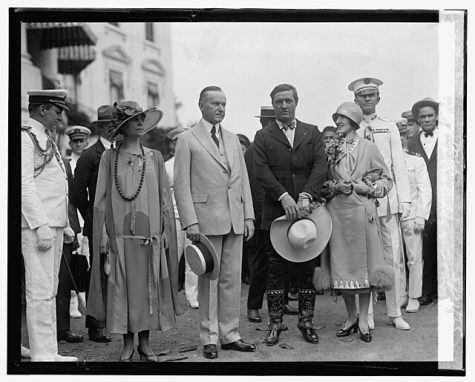
Tom Mix with President and Mrs. Calvin Coolidge, May 21, 1925.
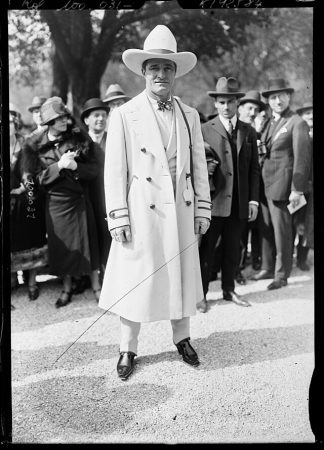
Tom Mix attempting to blend in during a trip to Paris, 1925.
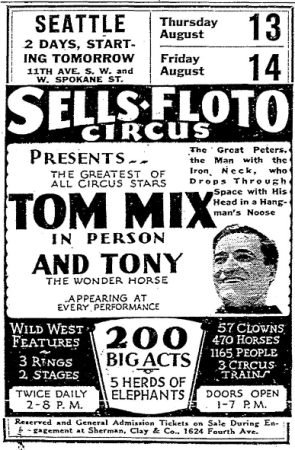
Sells-Floto Circus advertisement, August 1931. (Seattle Post-Intelligencer, 12 August 1931, Page 6)

Mary Jane Thompson gets some one-on-one time with Tom Mix at Seattle's Children's Orthopedic Hospital, August 13, 1931. (Seattle Post-Intelligencer, 14, August 1931, Page 3)
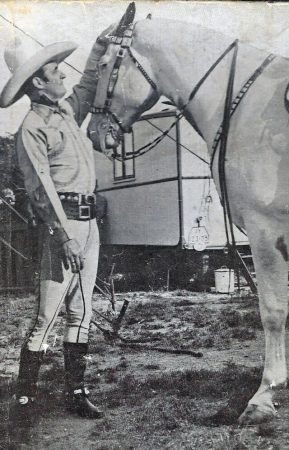
Tom Mix at Cirkus Belli in Denmark, ca. 1939.
Best Foot Forward: A Collection of Sound Era Engagements
Act II: Tom Mix
Yet another performer who put in an extended early stay in Seattle returned as his significant film work began to wind down. Cowboy star Tom Mix rode a tremendous wave of popularity with his feature films in the 1920s, but the arrival of talking pictures found the reigning cowboy king of Hollywood out of a job. Westerns, much like physical comedy, suffered a setback with the arrival of sound technology – in the rush to develop scenarios suitable for the new talking format, the major studios turned away from the western genre, and it would be several years before they were lifted out of B-movie status. In 1928 Mix parted ways with his longtime studio, Fox, and after an unsuccessful stint with Film Booking Offices (which evolved into RKO Radio Pictures), he left Hollywood altogether.
Shortly after Tom Mix’s departure from the screen he joined the Sells-Floto Circus as their star attraction, touring with his famous screen horse Tony. His act was a throwback to the old Wild West shows organized by Buffalo Bill, the Miller Brothers, and Cheyenne Bill a generation earlier, and Mix toured cities across America for over two years with the Sells-Floto organization, including at least one known appearance in Seattle, in August 1931.
Although the Sells-Floto organization was reportedly, at the time, on precarious financial footing, one would not have guessed that from the large troupe that arrived on August 12, 1931, just before the start of a two-day engagement at 11th Avenue S.W. and Spokane Street in West Seattle. In addition to Mix (in what was said to be the highest salary ever paid a circus performer), the Sells-Floto organization came with approximately 1,000 people in tow, traveling in over 20 Pullman railcars and featuring over 300 animals (including five “herds” of elephants), 300 wagons, 30 cars, and a big top tent holding three rings (with seating for 11,500) and two detached stages. Additionally, a sideshow (featuring “a congress of strange people”) and several associated tents filled the grounds, including space for a blacksmith, restaurant, doctor, and dressing quarters for the circus performers. Tom Mix himself traveled in his own private railcar and had 18 horses (not including Tony) to round out his western act – a small fraction of the 800 horses the Sells-Floto people claimed to have on tour.[1]
Billed as “the greatest of all circus stars,” Tom Mix was certainly the biggest of Sells-Floto’s 200 acts, though print advertisements also featured a second drawing card, the Great Peters, “the man with the iron neck.” Ironically, in both of Tom Mix’s known appearances in Seattle, part of the bill included a mock hanging: the Great Peters’ act consisted of dropping from the highest part of the big top in what was advertised as a regulation hangman’s noose. “This act,” noted The Argus, “which will be presented at both afternoon and evening performances, is a direct importation from Europe and is being presented in America for the first time.”[2] On each day of their engagement, August 13 and 14, the circus gave a 2:00 p.m. matinee and an evening show at 8:00 p.m.
Unfortunately, circus acts aren’t necessarily the type of entertainment that daily newspapers reviewed, so an account of Tom Mix’s appearance with the Sell-Floto show isn’t to be found. However, author John H. Nicholas, in his book Tom Mix: Riding Up to Glory, reprinted excerpts from an undated Sells-Floto program that outlined Mix’s contribution to the show. Following an introduction for Mix and the other performers, there was a demonstration of the old Pony Express (a throwback to his days performing with Cheyenne Bill), portraying “in realistic manner how the U.S. Mail was carried thru [sic] the hostile Indian country, over plains, mountains and thru [sic] storms and cyclones – with ever the one and only thought, ‘Nothing can stop the U.S. Mail.’” This was followed by a colorful display of roping tricks, the introduction of some trained horses, a demonstration of horsemanship by some of the cowboys and a wild finale with rides on some “outlaw” bucking broncos. Each of these horses, it was claimed, was personally selected by Mix and certified as a “man killer,” employing the same type of promotional lingo being used some 20 years previous. “The entire, Wild West Exhibition taking place immediately after the big show is over is under the personal direction of Tom Mix,” the program explained. “Mix positively appears in person at each and every Wild West Exhibition, with Tony, his wonder horse. Tom Mix takes an active part in each and every performance in addition to directing his company of star performers. Each person in Tom Mix’s Company of Wild West Stars is a champion in his class – direct from the studios of Hollywood.”[3] This account apparently saw no irony in claiming that authentic cowboys came from the backlots of southern California.
Despite the lack of journalistic attention devoted to Tom Mix’s act with the Sells-Floto Circus, there was plenty given to the star outside the big top setting. As was typical of most stops on the Sells-Floto tour – Mix often made personal appearances throughout the community, usually on behalf of children. Accordingly, like Rudolph Valentino’s Seattle visit eight years previous, Mix made a special appearance at Children’s Orthopedic Hospital at 10:30 a.m. on August 13, the day the Circus was to give its first Seattle shows. Organized by the Post-Intelligencer, Mix and 15 other performers were transported from the circus grounds in a special bus provided by the Puget Sound Power and Light Company, where they gave a special “mini-circus” performance for the children. In addition to the generosity of Puget Sound Power and Light, the Post-Intelligencer also persuaded the Pacific Steamship Company to donate hundreds of balloons, noisemakers and hats, and Western Dairy Products to provide special SunFreze ice cream for the event, transported to the Hospital in one of their special refrigerated trucks. All told, the event was expected to entertain over 120 patients at the Hospital.
“What a whale of a time the youngsters at the Children’s Orthopedic Hospital had yesterday at their own private circus, arranged by the Post-Intelligencer,” the paper trumpeted the following day. After balloons, toys, and party hats were distributed, the children gathered around to meet Tom Mix in person, witness the comic antics of several Sells-Floto clowns, then view a roping display by Ralph Clark, a whip-cracking act by Auga Gomez, and a “hair-raising” exhibition of acrobatics given by the Danwills.[4] (No mock hanging for this event.) In addition to kids surrounding the performers during their specialties, those too ill to be amongst the group were taken to a nearby balcony where they could see the action from above. The event concluded with ice cream for everyone.
It isn’t clear from accounts whether Tom Mix did anything more than make a personal appearance at the Hospital, but his presence alone created a sense of awe amongst most of the patients. Not so for young Mary Jane Thompson, however, who seemed to adopt the cowboy star as her temporary playmate for the event and had her photograph taken with Mix as part of the Post-Intelligencer’s coverage.[5] “[I]t’s an open question whether the performers from the Sells-Floto Circus, who contributed their services, [had] just as much fun as the youngsters.”
Tom Mix continued to tour with the Sells-Floto Circus for the remainder of 1931, but it wasn’t long before he returned to the screen, signing with Universal for a new series of westerns. With pictures such as Destry Rides Again (1932, seven years before the James Stewart/Marlene Dietrich remake) and My Pal the King (1932, and featuring a young Mickey Rooney), Mix remained a popular, though not necessarily top box-office draw. Once his Universal contract had expired, he made a brief serial film for Mascot.
Although circus work occupied much of his professional career during the last years of his life (in addition to the long-running radio show that bore his name), Mix was said to have missed performing before the camera. He eventually broke with the Sells-Floto organization and formed “The Tom Mix Circus” in the late 1930s, but the demands of constant touring eventually took a toll on the actor as he approached his mid-50s. “Mix was a performer of consummate skill,” John H. Nicholas observed, “and when he entered the arena the aches and pains his aging body seemed to disappear. The larger the crowd, the more he responded and the better he felt. Following his act, he usually went to his tent to think or to groom his horses in silence. Sometimes, however, he would stop to laugh and joke with the circus performers and hands, especially with the forty or so in his own troupe. He still had an infectious manner, and these people were drawn to him. On rare occasions, he was sullen and moody; when this happened, he would climb into one of his cars and roar from town to town at speeds that were terrifying.”[6] It was Tom Mix’s love of speed that would cut short his life; in October 1940, the cowboy actor died after failing to negotiate a curve near Florence, Arizona. He was 60.
By Eric L. Flom – January 2026
Notes:
[1] “In each city hundreds of tons of hay are contracted for to care for the 800 horses, as well as the elephants and camels,” went one account of the Sells-Floto arrival in Seattle. “Tons of fresh meat are purchased daily for the lions, tigers and other flesh-eating animals. The commissary department order each morning resembles the meat and grocery requirements of a small army while traveling. An order for 1,000 dozen eggs is an ordinary item.” (“Tom Mix and Famous Pony Reach City,” Seattle Daily Times, 13 August 1931, Page 18.)
[2] “Tom Mix Coming with Circus,” The Argus, 8 August 1931, Page 4.
[3] Reprinted from John H. Nicholas, Tom Mix: Riding Up to Glory (Oklahoma City: National Cowboy Hall of Fame and Western Heritage Center [A Persimmon Hill Book], 1980), Page 63.
[4] “Clowns Bring their Circus to Orthopedic,” Seattle Post-Intelligencer, 14 August 1931, Page 3.
[5] See “Aches and Pains Forgotten!,” Seattle Post-Intelligencer, 14 August 1931, Page 3.
[6] Nicholas, Page 66.
Best Foot Forward: A Collection of Sound Era Engagements
Act III: Harry Langdon
A frequent visitor to the Pacific Northwest before his motion picture work began, comedian Harry Langdon also made a sound-era appearance in Seattle, arriving at the newly-constructed Seattle Theatre in September 1928 and topping the Fanchon and Marco stage revue A Trip to Mars in a skit called Unrequited Love.[1] The stage show was in support of the Paramount feature film The First Kiss (Paramount, 1928), starring Gary Cooper and Fay Wray.
The Langdon appearance is notable in that the comedian was at a crossroads in his career at the time. While the first three installments of his six-picture deal with First National proved quite popular, the final three, which Langdon directed himself, met with lackluster results. First National opted not to renew Langdon’s contract, and consequently the comedian was shopping his services. He would ultimately be out of film work for over a year before signing with Hal Roach – not for features, but a return to two-reel comedies.
While between studios, Langdon undertook a short vaudeville tour that, it was claimed, earned him one of the highest salaries ever given a film star for a set of personal appearances. Although Langdon was performing five shows a day at the Seattle, his tour couldn’t have been all that grueling, since it appears that he was taking his act only to Seattle, Portland, San Francisco and Los Angeles.[2] Additionally, although he was linked with Fanchon and Marco for the tour, Langdon wasn’t listed as a featured performer in A Trip to Mars, but rather performed his own sketch as a “special added attraction” – an appended feature to the bill in the cities he played.
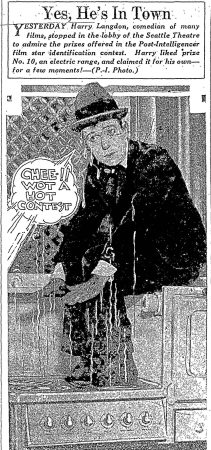
Prior to his first performance, Harry Langdon spoke briefly to reporter Marie Dunbar of the Post-Intelligencer, who caught the comedian clowning around in the lobby of the Seattle Theatre, known today as the Paramount. “I get my funny tricks from watching folks,” he revealed about the source of his comic inspiration. “Some great artists went to the dens of Paris among the Apaches for their character study. I go to the playground for my funny stuff and find a barrel of kids – because kids are the greatest comedians in the world.”[3] Langdon was jaunty throughout the interview; interestingly, Dunbar got him to open up on the subject of talking pictures, which were creating a stir in Hollywood at the time. Coupled with the growing popularity of radio programming, it appeared that the entertainment world had given itself over to the “gift of gab.” Langdon agreed that the talkies had turned the industry, in his words, “upside down,” but also expressed his complete confidence that he could meet the challenge. “I was twenty years on the stage,” he said, truthfully. “The talkies don’t scare me. Laugh that off.” Accompanying Dunbar’s article was a photo of the comedian “warming himself” atop an electric range, one of the many prizes on display at the Seattle Theatre for a film star identification contest being sponsored by the Post-Intelligencer.[4]
Langdon was received enthusiastically at the Seattle, particularly since he garbed himself in his typical film costume – a living embodiment of his onscreen image. Unrequited Love paired him with Mia Marvin, but a detailed description of the act isn’t to be found. Apparently, it began with some film clips, followed by the comedian’s appearance onstage. A short skit was then presented in which the befuddled Langdon character finds himself being pursued by Marvin, cast as an aggressive love interest. In the end, the reluctant Harry gets tricked into the woman’s arms.
The skit portion of the act apparently did not go over too well in Portland the week before, where Langdon was only mildly amusing and seemed embarrassed by the quality of his opening performance. According to Stanley Orne, reviewing the show for the Oregonian, Harry Langdon failed to appear for an extended curtain call following his act – Mia Marvin was dispatched instead with an apology, relaying Langdon’s promise to appear to better advantage for the remainder of his engagement.[5]
Debuting on Thursday, September 27th, Everhardt Armstrong of the Post-Intelligencer caught the first performance of Harry Langdon’s act in Seattle, and unlike his counterpart in Portland, was delighted with the whole of the stage show. But he was most impressed with Langdon himself, who “proved that he can be just as funny when viewed in the flesh as he is in his films. The crowd – the largest matinee audience in the history of the theatre, [manager] Sam Maurice assured me – was quick to respond to the droll appeal of Langdon’s antics. His spoken lines, truth to tell, were not especially important – a fact that mattered not at all. For Harry does not have to talk to keep the laughs coming.”[6]
Armstrong’s comments on Langdon were brief, but his journalistic counterparts were a bit more generous in terms of space. The unnamed reviewer at the Daily Times was typical.
Carrying with him the personality and character that has won him the distinction of being “filmland’s funniest fellow,” Harry Langdon was given a rousing reception of laughter and applause at the Seattle Theatre yesterday when he opened a week’s personal engagement.
That baby-faced expression that has marked his every screen appearance is with him on the stage. In fact, he is garbed and made up exactly as he was in Long Pants, Tramp, Tramp, Tramp and a great many of his other pictures.
The crowds liked the comedian on opening day, and indications are that his week’s engagement will be a record-breaking one as far as attendance is concerned.[7]
Harry B. Mills at the Star was little different with his own comments, save for the fact that he was the only reviewer to make mention of Langdon’s prior vaudeville experience.
The new bill at the Seattle theater scores strongly in all departments, with the single exception of the picture; and there will be many who will find in its heavy air of romance just what they have been wanting.
The big drawing card for this week is, of course, Harry Langdon, and the little film comedian proved at Thursday night’s show that he has not forgotten his old days in vaudeville. His act is called Unrequited Love, and calls for the assistance of Mia Marvin, a trained player who wears her clothes with the necessary dash and style to counter-balance Harry’s purposeful inelegance. Maxine Evelyn also comes on for a line.
The act is not the big laugh vehicle which Harry used to have in his automobile act, back before he had thought of the screen, but it drew a real demand for an encore, which he and Miss Marvin handled nicely.[8]
Unfortunately, while Harry Langdon claimed to have no fear of talking pictures, movie audiences failed to embrace him as a comic talent in the talkies. The late 1920s also saw his personal life suffering. His wife Rose, long his vaudeville touring partner, divorced him in 1928, and Langdon’s second wife, whom he married shortly thereafter, divorced him in 1931. After the second divorce, Langdon filed for bankruptcy – money problems would dog the comedian for the remainder of his life.
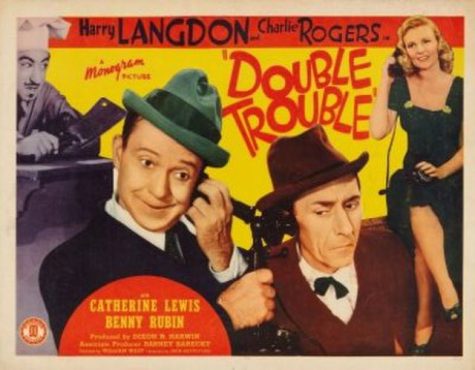
Harry Langdon’s later career, in fact, somewhat paralleled Buster Keaton’s – once a top comedy draw at the box office, he eventually found himself making a series of lackluster two-reelers, and finally eked out a living as a simple Hollywood gag man. Fortunately Stan Laurel and Oliver Hardy, with whom Langdon had become acquainted during his acting stint with Hal Roach in the late 1920s, brought the comedian on board for their 1938 film Block-Heads. The collaboration continued for two years, with Langdon getting co-screenwriting credits on the next three Laurel and Hardy films: Flying Deuces (RKO, 1939), A Chump at Oxford (Roach, 1940), and Saps at Sea (Roach, 1940). Langdon even found himself partnered with Oliver Hardy onscreen in the film Zenobia (Roach, 1939), made while Stan Laurel was out in a contract dispute. But the film did not do well at the box office, and Laurel soon returned as Hardy’s comedic partner, ending whatever pairing could have been made between Oliver Hardy and Langdon. After Saps at Sea, Harry Langdon continued in Hollywood as a small-time writer and occasional character actor. He died in 1944.
By Eric L. Flom – January 2026
Notes:
[1] The Seattle Theater, today known as the Paramount, was erected in 1928 and bears no relation to the Seattle Theatre that stood at the corner of Third and Cherry from 1892 to 1915. The original Seattle was torn down and, in its place, erected the Arctic Building, currently a registered landmark in downtown Seattle.
Fanchon and Marco were former vaudevillians (a brother/sister musical act) who moved into the management of stage shows late in their career. Their biggest successes came in the 1920s and 1930s, when they provided live entertainment for houses that primarily showed motion pictures. Their shows were short, usually filled with beautiful girls, and offered a way for larger urban movie theatres to diversify their bills. (Anthony Slide, The Encyclopedia of Vaudeville [Westport, Connecticut: Greenwood Press, 1994], Pages 167–168.)
[2] Langdon’s act, incidentally, which occupied the better part of a half-hour, was also mistakenly identified in a few advance notices as his first engagement in Seattle. (See “Langdon is Here for Personal Appearance,” Seattle Daily Times, 27 September 1928, Page 12; and “Quadruple Lead in New Bill Here,” Seattle Star, 27 September 1928, Page 9.)
[3] Marie Dunbar, “Yes, He’s in Town,” Seattle Post-Intelligencer, 28 September 1928, Page 5.
[4] Ibid.
[5] Stanley Orne, “Harry Langdon in Person Bolsters Portland’s Show,” Portland Oregonian, 21 September 1928, Page 6.
[6] Everhardt Armstrong, “Harry Langdon’s Antics Delight Seattle Crowds,” Seattle Post-Intelligencer, 28 September 1928, Page 15.
[7] “Harry Langdon, Film Comedian, Here for Week,” Seattle Daily Times, 28 September 1928, Page 16.
[8] Harry B. Mills, “Seattle Scores High With its Change of Bill,” Seattle Star, 28 September 1928, Page 10.
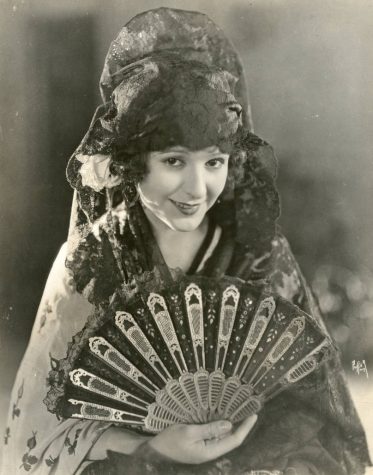
Actress Norma Talmadge, ca. 1921. (Photo by the Puffer Studios, courtesy University of Washington Special Collections, Order No. JWS35684)
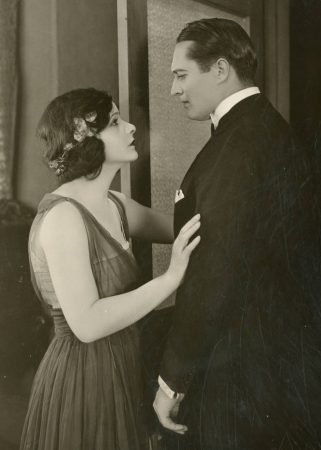
Norma Talmadge and Edmund Lowe in "The Woman Gives" (First National, 1920). (Courtesy University of Washington Special Collections, Order No. 26237)
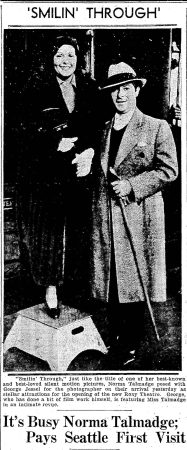
Norma Talmadge and George Jessel arrive in Seattle for their show dates, 1933. (Seattle Daily Times, 16 April 1933, Page 7)
Best Foot Forward: A Collection of Sound Era Engagements
Act IV: Norma Talmadge
Between 1890 and 1930, the appearance of silent stars on Seattle’s stages was largely male dominated. While a good number of actresses, too, such as Theda Bara, Marguerite Clark, Pauline Frederick, Clara Kimball Young, and others, found themselves playing the city during this period, in sheer numbers their engagements were less frequent compared to their male counterparts. Many of those who did were lesser-known figures in the world of silent film – Bessie Barriscale, Betty Blythe, Louise Glaum, Juanita Hansen, Enid Markey, Polly Moran, and Anna Q. Nilsson, to name a few. But once sound invaded Hollywood, a number of silent cinema’s more notable actresses made their Seattle stage debuts, often as their focus changed from film to theatre in the twilight of their careers. One of these was a veteran of the old Vitagraph Studios who eventually became one of the era’s top box-office draws, Norma Talmadge.
Despite her popularity with audiences, little of Talmadge’s screen work stands out as particularly distinguished today. With a limited acting range and formulaic plots, her pictures (often derided as “weepies”) were squarely aimed at a female audience and fail to resonate today as they once did. Talmadge’s reputation has also suffered because many of her films are no longer extant.
Born in Jersey City, New Jersey, in 1897, Norma Talmadge began her screen career at 13, posing for illustrated song slides that were often shown in film and vaudeville houses between presentations. She was really enthralled with motion pictures themselves and eventually used her modeling experience to get her foot in the door at the Vitagraph Studios in New York. At first Norma’s mother, Margaret (“Peg”) Talmadge, had reservations about the film industry. But after observing how much Norma enjoyed the work – not to mention foreseeing a lucrative opportunity for the family – Peg Talmadge became a convert and began to carefully groom the screen careers of Norma and her sister Constance, who would also end up on the Vitagraph payroll. A third sister, Natalie, was never much interested in pursuing a film career, a source of private indignation for Peg, who quickly blossomed into a stage mother of nightmarish proportions.
Norma Talmadge’s career was, at first, a little slow going, for she had difficulties picking up even the most basic techniques of acting – her early work at Vitagraph, in fact, is said to have shown improvement only after popular leading man Maurice Costello took her aside and began giving her pointers. She made hundreds of films between 1910 and 1915 (many of which are now lost) and was only beginning to catch on with audiences when she decided to leave the Vitagraph family.
After her departure, the years 1915 and 1916 were tremendously important to Norma Talmadge as an actress. After a brief stint with another studio, in 1915 she joined the Triangle Film Company under D.W. Griffith’s Fine Arts banner and began an association with screenwriter Anita Loos, who over the years wrote a number of films boosting the careers of both Norma and Constance Talmadge. Then, in October 1916, Norma married Joe Schenck, a wealthy executive in Marcus Loew’s vaudeville organization who was just beginning work in the motion picture field. It was a short two-month courtship before the nuptials, and more than a few commentators have noted that the Talmadge clan (mother and her girls always came as a package deal) had interests far greater than Norma’s marital bliss when Schenck proposed. “Joe had already become more than Norma’s bridegroom,” Anita Loos recalled later. “He was her Pygmalion, Santa Claus and Sugar-Daddy – and the son-in-law of Peg Talmadge’s fondest dreams.”[1] Indeed, throughout the silent period, Norma and Constance Talmadge’s screen success had much to do with Joe Schenck’s guiding hand, for he was instrumental in setting up their own production companies, completing business deals on their behalf, acquiring properties, and providing the type of material lifestyles that Peg Talmadge felt her girls so richly deserved. He even encouraged the marriage of Natalie Talmadge to then-Schenck employee Buster Keaton, a union that took her off of Peg’s hands but ultimately proved unsuccessful.
Throughout the 1920s, Norma Talmadge was the epitome of elegance and sophistication both on and off screen and wasn’t very troubled by the formulaic motion pictures she tended to release. Of Panthea (1917), the first film she made for the Schenck-backed Norma Talmadge Film Company, Jack Spears noted “(i)t had the ingredients that were in the films which, in the next dozen years, propelled Norma Talmadge to her great success. Roughly, these consisted in having a brave, tragic and sacrificing heroine in beautiful clothes shed tears amid lavish surroundings, and experience redemption just before the fade-out.”[2] Though she never made a “prestige” picture, Talmadge releases were first-rate productions, from the costumes and settings to the supporting cast around her. And despite the type of pictures she appeared in, Jeanine Basinger has argued that Talmadge’s screen characterizations (despite a dated acting style) were more varied than she often gets credit for, marking the actress as the “Meryl Streep of her day.”[3]
Regardless of opinions on her work, Norma Talmadge – one of cinema’s biggest stars during the silent era – didn’t make a smooth transition to sound. Despite a serviceable speaking voice (albeit burdened with a “New Yawk” accent), Talmadge, audiences found, did not possess a voice to match her sophisticated public image; she made two sound pictures, but her screen career came to an abrupt halt with the talkies. Neither Norma nor Constance Talmadge were overly concerned with the loss of their popularity, however – both were rich women who walked away from the industry with few qualms.[4]
Nevertheless, Norma Talmadge made her Seattle stage debut in April 1933 with vaudeville comic George Jessel, who would eventually become her second husband. The appearance was a bit of a turnaround for Talmadge, who had earlier expressed (though likely through the efforts of a ghost-writer) that “I am essentially a film actress and prefer to remain so. The desire of the actor to hear the spectator’s plaudits ringing in his ears, to feel the personal gratification of swaying the crowd across the footlights does not tempt me.”[5] Her arrival was engineered by John G. von Herberg, one of the Seattle’s leading picture exhibitors (and who, along with partner Claude S. Jensen, had over two decades in film by 1933). Together, their firm engaged Norma Talmadge and George Jessel to help kick off the grand opening of the Roxy Theatre at Seventh Avenue and Olive, a venue formerly known as the Fox (and later known as the Music Hall). The debut picture for the house was Universal’s The Kiss Before the Mirror (1933), starring Nancy Carroll and Frank Morgan, but the opportunity to see Norma Talmadge open each performance in a stage act entitled Intimate Revue was arguably the bigger attraction.
Talmadge and Jessel had been performing their show throughout the East and South with some success. They had just returned to California from an engagement in New Orleans when von Herberg lured them up to Seattle, in what was billed as their first West Coast engagement. The two helped preside over the opening of the Roxy at 5:00 p.m. on April 15, 1933, which was also heralded by the University of Washington marching band and a large fireworks display prior to the first performance at the renovated theatre. John von Herberg also utilized his media ties at the Daily Times to pull out all the stops when it came to the opening. On the morning of their debut, photographers from the Times greeted both George Jessel and Norma Talmadge as they arrived by train, the pair heading directly from the station to the Roxy. It was there that Times reporter Dorothy Brant caught up with them, although her gossipy moments with the actress were frequently interrupted by Jessel’s desire to rehearse.
There are those celebrities who take to their beds when they leave a train and there are those who hunt up a restaurant first thing. But there are two who plunge into their work before they take off their hats – Norma Talmadge, grande dame of the motion pictures, and George Jessel, Broadway star and her partner in the revue they’re staging this week at the new Roxy Theatre.
Everyone thought they were going to their suites at The Olympic. Even Sam, the doorman at the Roxy, wasn’t excited when he poked his head out the door as trumpets sounded in the street.
“And here was Miss Talmadge sweeping in and nobody at all to welcome her but me!”
“But heavens, what could we do?” Miss Talmadge flung out her hands. “Here we decided to come to Seattle on two hours notice – our company was scattered all over the United States and we had to wire ahead to each one and pick them up at different places. We rehearsed on the train and now we’ve got to go all through it for tonight. Oh well, it’s….”
“Norma!”
“Coming, George.”
“Look what you’ve done to me…dum, dum, di dum ti dum…”
And with one man playing the piano and another polishing it, with a stage hand muttering under his breath as he dropped a few properties, with a secretary out in the foyer asking very loudly, “Where are the dishes?” Norma Talmadge and George Jessel, she as pretty as ever in a box coat of pale blue tweed, with her dark hair fluffed about her face, and he in a cocoa brown suit and a hat on the back of his head, joined hands as they swayed through their act.
“Why did you make those eyes…”
Miss Talmadge leaned against a table while the organ blared out. “We’re going to put on a revue with Bea Lillie and Willia and Eugene Howard this summer during the Century of Progress Fair in Chicago. Yes, this is my first visit to Seattle. No, I really like the rain; it was so hot on the train…”
“Norma!”
The music struck up again, the stage hand went on muttering, the secretary asked about something else, and –
“Look what you’ve done to me – dum, dum, di dum ti dum…”[6]
Over competition for Norma Talmadge’s attention Brant also got the actress to comment, albeit briefly, on her faltering marriage to Joseph Schenck. The two had been apart for some time and Talmadge had been seen in public with other men. Even so, no official word had come from either party. “No, I haven’t made any plans yet for a divorce from Joseph Schenck,” she told Brant. “I’m not hiding under a rock. When I make up my mind to get the divorce I’ll call up the press and tell them all about it.” (Talmadge would, in fact, marry George Jessel almost a year after their joint appearance at the Roxy, and only nine days after she officially divorced Joseph Schenck in Juarez, Mexico.)
The christening of the Roxy proved a tremendous success, at least according to the Daily Times, which gave the opening front-page coverage. Although the house had merely been renovated, one could scarcely tell from the type of notices put into the papers by exhibitor John von Herberg, which gave every indication that it was the entertainment event of 1933. Richard E. Hays, in fact, dramatic critic for the Daily Times, likened the opening festivities to a gala of Sid Grauman proportions, heralding “the opening of one of the finest theatres on the Pacific Coast and the world premiere of a new picture.”[7] Beaming lights illuminated the theatre from the street, bunting and flags decorated the building from top to bottom, the marching band blared, and fireworks crashed overhead.
And although the motion picture attraction, The Kiss Before the Mirror, headlined the entire bill, it was Norma Talmadge who proved the favorite of Seattle audiences. Moreso than other famous performers, Talmadge’s appearance was an obvious attempt to trade on her celebrity status. Her act with Jessel was hardly a strenuous one (for her, at least), but few in the audience seemed to care. “Although Mr. Jessel’s own efforts are responsible for the major share of the entertainment in his revue,” Richard Hays noted in the Times, “Miss Talmadge is the magnet that draws the crowds and she is a feast for the eyes in a repertoire of stunning gowns that run the gamut of smartness…Miss Talmadge may not be any great shakes as a dramatic actress, but she is gracious and attractive and the opening audience liked her – and let her know it, too. Mr. Jessel’s the master of ceremonies and star and he and Miss Talmadge appear in several skits.”[8]
Additional honors came from the Seattle Star, which greeted both the stage show and the film with high praise.
[The] jammed house that came to see Norma Talmadge in person was audibly and royally entertained by Georgie Jessel and the world premiere of The Kiss Before the Mirror, a subject that is going to get a lot of consideration when it comes to picking the ten best pictures of this season. Norma Talmadge, “first lady of the screen,” brings to her personal appearance all of the charm which made thousands of small boys, and many not so small her ardent, at-a-distance admirers; a devastating ability to wear clothes smartly, and an easy stage presence.
She also drew one large vote of thanks from this reviewer thru [sic] being the first “in person” star we’ve ever seen who doesn’t make one of the stereotyped addresses telling “how glad I am to be in Seattle.”
For the rest of the stage fare, it’s about 90 per cent Georgie Jessel. He wisecracks intimately with his audience, sings “Fit as a Fiddle,” “Deep as the Ocean” and “Look What You’ve Done”; presents a series of three blackouts, and walks away to generous hand-smacking.
Three others constitute the troupe, with Mona White, blues singer, scoring decisively [in her own] right with “Chloe-e” and “St. Louis Blues.”
It would be useless to tell you what Georgie Jessel says or does, outside of his songs, because you won’t hear the same thing [at other performances] anyway. He is one of those versatile comedians who changes his lines every show, much to the disgust of the stage hands.[9]
Only Ellen McGrath of The Argus (the Post-Intelligencer did not review the Roxy offering) criticized the pair for the act, although she didn’t single out Norma Talmadge as the source of the problem.
George Jessel and Norma Talmadge were brought to Seattle to open the Roxy Theater this week. In spite of his rating as a famous Broadway comedian, Jessel turned out to be just another small-time vaudeville actor. His comedy never quite comes off. He depends for his laughs on a series of blue gags, neither funny nor new. Espying a small boy in the front row, he decided the youngster’s name was Jimmy which served as an excuse to refer to [former New York Mayor] Jimmy Walker in the act; Jimmy Walker, who has outlived his usefulness even as the subject of a vaudeville actor’s gag. Jessel also sings but his voice continuously threatens to get out of control.
Norma Talmadge assisted Mr. Jessel by playing straight for his gags. She looked as lovely as the screen pictured her, and wore five stunning gowns which brought a sigh to every woman in the house.[10]
Over time, audiences seem to have been more in McGrath’s camp, for the vaudeville act of Jessel and Talmadge eventually fizzled, as would their marriage, which ended in 1939. Norma Talmadge remarried again in 1946 but spent most of her later life out of the public eye. She died in 1957 at the age of 60, after suffering from a painful arthritic condition that kept her in a wheelchair for most of her final years.
Ironically, however, it wasn’t Norma Talmadge or the renovated theatre that made for the biggest headlines during her engagement at the Roxy. Instead, it was an attempted bombing of the venue during the morning hours of April 17, 1933, less than two days after the Roxy officially opened for business, which overshadowed almost everything else surrounding the new theatre.
That morning, while locals slept peacefully, a small explosive device was thrown toward the Roxy from the rooftop of the Terminal Apartments, located adjacent to the theatre. But the bomb apparently struck something along the way, glanced away from its target and fell instead onto a lower section of the Terminal. Although no one was seriously injured in the blast, a gaping hole was blown in the apartment’s lower rooftop and glass showered the alleyway between the Terminal and the Roxy. The rooms of many tenants, including a number of families with small children, where strewn with glass and debris, and a few were no longer habitable.[11] It was the second such incident to occur that evening – earlier, it seems, a stink bomb had been hurled directly at the Roxy box office.
After police officials arrived on scene, both the Terminal manager and a tenant provided the description of a man observed hurrying away from the commotion: approximately 45 years old, five foot eight inches tall, wearing a blue sweater, with gray hair and a mustache.[12] Three men and two women were detained for questioning within hours of the incident, although the women were released a short time later.
Early speculation put union men behind the bombing – John von Herberg was no stranger to labor troubles during his long stint as a Northwest exhibitor. This, at least, was his contention, and he immediately received a Superior Court injunction restraining the Central Labor Council of Seattle, the International Alliance of Theatrical Stage Employees and Moving Picture Operators of the United States, Local No. 154, and the officers of said organizations “from bombing or attempting to bomb” the Roxy.[13]
According to papers filed in support of the injunction by Jay C. Allen, von Herberg’s lawyer, the theatre manager had agreed to make the Roxy a union house and hired several projector operators and stagehands at specified wages. However, labor officials then demanded that von Herberg unionize four additional theatres under his management, which he refused to do. Branding von Herberg and his company, First National Theatres, Inc., as supporters of unfair labor practices, the unions formally picketed the opening of the Roxy – a demonstration that went unmentioned in newspaper accounts of the event. This proving ineffective, according to von Herberg they conspired to influence patronage (and possibly close the venue altogether) with the blast. Union officials, as expected, called the charges ridiculous and maintained that neither they nor their membership had anything to do with the incident.[14] Still, an air of paranoia existed over what may happen next, and it was reported that the wife of the Roxy’s manager requested a 24-hour police watch after observing several suspicious characters near her north Seattle home.
Von Herberg’s restraining order may have helped limit union picketers following the blast, but it failed to deter protesters from gathering in front of the Roxy. One, Harry Kroeger, a member of the local Alliance of Theatrical Stage Employees and Moving Picture Operators, brought a $50,000 lawsuit against von Herberg after he was detained the evening following the bombing. Unjustly, he claimed, Kroeger was held and questioned by police for over five hours for his alleged connection to the blast.[15]
Five days after the explosion, von Herberg received a rather generous decision from Judge Malcolm Douglas, who ruled that there could be no more than two union pickets visible at any given time, and at a distance no closer than 100 feet from the theatre. At the same time, Judge Douglas also ruled that there was insufficient evidence to suggest that organized labor had any connection with the blast, which seems to have effectively ended police attempts to locate the suspected bomber(s). Von Herberg had asked the court to require a wording change on some of the picket signs, but this was denied.[16] Throughout the ordeal, the Roxy seems to have played all its regularly scheduled shows, with no reports of lost patronage. Additionally, neither Norma Talmadge nor George Jessel seem to have made any public statements regarding the incident.
By Eric L. Flom – January 2026
Notes:
[1] Caption to photo of Norma Talmadge and Joe Schenck in Anita Loos, The Talmadge Girls (New York: The Viking Press, 1978), between pages 20 and 21.
[2] Jack Spears, “Norma Talmadge Made a Career, and a Fortune, ‘Out of Sobs and Smiles,’” Films in Review (January 1967), Page 25.
[3] Jeanine Basinger, Silent Stars (New York: Alfred A. Knopf, 1999), Page 142.
[4] See Francis Marion, Off With Their Heads!: A Serio-Comic Tale of Hollywood (New York: The MacMillan Company, 1972), Page 195.
[5] Norma Talmadge, “What Makes for Screen Success,” from Margaret L. Talmadge, The Talmadge Sisters (Philadelphia: J.B. Lippincott Company, 1924), Page 196.
|[6] Dorothy Brant, “It’s Busy Norma Talmadge; Pays Seattle First Visit,” Seattle Daily Times, 16 April 1933, Page 7.
[7] Richard E. Hays, “Fireworks, Bunting, Music Herald Opening of New Roxy,” Seattle Daily Times, 16 April 1933, Page 1.
[8] Richard E. Hays, “New Roxy has Fine Program for Opening,” Seattle Daily Times, 17 April 1933, Page 8.
[9] Harry B. Mills, “The New Shows,” Seattle Star, 18 April 1933, Page 14.
[10] Ellen McGrath, “Jessel-Talmadge in Person,” The Argus, 22 April 1933, Page 6.
[11] “Bomb Thrown at Roxy Theatre!,” Seattle Post-Intelligencer, 17 April 1933, Page 1.
[12] “Bomb Hurled at New Roxy,” Seattle Star, 17 April 1933, Page 9.
[13] “Theatre Takes Bomb Battle into Court,” Seattle Post- Intelligencer, 18 April 1933, Page 11.
[14] Ibid.; see also “Picket Sues Von Herberg for $50,000,” Seattle Post-Intelligencer, 19 April 1933, Page 11.
[15] “Picket Sues von Herberg for $50,000,” Seattle Post-Intelligencer, 19 April 1933, Page 11; see also “Five Questioned in Bombing Near Film Theatre,” Seattle Daily Times, 18 April 1933, Page 5; and “Women Freed After Quiz in Bombing Case,” Seattle Daily Times, 19 April 1933, Page 7.
[16] “Roxy Pickets Must Stay 100 Ft. From Doors,” Seattle Post-Intelligencer, 23 April 1933, Page 3.
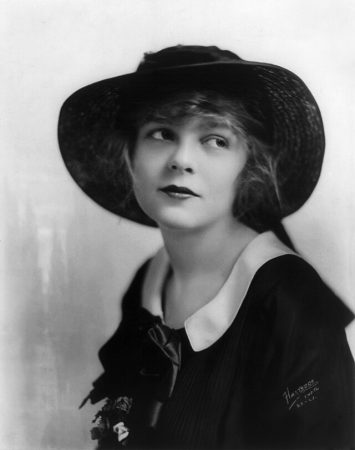
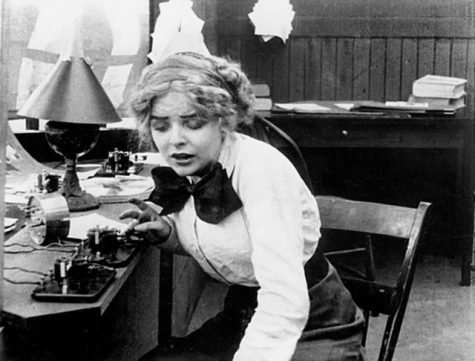
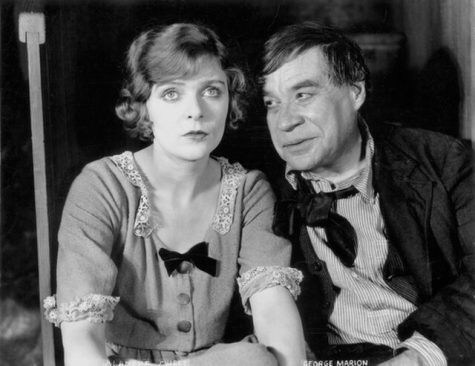
Best Foot Forward: A Collection of Sound Era Engagements
Act V: Blanche Sweet
In contrast to the hype generated by Norma Talmadge’s appearance at the Roxy in 1933, Blanche Sweet, one of D.W. Griffith’s first and most durable screen heroines, made a much more low-key stage engagement in the summer of 1931.
Born Sarah Blanche Sweet in Chicago on June 18, 1896, she was the daughter of a dancer, Pearl, and a wine dealer named Gilbert Sweet. Her father abandoned the family shortly after Blanche’s birth, and her mother – who was only 19 years old – died shortly thereafter.[1] Care of little girl thus fell upon her maternal grandmother, Cora Alexander, who secured Blanche’s first stage role when she was only 18 months old. Dozens of child parts followed – Blanche once remembered auditioning for the great Richard Mansfield’s company but refused to try hard because she “didn’t like his face.” By the time Blanche was four years old, however, she was touring alongside Marie Burroughs and Maurice Barrymore in The Battle of the Strong.
Shortly thereafter, Blanche – who at the time performed as Blanche Alexander – earned herself another engagement of note. Beginning in 1902, she began touring with singing comedian Chauncey Olcott, famed for his Irish character portrayals and, more importantly, for popularizing such ballads as “My Wild Irish Rose.”[2] Beginning with the 1902-1903 theatrical season, when Olcott was presenting Old Limerick Town, Sweet formed a part of the actor’s touring company, and signed on for the following season as well when the actor produced Terance. The time with Olcott helped cement her desire to become an entertainer. “I worked for three years with Chauncey Olcott, who was a very fine singer of popular music, not operatic,” Blanche Sweet told an interviewer in the 1980s. “During my three years with him, we played one-night stands or one week, sometimes two, but no more, except Terance, which he did in New York City. That was fine. It was exciting to me, at least, because he drove a stagecoach. I don’t mean a theatre coach. I mean a real coach and four horses on the stage – real horses – which then was a bit unusual.” Clearly, Sweet took away a child’s memories of her engagements with the Olcott company, as evidenced by her recollection of the actor’s magnificent stagecoach. The actual rigors of the traveling performer seem to have been lost on her at such a young age.[3]
It was while touring with Chauncey Olcott that young Blanche Sweet, performing as Blanche Alexander, made her Seattle debut. In a three-day engagement at the Grand Opera House beginning June 4, 1905, the young actress played the part of Bessie Ronyane in A Romance of Athlone, written by Olcott’s manager Augustus Pitou. In four acts, the play was set in Athlone, Ireland, around 1800, where Olcott played Dick Ronyane, the youngest son of an Irish nobleman, who returns to his father’s country home to encounter the lovely Rose Manning, daughter of a noted military man and bride-to-be of his elder brother Francis. Tensions between Dick and his father are high – Sir Phillip Ronyane has even accused his son of being a secret revolutionary.
Rose, of course, finds herself smitten not with Francis, her betrothed, but to the brash young Dick, much to the dismay of Standish Fitzsimmons, a friend of the Ronyane family. Fitzsimmons secretly hatches a plan to guarantee that Rose will eventually marry the “correct” Ronyane brother. The bait is Bessie (Sweet), Dick’s beloved sister, whom Fitzsimmons arranges to have kidnapped and held for ransom by local gypsies until the wedding between Rose and Francis can take place. Dick, however, becomes wise to the plot, and eventually challenges Standish to a climactic sword fight at the end of the play – one that, in defending his own sister against the sinister plans of another, manages to seal Rose’s love for the honorable Dick Ronyane.
The play (which incorporated several of Chauncey Olcott’s more popular songs) was a prime attraction for local audiences. “Seattle theater goers have a warm place in their hearts for Chauncey Olcott,” claimed the actor’s advance publicity, “whose rich tenor vioce [sic] is of the sweetest quality and [who] possesses a tender pathos that suits the crooning, soft ballads of Ireland.”[4] The production did not disappoint. According to the Post-Intelligencer, the play was a sentimental Irish romance that incorporated familiar themes and settings, “for what would an Irish play be if it had not its abbey and the young woman whose hopes have been blasted because she loved not wisely?” Comparing Chauncey Olcott’s work to Andrew Mack, essaying similar stage roles at the time, the Post-Intelligencer found much to recommend about Olcott’s performances, which tended to focus, of course, on his singing. “While time has penciled a few lines about Mr. Olcott’s face, it has been charitable in not attacking his voice, and he still sings the same sort of songs in exactly the same sort of a way that he has since he became a figure in theatrical affairs…Mr. Olcott’s attitude toward children is always pleasing and the confidential way in which he talks and sings to them is responsible for a large section of his popularity.”[5]
The Post-Intelligencer’s reference to Olcott’s work with children wasn’t an isolated remark. To the Star, in fact, it was the highlight of A Romance of Athlone – barring, of course, the songs themselves. Their reviewer thought the plot a bit melodramatic, but Olcott’s sincerity carried the day, even considering that his most famous tune, “My Wild Irish Rose,” didn’t necessarily measure up to the other songs in the play. “Best of all the good numbers through which Olcott caroled in A Romance of Athlone was the beautiful lullaby which the rollicking Dick sings in the second act to his little sister. In this the softer tones and all the rare tenderness of Olcott’s emotional tenor are brought out in a sympathetic scene, and the curtain is effectively timed, falling as the little one drops asleep at the end of the lullaby. After repeated encores, Olcott appeared before the curtain with the youngster in his arms, clad in her long ‘nightie,’ in lieu of making a speech.”[6] The youngster in Olcott’s arms was none other than Blanche Sweet, who – only two weeks before her ninth birthday – was enjoying her first bit of appreciation from Seattle audiences.
Following the June 6, 1905, close of A Romance of Athlone, the Grand Opera House went dark for a short period. Although the troupe immediately following the Olcott company didn’t arrive in Seattle in time for their opening performance, they nonetheless played on the second of their scheduled two-night engagement on June 17. The company showcased Barney Bernard in The Financier; young Marshall Neilan, who in 1922 would become Blanche Sweet’s first husband, essayed the role of Dan. Seventeen years earlier, in June 1905, they missed each other in Seattle by a mere 11 days.
Following the completion of her engagement with Chauncey Olcott, Blanche Sweet briefly retired from theatre in order to take up dance. In 1906, by then reunited with her father and living in San Francisco, she found herself caught in the city’s famous earthquake, after which she moved to Berkeley, studying dance from Ruth St. Denis. Money was tight, however, and soon she was off to New York, acting onstage as a way to fund dance lessons from, among others, Gertrude Hoffman.
Another financial opportunity presenting itself in the East was in the fledgling motion picture industry, where Blanche could earn extra money as a bit player. Her first experience before the camera was at the Edison Studios, but she soon found herself performing at Biograph under the direction of D.W. Griffith. She appeared in a number of Griffith’s 1909 releases, filmed in and around New York, and although she did not travel with the company during their winter sojourn in California, she rejoined the Griffith forces in 1911 and quickly established herself as one of the director’s more popular female stars. Through work in Biograph films such as The Lonedale Operator (1911) and The Painted Lady (1912), Sweet became one of the screen’s most recognized and talented actresses, and while still only a teenager. She eventually left Griffith and Biograph after playing the title role in Judith of Bethulia (Biograph, 1914), but continued work in feature films throughout the silent period (initially for Jessie Lasky), including The Warrens of Virginia and The Captive (both 1915), each made under the direction of Cecil B. DeMille. The following year Sweet would make several films for Cecil’s brother, William.
Although her Lasky features were hardly innovative, she remained a considerable box-office draw until the close of World War I, after which her film output dwindled. But Blanche Sweet was not without some shining moments. She played the title role in an adaptation of Eugene O’Neill’s Anna Christie (First National, 1923) to great acclaim and followed this with a turn in Thomas Hardy’s Tess of the D’Urbervilles (MGM, 1924), made under husband Marshall Neilan’s direction. Yet despite these triumphs, her popularity never managed to climb back to earlier heights, and she eventually turned to making films in England. She and Neilan divorced in 1929, and though Sweet played in a handful of sound productions, none managed to jump-start her career as a screen actress.
Late in her career Blanche Sweet returned to the stage, an effort that brought her to Seattle for only the second time. In August 1932, the actress opened a six-day run at the Fox Fifth Avenue Theatre in a Fanchon and Marco stage revue called Sweet and Lovely, which preceded the bill’s main draw, the MGM film Blondie of the Follies (1932) starring Marion Davies and Robert Montgomery.
The show, designed specifically to showcase Sweet’s talents, was a variety performance with several supporting acts. The highlight of each presentation found Blanche Sweet singing, giving a ballroom dancing demonstration, and enacting a scene from Anna Christie, which had been remade only two years previous as Greta Garbo’s first talking film.[7] Following the scene from Anna Christie, in which Sweet’s character, a prostitute, reveals her past to both her father and her lover, the actress openly challenged the audience to contrast the quality of her live presentation to her screen version (and by implication, no doubt, Garbo’s version). According to own her publicity, at least, Sweet “emerges from that comparison successfully, revealing herself as an actress who has good control of emotional expression and a keen appreciation of the significance of the scene in question.”[8]
Unfortunately, commentary on the Fifth Avenue bill focused almost strictly on Blondie of the Follies; reviews from the Post-Intelligencer and Daily Times mention Sweet’s stage revue only in passing.[9] Both papers, in fact, had more to say about the Fifth Avenue’s “Fur Revue” – a fashion show sponsored by the Hudson Bay Fur Company – than the Sweet engagement itself. Although the Times did manage to note that the actress “was given a noisy welcome and deserved it,” Blanche Sweet fared the best with Harry B. Mills of the Seattle Star.
[Fanchon and Marco’s] “Sweet and Lovely” idea presents a wide variety of talent, ranging from a serious presentation of a scene from Eugene O’Neill’s Anna Christie by Miss Sweet to a repetition of some scenes from the recent Vanities by Clarence and Claude Stroud.
Blanche Sweet can’t be classified as the most versatile star to ever leave Hollywood, but she brings a touch of sincerity to all of her work that is not only effective but commendable.
She appears in a scene from the O’Neill drama, does two songs with Al Rinker, who used to be a member of the original Rhythm Boys with Paul Whiteman, and dances a waltz with Loc Lorraine as her partner. When you compare her work with that of the average film luminary who steps into presentation work, the showing is excellent.[10]
Ellen McGrath of The Argus, however, had a slightly different take on Sweet and Lovely, which wasn’t entirely favorable (and which also demonstrated her unfamiliarity with Blanche Sweet’s film career). “There is little a screen actress on a personal appearance tour can do except sing a little, dance a little, say she is happy to be in Seattle and talk about the last picture in which she appeared,” she noted. “Miss Sweet does them all. Her last picture, a silent version of Anna Christie, was so long ago that hardly anyone except the actress can remember. She acted a scene from the O’Neill play. In it Anna, as played by Miss Sweet, emerged with a voice reminiscent of many hours toil with a teacher of voice. It was all right as voices go, except that stoic, uncouth Anna, fetched up in a fishing village, boasted no phonetic pronunciation. Entirely satisfying, however, was Miss Sweet as an exponent of what a well-dressed woman should wear. Her display of gowns (she changed costumes five times) was discouraging to any noble intentions of Seattle women who intended to replenish this season’s wardrobe liberally from those held over from last year.”[11]
By and large however, it was Blondie of the Follies, the Marion Davies film attraction, which grabbed most of the attention at the Fifth Avenue, with the stage portion treated as incidental entertainment. Even so, Blanche Sweet seemed unconcerned with the scant attention her appearance was garnering and continued to go about her business. On August 26th, for example, she was the guest of honor at a tea given by socialite and Daily Times columnist Dorothy Neighbors at the Fraser-Patterson Department Store, an event that was also open to the public. Sweet casually mingled both with Neighbors’ invited guests and the curious who happened to drop in, never once putting on airs. She also talked openly with the local press. While her focus was on fashion and looking one’s best, Blanche Sweet certainly demonstrated that she wasn’t pretentious.
Sitting in a cool lounging robe with one foot tucked comfortably under her, Blanche Sweet confided anxiously that she wanted to get fat. “Well, not exactly fat, of course, but a little more plump,” she explained, as she pointed with a rueful smile to a big bottle of olive oil on her side table, which she declared she conscientiously imbibes for that purpose.
“Hips can’t be too slim,” she admonished, but “I do love fat legs and round arms and necks…”
Her glowing coat of suntan proclaims her a lover of the outdoors. “Aren’t you afraid of coarsening and roughening your skin?” she was asked.
“I’ve been warned of that very thing by beauty specialists, but after studying middle-aged women I’ve decided I’d rather be a little weather beaten and wholesome and healthy looking than go languidly around with camille skin looking as if a breath of air would whisk [me] away. And I won’t be bored,” she chuckled.
Her smile, the twinkle in her eyes, reveal a true sense of humor and love of life. She attributes it to a healthy frame of mind and a fit physique, for she is a firm advocate of sleep and food – “Plenty of both!” she cautioned.
With the confident assurance of a beautiful woman she claims that beauty doesn’t matter. “It’s personality that counts,” in her opinion, and “character lies behind all personality.”[12]
If star watchers weren’t able to make the department store tea, they still had the opportunity to see Blanche Sweet have her hair done daily at the Fashion Permanent Wave Co., on the fourth floor of the People’s Bank Building. “Miss Sweet, like other modern American women, realizes the importance of attractive hairdress,” noted owner La Rue Berriault in an ad trumpeting the coiffure coup, “as is evidenced by the fact that she insures regular daily appointments by making arrangements with us in advance.”[13]
Like another of D.W. Griffith’s famous protégées, Lillian Gish, Blanche Sweet turned to stage acting during the early sound era, although efforts such as Sweet and Lovely failed to keep her in the public spotlight for any length of time. Her stage career in the 1930s didn’t necessarily blossom as Lillian Gish’s did, but one of Blanche Sweet’s more notable engagements came in 1935, when she appeared on Broadway in Robert Sherwood’s The Petrified Forest. The play also featured Leslie Howard but made a star of a young trouper named Humphrey Bogart, cast as the play’s desperate hoodlum.
Having divorced Marshall Neilan in 1929, Blanche Sweet married Raymond Hackett in 1936, by all accounts a happy union, and later in the decade hosted her own radio show. But by 1940 she had dropped almost completely out of sight, and by the 1950s Sweet was working rather anonymously as a clerk in a New York department store.
Luckily, however, in the 1960s (and on through her death in 1986) she became heavily involved in film scholarship and preservation. Particularly through the Museum of Modern Art in New York, Blanche Sweet’s vivacious personality and tireless efforts, like that of her Biograph counterpart, Lillian Gish, proved instrumental in promoting the cause of silent film appreciation, study, and restoration.
By Eric L. Flom – January 2026
Notes:
[1] Around 1905, during a theatrical engagement in Denver, Blanche Sweet recalled that her father saw the show and, after seeing the girl with her grandmother, realized that Blanche was his daughter. Later he attempted to contact her, calling her on the telephone, presumably at the theatre itself. “I was so thrilled,” Sweet recalled some 80 years later, “not that it was my father. No, that didn’t mean a thing. The telephone was something new and I was thrilled to be talking on the telephone.” (Blanche Sweet to Kevin Lewis, “Happy Birthday, Blanche Sweet,” Films in Review [March 1986], Page 132.) According to J.B. Kaufman, the telephone incident took place while Sweet was on the road supporting Chauncey Olcott in A Romance of Athlone – the very tour that brought her to Seattle. (Letter from J.B. Kaufman to author, dated 2 April 1999.)
[2] In 1947 Chauncey Olcott was the subject of the screen biopic My Wild Irish Rose, released by Warner Bros. Ray Heindorf and Max Steiner, musical arrangers for the production, scored an Academy Award nomination for their efforts.
[3] William L. Drew, Speaking of Silents: First Ladies of the Screen (Vestal, New York: The Vestal Press, Ltd., 1989), Page 216.
[4] “Chauncey Olcott’s Engagement,” Seattle Post-Intelligencer, 4 June 1905, Magazine Section, Page 11. Chauncey Olcott’s engagement in 1905 was the actor’s second visit to Seattle. All told, he would make 10 local appearances, the last coming in 1925, seven years before his death.
[5] “A Romance of Athlone,” Seattle Post-Intelligencer, 5 June 1905, Page 6.
[6] “At the Theaters,” Seattle Star, 5 June 1905, Page 3.
[7] The inclusion of the scene from Anna Christie is interesting, considering Blanche Sweet was quite upset with the Garbo version. She told William M. Drew in 1983 “[i]ncidently, I had an opportunity to do the sound remake of Anna Christie [1931] which was done by Greta Garbo for MGM. Greta had an idea about playing Anna, and I had an idea about playing Anna. In fact, I told her at the time, ‘I’m glad you’re going back to Sweden because then I’ll do Anna instead of you.’ The next day about dawn – well, I’m exaggerating a little but very early – she signed the contract to remain in this country with MGM and do Anna. If I’d kept my mouth shut, I would have done the sound version.” (Blanche Sweet to William L. Drew; Drew, Pages 230-231.)
[8] “Cinema Star to Appear in Person Here,” Seattle Post-Intelligencer, 25 August 1932, Page 10.
[9] The Fox Fifth Avenue Theatre, which was extending a heavy promotional effort for Blondie of the Follies, was also sponsoring a “Blondie of Seattle” contest in conjunction with the film. Women entering the contest stood to win $35 and the opportunity to appear onstage as part of the venue’s weekly fashion show.
[10] Harry B. Mills, “New Shows,” Seattle Star, 26 August 1931, Page 6.
[11] Ellen McGrath, “Stage, Screen, Music,” The Argus, 27 August 1932, Page 6.
[12] “Blanche Would Be Plumper; Good Health is Star’s Goal,” Seattle Daily Times, 26 August 1932, Page 23. With her disparaging comments about thin and impossibly pure movie heroines, one wonders whether Sweet was referring in some way to Lillian Gish, who supplanted her as D.W. Griffith’s female prototype at Biograph and, for the most part, embodied the type of femininity Sweet claimed to deplore.
[13] “Blanche Watches her Coiffure,” Seattle Post-Intelligencer, 25 August 1932, Page 10.
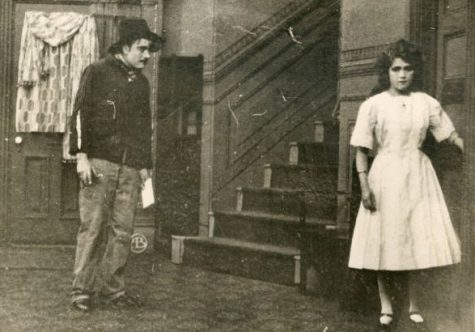
Sixteen-year-old Mary Pickford in D.W. Griffith's "The Lonely Villa" (Biograph, 1909). (Courtesy University of Washington Special Collections, Order No. 35001)
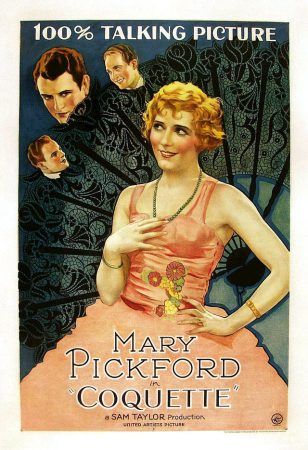
Silent star Mary Pickford marched into the sound era by making the all-talking picture "Coquette" (United Artists, 1929).
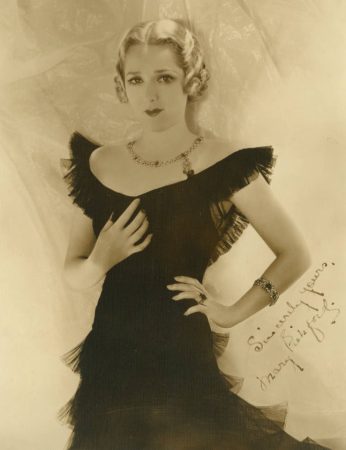
Publicity still of Mary Pickford from the "Coquette" stage tour, 1935. (Courtesy University of Washington Special Collections, Order No. 25645)
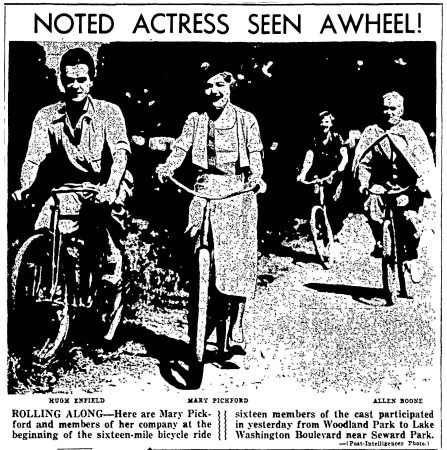
Mary Pickford and members of the "Coquette" company bicycle through Seattle. (Seattle Post-Intelligencer, 25 May 1935, Page 4)
Best Foot Forward: A Collection of Sound Era Engagements
Act VI: Mary Pickford
Yet another actress with an association to director D.W. Griffith went on to establish herself as one of the biggest talents of the silent era, if not one of the biggest motion picture stars ever. While actresses such as Norma Talmadge or Gloria Swanson had legions of their own devoted fans, almost no other performer (male or female) from the era was more universally adored than Mary Pickford.[1]
Born Gladys Smith in Toronto, Canada, in 1892, Pickford’s father died while she was young and her mother, looking for ways to make ends meet, got her children started in local theatre. Fiercely independent and ambitious, even at her youthful age, after only a few seasons young Gladys Smith moved left Canada for New York, where she managed to get an audience with none other than David Belasco, one of Broadway’s top producers. Belasco liked the brash young girl and found a role for her in the William de Mille play The Warrens of Virginia, a hit during the 1907-1908 theatrical season. It was quite an honor for 14-year-old Gladys Smith, being associated with one of Broadway’s biggest theatrical men – David Belasco’s only request was that she find a more appropriate stage name. Rummaging through the Smith family tree, Belasco eventually settled on “Mary” and the last name of her maternal grandmother, “Pickford.”
But after the close of The Warrens of Virginia the family again hit hard times, and in 1909 Mary’s mother suggested she try motion pictures, as many of the major studios were then located in New York. Pickford was appalled: although her siblings loved the movies, she recalled getting motion sickness when viewing her first film, and with pretentions of being a serious stage performer, she knew that acting in the “flickers” was an embarrassment. “In my secret heart I was disappointed in Mother, permitting a Belasco actress, and her own daughter at that, to go into one of those despised, cheap, loathsome motion picture studios,” Pickford recalled in her autobiography. “It was beneath my dignity as an artist, which I most certainly considered myself at the time. Belligerently, I marched up the steps of Biograph.”[2]
Not only did Mary Pickford have the good fortune of making Biograph Studios her destination of choice, where D.W. Griffith was beginning to hone his talents, but she also entered the film industry just as the emerging star system was beginning to make individual performers famous. Very quickly, Pickford became a motion picture favorite, a mantel she would not relinquish for over two decades.
At first, however, she wavered between a stage and film career. At one point during an argument with Griffith, Pickford announced she was leaving the director to return to David Belasco, which Griffith wrote off as a tall boast – until she managed to make good on her word, earning a part in Belasco’s stage production of A Good Little Devil.
Ultimately, however, Mary Pickford found herself wed to the movies, a popular star and independent spirit who proved herself not only in front of the camera but behind the scenes as well. Not only did she write a few of her own scenarios (particularly at Biograph) and eventually produce her own pictures but, in 1919 joined forces with Griffith, Charlie Chaplin and Douglas Fairbanks to form United Artists; her involvement in company affairs proved she was not only a popular entertainer but also an astute businesswoman. As an actress she was so popular with motion picture audiences that when she divorced her first husband, Owen Moore, and married Douglas Fairbanks in March 1920 (himself a recent divorcee), the expected public outcry never materialized – the couple was instead hailed as American royalty. This, only a few years after a similar situation helped tarnish the reputations of Francis X. Bushman and Beverly Bayne.
Throughout her film career, Mary Pickford became so closely associated with the spunky young heroines she played in hits such as Tess of the Storm Country (Famous Players, 1918, and remade for United Artists in 1922), Pollyanna (United Artists, 1919), and Little Annie Rooney (United Artists, 1925), that her attempts to move away from that image often proved her biggest box-office disappointments. “The character of Mary Pickford was an endearing little spitfire,” Kevin Brownlow remarked of her trademark persona. “She was delightful; she projected warmth and charm, but she had the uncontrollable fire of the Irish. Whenever a situation got out of hand, she would not submit to self-pity. She would storm off and do something about it, often with hilariously disastrous results.”[3] Though Pickford’s “little girl” screen persona may have been tiresome to her, Jeanine Basinger has argued that the actress actually managed to vary her portrayals over the years, keeping them familiar but fresh for motion picture audiences. In addition, several of her screen roles allowed Pickford to play dual roles (as in 1921’s Little Lord Fauntleroy), which allowed her to stretch her abilities.[4]
The coming of sound offered a new opportunity to break with her popular film image, and her first role in a talking picture was in Coquette (United Artists, 1929) – not one of her more memorable films but a performance that earned her an Academy Award as the year’s best actress. Symbolically, she broke with the girlish characters of her past films by cutting her long golden locks into a contemporary bobbed style, a more mature look. “I made Coquette, my first talking picture, and had the great satisfaction of winning the Academy Award,” she recalled in her memoirs. “For that my curls seemed at the time a small price to pay.”[5] Pickford made two other sound films, but could not maintain the audience popularity that was once hers during the silent era.
Even so, Mary Pickford remained an important figure both inside and outside the movie industry, and one of her best-received performances in the early 1930s was a live radio broadcast of Coquette, which was repeated twice due to overwhelming popular demand. Based on positive reaction to her radio work, Pickford engineered a return to the stage in the same vehicle, picking Seattle as the opening city on a planned tour of the United States. Although she was apparently to have begun the engagement in January 1935, scheduling difficulties (related, perhaps, to her divorce from Douglas Fairbanks, which was finalized that month) pushed the opening back to May 20, 1935, when the former Gladys Smith arrived at Seattle’s Metropolitan Theatre to begin a new phase in her career.
According to the show’s publicity, it had always been Mary Pickford’s desire to return to the stage; Coquette would be her first appearance in the footlights since childhood. (This advance material neglected to mention she had played a few eastern dates in The Church Mouse the previous year.) Russell Fillmore, who had also directed Pickford in her Church Mouse engagements, directed Coquette, a three-act drama. From Seattle the actress planned to head south to Portland, then over to Boise, Idaho, before moving to the East and South with the tour.
The return of Mary Pickford to the stage was certainly an event – publicity for Coquette went as far as to assert that it was of paramount importance to the entire world of entertainment. Everhardt Armstrong of the Post-Intelligencer helped set the tone for the engagement with an article appearing eight days prior to the opening, where he announced Coquette as one of the most important theatrical events ever to take place in Seattle.
The attention of theatre-conscious America will be focused on Seattle on Monday evening, May 20, when Mary Pickford opens a new chapter in theatrical history by appearing in her first full-length stage play since she was a girl of sixteen, at the dawn of a career without parallel in the annals of acting.
The phrase “America’s sweetheart” was no mere coinage of an ambitious press agent’s brain. It expressed the literal truth. For Mary Pickford, at the height of her screen career, was not only the most popular actress in the United States, but the most popular actress in the world. There have been hundreds of talented and beautiful aristocrats of the screen. There is only one Mary Pickford. And she is still “America’s sweetheart”…
Naturally, all Seattle is interested. So is all Hollywood. So is New York’s far-famed Broadway. So are London and Paris.
For Mary Pickford is a world figure; and her return to the footlights is a world event. In selecting Seattle for the “first night” of the new production of Coquette, the star is not only conferring an honor upon the city, but at the same time is giving recognition to the fact that following her presentation of the same play on the radio, although she was deluged with requests to enact it on the stage, the largest number of letters and telegrams came from Seattle and the Pacific Northwest.
After her Seattle engagement, Miss Pickford will tour the other cities of the Pacific Coast, and she is being urged to enact Coquette on Broadway.[6]
The company supporting Mary Pickford was comprised mostly of stage and film veterans – among others, John Miltern, Gay Seabrook, Hugh Enfield, and Gavin Gordon. Interestingly, John St. Polis, cast as Pickford’s ill-fated father in the film version of Coquette (and who gave perhaps the picture’s best performance) reprised his role for the stage tour. One of the show’s worst kept secrets was that the cast also included a small role for a young woman named “Ann Kirby,” the same as Mary Pickford’s grandmother. She was actually Gwynne Pickford, daughter of Lottie Pickford, Mary’s sister.[7]
Coquette starred Pickford as Norma Besant, a vivacious Southern belle with affections for Michael, a young man of questionable reputation. Her father’s stern opposition, of course, only increases her attraction. But the love affair turns tragic when Norma’s father shoots Michael and is tried for murder, tearing Norma’s heart between her dead lover and her father. (In the original stage production, Norma commits suicide at the end of Coquette; this detail was altered when Pickford filmed the play in 1929. Seattle reviews do not indicate whether the 1935 stage version of Coquette used the original ending.[8])
The opening of Mary Pickford in her first major stage effort in two decades was, as Everhardt Armstrong portrayed it, an intensely watched affair. The actress and her fellow performers arrived in Seattle on May 17, three days before opening night, and hunkered down at the Metropolitan Theatre for rehearsals and last-minute preparations. So important was the show’s success that the Star reported that Pickford would not be accepting any social invitations or attending public functions throughout the whole of her Seattle engagement.[9] (This self-imposed exile would not hold up for the duration of her visit.)
The seriousness of the production was reiterated in some of the advance material for Coquette, particularly on the day of the opening. In a warning of sorts, the show’s publicity linked the future of Pickford’s stage success with the future of Seattle as a theatrical center. “(T)he commencement of this limited engagement of six evening performances and two matinees not only launches an extended theatrical tour for ‘America’s Sweetheart,’ but also establishes this city as the place in which to begin ventures of this type, several of which are now in prospect…The success of the Pickford engagement will definitely set Seattle as the birthplace of stage tours on the Pacific Coast, according to those sponsoring this enterprise.”[10]
Seattle audiences, however, didn’t need such prodding, for both critics and crowds warmly greeted Mary Pickford in Coquette, and in a manner befitting her celebrity status. The actress revealed a true talent onstage, not only for light comedy but also for straight drama, and her efforts easily won over the audience. Everhardt Armstrong’s thoughts on Pickford’s opening performance were typical.
A triumph, brilliant and complete, was Mary Pickford’s return to the stage, last night at the Metropolitan, in Coquette, a play giving scope to the personal magic that made the petite actress the most dazzling figure in motion picture history.
This magic operated so potently last evening, that during scenes of high emotional tension many members of the audience were moved to tears…
The star’s superb acting in the poignant climax stirred her audience to such a pitch of enthusiasm that I lost track of the curtain calls; and the massed Mary Pickford enthusiasts would not leave the theatre until their idol made a gracefully phrased speech, in which she told of her happiness in being able to meet face to face the playgoers who through the years had expressed their liking for her work in pictures.[11]
Harry B. Mills of the Star proved a better counter of curtain calls than Armstrong, reporting a full 10. He also asserted that Pickford had lost none of her status as a performing artist – her potential as a stage actress, in his estimation, would rival her years of motion picture work. “It was the audience at her premiere which cast the vote,” Mills noted, “just as it is the audience in later presentations in this and other cities who will repeat it, and there is no gainsaying their verdict. That is one of the rules of the American theater, and it is safe to predict that those who attended the Metropolitan last night saw the official acceptance of a (to the speaking stage) new star.”[12] Mills’ review also highly praised the supporting cast and the work of the director, Russell Fillmore, elements easy to overlook in all the hoopla surrounding the actress. Predictably, Richard E. Hays of the Daily Times was also quite enthusiastic about the production. “The audience, on the star’s first entrance last night, gave her an overwhelming reception in prolonged applause that all but reduced her to tears,” he wrote of the opening. “Considering the first-night nervousness she must have felt, but did not show, her performance last night was superlative throughout…”
After the play, Richard E. Hays managed to get backstage with the star, who seemed quite overwhelmed with her reception from the Metropolitan crowd. “I thought for a moment I would not be able to find my voice,” she told Hays in her dressing room, referring to the ovation that greeted her entrance. “They were wonderful. I shall never forget them.”[13]
One of the more interesting reviews of the Pickford engagement came from Jacque Casad in The Argus. Casad was a former dramatic editor with the paper and was asked to return for a special “guest appearance” to review Coquette; she offered a unique perspective on Mary Pickford’s first appearance in Seattle.
Twenty years ago I was dramatic editor of The Argus. I had held that post for some years, through which time I had watched the cinema struggling for a footing. The moving picture of those days was properly regarded as the illegitimate spawn of the drama, and as such was not deemed worthy of more than advance notices by the press. No one ever thought of reviewing a motion picture. After all, what was there to say about them? But in the editing of advance notices I encountered one name more than any other. It was Mary Pickford – later to become “America’s Sweetheart.” Hardly a week passed that I did not have to write a little story about Mary Pickford’s forthcoming picture. For, believe it or not, she made a new picture almost every week. In one year Mary Pickford, according to the files of The Argus, appeared on the screen of the Clemmer theater in no less than four dozen different pictures.
Mary Pickford made no compromise with maturity in choosing a play for her return to the stage. It was as America’s Sweetheart that she won fame and fortune; it is America’s Sweetheart she will remain. Coquette typifies the sweet unaffected girlhood that motion picture audiences took to its bosom twenty years ago. She portrays an impulsive, Southern girl, the darling of her father and brother and all the village swains – light, frothy comedy played in Miss Pickford’s best manner. In the second act the play moves to grimmer stuff. Her father’s objection to the poor, white strain in his daughter’s favored suitor provokes the shot that kills her sweetheart and places her father in the murderer’s chair. [The t]ransition of Miss Pickford from the carefree girl to the sorely-perplexed figure, wavering between loyalty to her dead sweetheart and her father, was nicely achieved, [and] revealed an emotional depth in her interpretation of love and frustration.[14]
Shortly after her debut at the Metropolitan, Mary Pickford sat down with Daily Times society reporter Virginia Boren for an afternoon tea at the Olympic Hotel, a two-hour affair in which the star opened up on a variety of issues. The subjects were so diverse that Boren categorized the resulting article – they ran the gamut from clothes to marriage to her Hollywood estate, Pickfair. The actress, clad in an exquisite white velvet tea gown, was relaxed throughout the interview, despite a steady stream of interruptions from autograph seekers, personal staff, and long-distance phone calls. “I have always loved this play,” the actress noted of Coquette. “This is a lark for me and a dream realized. I always wanted to meet all my fans face to face. I have yearned to play in the legitimate. It is real freedom for me…The stage takes a great deal out of me. For instance as Norma Besant in Coquette I must sustain one mood for two and a half hours while in the movies the longest take of this kind would be five to six minutes. But I love seeing the people I play to, feeling their reactions.”[15]
Some of Mary Pickford’s comments to Boren still resonate. On her personal philosophy: “Live each day to its fullness and try not to fret about the future…I don’t believe there is a single person in the world who has unqualified happiness…but be as happy as you can.” Other comments are quite dated: “Women should defer to men, especially when the woman is not working and the man is. If he wants to go to the show, ‘fine’…if he wants to sit at home…equally ‘fine.’ If he wants to complain, listen. Try to be a pal and you’ll be a successful wife.’” Her most telling comments, however, were on the subject of marriage, especially considering that her own to Douglas Fairbanks had formally ended just a few months prior to the Metropolitan engagement. “I used to think that if stricter marriage laws were passed it would help but now I know that it’s just people and the way they change that cause divorce. For instance, a couple will live in ideal bliss for five, seven, ten years and then one of them changes…and there’s a divorce. But perhaps this modern way, this honest, frank facing of facts is better…The chief cause of matrimonial disasters in Hollywood is the fact that both the husband and wife have so many interests…Each one is talented, each one is in the limelight. In other words, one can not be a little superior to the other [or] then the trouble begins.”[16]
On a lighter note, Mary Pickford utilized a splendid Friday morning late in her Seattle engagement to take in some city views via bicycle. Together with 16 members of the Coquette company, they started by pedaling around Seattle’s Woodland Park and Green Lake, although the actress, according to a reporter along for the haul, insisted on extending the trip in light of the good weather. With three cars running behind to pick up stragglers and their bicycles, Pickford and her crew rode from Green Lake to the University of Washington, through campus, across the Montlake Bridge and onto Lake Washington Boulevard, where they continued to Seward Park, a distance estimated at 16 miles.[17] “Seattle certainly has a delightful climate and beautiful scenery,” Pickford proclaimed after the trip. “I enjoyed every minute of the ride. The sunshine was glorious, the breeze was grand and everything along the route so fresh and clean.”
In the long run, Mary Pickford’s stage tour of Coquette did little to extend her career outside of Hollywood; in her autobiography Sunshine and Shadow, published in 1955, she makes no mention of the tour at all. Following her divorce from Douglas Fairbanks in 1935 and subsequent marriage to actor and bandleader Charles “Buddy” Rogers in 1937, Mary Pickford effectively retired from the entertainment industry, save for her involvement in business matters affecting United Artists, where she continued to be active well into the 1950s. Although her public appearances dwindled over the last two decades of her life, Mary Pickford was given an honorary Oscar at the 1976 ceremonies for her achievements in the industry. She passed away in 1979.
By Eric L. Flom – January 2026
Notes:
[1] In 2001 an early version of this section appeared as Eric L. Flom, “Mary Pickford begins a national stage tour at Seattle’s Metropolitan Theatre on May 20, 1935,” HistoryLink (https://www.historylink.org/File/2964), accessed 20 December, 2025.
[2] Mary Pickford, Sunshine and Shadow (Garden City, New York: Doubleday & Company, Inc., 1955), Pages 63 and 65.
[3] Kevin Brownlow, The Parade’s Gone By… (New York: Bonanza Books, 1968), Page 120.
[4] Jeanine Basinger, Silent Stars (New York: Alfred A. Knopf, 1999), Pages 34–35.
[5] Pickford, Pages 175 and 176.
[6] Everhardt Armstrong, “Premiere Focuses Attention,” Seattle Post-Intelligencer, 12 May 1935, Stage & Screen Section, Page 5.
[7] “Mary Pickford’s Niece on Stage,” Seattle Post-Intelligencer, 25 May 1935, Page 4.
[8] See Kevin Brownlow, Mary Pickford Rediscovered: Rare Pictures of a Hollywood Legend (New York: Harry N. Abrams, Inc., 1999), Pages 231–232.
[9] “International Star Next,” Seattle Star, 17 May 1935, Page 11.
[10] “Coquette at Metropolitan This Evening,” Seattle Post-Intelligencer, 20 May 1935, Page 16. Even with the increased focus given the Pickford engagement, a little bit of showmanship was also employed in order to keep crowds streaming in: Free “autographed” photos of the actress, distributed to audience members attending either the Wednesday or Saturday matinee shows.
[11] Everhardt Armstrong, “Mary Pickford Triumphs in Her Return to Stage,” Seattle Post-Intelligencer, 21 May 1935, Page 16.
[12] Harry B. Mills, “Mary Pickford Given Ovation,” Seattle Star, 21 May 1935, Page 11.
[13] Richard E. Hays, “Mary Triumphs in Stage Play,” Seattle Daily Times, 21 May 1935, Page 8. Wishes for a successful return to the stage didn’t come only from crowds at the Metropolitan. Between the theatre and her suite at the Olympic Hotel, it was reported that cablegrams had come in from many of Hollywood’s biggest names to applaud Mary Pickford’s new endeavor: Will Hays, Carl Laemmle, Norma Shearer, Irving Thalberg, Shirley Temple, Wallace Beery, Jeanette MacDonald, Jean Harlow, Bette Davis, Ronald Colman, Leslie Howard, Walt Disney, Bing Crosby, Charlie Chaplin, Barbara Stanwyck, Al Jolson, Mr. and Mrs. Harold Lloyd, Fredric March, Eddie Cantor, Lionel Barrymore, Sid Grauman, Clark Gable, and George M. Cohan, among others. (See “Pickford Matinee Today,” Seattle Post-Intelligencer, 22 May 1935, Page 22.)
[14] Jacque Casad, “Mary Pickford,” The Argus, 25 May 1935, Page 5.
[15] Virginia Boren, “Mary Pickford and Virginia Boren Talk and Talk Till Tea Gets Cold,” Seattle Daily Times, 24 May 1935, Section II, Page 2.
[16] Ibid.
[17] “Noted Actress Seen Awheel,” Seattle Post-Intelligencer, 25 May 1935, Page 4.
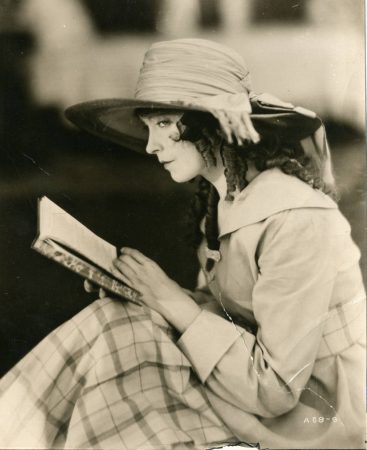
Lillian Gish in D.W. Griffith's "The Greatest Question" (First National, 1918). (Courtesy University of Washington Special Collections, Order No. 17752)
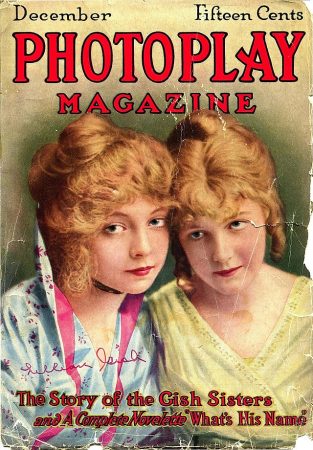
Lillian and sister Dorothy Gish, ca. 1914. (Photoplay, December 1914)
University of Washington drama professor Glenn Hughes, August 10, 1948. (Photo by James O. Sneddon, courtesy University of Washington Special Collections, Order No. UWC8778)
Showboat Theatre at the University of Washington, on the shores of Portage Bay, ca. 1960.
Gish in "Mrs. Carlyle," at Seattle's Showboat Theatre, October 23, 1948. (Photo by James O. Sneddon, courtesy University of Washington Special Collections, Order No. UWC9949)
Lillian Gish visits with students from Seattle's Lincoln High School, October 20, 1948. (Courtesy University of Washington Special Collections, Order No. UWC9944)
Best Foot Forward: A Collection of Sound Era Engagements
Act VII: Lillian Gish
Yet another of D.W. Griffith’s female talents, and a woman whose theatrical achievements were hailed as much as her motion picture work, was Lillian Gish. Born in Springfield, Ohio, in 1896, Gish’s father deserted the family when she was quite little, and in 1902, like so many other child performers, Lillian (along with her sister Dorothy) took to the stage to support the family. Although the Gish sisters were often separated, obtaining work in separate touring companies, they remained close, and eventually developed into actresses of considerable potential. In one of her earliest stage engagements, Lillian even supported the great Sarah Bernhardt (though as a dancer, not in an acting role). “I recall the Divine Sarah standing near me in the wings, waiting for the curtain to rise,” Gish wrote in her autobiography. “My hair was very fair. Mother put it up in curlers every night, and when it was combed out the effect was like a nimbus around my face. Madame seemed attracted to my hair and would run her fingers through my curls. To my eyes, she was an apparition with her dead-white face, frizzled red hair, and eyes the color of the sea. She spoke in a singing voice, but her words were strange; I had never heard French before.”[1]
The Gish sisters put in several years as juvenile performers before turning to motion picture work, and it was Mary Pickford, in fact, whom they had befriended in New York theatre circles, who introduced them to D.W. Griffith and the Biograph Studios.
Both Gish sisters became staples at Biograph but Lillian, in particular, blossomed into the prototype Griffith heroine: thin, frail, pure of heart and often quite vulnerable. In the hands of many actresses such roles would come off as shallow and nondescript, but Lillian Gish had an innate gift for these characterizations, with a subtleness in her performances that gave them depth and emotional feeling, making her an ideal subject for Griffith’s Victorian notion of femininity. With few exceptions, she would work with the director almost exclusively from her film debut in 1912 until 1921, when she and Dorothy starred in Griffith’s epic of the French revolution, Orphans of the Storm, based on the old stage melodrama The Two Orphans.
Lillian Gish moved to MGM in the mid-1920s, making several excellent films, including an adaptation of Nathaniel Hawthorne’s The Scarlet Letter (MGM, 1926) and The Wind (MGM, 1928), both under director Victor Sjöström. Yet as the sound era dawned, Gish was increasingly viewed by Louis B. Mayer as an overpriced studio asset; some have even argued that Mayer purposely sabotaged Gish’s career in order to build up Greta Garbo’s. Louis B. Mayer reportedly questioned Gish as a box-office draw, particularly in light of talking pictures, which he felt she could never master. Gish took her cue, left the film industry and returned to the New York stage, where audiences warmly received her in a 1930 revival of Anton Chekhov’s Uncle Vanya, the first of many stage roles throughout the 1930s and 1940s that would cement her as a first-rate actress in both arenas. Although she tackled a film role here and there (most notably King Vidor’s Duel in the Sun [Selznick Releasing Organization, 1946] and Night of the Hunter [United Artists, 1955] directed by Charles Laughton), much of Lillian Gish’s later reputation came from her ongoing stage work, together with her tireless efforts on behalf of the preservation and study of silent films.[2] She worked at both endeavors until shortly before her death in 1993, at the age of 96.
Lillian Gish made her only known stage appearance in Seattle in October 1948, when she played a full three weeks at the Showboat Theatre on the University of Washington campus in Mrs. Carlyle. The play was written by Professor Glenn Hughes, who came to the University of Washington during the First World War and gradually lifted drama from occupying a small portion of the English curriculum to a full-fledged department of national reputation.[3]
A strong proponent of theatre-in-the-round, Glenn Hughes was born in Cozad, Nebraska, in 1894, but moved to California as a young boy, eventually graduating from Stanford University in 1916. At 22 he accepted a teaching position at what is now Western Washington University in Bellingham but eventually settled into the English department at the University of Washington, where he received a master’s degree in 1920.
For a brief period in the 1920s, Hughes balanced his teaching post with a stint covering local theatrical engagements for the Seattle Star. He also raised money for a separate Drama Department at the University of Washington by organizing a foreign film series that brought several motion pictures to Seattle which otherwise would never have been exhibited locally. This film program was a success but had to be discontinued in 1931 due to the Depression.
Glenn Hughes briefly left the University of Washington for Scripp’s College in California but was lured back with the promise of a separate Drama Department and the freedom to develop it himself. It was an opportunity that an ambitious Hughes could not pass up. Not only did he vastly expand the curriculum of the program, but in the mid- to late-1930s worked closely with the Federal Theatre Project (a component of Franklin Roosevelt’s Works Progress Administration) to build two separate theatres on campus, the Penthouse and the Showboat.
His drive, however, caused friction. Not only would Glenn Hughes have “creative differences” with many of the figures who helped get the University of Washington Drama Department off the ground, but once the campus theatres were operating on a regular basis, frequent complaints arose that he seemed more interested in box-office receipts than enhancing the Department’s reputation. He was also accused of working tirelessly to promote himself, sometimes at the expense of the University. By the time Hughes retired in 1961, drama at the University of Washington was past its glory days, and his increasing difficulties with faculty members had begun to damage the program. Glenn Hughes passed away in 1964.
In addition to founding and developing the Drama Department at the University of Washington, Glenn Hughes was also an accomplished playwright, producing numerous plays and one-acts during his tenure at the University. One of these was the world premiere of Mrs. Carlyle, a historical comedy centered on the wife of the English writer Thomas Carlyle. In her autobiography, Lillian Gish claims Hughes wrote the play specifically with her in mind, and that she agreed to originate the title role of Jane in Seattle; local players took up not only the role of Thomas Carlyle, but other literary giants depicted in the play, including Alfred Tennyson and John Stuart Mill. This was a bit unusual in that University productions tended to be all-student affairs, with the engagement of a guest star almost unheard of. Whether to afford Gish some more “capable” support or whether to give some of the Department’s more established figures an opportunity to play alongside her, the principal cast was largely made up of Drama school staffers.
The production was presented at the Showboat, one of Glenn Hughes’ theatres constructed with funding provided through the Works Progress Administration. Built in 1937, it was one of the city’s most unusual venues – a throwback to the infamous showboats, or “floating theatres,” that cruised American rivers during the 19th century, presenting not only plays but sometimes vaudeville, minstrel and circus entertainment. Located at the southern end of the campus, on Portage Bay, the Showboat was a derivation of its model, much smaller than a Gilded Age vessel and constructed on pylons in the water to give only the illusion of an actual boat.[4] “The auditorium seats two hundred and twenty spectators,” Philip Graham wrote in his 1951 book, Showboats, “and the stage is efficiently and beautifully equipped, with a revolving disc to permit quick change of scenes, a permanent sky-dome, and an elaborate switchboard for remote control.”[5]
Because the venue was more closely associated with the University of Washington than the established downtown theatres, Lillian Gish’s visit received comparatively little attention from Seattle’s dailies than had been the case for stars such as Norma Talmadge and Mary Pickford. Nonetheless, Mrs. Carlyle played a scheduled three-week run at the Showboat, with performances every evening except Sunday (plus a Saturday matinee) beginning October 8, 1948. The supporting cast of Mrs. Carlyle featured, among others, Robert Gray, Robert Prins and Ruth Prins, later to host one of Seattle’s earliest television shows for children, the Peabody Award-winning Wunda Wunda. Ten additional cast members rounded out the play.
Following her stint at the Showboat, Lillian Gish was scheduled to leave Seattle for New York, where she was to be in a staging of August Strindberg’s The Father.[6] With a replacement actress taking over the title role, Mrs. Carlyle was to have Friday and Saturday performances only throughout the month of November.
Interestingly, the play almost didn’t open at all, at least not with Lillian Gish as part of the cast. Shortly after Gish arrived in Seattle to begin rehearsals, her mother unexpectedly passed away in the East, prompting her to return for the funeral. The actress contemplated bowing out of the show, but appeals from Glenn Hughes managed to lure her back in time for the opening. Taking place in September 1948, none of these backroom negotiations were revealed to the press – the Showboat continued to advertise that Lillian Gish was to make her Seattle stage debut on October 8th as if nothing had occurred. Even so, the venue was careful to report that she would play the title role of Mrs. Carlyle for only the first week of the run.[7] It was later announced that Gish would stay for the entire three weeks.
The night before the official opening, a special invitation-only performance was given as a preview. J. Willis Sayre, then writing for the Post-Intelligencer, was in attendance, although his review was held until October 9, the day after Mrs. Carlyle opened to the general public. Sayre was impressed, though his comments were a bit non-descript.
Mrs. Carlyle starts out with two points of special interest. First, it was written by Glenn Hughes, head of the School of Drama at the University of Washington; one of the climaxes, it might be said, of his 28 long years of public service on the campus. It is easy to realize the prodigious amount of research work he must have put into it.
The play’s second highlight is its offering, as its star, Lillian Gish, in her first appearance as a Seattle stage actress. To the oldtimers she will seem little changed by the passing years from the winsome girl whose appealing personality and feeling for her roles made her the foremost of the David Wark Griffith dramatic stars in the era of silent films. The generations will discover why fame came to her and has stayed with her. Mrs. Carlyle is a “class” offering in that its appeal will be to the discriminating showgoers who prefer a play that is thoughtful and thoroughly atmospheric to one that relies much more upon physical movement. It is a historical, almost completely factual, revelation of the courtship and years of married life of Thomas Carlyle and Jane Welsh.
To the accompaniment of tasteful settings and lavish costuming, the play has a well-balanced supporting cast including Ruth Balkema Prins, Chris Hansen, Wayne Carson, Jeff Forsythe, Robert Gray, Robert Prins and half a dozen others.[8]
Nat Lund, writing for the Daily Times, held his review of Mrs. Carlyle until three days after the play’s debut. Lund managed to present a more thorough account of the play, although like Sayre’s article, his review was a short one.
To make credible and interesting the despairs and triumphs of a person dead a hundred years is a task of considerable difficulty, but Glenn Hughes and Lillian Gish have made of Mrs. Carlyle, at the Showboat Theatre, a warm and moving portrait of the wife of the great Scottish author. The slow, stubborn rise to literary fame of her temperamental husband is mirrored in the problems – domestic and romantic – which beset his wife. Hughes’ play covers a 22-year period, and Miss Gish, in the title role, is superb as a the [sic] loyal, optimistic spirit who maintained Carlyle’s often-lagging faith in himself…
Miss Gish, on stage almost constantly throughout the three acts and six scenes of Mrs. Carlyle, as has been said, consistently enjoyable and believable…it’s a play of which star, author and Seattle may be proud.[9]
On October 12, the same day Lund’s review appeared in the Times, the campus newspaper, the University of Washington Daily, also reviewed Mrs. Carlyle, a highly complementary account penned by Sophus Winther, a professor in the University’s English Department.
Professor Hughes made use of all the scholarship in the field and by the art of selection caught the most dramatic moments in the lives of the principal characters. This is a living and vital story of love, poverty, disappointment, despair, fidelity to great principles of art, hunger for recognition, triumph over physical and spiritual disaster. It is a story of turbulent personalities struggling against their inner conflicts, victimized by trivialities and saved by faith in their common objectives. It is an impassioned interpretation of two great characters whose lives left a remarkable imprint on a great period in English letters.
As a further honor to Professor Hughes and to our University school of drama, Lillian Gish came here from New York to play the leading role. She represented every mood of the head-strong and adventuresome young Jane to the mature and beloved Mrs. Carlyle of the successful years in London. Her personality seems to be Jane’s. The quality of her voice, gay, sad, earnest and sometimes tragic, moved the audience as the play developed. Miss Gish has an indefinable magic. She never resorts to the obvious or the extreme. She seems to play down the part, ignoring the outward struggle and by the charm of her personality, by convincing sincerity, she leads the audience into complete acceptance of the action. Her performance embraced every actor in the company on that same sincere basis. She made the play a unity of action that carried remarkable conviction.[10]
Generous praise, indeed, for both Hughes and Gish, but praise that seems all the more generous today after reading Mrs. Carlyle, which was published by the University of Washington Press in 1950. Although Gish was 52 years old at the time, when we first meet Jane in the play, the character is only 20 (by the end of the play Jane Carlyle is 42). Mrs. Carlyle initially portrays her as a beautiful, bright and witty figure, whose captivating presence enthralls almost every man in her midst. But as the play progresses, even though we are assured that Jane has retained these qualities, the focus becomes more on her role of placating an increasingly temperamental husband, one who demands a good deal of emotional and intellectual control over his spouse. Jane, in fact, who once showed literary promise herself, is reduced to playing the role a dutiful wife, supporting her husband’s various projects and changing fancies while occupying her own time with idle tasks. Only late in the play, after Thomas Carlyle’s attentions have been steered away by a rich socialite, does Jane begin to assert herself with her husband – one of the production’s few moments of dramatic tension.
As a model for Mrs. Carlyle, Glenn Hughes seems to have taken the old adage that “behind every man is a good woman,” although the results (on paper, at least) don’t seem to generate much in the way of dramatic momentum. Critic David B. Pennell, reviewing Mrs. Carlyle for The Argus, was the only reviewer at the time to draw a similar conclusion.
It is remarkable that Miss Gish, in the title role of the wife (nee Jane Bailie Welsh) of Thomas Carlyle, does not predominate over the rest of the cast – which includes mature staff members of the School [of Drama] – so much as this reviewer anticipated she would. If this is partly to be laid to Miss Gish’s generosity, it is also partly attributable to the fact that the role of Mrs. Carlyle is not a great part for her.
Mr. Hughes’s play seems aimed at praising an ideal of domestic partnership, in which a woman, herself intellectually and literarily gifted, subordinates what claims she might have to an independent destiny in favor of a selfless espousal of her husband’s pursuit of fame and its rewards…The figure of Thomas Carlyle which appears seems hardly worth all Jane’s trouble, as far as this play is concerned. There it [sic] little evidence of the greatness which made him one of the most lionized literary men in Victorian London, for here he is petty, bombastic, self-centered, even weak…
The relevance of this is that people who we are told are great people are presented in these episodes of their domestic life in a mean light, as merely ordinary people – their greatness is made heresay, and has not place in the play. If the characters were named Smith, Brown and Jones instead of Carlyle, Tennyson, Mill, Jeffrey, and Mazzini, the fact that their talk is usually commonplace would be inescapable. Mr. Hughes’ lines are uniformly literate but hardly ever exciting.[11]
Were it not for Lillian Gish’s presence, Pennell also noted, in a performance which “not surprisingly vindicated her high place in the theatrical profession,” there would be little worth viewing in the play at all.
Late in the show’s run, the Daily, the University of Washington’s campus newspaper, provided a behind-the-scenes look at Mrs. Carlyle, one of the few original pieces to be written about the play after its debut. On October 19th, Daily reporter Bill Clark offered a backstage view of the production, in a brief article focusing on neither the play nor its star but on the mechanics of its staging. Even after two weeks of regular shows, Clark could sense the heightened tension at the Showboat. “At 8:41 the show has been on 60 seconds,” he noted of the evening’s performance. “Nothing can stop the machinery of play-acting now. A semi-professional production, the work out front features a famous star who seems more a presence than an actuality. The presence causes the students [backstage] to stand a little straighter, quieter while they wait and perspire under the heavy costumes.”[12] Unintentionally, Lillian Gish had become the type of formidable presence she remembered Sarah Bernhardt to be when Gish played alongside her as a little girl.
The most unusual (and unfortunate) aspect of Lillian Gish’s visit to Seattle was how little attention an actress of her caliber garnered from the theatrical departments of the city’s daily newspapers. There doesn’t appear to be a record of when Gish arrived in Seattle, where she stayed, or what she did during her visit. Neither the Times nor the Post-Intelligencer ran interviews with her (the Star, for years Seattle’s third daily newspaper, had ceased production the summer before), although it isn’t clear if they weren’t interested or whether Gish simply wasn’t giving any. Save for a few carefully scripted announcements released by the Showboat, Lillian Gish’s only stage appearance in Seattle would have been a very easy one to miss altogether. Aside from a surprise party given in her honor by the Drama Department shortly before the actress departed for New York, almost nothing beyond the show’s reviews was noted about her entire stay.[13] Gish also had little to say about the experience in her memoirs. “In the fall of 1948 Professor Glenn Hughes had his play, Mrs. Carlyle, ready for rehearsal in Seattle. I had not wanted to go so far west, but as he had written it for me, I accepted, and went off to work with a delightful group of talented people.”[14]
By Eric L. Flom – January 2026
Notes:
[1] Lillian Gish (with Ann Pinchot), The Movies, Mr. Griffith and Me (Englewood Cliffs, New Jersey: Prentice-Hall, Inc., 1969), Pages 24–25.
[2] Interestingly, the Paramount Theatre (known as the Seattle Theatre when it originally opened) showed Duel in the Sun just two weeks prior to the opening of Mrs. Carlyle, the play which first brought Lillian Gish to Seattle. The engagement was advertised as the film’s first local screening at regular prices.
[3] See Cassandra Tate, “Glenn Hughes (1894–1964),” HistoryLink (https://www.historylink.org/File/3694), accessed 21 December 2025.
[4] The fact that the Showboat was not seaworthy, it seems, almost caused the project to be shut down for good. Apparently a WPA representative arrived to inspect construction on the theatre and, expecting a real vessel, was shocked to discover that it was not designed to float at all. A quick call to the East shut down the project, and it took Hughes two months and a lot of maneuvering to get construction of the Showboat back on track. (See Marilyn Dale Bennett, The Glenn Hughes Years, 1927–1961— University of Washington School of Drama [Ph.D. Dissertation, School of Philosophy, University of Washington, 1982], Page 70.)
[5] Philip Graham, Showboats: The History of an American Institution (Austin, Texas: University of Texas Press, 1951), Page 189.
[6] “Lillian Gish Now in Farewell Week,” Seattle Post-Intelligencer, 24 October 1948, Pictorial Review, Page 21.
[7] See “Lillian Gish Star of Hughes Play,” Seattle Daily Times, 21 September 1948, Page 27.
[8] J. Willis Sayre, “Mrs. Carlyle Has Fine Start,” Seattle Post-Intelligencer, 9 October 1948, Page 7.
[9] Nat Lund, “Lillian Gish Scores in New Hughes Play,” Seattle Daily Times, 12 October 1948, Page 15.
[10] Sophus Winther, “Hughes Play Mrs. Carlyle Success; Lillian Gish Stars,” University of Washington Daily, 12 October 1948, Page 4.
[11] David B. Pennell, “The Carlyles at Home,” The Argus, 23 October 1948, Page 4.
[12] Bill Clark, “Theater Backstage Tense as Play Unfolds Out Front,” University of Washington Daily, 19 October 1948, Page 1.|[13] “Miss Gish Honored for Carlyle Show,” University of Washington Daily, 29 October 1948, Page 3.
[14] Gish, Page 361.
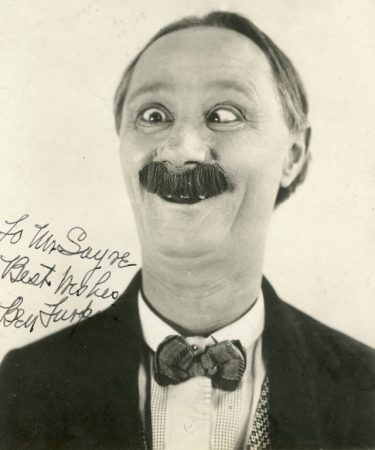
Screen comedian Ben Turpin, ca. 1921. (Courtesy University of Washington Special Collections, Order No. JWS21236)
When Charlie Chaplin signed a new contract with the Essanay Company, his first release paired him with Ben Turpin in "His New Job" (Essanay, 1915).
Thirty years of Ben Turpin as a performer. (Exhibitor's Herald, 6 May 1922, Page 37)
Ben Turpin in Tacoma helping promote Northern Pacific Railroad's signature dish, the "Great Big Baked Potato," ca. 1923. (Courtesy Washington State History Museum, Catalog ID 2004.69.87)
Best Foot Forward: A Collection of Sound Era Engagements
Act VIII: Ben Turpin
Following Mary Pickford’s engagement at the Metropolitan in 1935, there were only three major figures from the silent era yet to appear on the stages of Seattle. Lillian Gish’s visit, in October 1948, was the last of these. Two others, however, appeared before her, but unlike Gish, whose acting career continued to flourish after the introduction of sound to film, both the remaining personalities appeared as nostalgic throwbacks to an earlier age. The first was the engagement, in May 1938, of 71-year-old Ben Turpin, the old comedian of Mack Sennett fame who built an entire film career on the basis of his cock-eyed looks. Booked for one full week into the Palomar Theatre, which liked to bill itself as Seattle’s last remaining vaudeville house, Turpin was clearly a vestige of a bygone era, and in an entertainment form that didn’t have much longer to survive.
Ben Turpin was born in New Orleans in September 1869, although when he was seven his family uprooted themselves from the South and settled in New York’s lower East Side. Turpin – who as a youngster had not yet developed his eye condition, known as strabismus – left home in his late teens, and after proving unsuccessful at other endeavors, took his outgoing personality onto the vaudeville stage where he specialized in comedy and acrobatics. His specialty was wild pratfalls, including a stund that Barry Brown described as “a trick which starts from a standing position, with the acrobat throwing himself backwards and landing on his feet. Turpin learned to modify this for laughs, landing on his face or back or any other part of his anatomy that got the biggest audience response. There are many versions of the origins of his strabismus, including [the] contention that it was caused by damage to an optic nerve through repetition of these brutally masochistic backward somersaults.”[1]
Turpin spent several years in vaudeville before joining the fledgling Essanay Film Company in 1907, where he appeared in knockabout screen comedies over two years without much success. Most of these have not survived. He went back into vaudeville, but returned to Essanay in 1914, taking small film roles while doubling as the studio janitor. His second stint with Essanay was fortuitous, however, since the company eventually signed film comedy’s newest star, Charlie Chaplin, in 1915. For the comedian’s first two Essanay releases, Chaplin selected Ben Turpin to play opposite him.
Ben Turpin reportedly didn’t like his new partner very much, but the exposure of working alongside one of the industry’s biggest names helped introduce his likeness to motion picture audiences. Later, Turpin moved his talents over to Vogue and Mutual, but finally achieved success in his own right after joining forces with Mack Sennett in 1917, quickly becoming Sennett’s top comic. It was a relationship that lasted until the mid-1920s, and one that helped Sennett remain competitive in the comedy field after World War I, when the old Keystone-style slapstick slowly gave way to more subtle feature-length comedies.[2] In his own effort to graduate from slapstick, Ben Turpin earned lasting fame for his many parodies of famous film figures and trends, such as his send-ups of Erich von Stroheim or of the Valentino craze in The Shriek of Araby (Sennett, 1923).
The comedian eventually retired from the screen in 1924 to take care of his ailing wife, Carrie Le Meux. “What’s the good of all the money I got if I can’t make my wife well?” Turpin is said to have remarked at the time. “She’s all the counts. As long as she needs me the movies can go hang.”[3] Unfortunately, the comedian’s wife died in October 1925; he would remarry less than a year later.
Ben Turpin eventually returned to the screen, but only in the occasional cameo role, though he had a recurring part in the 1934 Mascot serial The Law of the Wild.[4]
The Palomar engagement in 1938 was the second for Ben Turpin in Seattle, who first visited the city in October 1921 in the vaudeville sketch Look at Me, booked for a weeklong engagement at the Pantages. The effort teamed him with Bert Hadley and Kathryn McGuire; McGuire would eventually be Turpin’s leading lady in The Shriek of Araby, and later played opposite Buster Keaton in two of his best films, Sherlock, Jr. and The Navigator, both of 1924. Publicity from the engagement suggests that Ben Turpin was an added attraction to the Pantages bill and that he was beginning the western leg of an exclusive vaudeville tour.
The act itself came with little description but apparently featured Turpin in scenes derivative of his motion picture antics, including singing, dancing, performing various comic bits and, of course, demonstrating his signature pratfalls. Crowds at the Pantages ate it up. “Ben Turpin, the Mack Sennett comedian whose eyes are laid out on unconventional lines, climaxes an unusually strong bill at The Pantages this week,” wrote the Seattle Daily Times. “Turpin made his first appearance yesterday afternoon and demonstrated riotously that he can be funny on the stage as well as the screen, a thing which many film comedians cannot do.”[5]
The Post-Intelligencer had a similar reaction, noting that Turpin headlined a vaudeville bill that delighted audiences with an assortment comic offerings. Other acts included the LeGrohs, a trio of comedy acrobats, a presentation of the Willard Mack playlet Who is She?, a highwire act by the Four Hortons, and xylophone experts the Avalos.
Ben Turpin has a back – that’s to be tumbled on. He has two feet – they’re to be tripped on. He has a face – to hang his mustache on. And Ben Turpin has eyes – such eyes as none but Ben can, or will, claim.
And Mack Sennett’s slapstick star uses them all, much to the joy of Pantages patrons this week. As the “leading man” in Look at Me, which is what they do, he finds able partners in Katherrn [sic] McGuire and Bert Hadley. Perhaps there were those who were disappointed at the lack of custard pies and at Ben’s oversight in not turning the hose on the audience, but all the other stunts are present in profusion…
[It’s a] bill that leaves one wanting to laugh some more, but not quite able to do it. Probably the only unlaughable features are Pathé News and the Pantages orchestra – for even the Avalos, expert xylophonists as they are, approach too nearly the gymnastic not to merit at least a smile.[6]
Only the Seattle Star had anything resembling criticism for Turpin’s act, which highlighted, in their opinion, a well-balanced bill at the Pantages. “[Ben Turpin] delighted the large audiences with his tumbling and general funmaking, but the exhibition was tame compared with some of his screen appearances, as there were no house-wrecking or other indoor sports in which Turpin usually indulges.”[7]
By 1938, however, when the comedian returned to Seattle, much had changed – in vaudeville, in motion pictures, and in Turpin’s own fortunes. Nonetheless, the Palomar engagement (the venue, formerly the Pantages, had been renamed in the 1930s) was a link to a type of entertainment, and entertainer, of yesteryear. Even Ben Turpin’s advance publicity played in this notion. “Back in the days when stars like Alice Faye and Dorothy Lamour were just small lassies, there was an actor named Ben Turpin who was sitting atop the entertainment world. Years and years ago Ben was in what was referred to as his prime.”[8] The short bill of live acts at the Palomar, highlighted by Turpin, supported a pair of B-pictures, The Kid Comes Back (Warner Bros., 1938) with Wayne Morris and Invisible Enemy (Republic, 1938) with Alan Marshall.
The Palomar was a popular destination for nostalgic crowds hankering for a taste of the good ol’ days. Turpin, touring the West Coast with his act, was thus in his element, even if age prevented him from performing the type of acrobatics he had 16 years previous on the same stage. Much of his 1938 appearance, in fact, was strictly a monologue on his acting days, trading one-liners with the show’s “master of ceremonies” Jerry Ross, and certainly of little strain to the comedian. “With his melon hat, long hair, ankle-length trousers, moustache, leer and above all his run-together eyes,” wrote Randolph Smith in the Star, “Turpin would be comical enough without the running fire of wise cracks and patter he trades with Ross. At the end of the act he thanks everyone and extends a fatherly benediction.”[9]
J. Willis Sayre visited the Palomar, and expressly for the opportunity to see Ben Turpin live. He found the comedian a pleasure to behold.
Just as fast as a seat became empty yesterday at the Palomar someone else slid into it; there was a constant jam of humanity around the place. There were lots of strangers; Seattle’s only vaudeville showshop is popular with the out-of-town folk when they come into town on a holiday.
The outstanding name on the bill was that of good old Ben Turpin, who appeared only once before on the same stage many years ago, and who five or ten years before that was a tremendous favorite, in the days when Mack Sennett was making two-reel comedies at Santa Barbara with Chaplin, Ford Sterling, Billy Bevan and Turpin, all on the screens in Seattle.
Ben has the same old expression he always had, and still capitalizes [on] the fact that his eyes don’t track; still wears funny clothes and a trick mustache and a little hat. This time he is doing a comedy monologue with the ample assistance of Jerry Ross, and for an encore he tells about being in pictures since 1908, saying what is true, that in these thirty years he had made a lot of persons happy and made a lot of them laugh. It is nice to see Ben again.[10]
The reviewer for the Daily Times couldn’t have been in further agreement.
Nearly three decades ago, when movies cost a nickel and the stage still reigned supreme, a droll little man with a brown derby and eyes that multiplied everything they saw by two, began to entertain theatre fans with his sly humor and what was then perhaps the favorite sort of comedy, slapstick.
Now that little man is 71 years old. He’s Ben Turpin, still being encored before the footlights, still wearing his mustache and brown derby, still cross-eyed. Yesterday he came to the Palomar Theatre, where he is headlining the new vaudeville show this week, and the capacity holiday audiences proved to him that genuine old troupers will always be received with warm affection. His wisecracks and banter are presented much the same quiet way they used to be, but it is the romantic glow that surrounds an old favorite comeback that makes his appearance at The Palomar successful – [and] it is.[11]
Though in his later years stage engagements occupied the bulk of Ben Turpin’s time as a performer, he didn’t abandon film altogether, putting in at least two cameo film appearances before his death in 1940 – as a bartender in 1939’s Hollywood Cavalcade, and a small role in Laurel and Hardy’s Saps at Sea (Roach, 1940). But regardless of his actual talent as a screen comedian, it was Turpin’s eyes that made him a memorable comedic figure. They were so distinctive, in fact, that in 1949, when James Agee wrote his landmark article on silent comedy, “Comedy’s Greatest Era,” the cover of Life magazine was graced with a mug shot of Turpin’s face, despite the fact that Agee’s piece focused primarily on the work of Charles Chaplin, Harold Lloyd, Buster Keaton, Harry Langdon, and Mack Sennett.[12] In a small way, at least, the image of Ben Turpin symbolized an entire era of screen comedy.
By Eric L. Flom – January 2026
Notes:
[1] Barry Brown, “Ben Turpin: 1869-1940,” Films in Review (October 1977), Page 468.
[2] Ibid., Page 473.
[3] Ben Turpin, quoted in Simon Louvish, Keystone: The Life and Clowns of Mack Sennett (New York: Faber and Faber, Inc. – 2003), Page 198. Louvish took this quote from clippings in the Ben Turpin file at the New York Public Library.
[4] Ibid., Page 150–151.
[5] “Ben Turpin Scores Hit,” Seattle Daily Times, 31 October 1922, Page 11.
[6] “Ben Turpin Heads Bill of Fun,” Seattle Post-Intelligencer, 31 October 1922, Page 11.
[7] “Turpin at Pantages,” Seattle Star, 31 October 1922, Page 8.
[8] “Palomar Brings Old Stage Star,” Seattle Daily Times, 29 May 1938, Page 6; see also “Ben Turpin at Palomar,” Seattle Post-Intelligencer, 29 May 1938, Section C, Page 4.
[9] Randolph Smith, “Ben Turpin Tops Good Palomar Bill,” Seattle Star, 31 May 1938, Page 7.
[10] “Ben Turpin Star of Palomar Bill,” Seattle Post-Intelligencer, 31 May 1938, Page 22.
[11] J.R.R., “Ben Turpin is Applauded on Palomar’s Bill,” Seattle Daily Times, 31 May 1938, Page 14.
[12] See cover of Life (3 September 1949).
Film producer J. Stuart Blackton, ca. 1919. (Courtesy University of Washington Special Collections, Order No. JWS25745)
Sheet music for" The Battle Cry of Peace," based on the movie of the same name, produced by J. Stuart Blackton (Vitagraph, 1915).
Image from "Humorous Phases of Funny Faces" (Vitagraph, 1906), animated by J. Stuart Blackton.
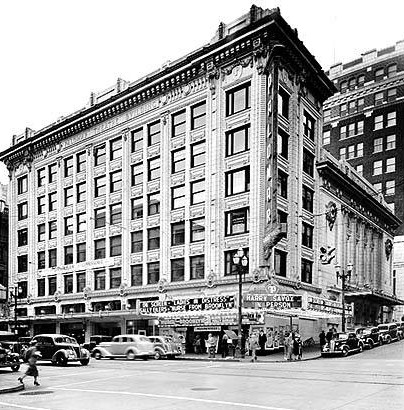
Seattle's Palomar Theatre, formerly the Pantages, ca. 1938. (Photo by Asahel Curtis, courtesy University of Washington Special Collections, Order No. SEA0446)
Best Foot Forward: A Collection of Sound Era Engagements
Act IX: J. Stuart Blackton
Less than a year following Ben Turpin’s departure from the Palomar, in March 1939, the venue saw the arrival of another old-timer to its stage – “Commodore” J. Stuart Blackton, one of the driving forces behind the Vitagraph Studios and a preeminent figure in the motion picture industry since the end of the 19th century. In a weeklong engagement, Blackton made personal appearances with a compilation film he had put together called Stars That Will Live Forever, pulling material from the film vaults of several companies, including Vitagraph, which had been sold to Warner Bros. in the mid-1920s.
J. Stuart Blackton was born in England in 1875; his family immigrated to the United States when he was 10. After showing considerable talent as a writer and illustrator, as a young man Blackton took a job with the New York Evening World, with one of his earliest assignments to travel to New Jersey and interview the Wizard of Menlo Park, Thomas Edison. Edison, of course, was a pioneer in motion picture technology, and J. Stuart Blackton found himself not only meeting with the famed inventor but also posing for his cameras, using his drawing skills in three short films: one of Blackton creating a caricature drawing of Edison, a second of Presidents Grover Cleveland and William McKinley, and a third of a female figure.[1] The first, released as Edison Drawn by World Artist (Edison, 1896), was an instant success as a novelty film, and the notoriety fired Blackton’s interest in the medium. Together with Albert E. Smith, with whom Blackton had earlier developed a vaudeville act (and which also included a demonstration of his drawing talents), the pair formed Vitagraph Studios in 1897.
Although many of their early releases, like other studios at the time, were simple gimmick films or pictures of current events, Vitagraph productions eventually grew to incorporate narrative films after the turn of the century. Together with Edison and Biograph, Vitagraph quickly became one of the big three companies in the early motion picture industry, a position it would hold until the mid-teens.
Whereas D.W. Griffith’s Biograph releases were developing new methods of storytelling for the screen, Vitagraph’s contribution – the creative portion of which was largely masterminded by Blackton – was to develop a hugely successful business model. In addition to producing hundreds of fine films (not to mention assembling a stock company that included such early stars as John Bunny, Maurice Costello, Clara Kimball Young, Norma Talmadge, Anita Stewart and others), Vitagraph stood as the largest and perhaps most efficient of the early studios. Additionally, J. Stuart Blackton himself is credited as a pioneer of motion picture animation, which he began with a series of films released in 1906. (The concept was really an extension of his early drawing films, which Blackton dubbed “lightening sketches.”)
Vitagraph eventually lost ground to competing movie studios, and in 1917 Blackton left the company to become an independent producer. His efforts outside the organization proved disappointing, at least in commercial terms. Although he continued directing until 1926, including a stint in his native England, Blackton’s later work was mostly notable for its experimentation, particularly with an early version of color film.
By the early 1930s, J. Stuart Blackton – who long strove to be a member of high society and spent much of his fortune in this pursuit – had declared bankruptcy. The producer, who by most accounts took the loss of his fortune in stride, spent the last few years of his life showcasing a compilation film of the silent era, which kept him connected to the industry and helped pad a modest income.
Commonly known as either The Film Parade or The March of the Movies, J. Stuart Blackton presented the film in Seattle under the title Stars That Will Live Forever. Interestingly, the film mixed clips from early motion picture history with staged recreations, most often shot by Blackton himself when the actual films were lost or the producer was unable to obtain the rights. According to Anthony Slide, who (together with Robert Gitt and Marian Blackton, the producer’s daughter) helped restore much of the picture in the 1970s, Blackton’s project had an interesting genesis. “The idea for The Film Parade originated with one of the Vitagraph Company’s leading directors of the teens, William P.S. Earle, who had retired financially secure in the Twenties, lost everything in the Wall Street crash, and by the Thirties was reduced to selling vacuum cleaners from door to door,” Slide noted for Films in Review, in an article reprinted in his 1979 book, Films on Film History. “Earle and Blackton combined resources, with Earle taking care of the camera and handling the special effects, his former boss acting as producer, director and occasional actor. The partners rented a small loft above the former headquarters of a soap company at 919 Lillian Way in the heart of Hollywood, and to assist them in this venture enlisted the aid of Blackton’s daughter, Marian, his son Jim and Jim’s wife, Melvia, Ben Hendricks, Jr., and former silent actress Margerie Bonner, who was later to marry novelist Malcolm Lowry.”[2]
Compiled on a shoestring budget, J. Stuart Blackton used some connections to obtain footage from films such as The Big Parade (MGM, 1925) and Walt Disney’s animated short Steamboat Willie (Disney, 1928), which first introduced the world to Mickey Mouse. But when he could not rely on the generosity of others, the producer simply recreated scenes of interest. “Where footage did not survive,” Slide observed, “Blackton and Earle recreated it. They did not have the Edison film of Fred Ott’s sneeze [originally released as Edison Kinetoscopic Record of a Sneeze (1894)], so Earle recreated that great moment in film history and impersonated Ott. The Vitagraph films of A Visit to the Spiritualist and His Sister’s Beau were recreated, with Marian Blackton, heavily padded, appearing in the latter as the sister and Ben Hendricks as the Beau. The 1899 Blackton film of The Battle of Manila Bay did not survive, so just as J. Stuart Blackton and his partner Albert E. Smith had faked it back then with a water tank, cardboard cut-out model ships and Blackton’s cigar smoke, the partners did it again.”[3] Slide even notes that J. Stuart Blackton himself donned blackface and sang “Mammy” after his request for footage of Al Jolson in The Jazz Singer (Warner Bros., 1927) was declined.
To help fund the project, J. Stuart Blackton sold a number of original, early Vitagraph films in his possession, and although it failed to create much of a sensation upon its 1933 debut, the compilation film was nonetheless a labor of love for the producer. It was never a box-office success, but crowds appreciated the picture’s nostalgic value.
Interestingly, J. Stuart Blackton originally made the film with sound, complete with a synchronized musical score and narrative track. He was a perfectionist, however, and took to regularly cutting the film as he thought of improvements or was able to secure additional footage. Whether the result of his constant cutting or because he felt the picture was more aesthetically pleasing in a silent format, he was soon presenting the film without any musical accompaniment at all. Replacing the sound was Blackton himself, who would remain onstage and provide a running commentary throughout the screening – a throwback to the lecturers often employed by early motion picture exhibitors to narrate films during the industry’s infancy. It was in the latter format that he presented Stars That Will Live Forever at Seattle’s Palomar Theatre.
The Star’s Gilbert Brown, who did not actually review the Palomar bill during the producer’s stint in the city, devoted an entire column to Blackton’s personal history, and although the piece (most likely padded by advance material) contained bits of misinformation, the reporter found J. Stuart Blackton’s own story as colorful as the stars in his film.
Blackton was one of the first actors before the motion picture camera. This was in 1896, when as an artist-reporter on the New York World, he was sent to interview Thomas A. Edison. Edison had just completed his “Vitascope,” and insisted upon making a movie film of Blackton as he sat sketching. Fired with the possibilities of the new invention, Blackton acquired a projector and 10 reels of film, and opened a nickelodeon. That didn’t satisfy him; he wanted to make pictures, too. So he converted his projector into a camera and started making pictures.
From then on his career was an impressive list of “firsts.” Blackton made the first newsreel in 1898 – shots of U.S. troops leaving for the Spanish-American war. They were shown at Proctor’s and William A. Brady’s theater eight hours later. Then he fitted up the world’s first movie studio, on the Morse building roof in New York. In 1900, with William T. Rock and Albert E. Smith (not the Brown Derby Al), he organized the pioneering producing company, Vitagraph Pictures. They started with $300, and in 10 years were doing a $6,000,000 annual business.
A bit later Commodore Blackton opened the first “de luxe” movie house, charging $1 admission to the Vitagraph theater at Broadway and 44th St. He was editor and publisher of the first screen fan magazine, Motion Picture Magazine. Out in the Flatbush section of Brooklyn he built the first glass-enclosed studio. His “super-production” of 1915, The Battle Cry of Peace, was an important movie event of those years.
That same year the industrious Blackton organized the Motion Picture Board of Trade, later known as the Association of Motion Picture Producers of America (the Hays organization to you, Gertrude). And in 1920 he brought over from London the first all-color film, The Glorious Adventure, a livid-hued affair in “Prisma Color” starring Lady Diana Manners.
Vitagraph was sold to Warner Bros. in 1926 – the name is still used for Warner’s distributing organization – but Commodore Blackton just won’t quit. Even now, in his 65th year, he is pioneering a new system of producing and distributing educational shorts, and this trip with his souvenir film is sort of a mailman’s holiday.”[4]
J. Stuart Blackton’s weeklong engagement in Seattle was quite low on the Palomar bill. A pair of first-run feature films, North of the Yukon (Columbia, 1939), a Canadian Mountie picture starring former gridiron hero Charles Starrett, and My Wife’s Relatives (Republic, 1939), starring James Gleason and Mary Hart, topped the week’s attractions, with Blackton sandwiched amongst a handful of small-time vaudeville performers. Nevertheless, for reviewers, at least, Stars That Will Live Forever was the highlight of the show.
While the length of the film wasn’t discussed in either press material or accounts of the show (one critic called it “a fast reel of pictures”), Blackton’s picture generally ran about an hour, although with his penchant for cutting the film, it is impossible to determine if a full presentation was given in Seattle. Despite supporting a pair of feature films and several live acts, however, Stars That Will Live Forever seems to have taken in quite a bit of footage. Many of the clips mentioned specifically in reviews of the Palomar bill dated from about the time that Blackton entered motion pictures in the late 1890s. These glimpses included footage of President William McKinley (in addition to footage of William Howard Taft, Theodore Roosevelt, and Woodrow Wilson), troops departing for the Spanish-American War, Czar Nicholas of Russia, and a pre-1900 Easter parade. From there the picture moved into the traditional (or more precisely, post-Griffith) silent era, with short sections featuring the Gish sisters, Mabel Normand, Broncho Billy Anderson, Chaplin, Lloyd, Pickford, Fairbanks, Valentino, Ramon Novarro, Corrine Griffith, Bebe Daniels, Wallace Reid, William S. Hart, Marie Dressler and Will Rogers. J. Stuart Blackton’s own Vitagraph stars were also well represented: John Bunny, Flora Finch, Clara Kimball Young, Anita Stewart, and Maurice Costello also seem to have made appearances. A clip from one of Mary Pickford’s two versions of Tess of the Storm Country, one from Lon Chaney’s Hunchback of Notre Dame, and another from The Big Parade specifically warranted mention in reviews of the presentation.
Blackton, who was introduced onstage prior to each screening, somehow managed to narrate throughout the presentation of the film, injecting stories and commentary into the proceedings which helped illuminate the personalities onscreen, many of whom seemed to have simply vanished by 1939. Both the Daily Times and J. Willis Sayre at the Post-Intelligencer noted the historical value of Blackton’s presentation and found it far and away the best attraction at the Palomar. Sayre’s words were typical.
There’s an exceptional novelty at the Palomar this week, something you never saw before and may never see again in so complete a form. It is Commodore J. Stuart Blackton, a director who goes back to the cinema’s beginnings, who was identified with the crude flickers long before American was turning out one-reelers at Santa Barbara or Gilbert M. Anderson was riding up into the canyon back of Niles, making up his “Broncho Billy” stories – as he told this writer at the time – after he got out on location…It will awaken golden memories among the old-timers and be a source of wonder to the youngsters used only to the technically perfect productions of today…Most of those old silents are just funny today, but not all of them. The scene of farewell in The Big Parade between John Gilbert and Renee Adoree, is shown; it is not excelled by anything on any screen in America today. It will bring tears to your eyes if you are human. Blackton is an excellent narrator, too. You feel his sincerity.[5]
After reeling off several motion picture personalities seen in Stars That Will Live Forever, Sayre’s counterpart at the Times was no less enthusiastic. “Once glorious names of the screen, those, but by no means are they forgotten yet. It was an audience filled with eager nostalgia for the flickering past of motion pictures who proved that to J. Stuart Blackton at the Palomar Theatre yesterday…Blackton tells of each star that appears, many of whom he personally directed in films or introduced to Hollywood. This is a screen and stage treat that’s rare entertainment. Don’t miss it!”[6]
Ultimately, the tour that brought Stars That Will Live Forever to the Palomar in 1939 would be one of the last J. Stuart Blackton would complete. Just two years following his Seattle appearance, in August 1941, Blackton died at age 66 following injuries received in a car accident. “The whole production [of Stars That Will Live Forever] may seem quaint to many,” Anthony Slide observed, “but to all those who know the activities of J. Stuart Blackton and the Vitagraph Company, it is exceedingly moving. Whatever one may think of it, [the film] must take its place as the last major Blackton production, a fitting close to a great man’s career. It is touching that Blackton chose to dedicate the film to Thomas Edison, whose contribution to the cinema has been downgraded in recent years, but who obviously meant a lot to pioneer Blackton…[The picture] did not get Blackton much during the last years of his life perhaps, although he certainly enjoyed its production and, as daughter Marian says, it made him a ‘happy has-been,’ but the film is now in the Library of Congress, and that does assure Blackton a place of posterity. I am sure he would be proud of that…”[7]
By Eric L. Flom – January 2026
Notes:
[1] Charles Musser, The Emergence of Cinema: The American Screen to 1907 (Berkeley: University of California Press, 1990), Pages 120–121.
[2] Anthony Slide, Films on Film History (Metuchen, New Jersey: The Scarecrow Press, Inc., 1979), Page 56. Slide’s comments were originally printed in an article he contributed to the February 1978 edition of Films in Review.
[3] Ibid., Pages 56–57.
[4] Gilbert Brown, “The Show Shops,” Seattle Star, 27 March 1939, Page 14.
[5] J. Willis Sayre, “Old Stars Relive at Palomar,” Seattle Post-Intelligencer, 28 March 1939, Page 22.
[6] J.R.R., “Famous Stars of Early Films Pass in Review,” Seattle Daily Times, 28 March 1939, Page 24.
[7] Slide, Films on Film History, Page 57 and 58.