
Laugh, Town, Laugh: A Collection of Vaudeville Engagements
Laugh, Town, Laugh:
A Collection of Vaudeville Engagements
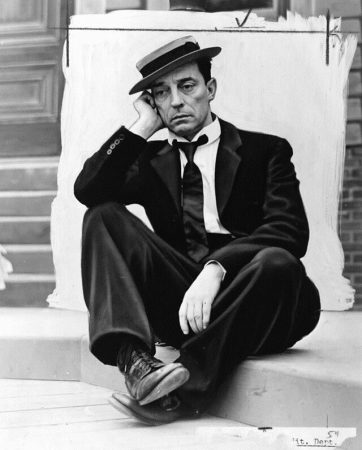
Buster Keaton, ca. 1939.
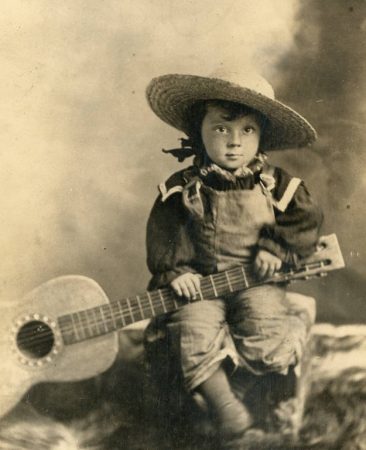
Baby Buster, ca. late 1890s. (Courtesy University of Washington Special Collections, Order No NWS13650)
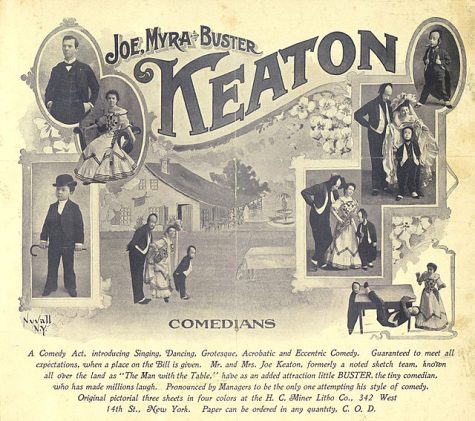
Advertisement for the Keaton family vaudeville act, ca. early 1900s.
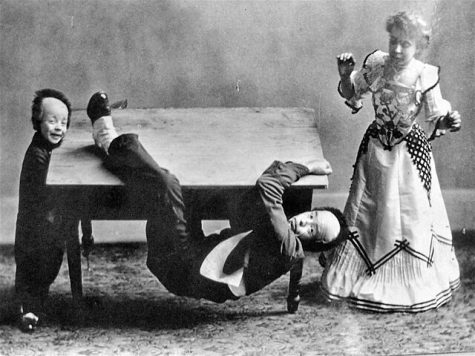
The Three Keatons vaudeville act, ca. 1901.
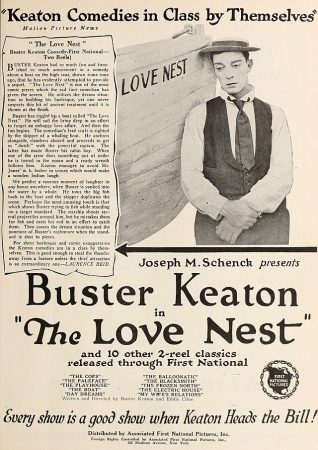
Advertisement for Buster Keaton's "The Love Nest" (First National, 1923).
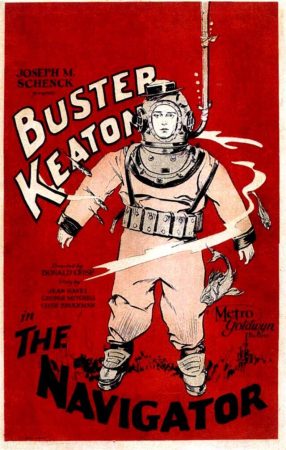
Film poster for Buster Keaton's "The Navigator" (MGM, 1924).
Act I: Buster Keaton
When vaudeville entertainment became popular in America toward the end of the 19th century, a new breed of artist was unleashed on the public. Many were performers who could, and eventually did, adapt their talents for traditional stage and/or film roles, but the format also provided a showcase for acts that seemed more appropriate in a circus sideshow than a formal theatre. Aggressive vaudeville managers sometimes went out of their way looking for new and original performers to attract public attention, resulting in a proliferation of novelty acts, often capitalizing on popular fads or wholly unusual skills. Many (most?) of these performers had short lifespans as entertainers but nonetheless managed to make a name for themselves during their brief moment in the spotlight. A spare few went on to have careers of any length, such as swimmer Annette Kellerman, who visited Seattle on three occasions with her famous diving exhibition, which at one time was the toast of the Orpheum circuit. Kellerman, who went on to make a number of silent films, most notably Neptune’s Daughter (Universal, 1914) for director Herbert Brenon, was the exception to the rule. Many novelty performers had little to go on aside from one or two specialty talents, so they enjoyed a little momentary fame before disappearing altogether.
Still, vaudeville was the perfect showcase for other, more traditional specialties. Comedians, in particular, found the vaudeville arena well-suited to their craft, and indeed, in terms of later film talent – silent and sound – they were among the most frequent performers on Seattle’s stages. Vaudeville provided an excellent training ground for a comedian’s skill. Whereas someone like John Bunny, belonging to an earlier generation of comic actors, earned experience with various stock and traveling companies, vaudeville allowed comedians to emphasize their own particular gifts. Though larger comedy troupes existed, no longer did a comic have to pay his dues as a legitimate actor, bound by the confines of a particular role, as had been the case for much of Bunny’s stage career. Instead, vaudeville offered comedians the opportunity to devise their own material, particular to their own tastes and talents. The result was a large-scale experimentation with different characters, situations, and varying degrees of vulgarity, all of which expanded the boundaries of stage comedy. To that end, the list of young comedians who visited the Seattle stage in the early 20th century is a virtual roll call of the figures that would shape film comedy throughout the silent period and beyond.
One such performer happened to get his start in motion pictures as a supporting player for Roscoe “Fatty” Arbuckle. In 1917, after Arbuckle had risen to prominence at Keystone Studios, he began fielding offers from other studios vying for his services. One of these came from Joseph Schenck, who eventually signed Arbuckle away from the Sennett lot with a lucrative production deal. The comedian brought along his wife and nephew, Keystone veterans Minta Durfee and Al St. John, and filled out his company with a handful of others, including Buster Keaton, a vaudeville performer with no prior film experience.
Shortly before joining Arbuckle in 1917, Keaton disbanded the family vaudeville act that he had been a part of since childhood. Born in Kansas in October 1895, Joseph F. Keaton, Jr. was introduced into show business almost immediately – his parents, Joe and Myra, were vaudeville performers who regularly traveled throughout the United States. On one of these tours, in fact, young Joseph is said to have earned his famous name, an oft-told tale of dubious origin but one which Keaton himself stuck with to the end of his life. As a six-month old, the child, after taking a tumble down a flight of stairs with nary a whimper, was scooped up by a fellow vaudevillian who remarked that the baby had taken quite a “buster.” The performer was a small-time magician traveling with the same outfit, Harry Houdini, and the boy’s nickname stuck.[1]
Although the Keatons had other children (some of whom eventually performed with the family act), it was Buster who became the center of their routine. The Keatons’ specialty was a sketch so shocking that when Buster was quite young the trio was banned from playing certain jurisdictions due to child cruelty laws, enforced with vigor by the Gerry Society. Keaton was 21 at the time of his only known Seattle engagement, but the set-up was generally the same throughout his vaudeville career: Joe Keaton played a harassed father to Buster’s devilish son, with whatever the scenario degenerating into a comic fight. Particularly when Buster was young, this would often find the elder Keaton hurling his son through a piece of scenery, off into the wings or even into the crowd itself, courtesy of a strap on the back of Buster’s costume that allowed Joe to throw him like a suitcase. Myra Keaton, for her part, sang, danced or played an instrument, but generally got out of the way once the roughhousing began. It was under such conditions that Buster learned to take a fall – excellent training for the type of stunts that would highlight his later film work. (Keaton, for his part, steadfastly maintained that his father was a decent man who never abused him in any way.)
The Three Keatons, as they were called, were a popular but not overly successful act, touring throughout the East and Midwest but making only occasional appearances on the West Coast. By the time of their 1916 engagement at Seattle’s Pantages Theatre the show had been going downhill, with Joe Keaton’s drinking slowly ruining the timing and quality of their routine.
Although they had been a featured act at the Palace, New York’s famed vaudeville establishment, and had made a number of tours on the prestigious Orpheum circuit, in his memoirs the comedian recalled that his father accepted the tour of the Pantages circuit rather reluctantly – popular-priced vaudeville was a bit of a come down from the high-class houses the family had been accustomed to playing. Difficult, too, was performing their punishing act three times a day instead of the normal two. “We begged Alexander Pantages to let us do only two shows,” Keaton recalled in his autobiography. “Pantages was a tough old Greek who had started his money-making career as a saloon porter in the Klondike gold rush. His experiences in the Frozen North had not made him very benevolent. ‘You signed to do three shows a day,’ he told us, ‘and that’s what you’ll do.’”[2] After the family’s only known Seattle engagement, in fact, the Keatons would continue performing together for only three more months before Buster disbanded the vaudeville act. They were quite low on the bill at the Seattle Pantages, a weeklong affair in November 1916, where they were the first live act following an overture by the house orchestra and an installment of the Helen Holmes serial A Lass of the Lumberlands (Mutual, 1916), presented in “Pantagescope.”
Unfortunately, because they were not one of the featured attractions and because vaudeville reviews had become scant by that time (due, in part, to more space being devoted to motion picture coverage), one can only get a small glimpse of what Seattle audiences thought of The Three Keatons. The headlining show was Madame Anna Hesse-Sprotte, a Seattle operatic singer making her vaudeville debut, whose talents (not to mention her local ties) tended to dominate accounts from the Pantages. The Three Keatons, in fact, weren’t even the comic highlight of the bill – that honor apparently went to Rucker and Winifred, a duo act in which Rucker, in blackface, and Winifred, dressed as a Chinese man, preceded to get into a scrap over a bowl of chop suey. “It was the kind of act that had the kids in the gallery whistling and stamping their feet,” noted one paper. Of the Keatons, the Post-Intelligencer to observed that “(t)he Three Keatons, comedy acrobats, are a real honest-to-goodness scream. Last night’s audience laughed at their antics until tears came.”[3]
The Daily Times was less helpful in shedding light onto their engagement, merely noting the trio as “one of vaudeville’s funniest comedy acrobatic offerings.”[4] And, unfortunately, locating more on The Three Keatons proves equally fruitless when reviewing newspaper coverage from the family’s other Northwest engagements. In Vancouver, British Columbia, where the Keatons played the week following their Seattle engagement, the Daily Province noted “(t)here is everything from classical and modern dancing down to the slap-bang variety of comedy” in their act. “Their amusing acrobatic turn is a decided hit.”[5] The following week, beginning November 27, while the Keatons were playing the Pantages in Victoria, British Columbia, their act didn’t even warrant mention in the Daily Colonist.
But with respect to Seattle, what the Daily Times’ brief account of the Pantages bill did note was that the family was “back again.” The remark is unfortunate since the J. Willis Sayre Collection gives no other Seattle engagements for The Three Keatons, though it appears they played the city at least one other time shortly before their 1916 engagement at the Pantages. Keaton himself also fails to lend a clue as to when this visit (or visits) may have occurred. During his vaudeville days, the comedian kept diaries of his travels on the road, though the information he recorded was often rather sparse – the city in which the family played, the hotel they stayed in, and sometimes documenting their expenses. Now kept in safe keeping by the Damfinos, the International Buster Keaton Society, the comedian’s diary entry from the 1916 Seattle visit, for instance, is typically vague: apart from naming the city and the family’s arrival date, all that can be discerned is that the Keatons made the Rainier-Grand Hotel, at the corner of First and Madison, their temporary home for the week.[6] His entry offers nothing in the way of commentary about either the city or the engagement itself, merely presenting a record that he had been there.
The diaries also fail to reveal when the Keatons may have played Seattle prior to their 1916 engagement. The Three Keatons are known to have played the West at least three times – short tours in 1901, 1908, and the Pantages tour in 1916, but it cannot be pinpointed when the Keatons may have visited Seattle earlier. The assumption is that both were made on the Orpheum circuit; Orpheum vaudeville did not first appear in the city until the spring of 1902, when manager J.P. Howe offered several weeks of high-class variety offerings at the Seattle Theatre by special arrangement with circuit head Martin Beck. None of these programs list the Keatons as performers. Likewise for 1908 – John Considine officially brought Orpheum vaudeville to Seattle in August of that year, when acts played the Coliseum, a former skating rink that the Sullivan-Considine circuit transformed into a ten-cent vaudeville house. But a review of Coliseum programs from the venue’s opening through 1910 fails to list The Three Keatons as having performed. A review of Pantages programs for a full five years prior to their only known engagement in 1916, not to mention cross-referencing discernable gaps in the J. Willis Sayre Collection against newspaper announcements for the same weeks, also fails to turn up an earlier appearance for the family. And, finally, the digitized versions of both the Seattle Daily Times and Post-Intelligencer also fail to reveal when the Three Keatons may be appeared – only their 1916 engagement comes up through various searches.
As most program gaps in the J. Willis Collection come from Seattle’s smaller theatrical venues, some of which had relatively brief lifespans (or which didn’t regularly issue programs), it’s possible that the Keatons may have played one of these smaller houses, slipping in and out of Seattle without having had a record of their appearance preserved. In addition, because most dramatic critics tended to patronize only the larger, more established theatrical venues, their appearance may not have been recorded in local newspapers. This may be the likeliest scenario, for it is difficult to believe that the Keaton family, who regularly toured in vaudeville for almost two decades, would have made only one appearance in Seattle throughout their entire career. Pinpointing when or how many previous engagements they may have made, however, may now be impossible.
Some three months following the departure of the Keatons from the Pantages in November 1916, Buster Keaton would abandon vaudeville altogether and begin work on a new career in motion pictures. It was a well-timed move. As the prospects of his mentor, Roscoe Arbuckle, rose during the World War I era, so too did Keaton’s, and soon Buster earned his own production deal from Joseph Schenck. The independence unleashed Keaton’s brilliance: his short films, most notably One Week (Metro, 1920) and Cops (First National, 1922), are classic compilations of acrobatic comedy and a dark, somewhat surreal vision that distinguished him from the upbeat stories of Harold Lloyd and the sentimentality of Charlie Chaplin. (Also characteristics that, incidentally, made him less of a box-office draw at the time.) One of the signature characteristics of Keaton’s film character was his deadpan expression, an outgrowth, the comedian explained, of his youth in vaudeville, where the Keatons discovered that the less emotion Buster showed onstage, the bigger the audience seemed to react to their knockabout act. Keaton carried this straight into his films. “Keaton’s face ranked almost with Lincoln’s as an early American archetype,” writer James Agee has observed. “It was haunting, handsome, almost beautiful, yet it was irreducibly funny; he improved matters by topping it off with a deadly horizontal hat, as flat and thin as a phonograph record.”[7]
Eventually Buster Keaton jumped from two-reel comedies to features, producing films such as The Navigator (Metro-Goldwyn, 1924) and The General (United Artists, 1927), treasured today as classics of the silent period.[8] But the loss of his independence in the late 1920s and alcoholism eventually dismantled his career. By the mid- to late 1930s he was making cheap two-reelers, reinterpreting his old material and often, as the case was, proving the most entertaining aspect of these releases. By the 1940s Keaton was hardly performing at all, being reduced to a simple gag man.
Television, however, revived Buster Keaton’s career, first with a short-lived comedy show of his own, then through innumerable cameo appearances. This exposure helped spark interest in the comedian and his work, and by the 1960s a new generation of film buffs had rediscovered Keaton’s screen magic. In 1959 he received an honorary Academy Award, and shortly before his death Buster Keaton was honored at the 1965 Venice Film Festival for his contributions to the industry.
By Eric L. Flom – January 2026
Notes:
[1] Buster Keaton (with Charles Samuels), My Wonderful World of Slapstick (New York: Da Capo Press, 1987), Page 20.
[2] Ibid., Page 88.
[3] “Pantages Offers Special Program,” Seattle Post-Intelligencer, 14 November 1916, Page 7.
[4] “Hesse-Sprotte’s Debut Auspicious,” Seattle Daily Times, 14 November 1916, Page 9.
[5] “New Bill of Variety Opens at Pantages,” Vancouver Daily Province, 21 November 1916, Page 11.
[6] Copies of Buster Keaton’s journal entries from November 1916 were provided to the author by Audrey McDonald Wladis of the Damfinos, the International Buster Keaton Society.
[7] James Agee, “Comedy’s Greatest Era,” Life, 3 September 1949, Page 82.
[8] Technically Buster Keaton’s first feature film was The Saphead, released by Metro in 1920. This was very early in his career, however, and was the film was rooted more in its source material (the stage play The New Henrietta) than Keaton’s own comedic skills. Keaton went back to two-reelers for several years, honing his talents and establishing his screen persona before moving into features again with The Three Ages (1923).
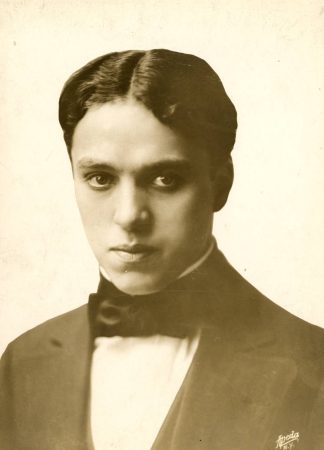
Vaudeville comedian Charlie Chaplin, ca. 1912. (Photo by Apeda Studios, courtesy University of Washington Special Collections, Order No. JWS33816)
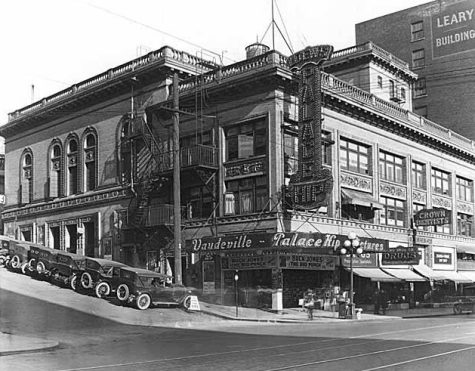
The Palace Hip Theatre, originally known as the Empress, ca. 1921. (Photo by Webster & Stevens, MOHAI, Image No. 1983.10.2110.2)
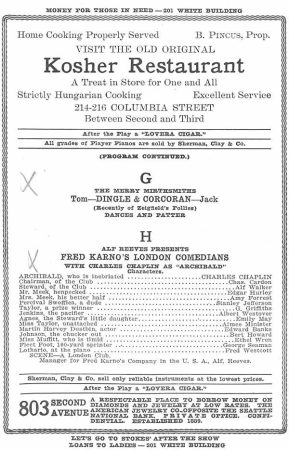
The Karno troupe in the Empress program, week of September 1, 1913. (Courtesy University of Washington Special Collections, Digital ID No. PAM0015)
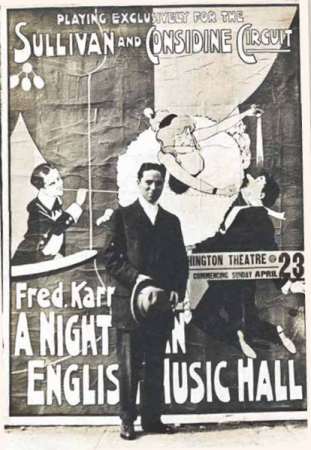
Vaudevillian Charlie Chaplin in front of a Karno advertising poster in Spokane, April 1911. (From the archives of Roy Export Company Limited)
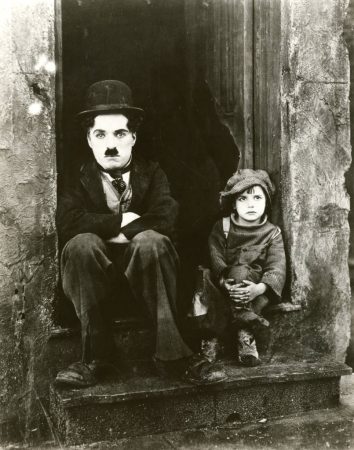
Charlie Chaplin and Jackie Coogan in "The Kid" (1921). (Courtesy University of Washington Special Collections, Order No. JWS19717)
Laugh, Town, Laugh: A Collection of Vaudeville Engagements
Act II: Charlie Chaplin
It’s only been since the late 1950s/early 1960s that films fans have rediscovered Buster Keaton’s film work and given him the credit he deserves as one of silent comedy’s most brilliant craftsmen. But the rise of Keaton’s reputation has come, arguably, at the expense of Charlie Chaplin’s, who for most of his lifetime was lauded as one of the few genius figures in motion pictures.
Chaplin was born into the poverty of Dickensian London in April 1889 and found his way to the footlights at an early age, following his father and mother, both of whom were veteran music hall performers. (Music hall being the English equivalent of variety or vaudeville.) He traveled the English circuit extensively, first with some minor dance and comedy organizations and later as a child actor in touring versions of Sherlock Holmes, opposite both William Gillette and H.A. Saintsbury. Through Sydney, his older half-brother, Chaplin eventually became a member of the prestigious Fred Karno comedy troupe in 1908, when he was only 19.
It was valuable experience for the comedian, who began inheriting roles in skits that Sydney, a stage performer himself, had helped make popular. Charlie Chaplin quickly became one of the Karno’s most talented comics and eventually traveled to the United States in 1910 as a featured performer in troupe’s American company. He is known to have toured the Sullivan and Considine vaudeville circuit several times before leaving Karno in late 1913 to accept an offer from Mack Sennett’s Keystone Studios. (Hollywood, ironically, was a detour the comedian felt would earn him enough quick cash to retire from show business altogether.[1]) Movies were a welcome respite from the rigors of the road. “These cheap vaudeville circuits were bleak and depressing,” Chaplin recalled of the time in his autobiography, “and hopes about my future in America disappeared in the grind of doing three and sometimes four shows a day, seven days a week. Vaudeville in England was paradise by comparison. At least we only worked there six days a week and only gave two shows a night. Our consolation was that in America we could save a little money.”[2]
Chaplin visited Seattle on five occasions before bolting for Keystone and immortality – three times on his first visit to America, twice on his second. Each was a weeklong engagement at Seattle’s Empress Theater (known as the Majestic during the company’s first engagement), and each featured the Fred Karno troupe as headliners of the week’s vaudeville bill.
The first engagement began on May 1st, 1911, when Chaplin and the Karno company performed A Night in an English Music Hall, the stage act for which the comedian was most renowned.[3] Chaplin biographer David Robinson described the skit, a faux-vaudeville setting titled Mumming Birds in England, where the comedian played a drunk.
The setting for Mumming Birds represents the stage of a small music hall, with two boxes at either side. The sketch opens with fortissimo music as a girl shows an elderly gentleman and his nephew – an objectionable boy, armed with peashooter, tin trumpet and picnic hamper – into the lower O.P. box. The Inebriated Swell is settled into the prompt side box, and instantly embarks upon some business of a very Chaplinesque character. He peels the glove from his right hand, tips the waiting attendant, and then, forgetting that he has already removed his glove, absently attempts to peel it off again. He tries to light his cigar from the electric light beside the box. The boy holds out a match for him, and in gracefully inclining to reach it, the Swell falls out of the box.
The show within the show consisted of a series of abysmal acts…The acts changed over the years, but some remained invariable: ballad singer, a male voice quartet, and the Saucy Soubrette, delighting the Swell with her rendering of ‘You Naughty, Naughty Man!’ The finale was always “Marconi Ali, the Terrible Turk – the Greatest Wrestler Ever to Appear Before the British Public.” The Terrible Turk was a poor, puny little man weighed down by an enormous mustache, who would leap so voraciously upon a bun thrown at him by the Boy that the Stage Manager had to cry out, ‘Back, Ali! Back!’ The Turk’s offer to fight any challenger for a purse of £100 provided the excuse for a general scrimmage to climax the act.[4]
The role of the Inebriate had Chaplin made up to look considerably older than his 22 years, yet his appearance and comic antics were so well done that few noticed his youthful age. Indeed, Chaplin was so effective at playing drunks that intoxication was a frequent theme in his early film work.
The initial engagement for the Karno troupe met with the approval of Seattle audiences, at least according to the Daily Times. “This week’s bill at The Majestic makes up for what last week’s bill lacked – genuine entertainment and plenty of fun,” the paper commented. “There are six good numbers, the best of which is Fred Karno’s London pantomime company in A Night in an English Music Hall. Eight ‘bum’ acts are enacted before a double audience, with Karno’s cast of more than a dozen members seated in the ‘near’ boxes on the stage. The setting is realistic and the British audience properly hoots each performer. At times there is a smattering of low comedy and clown play, but the number kept the well filled house in an uproar of riotous merriment at the initial performance yesterday afternoon.”[5]
The Post-Intelligencer also lauded the Karno offering at the Majestic. “The new show at the Majestic is a member of the well-known ‘Humdinger’ family. It ‘humdings’ from start to finish. It is toplined by Fred Karno’s London Pantomime Company in A Night in an English Music Hall. There are nearly twenty people in the cast and it [plays] about half through the show. Every member of the company is a comedian and the laugh is continuous; it doesn’t come in spots.”[6] The Star took the bulk of their review to focus on the headline act, which they felt topped an exceptionally good show at the Majestic. Calling the bill “a screamer” and “100 percent strong,” the paper noted that “Fred Karno’s London Pantomime company presents the playlet. The stage and box scene reproduced and circling thereabout is a batch of fun involving performers and box patrons. The audience last night was kept in an uproar.”[7] Interestingly, while both the Star and Post-Intelligencer were delighted by the whole of the Majestic bill, which included a trapeze artist, a xylophone act, and a pair of comedy sketches (in addition to the Karno offering), neither knew what to make of a performer who called himself Phenomena, who sang songs using several unusual voices. Both papers made special note of his act, which was held out as the bill’s “freak feature.”
The Karno company returned to the Majestic (by then renamed the Empress) in October 1911 with A Night in a London Club, a comedy sketch that again found Chaplin playing a drunk, a character named Archibald Binks. The part of the “souse,” as he was often referred to in print advertisements, had evidently made a strong impression on American audiences, for the Karno engagement was careful to note that the new sketch again contained this character.[8] Set, obviously, in a London club, the act also claimed to utilize more members in the Karno company. “Most of us who had the pleasure of seeing Fred Karno’s A Night in an English Music Hall some months ago will welcome the new Karno pantomime, carrying 15 people, called A Night in a London Club,” announced the Empress prior to the troupe’s arrival. “It will provide a ‘souse’ such as that seen in the former production. This act, however, will outshine the other by reason of the number of people carried. It is one of the largest vaudeville productions on the road, and is provided Empress patrons by Sullivan & Considine at an enormous expense. Seeing is believing. See A Night in a London Club and laugh for a week.”[9]
The new effort by Karno was also well-received by Seattle audiences; other acts on the bill included Madame Fifi Ronay’s trained poodles, a pair of comedians, and a song and dance routine by Powder and Capman. The show ended with the screening of some unidentified moving pictures.
Calling it a “bang-up, corking good show,” the Star lauded not only the Karno troupe but also singer Will Oakland, both highlights of the bill. “The Karno production is on par with A Night in an English Music Hall, seen here a short time ago,” the paper observed, “and like the latter, it furnishes a ‘souse’ that’s a scream.”[10] While recognized only as his stage persona in the Star’s review, Chaplin scored his first individual mention in Seattle from the Post-Intelligencer. “Sullivan & Considine, true to promise, inaugurated their first large production with Karno’s A Night in a London Club with success at the Empress yesterday. The piece is of the pantomime, rough comedy style, and carries fifteen people, about a laugh a minute. The proverbial ‘souse,’ such as was provided by the same author in his A Night in an English Music Hall, is in evidence, and largely so, in the person of Charles Chaplin, who is a clever comedian.”[11]
J. Willis Sayre reviewed the same Empress bill for the Daily Times, and although he enjoyed the show as a whole (with the exception of one, unmentioned act), he seems not to have been overly impressed with the Karno contribution. “Unique is every sense of the word is the F. Karno offering. A Night in a London Club, a brief glimpse of a ‘jinks’ at that nocturnal hour when clubmen cluster, do hari kari to harmony in bunches, and speak and act with bibulous frankness. It keeps the audience in an uproar. When it is all over no one can recall a line worth mentioning, but nevertheless one’s system has been looted of a lot of laughs by its slap-stick comedy.”[12]
Interestingly, the sketch may not have been overly memorable to Sayre because it was an improvised act, Chaplin biographer David Robinson has suggested, which seems to have been conceived by the Karno troupe while touring America. The setting was a London club where various members were called upon to give an impromptu performance, although each individual meets with some sort of catastrophe in the process. Chaplin, as Archibald Binks, much like his appearance in A Night in an English Music Hall, manages to be a persistent nuisance to anyone attempting to entertain the group. In the absence of hard evidence, Robinson surmised that the troupe may have put the act together using a set from one of Karno’s other sketches, then freely borrowed material from the group’s other comedy routines. However, Robinson’s research didn’t turn up any performances of the playlet outside a weeklong Chicago engagement during January and February 1911.[13] As the Karno troupe was still performing the sketch 10 months later at the Seattle Empress (and would perform it there yet again, in 1913), this improvisational act – if that’s how it came into being – must have formed a more or less permanent position in their repertoire during Karno’s U.S. tours.
When Chaplin and the Karno folks returned to Seattle, J. Willis Sayre was far more impressed with the company. Again, their weeklong engagement was at the Empress Theatre, where they returned beginning April 1, 1912, with their signature piece, A Night in a English Music Hall.[14] By now, on Karno’s third Seattle visit, Charlie Chaplin’s growing popularity with American audiences found him singled out more and more in press relating to the engagement. “There are fifteen of England’s best comedians in the company,” went the announcement in the Empress program, “and the list is headed by the clever English cemedian [sic], Chas. Chaplin, who will take the part of ‘The Inebriated Swell.’”[15] Additionally, Chaplin’s photo made The Argus’ dramatic page, while a pre-engagement notice from the Star noted that Chaplin was a recognized Seattle favorite, based on his previous Karno visits.[16]
In a show that also featured Japanese acrobat Toku Kisshe, a pair singing and dancing acts, and a comedy playlet called His Awful Nightmare, reviews for the second presentation of A Night in an English Music Hall were again filled with praise. “With the return of the famous Fred Karno’s London comedians in A Night in an English Music Hall as topnotchers and every other act of unusual merit, the Empress offers a class A program this week,” contributed the Star. “The music hall performers with Charles Chaplin as the man with a terrible souse are even better than before, and it was plainly evident that a big part of the audience had come for another taste of their rare, hilariously crazy act.”[17] For their part, the Post-Intelligencer called Chaplin “funnier than ever,” while J. Willis Sayre, who made his way back to the venue again on behalf of the Daily Times, was pleased to report that the entire bill made it a “red letter week” at the Empress. Calling Karno, the headline act, “the screaming windup,” he noted that the sketch was “horseplay and low comedy, which everybody likes at least once on a vaudeville bill, and people yesterday laughed at it until they were ashamed of themselves.”[18]
The comedian’s fourth Seattle appearance was also greeted with highly complementary notices – a weeklong Empress bill that began December 23rd, 1912. By this point Charlie Chaplin’s name had arguably become the most valuable asset in advertising the Fred Karno troupe to vaudeville audiences, for his general popularity both in Seattle and elsewhere along the Sullivan and Considine circuit had made him a marquee performer.
The production for this engagement was The Wow-Wows, subtitled A Night in an English Secret Society. Fred Karno designed the sketch specifically for his American touring companies, as he was under the impression that the United States was home to numerous secret organizations, which the act satirized. The act apparently went over well with audiences, but only after the Karno troupe got comfortable playing it. When they arrived in New York and began presenting it for the first times, however, almost everyone in the new sketch (not to mention the other acts on the bill) uniformly hated it. “Appearing each night before a cold and silent audience as they listened to our effusive, jovial English comedy was a grim affair,” Chaplin recalled of the initial run of The Wow-Wows. “We entered and exited from the theatre like fugitives. For six weeks we endured this ignominy. The other performers quarantined us as if we had the plague. When we gathered in the wings to go on, crushed and humiliated, it was as though we were about to be lined up and shot.”[19]
Regardless, The Wow-Wows was greeted as a first-rate offering in Seattle (“one of the biggest hits of the circuit,” boasted the Empress), despite what the performers themselves may have felt. Audiences couldn’t have cared less, it seems, as long as Chaplin was the featured comedian of the troupe. “A big comedy hit will be presented at the Empress during the coming week, with Karno’s Comedians as the headline attraction,” went one pre-engagement notice. “This aggregation is one of the most popular companies that have ever played the [Sullivan and Considine] circuit. Charles Chaplin, the inimitable ‘souse,’ is of course the leading player. There are twenty in the company presenting The Wow Wows, or A Night in an English Secret Society. The act affords Mr. Chaplin plenty of scope for his wonderful portrayal of a ‘soused’ candidate being initiated into the mysterious society. They carry their own special scenery and other stage accessories. The act is said to exceed in point of comedy any of the former acts presented by this splendid aggregation of comedians. All along the line the act has been a hit. On the former appearance they established a new record for attendance, and it is anticipated that with a continuous performance on Christmas day they will again hang up a new record.”[20] The Karno troupe topped a bill that included a gymnastic exhibition, a violinist, a singing comedic playlet called The Maid and the Meddler, and comedienne Marie Stoddard.
Although hardly a negative word was uttered about the Karno troupe during their previous Seattle engagements, this visit garnered heavy praise. And most of this was heaped upon Charlie Chaplin, cast again as the drunk, Archibald Binks, and who – unlike earlier sketches – had a prominent speaking part. “The Wow Wows, the latest Karno offering,” noted the Post-Intelligencer, “shows Charles Chaplin in a speaking role instead of pantomime, as he was seen last season. Chaplin is as funny, if not funnier, this year than last. The act furnished plenty of opportunity for the large cast, with many new convulsing situations.”[21]
The Daily Times could find but one fault.
Exceptional hits are to be credited to three of the new vaudeville acts at The Empress. The first goes to Charles Chaplin, a local favorite, because of his previous Empress appearances, and one of the cleverest comedians visiting this city in popularly-priced vaudeville. Chaplin is funny all through and can get a laugh out of almost any line given him. He has an exceptionally comic personality.
He comes back in a new act, A Night in an English Secret Society. It is an amusing travesty on secret order initiations and Chaplin is the life of it all through. It is a pretentious production, with twelve people on the stage and three sets. The one improvement that could be made in the act would be to give that bevy of nicely-gowned girls more to do. Couldn’t this be made a coeducational lodge?[22]
Nine months later, the Karno troupe kicked off the new theatrical season at the Empress, a weeklong engagement beginning September 1, 1913, in what would be Charlie Chaplin’s fifth and final stage appearance in Seattle. As with the troupe’s October 1911 appearance, the sketch was A Night in a London Club, the act David Robinson surmised as having been adapted and improvised from other Karno material. The company again headlined the Empress show – other acts included the farce comedy sketch The Tamer (“presented” by Roland West, later to direct The Bat [United Artists, 1926], among others), a comedy song and dance act featuring Grace King, and an offering that appears to lifted directly out of a circus sideshow: the Nagyfys, a novelty act demonstrating the duo’s ability to place their tongues on intensely hot objects without pain or injury.[23] Both the Daily Times and the Post-Intelligencer predicted that the “standing room only” sign would be a familiar sight at the Empress throughout the week.
With each local appearance, Charlie Chaplin’s name had been growing more and more prominent, and by this – his last known stage visit in Seattle – the press had come to focus as much on Chaplin as the troupe as a whole. J. Willis Sayre, writing for the Daily Times, devoted the most column space to the act, reserving half his review for a discussion of the Karno troupe (and the comedian in particular). Interestingly, in 1913 Sayre labeled Chaplin’s style of comedy as unintellectual – exactly the opposite of what critics would say of him later in his career.
Two comedy hits are scored at The Empress this week, one of course going to the headliner, Karno’s London Comedians. As soon as the Empress regulars saw Charles Chaplin’s name on the program they knew they were in for a laughing time, and that is the way things turned out.
This particular [A] Night in a London Club is to some extent a variation on the preceding Karno offerings, but the essential thing, Chaplin’s inebriate comedy, remains the same, and it is as big a mirth-getter now as when he first came here. There is nothing to the twenty-minute turn, put on by fourteen people with a special stage setting, except the development of a number of types for Chaplin to have fun with, and the display of exceedingly low comedy that makes people laugh in spite of themselves. It is comedy that doesn’t appeal to the intellect, like John Drew’s, but straight to the ever-present sense of the ridiculous.
Chaplin is really an admirable eccentric comedian. His large support is typically English and answers all requirements. The souse is the real act. It made more than one auditor in the holiday jam yesterday sympathetically drunk with joy. It would be a good second curtain for Chaplin just to walk down the center of the [stage] table.[24]
The Post-Intelligencer was little different. Calling the Empress offering “one of the classiest vaudeville programs that had been sent over the circuit…,” the paper was quick to note that the Karno troupe – and specifically Chaplin – stole the show. A Night in a London Club “would be incomplete without that inimitable comedian Charles Chaplin, who yesterday afternoon kept the audience in one continual roar from the time the curtain came ascended until the close of the act. The same company, which has been kept intact for several seasons, constitutes the personnel of the offering. Mr. Chaplin is as funny as ever.”[25]
Roughly three months after his last Seattle engagement, in December 1913, the Karno troupe received a jolt when Charlie Chaplin announced he was leaving the group for Keystone Studios, where he began laying the foundation for his now-famous screen creations. With such classic shorts such as The Immigrant and Easy Street (both Mutual releases from 1917), and United Artists features such as The Gold Rush (1925), City Lights (1931) and Modern Times (1936), Chaplin would eventually become (under the guise of his screen character, the Tramp) one of the most recognized men in the world.
To a degree, however, the comedian’s stage days were always an important part of his personal history. After Chaplin’s name had been tarnished by political and moral charges in the early Cold War era, he returned to his stage roots for the film Limelight (United Artists, 1952), the melancholy story of an alcoholic variety performer on his way down and the relationship he forms with a young dancer on her way up. Chaplin would continue making films until 1967, passing away a decade later at the age of 87.
Charlie Chaplin wasn’t the only comedian from the Karno troupe to later find a home in motion pictures. Alf Reeves, who managed the American touring company, eventually became Chaplin’s studio manager, a position he held from 1918 until his death in 1946. (Reeves’ wife, Amy Minister – “Aimee” in some program listings – was also a Karno performer on the American tour; in A Night in an English Music Hall she played the “saucy soubrette” who serenades the drunk.) Additionally Albert Austin, who appeared in a number of Charlie Chaplin’s early two-reelers and who later directed several Jackie Coogan pictures, also played bit roles in each of the productions. But the most famous Karno veteran supporting Chaplin during these American tours was Stanley Jefferson, Chaplin’s roommate and understudy. Better known by the name he assumed after leaving the troupe – Stan Laurel – he played small roles in each of Karno’s Seattle engagements, failing to earn any critical recognition for his work.[26] Although Laurel himself would move into motion pictures full-time in the 1920s, it would be his pairing with Oliver Hardy – culminating in several sound shorts and features for Hal Roach Studios throughout the 1930s and 1940s – that would make him a film star in his own right.
By Eric L. Flom – January 2026
Notes:
[1] Letter from Chaplin to his brother Sydney, dated 4 August 1913; reprinted in David Robinson, Chaplin: His Life and Art (New York: McGraw-Hill Publishing Company – 1985), Pages 97–98. In his autobiography, Chaplin related that while touring America he and another vaudeville a performer on the Sullivan and Considine circuit, a trapeze artist, hatched a scheme to quit show business altogether and raise hogs in Arkansas. He claims to have given the proposal serious thought but ultimately demurred after researching hog-raising methods – he was put off by the process of castrating the animals. (See Charles Chaplin, My Autobiography [New York: Simon and Schuster – 1964], Page 126.) The performer, identified by Chaplin biographer David Robinson as Ralph Lohse, was playing one week ahead of the Karno troupe when they passed through the Pacific Northwest in the spring of 1911. He performed as part of the acrobatic team of Lohse and Sterling. (See program, Majestic Theatre, 24 April 1911, J. Willis Sayre Collection.)
[2] Chaplin, Page 135.
[3] Chaplin later used an adapted version of the skit for the Essanay two-reeler A Night at the Show (1915).
[4] Robinson, Page 82.
[5] “Plenty of Fun at Majestic,” Seattle Daily Times, 2 May 1911, Page 10.
[6] “Karno Sends Big Pantomime Show to the Majestic,” Seattle Post-Intelligencer, 2 May 1911, Page 7.
[7] “At the Majestic,” Seattle Star, 2 May 1911, Page 7.
[8] “Empress – Vaudeville,” Seattle Post-Intelligencer, 1 October 1911, Society Section, Page 6.
[9] See “Empress Notes,” program, Empress Theatre (25 September 1911), J. Willis Sayre Collection. With respect to cast size, in comparing Seattle programs A Night in a London Club offered only one additional player over the previous Karno sketch, A Night in an English Music Hall, which played five months previous. However, the Karno troupe billed themselves as 20 people strong, which may have included support staff and incidental characters along with the identified stage performers.
[10] “At the Empress,” Seattle Star, 3 October 1911, Page 8.
[11] “All Empress Acts This Week Combine an Excellent Card,” Seattle Post-Intelligencer, 3 October 1911, Page 7.
[12] J. Willis Sayre, “Much Comedy Put Forth at Empress,” Seattle Daily Times, 3 October 1911, Page 11.
[13] Robinson, Pages 90–91.
[14] In 2000 an early version of this section, detailing Charles Chaplin’s April 1912 engagement at the Empress, appeared as Eric L. Flom, “Charles Chaplin appears at Seattle’s Empress Theatre beginning April 1, 1912,” HistoryLink (https://www.historylink.org/File/2539), accessed 30 May 2025.
[15] See “Empress Notes,” program, Empress Theatre (25 March 1912), J. Willis Sayre Collection.
[16] The Argus, 30 March 1912, Page 6; see also “At the Empress,” Seattle Star, 1 April 1912, Page 8.
[17] “At the Empress,” Seattle Star, 2 April 1912, Page 8.
[18] J. Willis Sayre, “Empress Show Good From First to Last,” Seattle Daily Times, 2 April 1912, Page 8; and “Comedy at Empress and Charles Chaplin Funnier Than Ever,” Seattle Post-Intelligencer, 2 April 1912, Page 7.
[19] Chaplin, Pages 122–123.
[20] “Empress – Karno’s Comedians,” Seattle Post-Intelligencer, 22 December 1912, Society Section, Page 6.
[21] “Four Acts That Win Make an Attractive Bill at the Empress,” Seattle Post-Intelligencer, 24 December 1912, Section II, Page 2.
[22] “Hits Registered by Three Empress Acts,” Seattle Daily Times, 24 December 1912, Page 8.
[23] See “Empress – Vaudeville,” Seattle Daily Times, 31 August 1913, Automobile Section, Page 6.
[24] J. Willis Sayre, “Chaplin Brings Joy at Empress,” Seattle Daily Times, 2 September 1913, Page 7.
[25] “[A] Night in [a] London Club at Empress,” Seattle Post-Intelligencer, 2 September 1913, Page 7.
[26] Stan Laurel’s stage engagements in Seattle are detailed in Appendix I. Alf Reeves’ brother Billie, who originated the role of the inebriate in Karno’s A Night in an English Music Hall, also had a short film career of his own. (Although coming after Chaplin’s rise to fame, Reeves’ act often led to unfavorable comparisons with the Tramp.) Billie Reeves is known to have visited Seattle twice – once in 1913 at the Pantages, in a vaudeville comedy sketch called Too Full for Words; or, A Lesson in Temperance, and again in April 1918, on an Orpheum tour in a sketch called The Right Key but the Wrong Flat, which played a week at the Moore Theatre. At the time of his second engagement, Reeves had recently left the Ziegfeld Follies, but the sketch played more on his experiences with Karno. Billing himself as “the original drunk,” it was a 20-minute act that starred Reeves as a late-night reveler who mistakes the apartment of a flustered married couple for his own. Edwin Redding and Amy Webb played the couple. Although accounts of the act were sparse (Reeves played the middle of a crowded bill at the Moore that week), the Daily Times noted that “(n)o one really understands artistic intoxication until he sees Reeves.” (“Edwin Arden Headlines Moore Theatre’s Bill,” Seattle Daily Times, 15 April 1918, Page 9.)
Knowing Chaplin more intimately also paid off for some would-be entertainers. The comedian’s first two wives (he had four altogether) made vaudeville appearances in Seattle, both after their marriages were over but each utilizing the Chaplin name for added marquee value. Mildred Harris Chaplin, divorced from the comedian in 1920, turned up in 1929 at the Fifth Avenue Theatre in the Fanchon and Marco stage show Hollywood Scandals, which supported the feature film The Godless Girl (Pathé, 1929) by Cecil B. DeMille. Chaplin’s second wife, Lita Grey Chaplin, appeared twice, both headline appearances at the Orpheum, where she sang to some critical acclaim. Her first visit was in 1928, a little over a year after her highly publicized divorce from the comedian, and the second in 1932, when her act supported the RKO film version of Fannie Hurst’s Symphony of Six Million (RKO, 1932).
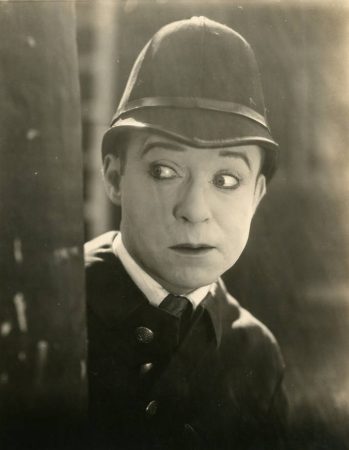
Silent film comedian Harry Langdon, ca. 1924. (Courtesy University of Washington Special Collections, Order No. JWS20503)
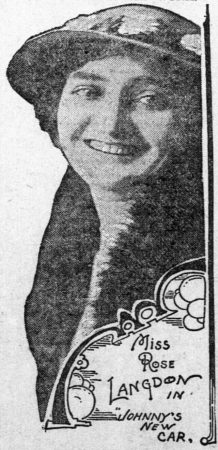
Unidentified newspaper clipping of Rose Langdon, ca. 1917.
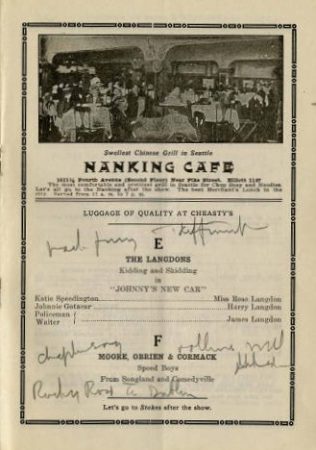
The Langdons in the Oprheum Theatre program, week of January 30, 1916. (Courtesy University of Washington Special Collections, Digital ID No. PAM0825)
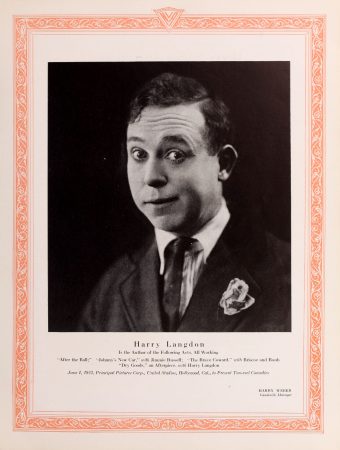
Vaudeville advertisement for Harry Langdon's stage act, ca. 1923.
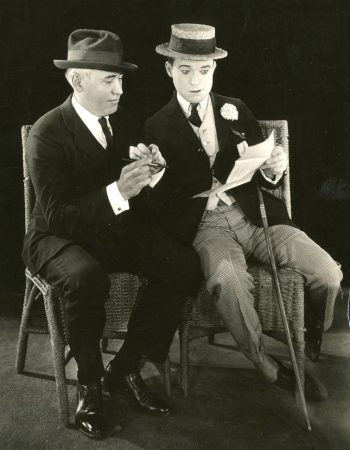
Langdon and Mack Sennett go over the comedian's movie contact, December 1923. (Courtesy University of Washington Special Collections, Order No. JWS24191)
Laugh, Town, Laugh: A Collection of Vaudeville Engagements
Act III: Harry Langdon
Another performer with a connection not only to Charlie Chaplin but also to Stan Laurel was Harry Langdon, who’s rise to fame put him (albeit briefly) amongst the great silent comedians of the 1920s.
Langdon was born into poverty in Council Bluff, Iowa, in June 1884. After performing a variety of odd jobs as a young boy, he made his first stage appearance in 1896, entering an amateur variety contest in Omaha. The stage bug must have been powerful, for just a year later, in 1897, Langdon ran away from home to join Dr. Belcher’s Kickapoo Indian Medicine Show, which took him through various small towns across the Midwest. Later, he honed his comic talents in sideshows, circuses and small stage companies. Shortly after the turn of the century he began a formal career as a vaudeville performer, where he would spend the next two decades before jumping to the screen in the 1920s.
Prior to having his film contract purchased by Mack Sennett (the comedian initially signed with an independent producer), Harry Langdon enjoyed a fairly successful stage career. He had but one primary act before joining the motion picture business, but it was exceptional enough that vaudeville audiences never seemed to tire of the sketch. First developed in 1906 and popularly known as Johnny’s New Car, the routine was Langdon’s bread and butter for nearly two decades – a mostly pantomime act which found the comedian at the mercy of an automobile with a mind of its own. The vehicle would stall almost immediately after coming onstage, and with nearly every effort Harry made to get it running again, something else would come apart or go heinously awry. “[The comedian’s car] was ingeniously contrived and provided Langdon with a noisy and persistent antagonist to which to respond in his own inimitable fashion,” Langdon scholar Joyce Rheuban has noted. “As Harry drove the car on and off stage, it bucked and backfired loudly and visibly with flames shooting out of the exhaust as if from a blowtorch. When Harry lifted the hood in an effort to repair the car, the radiator expelled a geyserlike jet of steam and the gas tank spit fire at Harry whenever he turned his back to it.” The car was also rigged to simulate an explosion, where “engine parts and the steering wheel were fired into the air and landed all over the stage. The car was designed and constructed by Langdon to fall apart, piece by piece, either at the touch of his hand or of its own volition as the act progressed.”[1] Adding to the comedian’s (mostly silent) befuddlement was a haranguing female passenger, played by Langdon’s wife, Rose, whose loud stage demeanor contrasted with Langdon’s passiveness.
The skit was a vaudeville favorite, conceived in an era when America was becoming infatuated with the automobile, then a sign of luxury for the average person. Langdon brought the sketch to Seattle for the first time in September 1913, when he played an Orpheum bill headlined by Lulu Glaser. Glaser, of course, formed the primary attraction, appearing in the musical playlet First Love, but the diverse bill also featured a comedy playlet called The Pumpkin Girl, a song and dance routine, and Kluting’s Entertainers, a trained animal act showcasing “educated” dogs, cats, and pigeons. Langdon was presenting the first version of his popular sketch (it underwent several changes over the years), titled A Night on the Boulevard, which found him playing a character named Johnny Flattire. He was supported by Rose Langdon as Katie Speedington, and a performer identified as Tully Langdon (Harry’s brother James) in three roles as a policeman, a waiter, and a chauffeur. The Langdons played the middle of an Orpheum bill characterized as “one good thing after another,” although they do not appear to have been the comedic draw that particular week. A blackface comic sketch by Swor and Mack took those honors – an improbably-titled act called Realistic Impressions of Southern Negroes.
A Night on the Boulevard was the comedian’s initial version of the car sketch, and although the playlet wasn’t described in detail during this particular visit, this sketch (which he toured with from approximately 1906-1915) typically found Harry as the chauffeur to a loudmouthed society belle. A Night on the Boulevard featured dialogue for all three actors, and in some versions included a song number for Rose Langdon.[2] But the comedian frequently changed the basic setup, not only to augment the act with better gags and effects but – more importantly – to keep it fresh for vaudeville audiences.[3]
The Langdon offering seems to have gone over well with Orpheum audiences. “The Langdons were noisily received in a travesty called A Night on the Boulevard,” noted the Post-Intelligencer, in their only mention of the comedian. “Harry Langdon’s ridiculous nonsense and a number of mechanical props aided the laughter.”[4] In the Daily Times, J. Willis Sayre found a bit more space to devote to Harry Langdon’s first Seattle visit. “Rose, Harry and Tully Langdon have followed up the line of comedy first made known in Tate’s Motoring by a difficult automobile turn that is a twenty-minute scream. There are trick things about the machine, acting scenery, a neat line of patter and Harry’s surprising facial expressions. It was one of the hits of the program.”[5]
Two and one-half years later, on January 30, 1916, the Langdons again turned up in Seattle, beginning another weeklong engagement at the Orpheum. This time the trio was presenting the second version of Langdon’s vaudeville act (running from approximately 1915-1921), entitled Johnny’s New Car.[6] Higher on the bill than their previous visit (the Langdons were featured second behind dancer Gertrude Hoffman), the act, aside from its title, had undergone some obvious changes. Langdon’s character was now named Johnny Gotacar, the part of the chauffeur had been dropped altogether, and James Langdon was identified by his given name, and not his stage name of Tully. Still, this version of the sketch was similar to the framework used in A Night on the Boulevard, though Langdon had improved his trick vehicle, designed a more elaborate stage backdrop, and ended the sketch with a mechanical effect showing the (newly-repaired) vehicle traveling off into the horizon, only to explode as its crests a hill in the distance.
The Langdons again received praise, although the Post-Intelligencer was still a bit stingy in elaborating about the act. “The Langdons, in Johnny’s New Car, are inimitable,” the paper noted in an almost obligatory fashion. “It is a new and very happy stage conception.”[7] The Daily Times was even worse – after gently chiding Hoffman’s presentation, Sumurun (devised by Max Reinhardt) as being too big and too ambitious for the vaudeville stage, all they could muster about Langdon was that his act was a “strong comedy hit.”[8] At the Star, the comedian merely received passing mention as part of a bill that began with the Orpheum Travel Weekly (featuring motion picture scenes from France, Spain, Russia, French West Africa, and Corsica), and included acrobatic comedians Paul, Levan and Dobbs, singer Grace DeMar, and a trio performing comedic songs.
By the time the Langdons made their third Seattle appearance, however, in February 1917, Johnny’s New Car and its creator were clearly a hit. So much so, in fact, that while the name of the sketch remained the same for this tour, the name of the troupe itself had changed: no longer known simply as “the Langdons” (although all in the act continued to share that last name, at least onstage), they were now known as “Harry Langdon & Company.” And, based prior appearances in Seattle, they were also an established favorite with vaudeville audiences; the Pantages, where they were now playing as a headline act, announced them as “…the de luxe [sic] representative comedy act of high-class vaudeville.” The Langdons shared the bill with singer Elizabeth Ott, a comedy sketch called See the Point?, the comedic dancing of Reynolds and Donegan, and a demonstration by Mickey Feeley and Mabel McCloud of something they called “The Submarine Dance.” The bill opened with the second installment of the movie serial Patria (International Film Service, 1917), starring Irene Castle and Milton Sills, and featuring Wallace Beery as Pancho Villa.
Interestingly, unlike previous visits, the program for the Pantages announced the Langdon engagement by outlining the plot of Johnny’s New Car, which offers a period description of the act as it stood at that time. Essentially, Langdon, as the hapless Johnny, is out for a drive with his girlfriend when his automobile stalls outside of an expensive restaurant. As Johnny gets out to fiddle with the machine, his sweetheart is delighted to order drinks and appetizers from a helpful waiter. “Johnny’s mishaps with the waiter and a passing policeman all form the basis for much comedy and many humorous situations,” the program reported.[9]
The Seattle Star felt the sketch was worthy of its top billing, calling Langdon’s efforts “a big time act if there ever was one.” Other critics, and certainly audiences at the Pantages, agreed with this assessment. Charles Eugene Banks, with the Post-Intelligencer, wrote a glowing review of Langdon’s act; his comments also suggest how much the comedian’s stage and (eventual) screen personas had much in common. Banks’ comments also made up for the slight in his column from a year earlier, when he reviewed Harry Langdon’s second Orpheum engagement in under 20 words.
Harry Langdon came to the Pantages theatre yesterday with his pretty side partner and his automobile. Langdon gets a lot of real fun out of a very moderate way of doing things. He says very little and his movements would make a snail look like a race horse. His countenance is mostly blank. But he is a master of pantomime and has a sixth sense of fun most acute. Just how he manages to make his automobile do the tricks it does has not been revealed. Out of it, or in combination with it, he gets comedy that keeps the audience in ripples of laughter. The girl that helps to make his act go over is about as silent as he is, but she has lots of expression, especially in her eyes.[10]
It is interesting to note that Rose Langdon’s character, in Banks’ description, was mostly silent during the act. Neither the Star nor Daily Times commented on her stage demeanor, but this account differs from other descriptions of the Langdon act or what scholars like Joyce Rheuban have uncovered about the comedian’s stage roots. It may be that Harry Langdon altered the sketch for this tour in such a way that it was completely (or nearly) told in pantomime.
The Daily Times also had warm comments about Harry Langdon & Company – almost half of their 1917 review, in fact, was devoted to the headline act. Although the critique is not credited to him, J. Willis Sayre appears to have authored the piece. “Harry Langdon is the big card on the Pantages bill this week,” their reviewer noted. “He brings back to town his altogether funny and refreshingly original motor car act, not like Tate’s Motoring, but nevertheless making the machine do its part to convulse the audiences. He is assisted by two others of the Langdon clan, Rose and James, and the whole act, Johnny’s New Car, makes a sketch that is good in itself and that is heightened by Harry’s facialisms. It is one of the prize turns of the winter season at 3rd Avenue and University Street.”[11]
Harry Langdon returned to the Pantages less than a year later, on January 7, 1918, when he again headlined the venue with Johnny’s New Car, topping a bill that included singer Dixie Harris (who dressed in a series of outlandish costumes for each of her numbers), equestrian Rosa Rosalind, a pair of acrobats, a comedy sketch called Shooting the Shoots, and The Cortez Trio, billed as street entertainers from Naples, Italy.[12] Langdon’s act was touted in print advertisements as “one of the biggest laughs of the year.”
The Post-Intelligencer felt the show was one of the better attractions in the city.
Harry Langdon and his funny little red automobile, and pretty Rosa Rosalind, a former Barnum & Bailey equestrienne, are the features of an excellent bill at the Pantages this week, but they were given a close run for the honors yesterday afternoon, on the opening, by Dixie Harris and her male quartet and Jarvis and Harrison, funmakers.
Langdon, with Rose and James Langdon, appear in Johnny’s New Car. That is the name of the comedy and that is what they do. Langdon is of the quiet type of laugh-producer, but keeps his audience howling with mirth just the same. The act shows humorously all the troubles and mishaps to which the automobile owner is heir – sometimes.[13]
The Daily Times, in a very brief review of the Pantages bill, devoted little attention to Langdon’s act, merely calling the comedian’s skit “hilarious” and noting that the sketch “drew all sorts of deserved appreciation.” Dixie Harris earned more. “Miss Harris’ costumes are rich and border on the gaudy,” the paper observed. “Her song, ‘Liberty Bell,’ will be widely warbled on the stage and tried on most pianos and ukuleles in the next six months. And the yodeling song of the four men is a gem.”[14]
Harry Langdon’s next visit began on May 1, 1921, at the Moore Theatre, which had, by then, become Seattle’s home for Orpheum vaudeville. Again, the act was Johnny’s New Car, but James Langdon was no longer touring with the show – he was replaced by a female performer who went by the stage name of Cecil Langdon. Irene Franklin headlined the show; the Langdons took second billing. Other acts included a roller-skating demonstration by the El Rey Sisters, three separate comedy skits, and an exhibition of strength by the Winter Brothers. “Harry Langdon, assisted by Rose and Cecil, will present Johnny’s New Car,” went a pre-engagement notice in the Daily Times. “This is said to be a wonderful ‘runabout’ and the skit around the ‘flivver.’ Harry’s peculiarity of speech and the fragile car provides a fund of merriment. There is a little storehouse in the front of the ‘car’ which alone provides any patron his money’s worth.”[15]
The act lived up to its billing, although the reviews, much like Langdon’s earliest visits to the city, tended to be undescriptive. “[Harry] Langdon is a legitimate comedian,” wrote the Daily Times, “funny in voice, mannerism and appearance, and his car is a comedy riot. It is of the type that seems to run better with every piece of interior mechanism it loses.”[16] The Post-Intelligencer elaborated little more. “Harry Langdon, assisted by Misses Rose and Cecil, provides fifteen minutes of wholesome laughter in a skit depicting the trials of a motorist, entitled Johnny’s New Car. The car proves to be a ‘tin Elizabeth’ of the most obstinate kind. The incident of its bad behavior in front of a fashionable cafe makes for a lot of clever fun. Mr. Langdon depicts a character of the ‘boob’ genus.”[17]
Harry Langdon’s final Seattle appearance before entering motion pictures occurred two years later, in January 1923, when he returned to the Moore Theatre as a headliner. Although Rose and “Cecil” Langdon were still assisting him, the act itself had been completely overhauled. No longer presenting Johnny’s New Car, the skit had been reshaped into the third and final version of his car sketch, now called After the Ball. This act (which Langdon presented from approximately 1921–1923), drew on the 1920s popularity of golf, with elements of Langdon’s car act incorporated toward the end of the sketch. The new playlet was divided into three separate sections: the first subtitled “In the Ruff,” set in the clubhouse of a country club where the comedian played a caddy, the second being “Trested Ruff,” out on the course, and the last called “Ruff Riding,” where Langdon once again employed his stage automobile.[18] “You don’t have to be a links enthusiast or a garage worker to enjoy the number. Scores of comedy situations are offered surrounded with a lavishness seldom found outside of dramatic productions.”[19]
The Langdons headlined a show that included, among others, a musical troupe called the 10 Seattle Harmony Kings, topical monologist Milt Collins, jugglers Johnson and Baker, and a singing comedy sketch called Playmates, featuring Francis X. Donegan and Julia Steger. The bill also featured the latest edition of the Pathé newsreel.
Although they were not the actual headliners (the Langdons shared top billing with the Harmony Kings, local singers who recently finished a vaudeville tour of the East), the crowd enthusiastically greeted them. “Two acts on the new vaudeville bill at the Moore appealed particularly to yesterday afternoon’s audience,” observed the Post-Intelligencer in a rather sparse review, “Harry Langdon’s golf course skit, After the Ball, and the jazz offering of the ‘Seattle Harmony Kings,’ a group of local entertainers who have been making a favorable impression all along the Orpheum circuit.” Calling Langdon’s act, in particular, a surefire hit, the paper didn’t deviate too far from the Moore’s pre-engagement notices, ending their two sentences devoted to After the Ball with “(a)nyone who has ever played golf, as well as those unversed in the game, will find much to enjoy in [the sketch].”[20] The Star was also short with the entire bill, which they felt was one of the best the Moore had offered in many weeks, but added that Harry Langdon had become “one of the big comedy favorites with Seattle vaudeville audiences.”[21]
The most interesting review, however, was from the Daily Times. Not only did they describe Langdon’s revised act but touched on an afterpiece comedy sketch performed at the end of the show – a sketch that went unmentioned in the Post-Intelligencer and was noted only in passing in the Star.
Because they are doing their bit in advertising Seattle to the patrons of vaudeville and again because their syncopated music represents the best of its type, the Seattle Harmony Kings deserve the ovation accorded them by the opening audience at The Moore yesterday.
Sharing the headline honors with Harry Langdon, one of vaudeville’s real comedians, the Seattle Harmony Kings scored a whale of a hit with the matinee audience. They began by presenting a syncopated version of the familiar aria from Samson and Delilah and they continue, alternating classics and popular selections. A lively dance by a colored boy is added to the entertainment. In many ways the act seems to be the best jazz band The Moore has offered.
Harry Langdon, quiet and droll, is a host in himself. Not satisfied with putting over a new comedy skit in which the laughter is continuous, he stages a riotous afterpiece at the close of the show in which virtually every member of the bill participates. Langdon first made the acquaintance of Orpheum Circuit audiences with Johnny’s New Car, in which his motor troubles were the basis for hilarity. He has now turned his attention to golf in After the Ball, a skit in three scenes; the first at the caddy house, the second at the first tee and the third in an automobile in front of a hospital. The afterpiece, which provides a comedy climax for the bill, shows what may happen when a wet goods store is turned into a dry goods store through prohibition.[22]
Shortly after Harry Langdon’s 1923 engagement at the Moore, the comedian signed with a small independent film producer; Mack Sennett eventually bought up his contract. Later that year saw the debut of Picking Peaches (1924), Langdon’s first motion picture, the start of brief but meteoric rise in Hollywood.
Yet although Harry Langdon is viewed as one of the great figures of silent comedy, his reputation has been tarnished by several factors, not the least of which was the similarity his screen character to Chaplin’s, the timing and brevity of his rise to fame, and his creative associations in the late silent era. The Langdon screen character, developed onstage and refined for motion pictures in shorts made for Mack Sennett between 1924 and 1926, was essentially that of an innocent who approached life with a child-like perspective. Unfortunately, it was a characterization that appeared derivative of Chaplin’s Tramp, and considering that the period of Langdon’s significant film work (several features produced between 1926 and 1928) coincided with a prolonged absence from the screen by Chaplin, detractors have asserted that Langdon’s character was simply a temporary heir to the Tramp’s legion of fans.
Harry Langdon’s importance has been further diminished by the fact that the three features for which he is best remembered, Tramp, Tramp, Tramp (First National, 1926), The Strong Man and Long Pants (both First National, 1927) were all produced with the help of a former Mack Sennett gagman named Frank Capra. Capra helped write Tramp, Tramp, Tramp and directed the other two, and in light of their career trajectories much of Langdon’s screen success has been ascribed to Capra’s influence. It didn’t help that Capra himself perpetuated that notion. In his 1971 autobiography The Name Above the Title, Capra describes Harry Langdon as arriving in Hollywood an unsophisticated talent whose screen character was entirely devised by himself and Arthur Ripley, first under Sennett and later during Langdon’s early features. Capra’s comments completely dismiss the comedian’s long and successful stage career. “I gained Langdon’s confidence and respect with my vetoing of gags that violated the character Ripley and I had created for him,” Capra recalled of their work on Tramp, Tramp, Tramp. “It was amazing to me that neither Langdon nor [director Harry] Edwards really understood, or took seriously, this integrity of characterization – which made Langdon what he was.” Capra’s assertion was, of course, preposterous – as descriptions of Langdon’s stage act showed (and as several writers have demonstrated in later research) that screen Langdon, from costume and make-up to mannerisms, was very clearly based on stage Langdon.[23]
In Frank Capra’s opinion, Harry Langdon also wasn’t prepared for his skyrocketing screen success, which led to a separate set of troubles. “The virus of conceit – alias the ‘fat head’ – hit Langdon quite hard. His early life had built up no immunity against it. He gave out interviews hinting that he was responsible for the story, the comedy, and the directing. Fortunately, we had begun shooting the next feature, Long Pants, before the accumulating avalanche of press clippings swamped his dressing room, inflaming conceit into a bad case of Langdonitis.”[25]
Depictions such as Capra’s did considerable damage to Harry Langdon’s historical reputation, but reassessments of his life and screen work have become more prevalent. In 1983, for example, Joyce Rheuban published Harry Langdon: The Comedian as Metteur-en-Scene, a detailed account of the comedian’s career distinguished by its attention to Langdon’s stage work. This focus allows Rheuban to highlight Langdon’s pre-film talents: not only did the comedian write and act in his own sketches, but he sometimes wrote material for others, built (and improved) his stage vehicle, as well as designed and painted his own backdrops. Studies like Rheuban’s have gone a long way toward correcting (mis)information around Harry Langdon’s career.
After a falling out with Capra following the completion of 1927’s Long Pants, Harry Langdon directed himself in the final three pictures remaining on his First National contract – Three’s a Crowd (1927), The Chaser, and Heart Trouble (both 1928) – but these films rarely showed the sparkle of his first releases and his contract was not renewed. And with these mediocre pictures coming, as they did, on the eve of sound arriving in Hollywood, it was indeed difficult to shop Langdon’s talents at the time. In the span of a few years, Harry Langdon went from vaudeville headliner to full-fledged movie star and back. Although he would continue to write and perform in Hollywood until well into the 1940s, he would never regain the acclaim that his first few shorts and features garnered early in his screen career.
By Eric L. Flom – January 2026
Notes:
[1] Joyce Rheuban, Harry Langdon: The Comedian as Metteur-en-Scene (East Brunswick, NJ: Associated University Presses, Inc. – 1983), Pages 17–18.
[2] Ibid.
[3] See program, Orpheum Theatre (22 September 1913), J. Willis Sayre Collection.
[4] “Miss Glaser Head of Fine Program,” Seattle Post-Intelligencer, 23 September 1913, Page 7.
[5] J. Willis Sayre, “Orpheum Again Puts Forth Several Hits,” Seattle Daily Times, 23 September 1913, Page 9.
[6] Appropriately, perhaps, the Seattle Daily Times chose to place the week’s theatrical announcements (including the advance material on the new Orpheum lineup) in the Automobile section of their Sunday edition.
[7] Charles Eugene Banks, “Tragedy Feature at Orpheum,” Seattle Post-Intelligencer, 31 January 1916, Page 7.
[8] “Famous Dancer Draws Big Crowd at Orpheum,” Seattle Daily Times, 31 January 1916, Page 9.
[9] Program, Pantages Theatre (19 February 1917), J. Willis Sayre Collection.
[10] Charles Eugene Banks, “Harry Langdon and His Auto are Clever,” Seattle Post-Intelligencer, 27 February 1917, Page 7.
[11] “Langdon’s Humor Wins in Pantages,” Seattle Daily Times, 27 February 1917, Page 14.
[12] Apparently, J. Willis Sayre wasn’t taken in the least with The Cortez Trio. Scrawled across the Pantages program from the engagement is his handwriting – partially illegible – that pronounces the act “a bad idea.”
[13] “Johnny’s New Car is Running at the Pantages,” Seattle Post-Intelligencer, 8 January 1918, Page 7.
[14] “Variety Four Popular in Songs at Pantages,” Seattle Daily Times, 8 January 1918, Page 10.
[15] “Dramatic and Vaudeville News,” Seattle Daily Times, 1 May 1921, Section III, Page 4.
[16] “Irene Franklin Brings Joy to Moore Crowds,” Seattle Daily Times, 2 May 1921, Page 5.
[17] “Moore’s Show is Exceptional,” Seattle Post-Intelligencer, 2 May 1921, Page 4.
[18] Program, Moore Theatre (28 January 1923), J. Willis Sayre Collection.
[19] “Moore,” Seattle Daily Times, 28 January 1923, Third Section, Page 5.
[20] “Golf Course Comedy is Clever,” Seattle Post-Intelligencer, 29 January 1923, Page 5. Joyce Rheuban notes that the written scenario for the Langdon film The Sea Squawk (Sennett, 1925) included material from Langdon’s stage act; see Rheuban, Page 45.
[21] “Laughs on Moore Bill,” Seattle Star, 29 January 1923, Page 16.
[22] “Moore Jazz Pleases,” Seattle Daily Times, 29 January 1923, Page 11.
[23] See Rheuban, Pages 14 and 18–20.
[24] Frank Capra, The Name Above the Title (New York: Bantam Books – 1971), Pages 64 and 68. Simon Louvish, through research in the Mack Sennett papers, discovered that Langdon had been making films on the Sennett lot months before Frank Capra even joined the studio, throwing into question Capra’s recollection of these early events. (See Simon Louvish, Keystone: The Life and Clowns of Mack Sennett [New York: Faber and Faber, Inc. – 2003], Page 216.) “Just another small reminder to take oral and personal memories with the usual pinch of salt,” he notes.
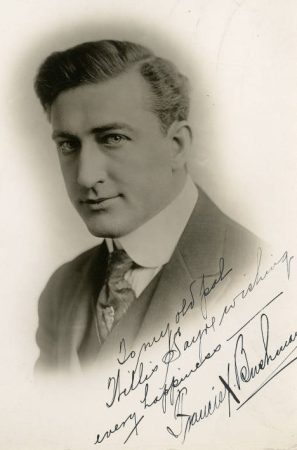
Screen heartthrob Francis X. Bushman, ca. 1923. (Courtesy University of Washington Special Collections, Order No. JWS27156)
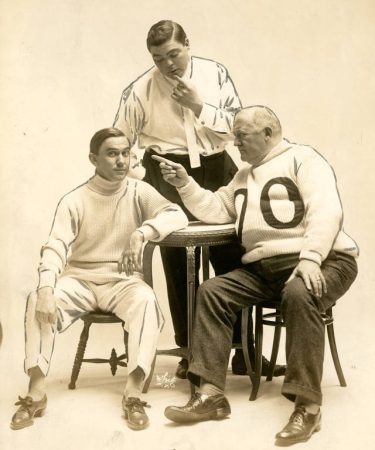
Promotional still for "Going Some," ca. 1909. (Photo by the White Studios, courtesy University of Washington Special Collections, Order No. JWS24500)
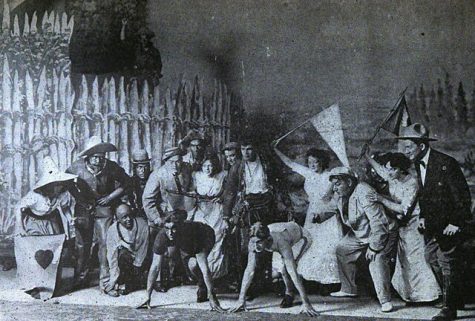
Footrace scene from Act IV of "Going Some," ca. 1909.
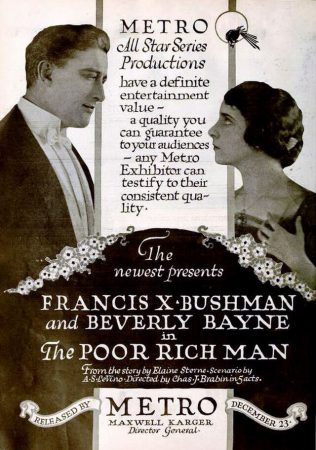
Trade advertisement for the Bushman-Bayne movie version of "The Poor Rich Man" (Metro, 1918).
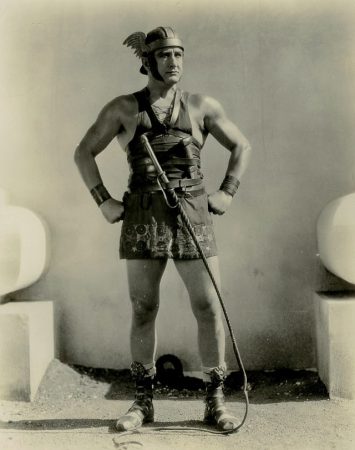
Francis X. Bushman as Messala in "Ben Hur" (MGM, 1925).
Laugh, Town, Laugh: A Collection of Vaudeville Engagements
Act IV: Francis X. Bushman
Aside from notable comedians such as Buster Keaton, Charles Chaplin, and Harry Langdon, the vaudeville stage was also a training ground for the stars of tomorrow (comic or otherwise), including those who wouldn’t find fame until well into the “Golden Era” of studio filmmaking, such as the Marx Brothers, W.C. Fields, and Fred Astaire. But it also offered more established actors the opportunity to showcase their talents in ways that differed from their source of fame. For some actors it served as an opportunity to exploit their popularity during times when their motion picture careers were temporarily, or in some cases permanently stalled. One such actor was Francis X. Bushman, one of the screen’s first sex symbols.
Bushman was born in January 1885 in Baltimore, Maryland, and first took to the stage just after the turn of the century, mostly in small roles with Eastern stock companies that earned him little notice. Ultimately, his first break in show business was earned not through his acting talents but through his striking good looks. Earning extra money as a model, Bushman’s likeness eventually became so popular that he was once voted “America’s Most Handsome Man” by a popular women’s magazine – notoriety that he had not achieved after several years on the stage, and something that helped earn him a film contract with Chicago’s Essanay Studios in 1911.
At Essanay, where he often played romantic leads, his pairing with actress Beverly Bayne became quite popular with early photoplay audiences, making them one of the screen’s first romantic teams. So successful were the couple’s films that after slightly more than a year together, Francis X. Bushman was able to command his own production unit at Essanay, a position he held until both he and Bayne were hired away by Metro in 1915.
The duo continued to be extremely popular in film shorts and serials up to World War I (this included the couple’s screen version of Romeo and Juliet, released by Metro in 1916), until scandal tarnished their careers. The chemistry between Bushman and Bayne was apparently as good off screen as on, and when it was discovered in 1918 that Bushman – who married in 1902 and had five children – divorced his first wife to marry his co-star, their popularity as a screen couple began to plummet. Although hardly a scandal to match those of later Hollywood lore, at the time it was nonetheless enough to hurt their standing with movie audiences. The pair eventually gravitated toward stage work as motion picture opportunities dried up.
Together, Francis X. Bushman and Beverly Bayne made two appearances in Seattle during the 1920s, the first in a road show production and second in a vaudeville playlet. Bushman, however, had made his first appearance on a Seattle stage much earlier, in 1909. That year he arrived playing the role of Jack Chapin, Jr. in the Shubert touring production of Going Some, a story collaboration between Paul Armstrong and Rex Beach.[1] Described as “riotously funny, according to all the auditors of the East who have been privileged to pass on its merits,”[2] the show played a five-night engagement at the Alhambra Theatre beginning Tuesday, September 28.
Although the comedy seems to have been a hit with Seattle audiences, as the Post-Intelligencer noted in their advance columns, the play was an odd hybrid of genres – a satire on college athletics set on a western cattle ranch.
The setting for this mixture of four-flushing and sentiment is the melodramatic West; the same sort of West that Armstrong made familiar in his Heir to the Horrah, where the frontiersmen wear big guns and are covered with Fuller’s earth alkali dust, where Mexicans smoke cigarettes faster than a high school boy, and wear silver trimmed sombreros to herd up the cattle. Into this environment comes J. Wallingford Speed, who has been a “yeller” at Yale, and his trainer comes along to complicate matters. A cook named Skinner, in a rival camp (a ringer) has won the prized phonograph of [the] Flying Heart ranch [in a footrace], and when Speed is announced as a runner he is hailed as the one who is to win it back; it and the favorite record of “The Holy City.” The girl he is in love with admires athletics and so it is up to Speed. The match is arranged and when it comes to a show-down the venal cook is tempted to throw the race and there you are. That is the briefest condensation of the facts, but the telling is a matter of two and a half hours of hilarity.[3]
Bushman (listed simply as “Frank” X. Bushman in the Alhambra program) failed to register with Seattle critics in his modest role as Chapin, owner of the Flying Heart Ranch and a college buddy of J. Wallingford Speed, although the production itself earned considerable praise. J. Willis Sayre, then writing for the Star, was by far the most enthusiastic about the show. “Going Some went a lot at the Alhambra playhouse last night before a record audience that had to break into hysterics to keep up with the speedy farce,” he wrote of the opening. “Going Some is the funniest bit of sustained foolishness that has scratched the feet of this city for many theatrical moons back. As a mirth stimulus it makes the greater number of so-called humorous efforts resemble the cheerful wail of a lost soul or the merry chortle of the banshee. It is absolutely grouch proof and guaranteed to fetch a cachinnatory rise out of any person on whom rigor mortis has not set in. No one who is not already an asset on the undertaker’s books can see Going Some and maintain even a shred of a peeve. Giggles, chuckles and smiles won’t go. It calls for the loud stentorian guffaw, haw-haw and he-he. It’s great.”[4]
Sayre couldn’t find a single weakness in the production, or at least didn’t notice one between his loud, stentorian guffaws, but he wasn’t the only reviewer to thoroughly enjoy the production. “People who were in the neighborhood of Russell and Drew’s uptown house and who were not lucky enough to be inside heard a din that threatened to blow out the walls,” observed the Post-Intelligencer. “The racket could have justified the turning in of a riot call if the neighborhood billboards had not proclaimed that unusual happenings were being recorded, and that the noise was laughter that the fake running race inspired.”[5]
Despite the favorable reaction to Going Some in 1909, Francis X. Bushman was several years away from achieving fame as an actor, earned in front of a camera instead of a live audience. Although he found fame in the years between the close of Going Some and his next Seattle visit, over a decade later, Bushman had returned to the stage by the time he and Beverly Bayne were the featured stars in The Master Thief, playing a five-day engagement at the Metropolitan – a full-blown Oliver Morosco stage play in which the screen stars served as the obvious attraction.
Beginning on January 6, 1920, a Tuesday evening, the Master Thief company had an unusual day off in Seattle due to a special Monday night recital at the Metropolitan by Carolina Lazzari organized by J. Willis Sayre, who had, by then, temporarily given up journalism in favor of promoting film, theatre, and concert engagements.
The Master Thief was apparently suggested by an incident in Richard Washburn Child’s Paymaster stories, in which his anti-hero – a criminal dubbed “the Paymaster” – regularly outwitted his opponents, including the police and other, more dangerous villains. The play, as adapted, was a mystery in which Bushman played a shady East Indian millionaire whose close business associates begin meeting terrible fates (either personal or financial) that seem to be the work of some sinister group. Bayne, of course, played the millionaire’s love interest, who helps him crack the case before he himself becomes a victim.
Both performers had opened The Master Thief in New York and found themselves touring with the production despite plans not to do so. At least this was the version recounted to the Post- Intelligencer by Beverly Bayne, who was the subject of a lengthy write-up shortly after The Master Thief opened. Interestingly, considering the scandal surrounding their marriage some two years before, the piece attempts to portray the couple as champions of traditional values.
Never having faced a real audience from behind the footlights until a few months ago, Mrs. Bayne Bushman experienced more thrills during the first one-night stops than her many motion picture admirers have enjoyed from a mile of film.
“I never realized how much a live audience meant before in assisting the actress,” she confided when interviewed at the New Washington hotel, “you feel their sympathy and approval. It is as if they were the big mirror placed before your face, and through their vision you could visualize your own emotions and ability. It produces that glow of artistry of natural acting that is more or less subdued by the manipulations of the camera. I found, however, that work with the movies increases the sense of action for the legitimate performance. One must be moving and playing one’s part constantly before the camera, and this prevents the tendency so many actresses have of dropping their character after saying their lines.”
Mr. Bushman is one of the many screen artists who is sharing his talent with [Oliver Morosco]. The actor’s strike in New York City sent the present company of The Master Thief upon the road, and extended his engagement with Morosco. After his return East, he and Miss Bayne will continue their work in motion pictures.
Mr. Bushman, who has been seen here in Romeo and Juliet and the romantic photoplay Graustark [1915], is the originator of the “Bushman Club,” composed of 27,000 members of the profession pledged to picture in their work on the screen only that which is decent and devoid of unpleasant suggestiveness. The patronage of the Bushman scenarios testifies to the success of this project. Mr. Bushman believes that it is the harmful plots and the extravagant productions that are tending to injure the popularity of the movies. “Already,” he says, “in New York the demand has returned for the spoken drama. The public is satiated with the unreal splendor of the screen. They wish [a] pleasing story with the true human appeal, [and] acting in a natural manner.”[6]
The Master Thief, a satire on the melodramas popular during the first part of the century, offered Seattleites the unique opportunity to see these photoplay actors in the flesh. Indeed, Francis X. Bushman and Beverly Bayne were the first film stars covered in this work to perform in Seattle after achieving popularity onscreen. “Motion picture fans have furnished a big proportion of the attendance this week,” observed The Argus, “as there seems to be an ever increasing desire on the part of people who have seen photoplay stars on the screen to watch them act and hear them talk on the legitimate stage.”[7]
Everhardt Armstrong, writing for the Seattle Post-Intelligencer, noted that the plot of The Master Thief “unloosed every tried and true device for the production of thrills that the playwright, E.E. Rose, could pry out of his memory.” Even so, the author also managed to throw in enough new material to keep the play unique. “Whatever might be said of The Master Thief, dullness is not one of its defects. Things happen. Revolvers gleam. Good women and bad juggle with the destinies of desperate men. The deep-eyed villain, careless of the rights and lives of others is thwarted in his sinister purposes by the omniscient hero, who eventually, of course, win [sic] the heart of the pure girl whom the evil genius sought to make his own. They are al [sic] there, our old friends so dear to the hearts of all true lovers of melodrama at its worst, or best. And among them insidiously glides through her serpentine course, a ‘vamp’ of the kind Theda Bara used to delineate so fetchingly.”[8]
The Daily Times also enjoyed The Master Thief, noting that the production wasn’t too far from the type in which Bayne and Bushman might have appeared in any given motion picture – the play was, in their words, simply a “picture play brought to life.” And like their rival the Post- Intelligencer, the Times found Bushman’s stage presence quite appealing, perhaps even more so than his film persona, for his speaking voice proved quite pleasant. Poor Beverly Bayne, however, managed to get overlooked in all the fawning over her husband; despite her efforts she appeared as little more than an accessory to the action. The Post-Intelligencer called her “charming,” while the Times could only note that “Miss Bayne is pretty, meets the demands of her role and wears lovely clothes.”[9] Despite her accomplishments onscreen, she was a footnote in this performance.
Beverly Bayne didn’t fare much better on the couple’s next visit to Seattle, in September 1921, when she and her husband kicked off the Orpheum vaudeville season by headlining the Moore Theatre with a one-act comedy called The Poor Rich Man, written by Edwin Burke. The playlet (based partly on the 1918 film starring Bushman and Bayne) centered on a wealthy young man who can’t find happiness – that is, until a spunky young woman shows him the way. Lavishly costumed and with commendable performances, the playlet was a rousing start to the 1921-22 season at the Moore, which had been completely renovated and redecorated prior to the debut performance. Francis X. Bushman and Beverly Bayne shared the bill with Taxie, the “educated” dog, Art Henry and Leah Moore in a comedy playlet called Escorts, and a number of singing acts.
Interestingly, however, all three of Seattle’s daily papers managed to let the Bushman engagement in The Poor Rich Man slip by with little comment. The Post-Intelligencer, in particular, did little more than offer a plot summary and note the exotic costumes and settings; as for the act, it was merely “amusing.” Their two sentences devoted to Taxie the dog, lower on the Moore bill, were more descriptive than the two paragraphs devoted to Bushman and Bayne. The Daily Times was only slightly better: “Mr. Bushman and Miss Bayne appear in a well-acted satirical playlet by Edwin Burke called The Poor Rich Man, a handsomely staged and gorgeously clothed skit that combines laughter with dramatic suspense. Mr. Bushman, as the young man worth $200,000,000, wears evening clothes – and a lounging robe almost too rich to be real, and Miss Bayne wears an evening gown and a wrap that look as if they might have been paid for by a young man with that much money. Their acting is capable and their appearance sumptuous.” The Times, however, ended their piece with a cautionary warning. “Mr. Bushman seems just a bit – a wee bit, perhaps – stouter than when he last appeared here and should be careful, for too much curve at the botoom [sic] of his classic profile would be altogether unforgivable.”[10]
Unfortunately, the Bushman/Bayne marriage – partially to blame for the decline in their screen popularity – ended in 1925. That very year Francis X. Bushman received a temporary boost to his career, however, returning to the screen as Messala in the massive (and much-troubled) silent production of Ben Hur.[11] When the part was offered to him, Bushman remembered, he was initially reluctant to accept – Messala was not the hero, as he was used to playing, but the villain. The change in characterizations was disconcerting, and years later Bushman related to Kevin Brownlow that he privately sought the counsel of William S. Hart about the role, since Hart had played Messala onstage before entering films. Bushman explained his misgivings, particularly the fact that he wasn’t going to play a hero, as his fans would have expected, but rather a “filthy Roman.” Hart let out a hearty laugh in response. “Frank,” he said, “that’s the best goddamned part in the picture.”[12]
While Ben Hur provided a temporary boost to Francis X. Bushman’s career, it wouldn’t vault him back to his former level screen popularity. Eventually he went back to vaudeville, returning to Seattle in January 1928 for a weeklong engagement at the Pantages in a dramatic playlet called The Code of the Sea. The playlet had been adapted from a serial novel appearing in American Weekly, but the plot itself went unmentioned during its Seattle presentation. The engagement was said to have been one of only two that Bushman was playing in the Northwest, and he was the headline attraction on a live bill supporting the feature film Silk Legs (Fox, 1927), starring Madge Bellamy. Also on the bill were the comedy playlet Putting it Over, starring Chester Spencer and Lois Williams, a trained bear act, Sandy Shaw, an impersonator of Scottish characters, and musical selections by the Dwight Johnson Band.
Although 44 at the time, Francis X. Bushman still displayed the characteristics that made him a screen heartthrob, despite a few more wrinkles, some graying hair and additional weight. The star still received a number of “mash” notes, it was reported, from women ranging from 16 to 60. He talked to the Post-Intelligencer during his engagement at the Pantages:
“How do I stay young?” laughed Bushman, “Why I am young. The easiest way to stay young is to forget your age – the strain of trying to keep young will make a Methuselah out of a college kid.”
Bushman has two grown daughters, Virginia and Lenore, and a twenty-four-year-old son, Francis X. Jr.[13]
“They call me the ‘Hermit on the Hill’ in Hollywood,” smiled Bushman.
“But my three children have careers of their own. I’m single again and I’m still on the stage – the same spot from which I started at sixteen – plus experience.”
And on that statement, “I’m single again,” hinges a bit of philosophy, for Bushman, whose former wife was Beverly Bayne, actress, believes that one artist plus another artist equals two bad sets of nerves.[14]
The paper’s interview was followed by a positive take on Francis X. Bushman’s stage performance, though they recognized that he was putting in little more than a glorified personal appearance. “Mr. Bushman’s fine histrionic ability, impressive physique and personality find splendid play in The Code of the Sea. It is by no means a one-man show, with a thin structure, merely designed to show the public what Bushman looks like in the flesh. The star has surrounded himself with splendid stage talent. His curtain speech, too, was of supreme interest, especially the little insight he gave into the making of Ben Hur. He told the audience that the chariot race, which takes ten minutes on the screen, actually involved 200,000 feet of film and seven weeks racing, Sundays included, to provide just what the director insisted upon having.”[15]
Francis X. Bushman also received an excellent notice in the Daily Times following the playlet’s debut at the Pantages, where he headed a bill that “leaves but little to be desired.” The Code of the Sea featured four principal actors, all of whom performed very well. Declaring that Bushman had “deserted the screen for his first love, the stage,” the star earned the lion’s share of attention, and was given a very warm reception by Seattle audiences. “Bushman,” noted the Times review, “whose recent screen triumph was in the role of Messala in Ben Hur, was given an ovation on his entrance last night, and the audience would not be satisfied at the conclusion of the act until he had made a lengthy curtain speech. In his talk he explained some of his work in the movies and in the making of the chariot race scene in Ben Hur and told of plans for making a world tour with his present stage company.”[16]
Harry B. Mills was even more generous in the Star.
There may be something weak on this week’s bill at the Pantages theater, but if there is it takes sharper eyes and ears than this writer possesses to find it. Here is another one of those rare occasions were every act pleases.
As for the headliner – Francis X. Bushman, in person and backed by a sketch of real dramatic merit, stops the show, and stops it dead. He does it by as fine a piece of repressed emotional work as we have seen in a long, long time.
A cast of three back him in Code of the Sea, and the work of two of these, Miss Gleason and Mr. Hitten, is away [sic] ahead of the average.
His act was closed by a curtain talk that showed even more showmanship than the manner in which the act was put across, with introductions for his fellow players, a few personalities touching – the making of Ben Hur, and a well turned allusion to the star’s enjoyment at being back on the stage and in Seattle again.
If you see nothing more this week at the Pan, Bushman’s act will pay back your admission cost.[17]
Unfortunately for Francis X. Bushman, The Code of the Sea may have been well-received in Seattle, but the vaudeville tour did little to revive his acting career. Once one of Hollywood’s wealthiest men and most renowned sex symbols, Bushman was reduced to occasional supporting roles in the 1930s and beyond, a far cry from his glory days in the teens. Some of his appearances were in notable pictures – he played Bernard Baruch in Wilson (20th Century-Fox, 1944), the film biography of the 28th President, as well as playing Mr. Tyson in Billy Wilder’s Sabrina (Paramount, 1954), opposite Audrey Hepburn and Humphrey Bogart. But for the most part he played small roles in unmemorable films, on top of occasional radio and television work. Bushman died in 1966, his final screen appearance being in The Ghost in the Invisible Bikini (American International Pictures, 1966), a ’60s beach party movie which featured roles for, among others, Boris Karloff, Basil Rathbone and Nancy Sinatra.
By Eric L. Flom – January 2026
Notes:
[1] Although Rex Beach collaborated on the story for Going Some, Paul Armstrong and J.C. Huffman completed the actual stage adaptation. The Alhambra engagement was part of an unofficial “Rex Beach Week” in Seattle. Not only was the famed author partially responsible for story elements for the play at the Alhambra, but the stage version of his book The Spoilers was playing to packed houses at the Lois Theatre, while his latest novel, The Silver Horde, was widely available in local bookstores.
[2] “Going Some Coming,” program, Alhambra Theatre (12 September 1909), J. Willis Sayre Collection.
[3] “Going Some is a Very Fast Comedy,” Seattle Post-Intelligencer, 29 September 1909, Section II, Page 4.
[4] J. Willis Sayre, “Going Some at the Alhambra,” Seattle Star, 29 September 1909, Page 3.
[5] “Going Some is a Very Fast Comedy,” Seattle Post-Intelligencer, 29 September 1909, Section II, Page 4.
[6] “Beverly Bayne Happy Actress,” Seattle Post-Intelligencer, 9 January 1920, Page 8.
[7] “Gossip of Plays and Players,” The Argus, 10 January 1920, Page 4.
[8] Everhardt Armstrong, “Thrills Abound in Melo- drama,” Seattle Post-Intelligencer, 7 January 1920, Page 11.
[9] “Chance to Hear Bushman Loving,” Seattle Daily Times, 7 January 1920, Page 11; and “Thrills About in Melodrama,” Seattle Post-Intelligencer, 7 January 1920, Page 11.
[10] “Orpheum Season Is On,” Seattle Daily Times, 5 September 1921, Page 8.
[11] Kalem put out a one-reel version of Ben Hur, one of the longest running and most successful stage plays in the early 20th century, in 1907. Filmed without obtaining the proper motion picture rights, the resulting lawsuit against the company prompted most early filmmakers to be more judicious (or, more appropriately, less obvious) when making film adaptations of popular novels or plays.
[12] Francis X. Bushman to Kevin Brownlow, The Parade’s Gone By (New York: Alfred A. Knopf, 1968), Page 390.
[13] Three months following the elder Bushman’s engagement at the Pantages, Seattle had the unusual opportunity to see Bushman’s children enjoy a weeklong engagement at the same venue, beginning March 18, 1928. Lenore and Ralph Bushman (performing under the name Francis X. Bushman, Jr.) headlined at the Pantages with a comic mystery sketch called The Third Door Back. The play centered on the efforts of a reporter tracking a supposed murderer, although interest in the act was clearly the Bushman lineage and not the playlet itself. Ernest S. Cowper, writing for the Post-Intelligencer, praised the excellent balance and diversity of the entire bill, but had a gentle put-down of the featured act. “Among the new talent is Francis X. Bushman, Jr. and his sister, Lenore, who have the black type on the program,” Cowper noted. “Their personalities are perhaps the most interesting elements in The Third Door Back, a dramatic playlet that was especially written for them. The playlet itself is thin, very much so, considering especially that it engages four persons to present it. However, the Bushmans are the kin of a famous sire and undoubtedly possess much of the stage abilities which made him notable. Their vehicle, however, is not com- mensurate with their talents.” (Ernest S. Cowper, “Variety is Keynote of Program,” Seattle Post-Intelligencer, 20 March 1928, Page 13.)
[14] “F.X. Bushman Still Dents Their Hearts,” Seattle Post-Intelligencer, 24 January 1928, Page 3.
[15] “Bushman in Person Heads New Program,” Seattle Post-Intelligencer, 24 January 1928, Page 6. According to Kevin Brownlow, the chariot race in Ben Hur was originally to be filmed on location in Italy, though a host of labor and technical difficulties (not to mention a few chariot accidents) kept the film from being completed in Rome. The Circus Maximus set was later recreated in Culver City, California, with much of Hollywood invited to fill the stands and cheer during establishing shots for the race. A total of 42 cameras were used that day; in the weeks that followed, 10-plus cameras rolled while the actors performed closer shots in an empty stadium. All told, Brownlow’s research would seem to confirm the claims Bushman made during his curtain speech at the Pantages. (See Brownlow, Pages 403 and 405-409.)
[16] “Bushman Given Great Ovation in New Playlet,” Seattle Daily Times, 24 January 1928, Page 10.
[17] Harry B. Mills, “‘Francis X.’ in Person is Show Stopper,” Seattle Star, 24 January 1928, Page 5.
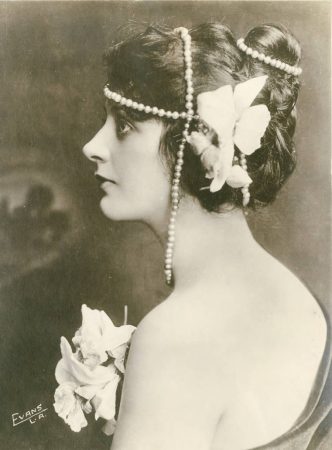
Silent film actress Nell Shipman, ca. 1924. (Photo by the Evans Studio, courtesy University of Washington Special Collections, Order No. 35649)
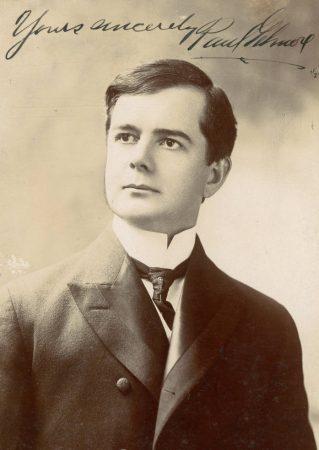
Stage actor Paul Gilmore, ca. 1904. (Courtesy University of Washington Special Collections, Order No. JWS18154)
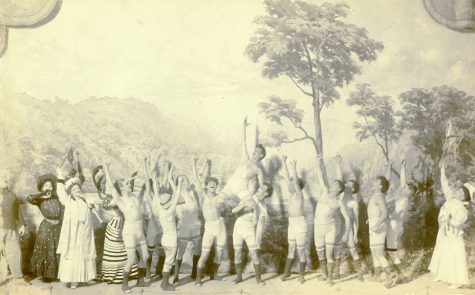
Climactic victory celebration in the final act of "At Yale," ca. 1907. (Courtesy University of Washington Special Collections, Order No. 23420)
Young Helen Barham in 1909, later known in Hollywood as Nell Shipman. (Courtesy University of Washington Special Collections, Order No. JWS33521)
Lithograph advertisement from the Jake Kilrain-John L. Sullivan championship fight, 1899.
Laugh, Town, Laugh: A Collection of Vaudeville Engagements
Act VII: Nell Shipman
Although never having attained the popularity of a Francis X. Bushman or even, one could argue, a Beverly Bayne, Helen Barham nonetheless established for herself a unique, if perhaps minor position in Hollywood during the silent era. Better known by her professional name of Nell Shipman, she wrote, directed and acted in several outdoor adventure films in late teens and early twenties, some made for her own production company. Moreover, Nell Shipman holds more than a casual interest to folks in the Northwest since, during childhood, she briefly called Seattle home.
Helen Barham was born to a proper English family in Victoria, British Columbia, on October 25, 1892. When she was only 10, the family moved from Canada to Washington state, eventually settling in Seattle. Even before her arrival in the Puget Sound area, however, Helen Barham had become interested in stage life. After seeing shows in Victoria – she was particularly enamored with Pollard’s Lilliputian Opera Company, starting point for both Daphne and Snub Pollard as child performers – she devoted herself to one day performing in the footlights.
While in Seattle, Helen – nicknamed Nell – began serious efforts at learning the acting craft, enrolling in Frank Egan’s dramatic school and studying piano.[1] It was through Egan that she landed her first stage role, an amateur production of Richard Brinsley Sheridan’s The School for Scandal, where she essayed the role of Lady Teazle at age 12.
According to Nell Shipman’s autobiography, it was also through Frank Egan that she secured her first professional engagement in 1907, when she landed a small role in a touring company headed by stage veteran Paul Gilmore. According to Shipman’s recollection, a leading lady in Gilmore’s company, then touring with the collegiate play At Yale, dropped out of the troupe in Vancouver, British Columbia, to marry a Royal Canadian mounted policeman. Accordingly, as other females stepped up into different roles, an opening for a small ingénue part became available. Egan, friends of Gilmore and his wife, arranged a dinner at the Barham house while the actor was casting for the part in Seattle, introducing him to young Nell and her family. She still had to audition for the role, but the initial meeting left a favorable impression, and Nell was hired to complete the tour. But, to help satisfy the concerns of her parents, the Gilmores put the girl under the supervision of a “Miss Helene” in the troupe, which seemed to allay any fears the Barhams had regarding their daughter’s care on the road. (According to the program for the 1907 Seattle engagement of At Yale, the role of Mrs. Clayton Randall was essayed by Helene Davenport.[2])
Shipman recalled the play fondly, particularly her small part near the end of the final act, set against the backdrop of a crew race.
The race was the big thing in Owen Wister’s play, his answer to Brown at Harvard. The Gilmore show had two crews, Crimson and Blue, and two racing shells madly stroked on a treadmill against a cycloramic background which unrolled a painted version of the Thames. Yale won; also the Hero, who sang and acted and stroked the Yale crew to the grand finale when he clasped his visiting sweetheart to his lettered sweater. The ingénue, who didn’t have many lines but some cute business, like battering the punching bag in the boy’s rooms, and getting it back in her eye, also got her man, the Juvenile Comedian. The chaperon for this wild adventure in the Sorority House was played by a character actress the Gilmores called “Our Miss Helene,” a lady mentioned with charming respect when Mrs. Gilmore was assuring my parents that when she and Paul were unavailable “Our Miss Helene” would look out for their child’s welfare.[3]
While certain aspects of Nell Shipman’s stage debut check out against her own version of the story, others do not. The At Yale company opened to good reviews at Portland’s Heilig Theatre on February 15, 1907 – nine days before their Seattle debut – with the Portland Oregonian printing, along with their critique, a cast list. As the troupe seems to have used Seattle as a jumping off point for Vancouver and Victoria before playing their scheduled engagement at the Grand Opera House, it’s possible that the vacancy could have occurred prior to their appearance at the Grand, as Shipman recalled, thereby necessitating a casting change. Yet the cast listing for the Portland engagement is identical to the Grand program in all but one way: assuming both sources are correct, it would appear that two of the men in the company exchanged roles. The cast for At Yale, in fact, was predominantly male – there were only four notable female roles in the play at all, and between the Portland and Seattle engagements no changes were indicated to these parts. The Grand program lists the role Shipman was eventually to play on the tour, Mame Brady, as belonging to Frances Scarth, and J. Willis Sayre, ever diligent in noting casting changes in his programs, made no such correction for the Gilmore engagement. Since there were plenty of smaller roles unmentioned by name, Shipman may have joined the Gilmore troupe in a smaller part, eventually graduating to Mame at some later point along the tour. (She was, however, recounting the “leading lady” story as early as 1919, when Shipman penned an autobiographical article for Photoplay in which she recalled her engagement in the At Yale company in a similar fashion.[4])
Nell Shipman’s memoirs don’t give a concrete date for her debut onstage in At Yale, but she intimates that her first performance was in Seattle or shortly thereafter. So, either with or without young Helen Barham amongst the cast, Paul Gilmore and his company opened a two-day engagement of At Yale on February 24, 1907, at the Grand Opera House.
Paul Gilmore’s musical comedy, written by Owen Davis (with songs by Daniel Dore), was one of many college-themed plays that had proven popular at the time, including Brown at Harvard, The College Widow, and Strongheart, the latter of which was written by William de Mille. At Yale’s novelty was that it did not climax in a football game, but the Harvard-Yale crew race – compared in one Seattle review to the horse race finale from In Old Kentucky and the chariot race in Ben Hur for its dramatic intensity. Gilmore, cast as Dick Seely, found romance in the mix by falling in love with a picture of his roommate’s sister (shades of William S. Hart’s appearance in The Queen of Sheba some 14 years previous). Seely manages to win the girl’s heart after his crew rows to victory, despite a scheming classmate who tries to sabotage the Yale boat.
Gilmore, known widely for his success in the John Drew vehicle The Mummy and the Hummingbird, was a frequent visitor to Seattle and an audience favorite – there was little doubt that his appearance in At Yale would be anything but a hit. In addition to adding a bit of versatility to his repertoire, the Post-Intelligencer noted, “Mr. Gilmore’s present visit is also a more generous recognition of his abilities, [as was discovered by] a packed house at the Grand, attesting [to] the growing popularity of Mr. [Jules] Murray’s star and the satisfactory bill that is offered. It is sure that Mr. Gilmore has never appeared to better advantage than he is in this season’s vehicle…Mr. Gilmore is manly and artistic in his work. His methods are honest and convincing – no matter what he does – and his capacity unlimited.”[5]
In addition to a balanced company, the Post-Intelligencer also lauded the scenery and stage mechanics, which were most apparent in the boat race. The Star, which was also greatly impressed with the finale, offered more detail in describing the effect. “The audience is not left to imagine the great match between the sons of Eli and Harvard,” they noted. “Through a flimsy, gauze-like arrangement which screens the scene from the audience and gives the effect of distance, the rowing shells with the opposing teams creep out upon the stage and fight it out where everyone may see – and feel.”[6]
The Daily Times was quite enthusiastic about the production, although they did observe that “(t)here is a line of melodrama about the second act and the details of plot are not worked down to the fine edge which better known dramatists have put into their works.” Still, Gilmore’s efforts overcame the play’s inherent weaknesses.
Paul Gilmore has always been a popular favorite with local play audiences, but last night at the Grand he opened to the largest and most enthusiastic house to which he has ever played in Seattle. This is due partly to the fact that Gilmore widely increases his circle of friends with each succeeding visit and partly to the fact that he now as a college play, a form of entertainment which is just at the present enjoying a pronounced vogue on the American stage…
There is a good healthy college thrill about the whole performance, and Gilmore and his associates admirably preserve the atmosphere of the play from start to finish. Gilmore himself easily triumphs at every point. He gets the girl, after much difficulty placed in his path by an ingenious villain, and he wins the boat race for Yale with equal facility. Also, he bests a mixed-ale pugilist, saves a New Haven girl from an Evelyn Nesbit fate and what is more important, impresses on his audience the fact that his Dick Seely is the best thing he has ever done…At Yale has its closing performance tonight, although it would undoubtedly have done well for a much longer engagement had the bookings of the house permitted.[7]
Although it is impossible to determine whether Nell Shipman, appearing as Helen Barham, made her first professional appearance at the Grand in 1907, she did complete the tour with the At Yale company, an experience that taught her much about the rigors of theatrical life. For the trip east, for instance, it was left to “Our Miss Helene” to help mold the 15-year-old Helen Barham into a proper, 18-year-old stage veteran so as to avoid intrusions from the Gerry Society. Additionally, Shipman was instructed not to mix with the extras, as many of the young men were gay; although she counted them as some of her favorite people in the troupe, she was discouraged from getting too friendly. Her most painful memory from being on the road with the At Yale company, however, was that the food was terrible, leaving her quite undernourished by the time the tour closed later in 1907 in New Haven, Connecticut (or, quite literally, at Yale). All along the way, “Our Miss Helene” extolled the virtues of Broadway – not for its glamour, but for its eating establishments. “Broadway, I learned, was more than any actor’s ultimate dream,” Shipman recalled. “It was a Heaven of Food.”[8]
Nonetheless, Nell Shipman was not dismayed by first theatrical tour to give up dreams of becoming an actress, and signed on for a revival of At Yale the following season. After that tour closed, she briefly got work in the East in a Jessie L. Lasky vaudeville sketch called The Pianopheinds, though the act was poorly received and folded rather quickly. She then returned to Seattle, basing herself there but putting in time with several troupes heading out on the road, including a stint with Charles A. Taylor’s stock company on travels through Alaska, Oregon, Utah, and Montana.
In the city itself, however, Nell Shipman is only known to have played one other engagement – under her given name of Helen Barham – some two years after her work with Paul Gilmore. This came in 1909, when she teamed with Dave Williams and Verne Layton to present the vaudeville playlet According to the Code, which played a weeklong engagement at the Pantages Theatre beginning February 15.
The sketch was playing Pantages time, according to advance notices, by “special permission” of actor/director T. Daniel Frawley, then presenting stock plays over at the Lois Theatre, also a Pantages-owned house.[9] Not much about the comedy piece is known, save for the fact that Williams, a husky comedian who apparently played an Irish character, organized the effort, and that the show’s publicity material promised “a very strong plot, and capable people in the parts.”
According to the Code was not the headline attraction at the Pantages by any means. That honor went to pugilists John L. Sullivan and Jake Kilrain, who were on a special vaudeville tour in celebration of their legendary heavyweight title bout that had taken place in Richburg, Mississippi, two decades earlier.[10] Not only was Sullivan one of the era’s premier sports legends, but the fight itself had taken on legendary proportions because the boxers, fighting bare-knuckled at the time, competed for 75 rounds on an extremely hot Southern day.
In their vaudeville act John L. Sullivan was the bigger name, with the famed pugilist giving a brief monologue before engaging Kilrain in a three-round exhibition “on the art of self-defense.” Nell Shipman recalled the fighter’s act in her memoirs. “[Our vaudeville tour] was a commemorative bill to honor Champion John L. Sullivan in a boxing bout with Jake Kilrain. For this Act I was always in the wings. Good old Jake was still in fine shape and every once in a while forgot this was play-acting and bopped the Champion, drawing a spot of [blood]. This would annoy fat, kindly old John L. who’d bawl out his former challenger, but gently…”[11]
That the opportunity to see John L. Sullivan in the flesh was eagerly anticipated was evidenced by the review for the Seattle Daily Times. Rather than sending their dramatic critic to the Pantages, they instead dispatched E.R. Hughes, their sports editor, to review the bill. Accordingly, a good half of his critique was dedicated to the headline attraction.
Though it is seventeen years since John Lawrence Sullivan demonstrated that he is no Marathon runner, by failing to catch Jim Corbett in twenty-one rounds at New Orleans, the Boston boy is still a popular idol, as was demonstrated at The Pantages yesterday, where the “big fellow” and his old time rival for the heavyweight championship, Jake Kilrain, are the headliners of a snappy bill. Or rather John is the headliner and Jake is the first assistant…
When Sullivan comes on to do his little monologue before sparring three rounds with Jake Kilrain, the lights are turned low. Frank Hall, Sullivan’s advance man, then trips to the center of the stage and lets the startled multitude gaze upon the [diamond] he has fastened in his tie, and the whole stage is enveloped in a soft blue light like dawn upon the mountains. That rock that Hall carries around as a headlight is the largest seen on any stage, and Mr. Hall, speaking from behind the stone, seems to be in a shadow.
Sullivan bristles his piratical mustache, tells a few Irish stories and winds up with a toast to women which he recites with gusto like the big basso leading off in the Stein song. A little later he appears in a gymnasium shirt, white flannel trousers and boxing shoes, and the muscles of his mighty arms are found to be encased in layers of lovely fat. The old time champion spars three short rounds with long rests in between, and during the intermissions, Mr. Hall and his headlight flit about the stage like a huge firefly in the twilight.
Sullivan’s act is the last on the bill and it is well worth waiting for, for it used to be considered an honor to shake the hand of the man who shook the mighty right paw of John L. Sullivan, and the old gladiator is one champion whose glory will never fade, for he never four-flushed; he always gave the public his best, and his hand is always open and his money free to those in distress.[12]
The Post-Intelligencer, by contrast, ran a rather short review of the entire bill, although they, too, found Sullivan and Kilrain the highlight of the show. “To a house packed from gallery to pit, and to a positive ovation, John L. Sullivan and Jake Kilrain opened at [the] Pantages theater yesterday. The act, which has created more interest than anything in the theatrical line that has been seen in Seattle for years, opens with a short introductory speech by Mr. Sullivan’s business manager, and then John L. himself appears and delivers a short monologue. Kilrain is then introduced, and they go into the sparring, which lasts three rounds. The men are enthusiastically received, and thoroughly appreciated as round after round of applause testifies at the fall of the curtain.”[13]
With such focus on the boxers, the supporting acts found it difficult to get themselves noticed, though the remainder of the Pantages bill (top-heavy with comedy) seems to have been a good one. The acts included the Fortune Brothers, knockabout comedians, Jack Atkins, a monologue comedian, the Hebrew comedy act of Gilbert and Katen, and an unbilled comedy act called The Unknown, who dressed in a hobo costume and “rids his system of a lot of funny stuff then sings a couple of songs,” noted the Daily Times. “His name does not appear upon the bill, but that oversight should be remedied right away. He made a hit and there are a lot of folks who would like to know his name.”[14]
Although cited by all three of Seattle’s dailies as being one of the show’s better acts, According to the Code got little more than a casual mention in print reviews. To the Post-Intelligencer they were “one of hits of the bill,” while the Star merely called them “interesting.” E.R. Hughes in the Daily Times gave the act its only extended notice during their engagement at the Pantages Theatre, though he himself found portions of the sketch disagreeable. “Dave Williams and Company…appeared in a comedy playlet called According to the Code. The skit was put on by special permission of T. Daniel Frawley. As Mr. Frawley works for Mr. Pantages in another house, it was really kind of T. Daniel to give his permission. Verne Layton, Dave Williams and Miss Helen Barham form the cast. They get by all right and every time Verne Layton used swear words he got a laugh. Had Mr. Layton used the same language outside the theatre he would have been arrested.”[15]
The actress later recalled that when the brief, six-week tour of Alexander Pantages’ western houses ended in California, the vaudevillians held a farewell party in which John L. Sullivan personally gave her an embroidered handkerchief as a gift.
After her vaudeville tour closed, Helen Barham again returned to Seattle and made a frightful effort at organizing her own vaudeville act, which played the small nearby cities of Everett and Snohomish before folding in Vancouver, British Columbia. Yet after she returned, the actress met up with Ernest Shipman, then working with the Baker Stock Company at the Third Avenue Theatre. Not only did she manage to land small roles with the Bakers (although not, apparently, while they played Seattle), she eventually became Shipman’s wife.
By 1912 Helen Barham – under her married name of Nell Shipman – was living in California and had become a mother while Ernest attempted to break into the business side of the motion picture industry. Shipman herself had abandoned the stage, but began putting her creative skills to work writing scenarios for some of the early film companies, eventually selling her work to Vitagraph, Selig, and Universal, among others. Shipman’s big break came with Universal, who bought a series of two-reelers from her collectively titled Under the Crescent, scenarios that were expanded and published in book form.
With recognized talent as a scenarist, Nell Shipman eventually began writing for star J. Warren Kerrigan, which also gave her the opportunity for small screen acting roles. Then, in 1914, during the filming of one of Shipman’s stories, Kerrigan apparently lost the services of his leading lady and director, who had run off to marry each other, and turned to Shipman to help salvage the production. “You wrote this mish-mash,” Kerrigan is said to have exclaimed, “so you can direct it.” And in an instant, Nell Shipman went from a writer and sometime actress to a scenarist, director, and leading woman for one of Hollywood’s most popular actors.
All three talents figured strongly into Nell Shipman’s future. She achieved stardom in her own right after appearing in a Vitagraph adaptation of James Oliver Curwood’s God’s Country and the Woman (1916), an immensely popular version of the outdoor adventure. (Other Curwood adaptations would follow, and eventually she and the writer would form a partnership producing his stories for the screen.) Shipman, however, while enjoying her newfound fame, deplored the treatment of animals she witnessed on early film sets. At one point during her stint with Vitagraph, when a bobcat was killed during filming, she was so filled with grief for the dead animal that she made a vow to herself. “I made up my mind during the shooting…that somehow I would get my own wild animal cast and make actors of them without the use of whips, shouted commands, charged wires poked into them, or by boring them with tiresome training.”[16]
It took several years, in the midst of which she filmed a sequel to her famous hit, Back to God’s Country (1919, which spawned yet another sequel, The Girl from God’s Country, in 1921). But she eventually left formal studio life behind and struck out on her own, spurning a lucrative contract offer from Sam Goldwyn in the process. Moving to Priest Lake, Idaho, in the early 1920s, Nell Shipman established her own independent film studio, complete with an entire zoo of wild creatures that she used while filming out-of-door adventures such as The Grub Stake (Nell Shipman Productions, 1923).
Yet despite her genuine talent and vision, in the 1920s it was increasingly difficult to operate outside the Hollywood system, and when her releases began running into distribution troubles she was forced to close her studio. As Ally Acker observed, “the fascination of Nell Shipman was this: her decision to remain staunchly independent in an emerging corporate, nonintuative Hollywood. She believed film was a collaborative process. She believed in shooting on real locations – which was becoming an antiquated notion in the new Hollywood that found shooting on studio-built sets more efficient.”[17]
With the demise of her Idaho studio, Shipman’s beloved animals were sold to the San Diego Zoo, and although she was no longer an active filmmaker in her later years she channeled her creativity into writing. In 1930, her book Get the Woman was serialized in McCalls, and she later wrote the story that became Paramount’s Wings in the Dark (1935), starring Cary Grant and Myrna Loy. Just before her death in 1970, she completed her colorful autobiography, The Silent Screen and My Talking Heart.
“Miss Shipman was a woman of determination and great skill,” film historian William K. Everson has observed, “a true ‘auteur’ long before that term came into common usage. Personal convictions and foibles recur frequently in her films. A love of animals and recognition of their need for protection and conservation was something she practiced in her off-screen life and a theme that she frequently brought into her films. A strong, independent woman, she usually cast herself in that light – frequently having to protect a weak and ailing husband from the rigors of the North! Somewhat like William S. Hart in his attitude toward the West, she loved the Northern wilderness for its own sake and beauty, but also saw it as a massive background which brought out the best and worst in men.”[18] Today her pioneering independence is celebrated with the annual Nell Shipman Award, honoring a female producer, director, writer, showrunner, mentor or program administrator who has worked to advance gender equity within the Canadian film and television industry.
By Eric L. Flom – January 2026
Notes:
[1] According to a short 1909 biography in The Argus written by J. Willis Sayre, Frank Egan performed onstage in the Midwest until the turn of the century, when he opened his first dramatic school in Chicago. Two years later, Egan relocated both himself and the school to Seattle, giving up performing except on special occasions. (J. Willis Sayre, “In the Show Business,” The Argus, 10 February 1909, Page 7.) Egan later opened a branch dramatic school in Los Angeles.
[2] Program, Grand Opera House (24 February 1907), J. Willis Sayre Collection.
[3] Nell Shipman, The Silent Screen and My Talking Heart (Boise, Idaho: Hemingway Western Studies Series, Boise State University, 1987), Page 7. At Yale was actually written by Owen Davis (as opposed to Owen Wister, author of, among other things, The Virginian).
[4] See Nell Shipman, “Me,” Photoplay (February 1919), Page 47.
[5] “Paul Gilmore in New Melodrama,” Seattle Post-Intelligencer, 25 February 1907, Page 7.
[6] “At Yale,” Seattle Star, 25 February 1907, Page 3.
[7] “Gilmore Draws a Big Crowd,” Seattle Daily Times, 25 February 1907, Page 8. Evelyn Nesbit was at the center of one of the early century’s most sensational murders, which took place in 1906. On June 25 of that year, New York millionaire Harry Thaw, Nesbit’s husband, shot and killed architect Stanford White at New York’s Madison Square Roof Garden after learning that Nesbit had once been White’s mistress. The resulting trial captured national attention, particularly as lurid details of the affair (with revealing looks into the private lives of New York’s rich and famous) unfolded during the investigation and court proceedings. Thaw was eventually judged insane. The tragedy spawned a number of early films, including recreations of the actual shooting, some of which were shot, printed, and playing in New York movie houses within days of the murder. The dubious notoriety even afforded Evelyn Nesbit an opportunity to take up acting, both onstage and onscreen. (The J. Willis Sayre Collection gives no known stage engagement for Nesbit in Seattle.)
[8] Shipman, Silent Screen, Page 12–13.
[9] At the time T. Daniel Frawley’s stock troupe at the Lois included a 17-year-old actress named Clara Kimball, later known to film audiences by her married name of Clara Kimball Young. Young’s Seattle appearances are detailed in Appendices I and II.
[10] The engagement of John L. Sullivan and Jake Kilrain was not their first appearance in Seattle – on April 23, 1899, the pair also formed the headline attraction on a variety bill at the Third Avenue Theatre. (See program, Third Avenue Theatre [23 April 1899], J. Willis Sayre Collection.) Interestingly, it was not uncommon for popular sports figures (particularly baseball players and boxers) to supplement their earnings with stints onstage; Sullivan, Kilrain, “Gentleman” James Corbett, Bob Fitzsimmons, and James Jeffries, among others, are known to have appeared locally. Including his 1909 engagement, John. L. Sullivan appeared in Seattle no less than nine times.
According to Eugene Clinton Elliott, John L. Sullivan could be as formidable in the footlights as in the ring. In one apocryphal story, during one early Seattle engagement the pugilist is said to have come onstage during a play’s climactic moment, announcing “I’ll save you, mudder.” The miscue prompted someone from the gallery to shout “Save her? You can’t even pronounce her!” This made Sullivan was furious. “The champion stepped into the footlights,” Elliott noted. “‘Who said that?’ [Sullivan] demanded. No answer. He pulled his coat back onto his shoulders and, returning to the wings, made a second entrance. ‘I’ll save you, mudder,’ he bellowed. He paused and looked into the audience. Silence. With the smile of [a] champion he clasped his hands over his head in a symbol of victory and, amid a burst of admiring applause, returned to the work at hand.” (Eugene Clinton Elliott, A History of Variety-Vaudeville in Seattle: From the Beginning to 1914 [Seattle: University of Washington Press, 1944], Page 16.)
[11] Shipman, Silent Screen, Pages 27 and 28.
[12] E.R. Hughes, “John L. Sullivan in Vaudeville,” Seattle Daily Times, 16 February 1909, Page 9.
[13] “Sullivan and Kilrain in Vaudeville,” Seattle Post-Intelligencer, 16 February 1909, Page 7.
[14] Hughes, Page 9.
[15] Ibid.
[16] Shipman, Silent Screen, Page i.
[17] Ally Acker, Reel Women: Pioneers of the Cinema, 1896 to Present (New York: Continuum, 1991), Pages 60–61.
[18] William K. Everson, “Rediscovery,” Films in Review (April 1989), Page 229.