
By the time J. Stuart Blackton appeared at the Palomar Theatre in 1939, only a handful of silent-era performers had made the transition to sound while continuing to earn star billing. Some found comparable success in sound pictures – Lionel Barrymore, for example, with his frequent character work, regularly appeared onscreen until the early 1950s. Others also continued with their film work, albeit in less prominent roles. Countless performers appeared in bit parts or made film cameos well into the 1960s – sometimes recognized, sometimes not. To the public, however, it appeared that many older screen figures had vanished altogether, replaced by newer and younger models.
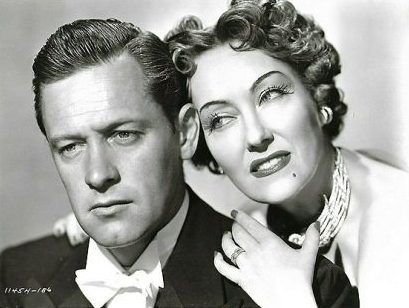
This was not always the case. Some stars retained their notoriety, to a degree, even after they had largely retired from the screen. And several found themselves visiting Seattle over the years, if only for a few brief moments. In July 1950, for example, actress Gloria Swanson rolled into town on a promotional tour for Paramount’s Sunset Boulevard (1950). Swanson’s comeback performance was earning critical raves, but Robert Heilman of the Daily Times was more impressed with her beauty than her work with director Billy Wilder – in his words, Swanson was “50 plus but looking 40 minus.” In the midst of a 13-week tour, Swanson’s flawless good looks and casual demeanor masked the grueling repetitiveness of these media events – “performances” that resembled the bygone era of one-night theatrical stands. “I’m pretty much fed up with me,” she admitted to everyone attending her press conference in the Olympic Hotel.[1] Gloria Swanson would return to Seattle on at least one other occasion, in 1976, when she appeared at the Frederick & Nelson department store to help promote a book written by her sixth husband, William Dufty.[2]
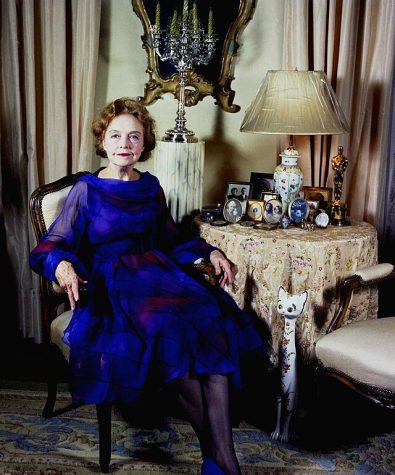
Lillian Gish had her own Northwest book signing in the spring of 1969, when the actress spent two hours at Seattle’s Bon Marché department store promoting her autobiography The Movies, Mr. Griffith and Me.[3] Like Gloria Swanson’s visit in 1950, her age was a fixation for several local writers, though Gish was determined not to cooperate. “Any woman who would tell her age would tell anything,” she remarked to Sally Raleigh of the Post-Intelligencer. “Any age you want to call me is fine. Say 110 or 130. People expect to see me on crutches.”[4] (For the record, the actress was 75 at the time of her visit.)
Gish was one of those rare silent performers who continued her career well after the advent of sound (shortly before her 1969 book tour, she and Helen Hayes appeared in a television adaptation of Arsenic and Old Lace), but the actress was openly critical of modern actors, whom she felt weren’t nearly as devoted to the craft as her peers had been. “When Sir John Gielgud played Hamlet,” Gish remarked to Times book editor Larry Rumley, “he wasn’t acting the role, he WAS Hamlet.” She had nothing but contempt for so-called Method acting, whereby the performer chooses to live a role (physically and emotionally) both onscreen and off. “It’s ridiculous,” the actress remarked. “How would you portray death if you had to experience it first?”[5]
Lillian Gish had nicer things to say about the one-woman show she had developed – a personal tour through film history from 1900 to 1928, much like J. Stuart Blackton’s Stars That Will Live Forever. “It runs an hour and 14 minutes,” she noted for the Times. “It includes excerpts from some of the best films made in those years.”[6] Shortly after her book tour concluded, Gish was scheduled to appear with this new show in Paris.
An American tour of her show was in the works, she claimed, and roughly five months later Lillian Gish again turned up in Seattle, performing it for one night only – October 17, 1969, three days after her 76th birthday – at the Moore Theatre. The visit, sponsored by the University of Washington Office of Lectures and Concerts, was less of an historical overview than a journey through her extraordinary career, limiting her remarks to the personalities with whom she was personally acquainted. “If we tried to show everything,” she confessed to the audience, “it would take months.”[7]
Gish was welcomed by a large crowd of students and film enthusiasts at the Moore. To the Post-Intelligencer she was “a grandame [sic] of American cinema,” while John Hartl of the Seattle Times found her an otherworldly presence. “It’s positively eerie to see Lillian Gish in person,” Hartl wrote, “to realize that she is not just a shadow on a screen invented by D.W. Griffith…From the young mother in Griffith’s 1916 epic, Intolerance, to the grandmotherly guardian of Depression orphans in the 1955 horror film The Night of the Hunter, she seems to have been the caretaker not only of movie children but of the movies as well.”[8]
The films used in Gish’s talk were culled from prints at the Museum of Modern Art in New York and represented some of the more familiar works of the silent era. These included glimpses of The Rink (1916) starring Charlie Chaplin, Douglas Fairbanks in The Thief of Bagdad (1924), as well as works by Mack Sennett and Rudolph Valentino. Gish’s own films (in particular her collaborations with D.W. Griffith) were also well represented. She showed numerous clips from The Birth of a Nation – an interesting choice for the Civil Rights era, given its inflammatory racial content. Her selections, however, in particular the battle scenes, allowed her to demonstrate how subsequent filmmakers had drawn from D.W. Griffith’s directorial work. Gish also lavished heavy praise on Griffith’s Intolerance, calling it his greatest film, although she refused to show even a single moment onscreen. “It would be like taking a chunk out of the Sistine Chapel,” she told the crowd.[9]
While the evening was a celebration of early film, Lillian Gish wasn’t afraid to cast a critical eye toward the period. For as much as her talk celebrated the genius of D.W. Griffith, she also described her mentor as a man with serious faults. “He did almost nothing to take care of his money,” she admitted. “I was surprised that a man of his intelligence and sensitivity was so careless when it came to taking care of the rights and profits of his films.”[10] Nor did she gloss over her feelings about the industry that propelled her to stardom. “We were stage performers at the time,” she remarked of herself and sister Dorothy, then early in their careers. “…[W]hen we saw one of our friends (Mary Pickford) in a film, we thought ‘That poor girl, she must be really desperate to act in pictures.’”[11]
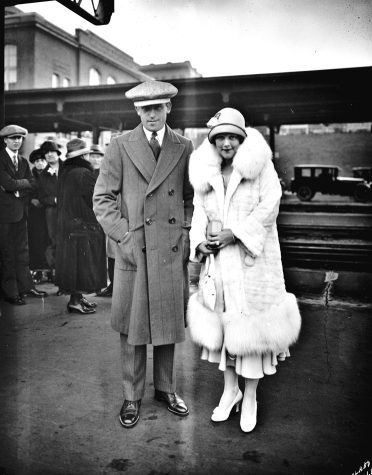
More lecture than performance, Lillian Gish’s 1969 appearance pegged her as the last major figure from the silent era to appear onstage in Seattle. More often than not, comparable celebrities arrived in the city on less formal business. In August 1949, for example, travelers in Seattle’s King Street Station were surprised to see director Cecil B. DeMille wandering about, killing time during a three-hour train layover.[12] (Even earlier, in 1945, DeMille appeared briefly at the Washington Athletic Club on Sixth Avenue at a party honoring longtime exhibitors from Washington and Alaska.[13]) Lon Chaney and his second wife, Hazel, made Seattle a regular stopover on their travels in order to visit one of the actor’s cousins, while actress Mildred Davis – Mrs. Harold Lloyd – made similar trips to the nearby Kirkland to visit a childhood friend.[14]
Harold Lloyd was no stranger to Seattle after his acting days. Lloyd’s all-American screen character – topped off with an iconic pair of horn-rimmed glasses – found him one of the top screen comedians of the 1920s. He made a number of sound era films (including The Sin of Harold Diddlebock in 1947, Preston Sturges’ “sequel” to Lloyd’s 1925 comedy The Freshman), but his popularity as a screen comedian diminished in the 1930s. After a brief stint producing, Lloyd devoted his time to personal and civic interests, becoming active in the Shriners organization. He was eventually elected to the group’s top national position in 1949.
In that capacity, Harold Lloyd made a prominent visit to Seattle in 1950, not as a veteran of the movie industry but as Imperial Potentate of the Shrine. Lloyd was in the midst of a goodwill tour that took him to most of the Shrine’s 170-plus local organizations and charity hospitals throughout the United States and Canada. Arriving on April 2, 1950, Lloyd came to the Northwest specifically to visit the Nile Temple in Edmonds, just north of Seattle.
Lloyd’s Edmonds visit was a fairly low-key event, but the following day he addressed a larger gathering of Shriners at Seattle’s Civic Auditorium. Reporters who caught him before the event, at the Olympic Hotel, found him a natural spokesman. “For a man who rocketed to fame when motion pictures were silent,” commented the Times, “Harold Lloyd is one of the greatest talkers you ever saw, or heard.” The comedian was eager not only to talk about his tour and the work of the Shriners, but also his newfound hobby of 3-D photography.
In the 10 months Lloyd has been wrapped up on the subject, he’s assembled 5,000 slides. He can’t wait to talk about it – but no one could interest him in what goes on BEHIND the camera until he learned of the three-dimension aspect. Now he’s wild for it.
“A hobby must absorb you and be exciting and enjoyable,” Lloyd said. “I believe life is much richer when a man has something to take him away from his regular vocation. Before this, it was painting. Before that, microscopy. But the biggest thing of all, right now, it the Shrine!”[15]
Harold Lloyd would return in 1969, just two years before his death, when the Shriners held their annual convention in Seattle. Then age 75, the comedian and former Imperial Potentate was on hand to accept an award as Shriner of the Year. In a presentation at the Seattle Center Exhibition Hall, Lloyd – who chaired the organization’s Board of Trustees at the time – received a plaque at the group’s awards banquet bearing the following inscription:
Of no man has Harold Lloyd ever said an unkind word, nor has he ever committed an unkind act. He is sincere and understanding and his creed is as humble as his tastes. He has no time for either prejudice or intolerance and his only hatred is the hatred of bigotry. It all adds up to “Do unto others.”[16]
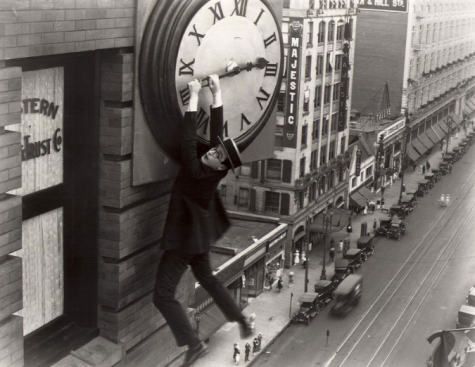
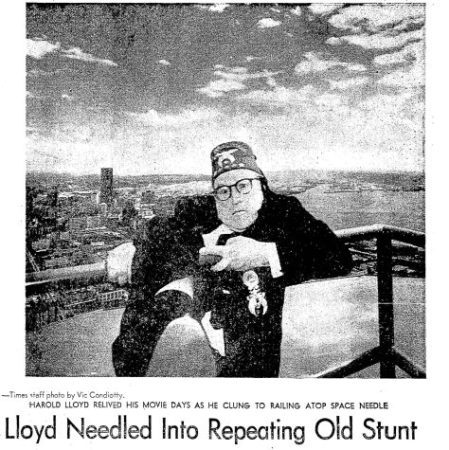
Lloyd kept a low profile for most of this visit, though he made at least one appearance noteworthy to fans of early cinema. Seattle Times reporter Dick Larsen and photographer Vic Candiotty coaxed the aging comedian into reliving a bit of his past, which was then preserved on the front page of the paper’s July 3rd edition. The pair escorted Lloyd to the top of the city’s most famous landmark, the Space Needle, where he was photographed dangling from the railing against the backdrop of Seattle’s downtown and Elliott Bay – an imitation of Lloyd’s famous building climb in Safety Last (1923). “In those days I did about 99 per cent of my own stunts,” the actor proudly boasted, stretching the truth a bit. Lloyd was also quite impressed with the Space Needle. “It’s marvelous.”[17]
Unlike figures such as Swanson, Gish, DeMille, or Lloyd, however, most silent era performers seemed to have disappeared from Hollywood scene. Not only were these performers largely forgotten over the years, but their work seemed ignored or, worse, ridiculed. Film and television audiences were familiar with things such as the television show Fractured Flickers, which recut old silent films, showed them at ludicrously fast speeds, then added narration that mocked both the stories and performances. Such treatment made silent film appear silly and frivolous, something that grandma and grandpa once enjoyed for reasons no one could explain.
Sound brought significant changes to Hollywood – new technology, new faces, and a new way of doing business. These changes brought the silent era to a swift close, despite the heights it had attained in terms of artistic and popular acclaim. A similar transformation had taken place earlier, on the American stage, where business had boomed in the late 19th and early 20th centuries. An expanding national railway, increased leisure time for the working classes and a growing interest popular entertainment helped make the theatre (including road shows, stock, and vaudeville) one of the nation’s leading forms of recreation. Yet this began to change around 1910, and not necessarily because of declining audience interest. Rather, the expense of presenting live entertainment had increased to the point where producers and performers could no longer reap the same financial returns. Each theatrical season saw fewer touring shows, more stock troupes disbanding, and a growing reliance on moving pictures as a way to draw audiences back into these older entertainment venues. It’s no wonder that many eventually transitioned to become movie houses – films were easier to obtain, required less overhead, and provided a better return on the investment.
As early as 1920 there was a sense that the golden age of stage entertainment had passed. That year Charles Hunt lamented the old days of live theatre, complete with all its foibles, in a syndicated column appearing in the Seattle Post-Intelligencer.
What has become of the 10, 20 and 30 cent dramatic companies that used to play all week in the town opera house?
What has become of Lady Audley’s Secret, Lost and Won, Ingomar, The Factory Girl and Queen’s Evidence?
Where are all the actors that got so much per week when they got it, and the cruel small-town landlord who seized the wardrobe trunks for board bills?
Where are the theatrical papers that used to print such ads as “Wanted, ingénue, heavy man, soubrette; good dressers on and off stage who can ‘double’ in brass?”…
What has become of the wonderful shop scene in The Factory Girl where the audience saw a huge fly wheel in action with all the rest of the shop painted on a drop curtain?
While we are placing these things, let us not forget to remember the “romp” with a wealth of taffy wig who sat on tables, hopped over barrels and disported herself generally in a way that gave the town swains in the “parkay” palpitation of the heart. It would be well, too, to locate the dark mustache who played the villain, meaner than the dickens in the play, but who was known as one of the best fellows in the world to the company.
Do you remember the night of Richard III, when there was not enough performers to put on the entire play and the king, after his assassination, came out in a one-act farce?
Do you remember how the king stopped the funeral procession of his victim, and the new super, in place of saying “stand aside and let the coffin pass” made it “stand aside and let the person cough?” Do you remember how the king glared at the unfortunate buck-fevered super for spoiling the climax?
Those were the happy days.
I wonder if they will ever come back…[18]
Hunt wasn’t the only one to observe that traditional theatre was dying. In 1939, when celebrating 50 years of statehood, the Washington State Historical Society enlisted several community figures to reflect on the previous half century. J. Willis Sayre accepted the task of outlining the state’s theatrical history (which, incidentally, he interpreted as being Seattle’s theatrical history). Most of his observations, of course, came from his own first-hand experience. “In the last fifty years, in this and every other state, the theatre has been so made over that its best friends of 1889 wouldn’t know it,” Sayre noted. “It covers entertainment fields unthought of half a century ago; its visible forms have materially altered; even its primary aims are different. Once designed purely for entertainment, the theatre of today has gone importantly sociological; it tackles current human problems and finds itself an agency for uplift and reform, and propaganda. The speaking stage, with reference to road productions, has persisted to a limited extent. The stars of such productions are notable; the settings are nothing like so elaborate and costly as the old days, and the supporting companies are often of indifferent caliber. This is doubtless because virtually all of the veteran stage-trained character men and women who have not retired have preferred steady employment in Hollywood to the uncertainty of the speaking stage.”[19]
Just like many of the silent stars covered in this work, J. Willis Sayre’s involvement in American theatrics began around the time it exploded in popularity, when Seattle figures such as John Cort and Alexander Pantages began changing the face of theatrical organization and management. And, as was the case with many of the actors, Sayre was also there to recount how those glorious days came to an end – the entertainment form he had once known morphing into a new and different version of itself. It’s been easy for historians to frame the decline of stage entertainment as stemming directly from the popularity of motion pictures. And while it is true that the stage enjoyed its greatest popularity immediately preceding the rise of motion pictures, it’s important to remember that the two had much in common, the stage playing an important role in the development of early cinema.[20] Many of the first motion pictures were of variety performers or theatrical re-creations, such as Edison’s The May Irwin Kiss (1896), featuring May Irwin and John C. Rice in a scene from the stage play The Widow Jones. Edison cameras also drew on vaudeville or novelty acts for early subjects, such as the serpentine dances of Annabelle Moore or the physical attributes of bodybuilder Eugen Sandow.
As motion pictures moved away from the experimental and novelty stage at the turn of the century, the industry continued to draw on the stage for material and for legitimacy – an example being the truncated version of Uncle Tom’s Cabin (1903) that director Edwin S. Porter made for the Edison Studios. Although original films and scenics grew to dominate the market, motion pictures still drew from the theatre, and repeatedly. In 1912 Famous Players – eventually to become Paramount Pictures – was founded by Adolph Zukor and theatrical producer Daniel Frohman, who sought to increase the prestige of motion pictures by releasing films of “Famous Players in Famous Plays,” as their slogan went.[21] The company’s first move was to import the French-made Queen Elizabeth, in which actress Sarah Bernhardt recreated her famous stage role. Viewed today, Queen Elizabeth shows early film’s indebtedness to the stage: particularly in the pre-Griffith era of filmmaking, many early pictures utilized backdrops of painted flats and rigid, full-length camera positions – scenes staged and shot as if the viewer were watching the action from the front row of the local opera house.
This was not all that motion pictures drew from the theatre; as we have seen, they also borrowed talent. For many actors and actresses, motion pictures weren’t necessarily the destination of choice when contemplating their professional careers. Often film provided temporary work while they pursued their stage ambitions, or in some cases offered refuge when careers began to flag. And ironically, acquiescing to film work (as Lillian Gish certainly thought Mary Pickford had done) was sometimes the turning point, allowing a performer to achieve the artistic laurels he or she had been seeking, albeit in a medium quite very different from the one they imagined.
Actors working on the stage and on the screen before 1930 faced an unusual set of circumstances. Many had benefited from the nationwide expansion of theatre and vaudeville circuits, only to see those opportunities shrink during the 1910s and 1920s, when industry economics and other forms of amusement siphoned away part of the audience. Then, many of these same actors, having abandoned the stage for the screen, saw their professional lives change again with the arrival of sound film in 1927. Some continued working in Hollywood. Others returned to the footlights, where they began their careers. And still others found their days as entertainers all but over. One era had ended, another had begun. Just as Charles Hunt lamented the passing of stage melodrama, so too did silent film appear to vanish from the public scene, taking with it many of the actors and actresses who lifted it to popular acclaim.
Most of the entertainers covered here are not necessarily remembered for the full of their careers. But to view these figures only through the prism of their film work ignores an early and important influence on their professional development. History has judged William S. Hart based on his screen appearances, lasting just over a decade, but the quarter-century he spent as a stage actor gets comparatively little attention. Perhaps that’s just the nature of celebrity – the image that captures the public’s attention at a certain moment in time becomes defining. But there is more to their lives and careers than simply the movies (or legends) they’ve left behind.
It’s my hope that the theatrical engagements profiled here demonstrate this. Chaplin simply didn’t become “Charlie” the first time he donned his famous costume before the camera. Rather, he drew from the outfits, sketches and characters he played or had seen during his years as a stage performer. “It is easy enough to find precedents for the [Tramp] costume in the English music halls,” noted Chaplin biographer David Robinson. “Grotesquely ill-fitting clothes, tiny hats, distasteful moustaches and wigger-wagger canes were the necessary impediments of the [English] comedian. Some of Dan Leno’s stage costumes hint at Chaplin’s; and Chaplin’s old Karno colleague, Fred Kitchen, used to complain gently that it was he who first originated the costume and the splay-footed walk.”[22] Similarly, Harry Langdon’s comedic sensibilities were honed over two decades of vaudeville, where he eventually rose to become a headline attraction. Based on descriptions, Langdon’s stage character was often at the mercy of larger forces (in this case, his stage automobile), slow in movement and blank in expression – not too far from the Harry Langdon we see onscreen.
On the other hand, Cecil B. DeMille and D.W. Griffith each wanted to become playwrights before settling into acting. But as directors, both drew frequently from their stage days. In DeMille’s case, familial connections on Broadway gave him the inside track to some of the stage’s most popular plays and stars, including early film versions of The Squaw Man, The Virginian (both of 1914), and The Trail of the Lonesome Pine (1916). Artistically, he also aligned himself with impresario and family friend David Belasco, who was often praised (and derided) for his popular stage plays. Griffith, on the other hand, repeatedly lifted narrative material from the stage melodramas with which he was familiar. Griffith’s early Biograph shorts are littered with themes and situations taken directly from his stage days (poetry and literature were other sources of inspiration), all of which culminated with 1913’s Judith of Bethulia, of which he was likely familiar based on his stage experience as a member of Nance O’Neil’s company. Even as late as 1920, with the feature Way Down East, Griffith not only adapted an old stage classic for the screen but improvised a new climax to his picture by incorporating an ice floe sequence lifted directly from the novel (and stage play) Uncle Tom’s Cabin.
Admittedly, the pattern doesn’t always hold. Lon Chaney and Marguerite Clark specialized in musical comedy – experience that didn’t necessarily carry over onto the silent screen. One could make a similar observation about Roscoe Arbuckle’s engagement at the Lyric: it was Arbuckle’s singing, not necessarily his comedy, that brought him the most attention in Seattle. Nonetheless, here were performers who came into the movies with the experience of their prior stage work. Chaney’s screen career gravitated toward crime and horror, though his talent as a make-up artist (carefully honed from his theatrical days) was a considerable help in the success of his filmic characterizations. Marguerite Clark, on the other hand, was unusually young while playing opposite DeWolf Hopper, which allowed her to develop a poise and maturity that carried directly into leading roles for the screen. And while the silent screen may have stifled Roscoe Arbuckle’s musical talents, his experience in free-wheeling, knockabout comedy (as the Posty’s burlesque troupe seems to have been) was certainly a factor in his success at Mack Sennett’s Keystone Studios.
Whether a performer arrived before, during, or after the period of their greatest acclaim, at least a portion of their personal and professional lives was played out before Seattle audiences. The same thing was occurring in cities all over North America: with each tour, each role, and maybe each performance, these actors were adding to their knowledge and skills. No one covered in this work entered the film industry without any previous experience – they may have been newcomers to motion pictures, but by no means were they newcomers to performing.
It’s through this framework that I’ve tried to view these artists. Many silent film performers appeared to become household names overnight, but that really wasn’t the case. They may have suddenly been catapulted into stardom, but only after years of hard work, learning the acting trade from the ground up. As Frederick Warde said during his visit to Seattle in 1900, the best classroom for actors was the stage itself, for the best performers “learned to act by acting; and that is the only way to learn. A young man can no more become an actor in any other way than a boy can learn to swim on the hearth rug at home or to sail a ship on dry land.”[23] Seattle, like audiences in other North American cities, was privy to this learning process, watching future screen legends in an embryonic stage of their careers.
By Eric L. Flom – January 2026
Notes:
[1] Robert Heilman, “Gloria Swanson on Time, With Aid of $1 ‘Turnip’ Timepiece,” Seattle Daily Times, 27 July 1950, Page 14.
[2] Paul Henderson, “Gloria Swanson Draws Awed Crowd,” Seattle Times, 16 September 1976, Page B1.
[3] See Larry Rumley, “Lillian Gish, Theater Legend, Here to Autograph New Book,” Seattle Times, 11 May 1969, Page 105; and Sally Raleigh, “Lillian Gish – A Book, A Name,” Seattle Post-Intelligencer, 11 May 1969, Style Section, Page 2.
[4] Raleigh.
[5] Rumley.
[6] Ibid.
[7] Lillian Gish in Patrick McDonald, “A Voice from the Silent Past,” Seattle Post-Intelligencer, 18 October 1969, Page 7.
[8] John Hartl, “Lillian Gish Shows Silents at Moore,” Seattle Times, 18 October 1969, Page 28.
[9] Ibid.
[10] McDonald.
[11] Hartl.
[12] See Eric L. Flom, “Cecil B. DeMille makes a surprise appearance in Seattle on August 25, 1949,” HistoryLink (https://www.historylink.org/File/7210), accessed 30 April 2025.
[13] See “Pioneers Greet Cecil DeMille,” Seattle Daily Times, 23 July 1945, Page 18; and “DeMille Visits City Quietly,” Seattle Daily Times, 25 August 1949, Page 11. These visits weren’t DeMille’s only ones to the Northwest since he gave up stage acting. In October 1924, blizzard conditions drove DeMille and his film crew off the slopes of Mount Rainier during location shooting for his 1925 feature The Golden Bed. (Eric L. Flom, “Blizzard forces Cecil B. DeMille film crew from the Nisqually Glacier on Mt. Rainier on October 26, 1924,” HistoryLink (https://www.historylink.org/File/7337), accessed 30 April 2025.) DeMille and company stayed in Washington state approximately two weeks, largely based out of Tacoma and Paradise Lodge on Mount Rainier.
[14] See Michael F. Blake; A Thousand Faces: Lon Chaney’s Unique Artistry in Motion Pictures (Vestal, NY: Vestal Press, 1995), Page 234; information about Mildred Davis supplied courtesy of HistoryLink’s Alan Stein. A 1925 Seattle stopover by Mr. and Mrs. Harold Lloyd was reported in the trade journal Motion Picture News, which noted that the famous couple spent an evening or two at the city’s new Olympic Hotel before heading south for Tacoma, then to the East. (See “Seattle,” Motion Picture News, 16 May 1925, Page 2451.)
[15] “Lloyd, Silent Actor, is Talkative,” Seattle Times, 3 April 1950, Page 30. Several of Harold Lloyd’s 3-D photographs were eventually be published in 3-D Hollywood (New York: Simon & Schuster, 1992), while a follow-up – Harold Lloyd’s Hollywood Nudes in 3D! (New York: Black Dog & Leventhal Publishers, 2004) – arrived in 2004. Both books were edited by Lloyd’s granddaughter Suzanne Lloyd Hayes, who presently heads the Harold Lloyd Trust.
[16] “Lloyd Wins Shriner of Year Award,” Seattle Post-Intelligencer, 3 July 1969, Page 2. See also “Lloyd Honored as Shriner of Year,” Seattle Times, 3 July 1969, Page 16.
[17] Dick Larsen, “Lloyd Needled into Repeating Old Stunt,” Seattle Times, 3 July 1969, Page 1.
[18] Charles E. Hunt, “Before Movie Days,” Seattle Post-Intelligencer, 11 January 1920, Page 6.
[19] J. Willis Sayre, “Theatre,” from Building a State: Washington 1889–1939 (Tacoma, Washington: Pioneer, Incorporated, 1940), Pages 184, 187, and 188.
[20] This would also be the case in the early sound era, when Hollywood raided Broadway for actors, playwrights, and properties tailored for entertainment rooted in dialogue.
[21] See Eileen Bowser, The Transformation of Cinema, 1907–1915 (Los Angeles: University of California Press, 1994), Page 225–227.
[22] Robinson, 114.
[23] See “Mr. Warde an Optimist,” Seattle Post-Intelligencer, 25 January 1900, Page 6.