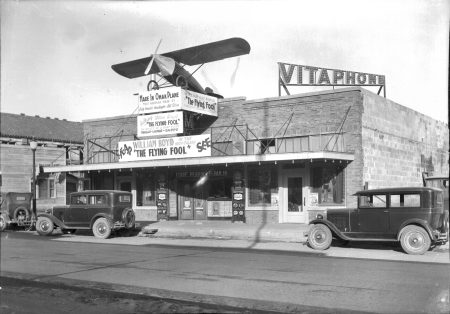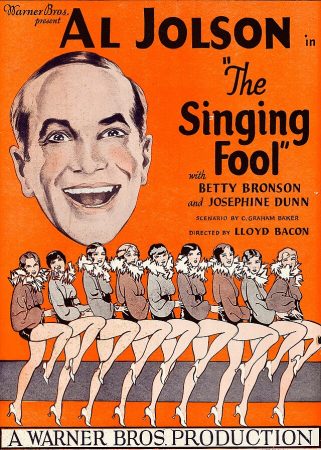
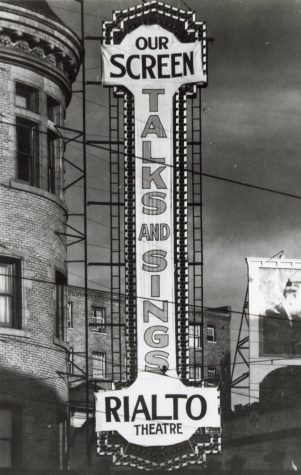
Although films like Don Juan and The Jazz Singer were proving that film audiences were finally ready to embrace sound motion pictures, the technology was really just a better version of earlier presentations. Synchronization and amplification were improved, of course, along with the ability to provide sound for some or most of a feature-length picture. At its core, however, these early releases were using sound much as it always had – providing music, sound effects and the occasional, albeit brief dialogue or song sequence. The Jazz Singer, in fact, was very much staged and shot as a silent film, save for a handful of sequences specifically designed to showcase Vitaphone technology. Nonetheless, at a time when box office receipts had been flagging, sound was an “innovation” that gave the film industry a shot in the arm, with audiences queuing up to see the latest Vitaphone or Movietone releases. Exhibitors like John Hamrick demonstrated, in the 1927/1928 time period, that sound could pay – and other showmen were eager to jump on the bandwagon.
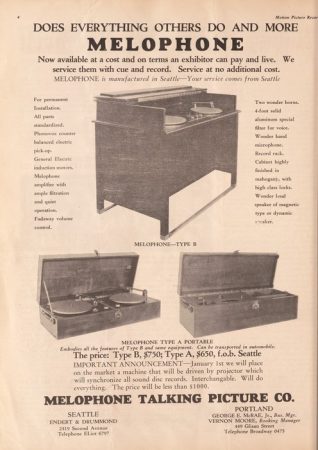
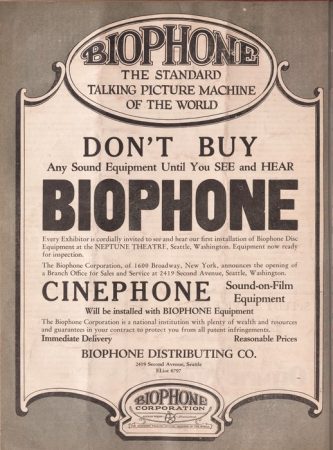
The problem was, of course, that the cost for installing formal sound equipment was steep, for a technology that no one was sure would last. Was this the future of motion pictures? Or was sound just a fad, like it had been in 1908 or 1913? Was the future in full sound or partial sound? Was there room in the marketplace for silent and sound films to coexist? Some venues were positioned to make jump quickly, allowing them to play silent and sound features at will. Others had to take a wait-and-see approach, either because they couldn’t afford a sound installation or because they wanted to see if the technology had staying power.
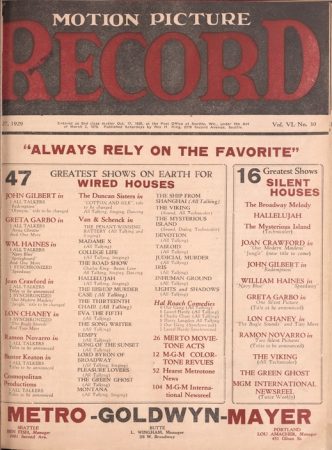
The production studios certainly didn’t have an answer – they all took wildly different approaches with their sound releases. Once the medium appeared popular, sound films couldn’t be made fast enough, but the treatment in many of these films was all over the map and, as a result, quality suffered. The different sound formats – silent with music, silent with a handful of talking sequences, and mostly or all talkies – was confusing to audiences, particularly because exhibitors often failed to make distinctions when advertising their shows. “The different kinds of sound pictures have brought about definitions [of films] that the public does not clearly understand…,” noted the Seattle-based Motion Picture Record. “Instances of false advertising not only injure the exhibitors standing with his trade but endangers the profits to be made on future 100 percent all talking pictures.”[1]
Sound created two different constituencies in the U.S. film market – venues that could show sound pictures, and venues that couldn’t. The studios continued to make both silent and sound pictures for the time being, but the money was in sound, and over time exhibitors saw fewer and fewer silent productions being made.
Things on the exhibition side would be in flux for several years, not only because of sound but also because of the Depression and the continued rise of radio programming, among other things.[2] Eventually, however, every exhibitor had to make the same decision: when and how to make the jump to sound. Given the changes going on in the industry, these were important decisions for the exhibitor to make, and in some cases their business future depended on how well they stuck the landing.
Notes:
[1] “Editorial Paragraphs,” Motion Picture Record, 6 April 1929 (Vol. 6, No. 14), Page 2.
[2] Donald Crafton, The Talkies: American Cinema’s Transition to Sound, 1926-1931 (New York: Charlie Scribner’s Sons – 1997), Page 4.