
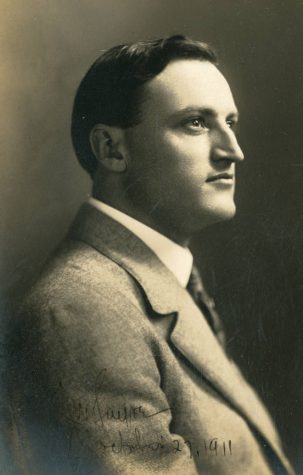
J. Willis Sayre was a cultural institution in Seattle – a journalist, promoter and patron of the arts, particularly the legitimate stage and symphonic/operatic music. During the first two decades of the 20th century he helmed, at one time or another, the dramatic page at all three of Seattle’s daily newspapers, in addition to a brief stint with The Argus, one of the city’s top weeklies. With the rise of moving pictures, his columns began to incorporate film material as well, helping pioneer (in Seattle, at least) a newspaper entertainment section that encompassed a wide range of shows – from concerts to plays to vaudeville to film, and everything in between.
But Sayre apparently had greater ambitions than just being a journalist or promoter – at one point, he actually tried his hand at screenwriting. On December 11, 1913, the American Manufacturing Company (known in the business as “the Flying A”) released His First Case, a one-reel, 11-minute drama penned by Sayre himself.
How did J. Willis Sayre catch this break? That’s not clear, but he had advantages most aspiring screenwriters did not. For one, he was an experienced journalist who had spent the better part of a decade covering stage and screen entertainment in the Northwest. Not only was he familiar with the business, but likely had contacts as well – locally, for certain, but perhaps regionally or even nationally. As a known quantity with direct/indirect connections to folks on the production side, Sayre was in a better position than most to get his film stories in front of the right people.
Little is known about His First Case or how it came to be selected by American Manufacturing, and the film does not appear to have survived. (Some 85% of all silent films, give or take, no longer exist since little value was placed on preserving movies after they ceased to have commercial value.) The picture was directed by Lorimer Johnson, and starred Harry von Meter, Lilian Rich, Jacques Jaccard and Chick Morrison.
The trade paper Moving Picture World provided a brief synopsis, as they typically did for new releases during this period. His First Case centered around Don McDonald (von Meter), a young lawyer fresh out of law school. He intends to wed his longtime sweetheart Clara (Rich), though her father will not give permission until the young man wins his first court case. That opportunity surfaces after tragedy befalls the father. During a drunken poker game he’s fleeced by a pair of card sharps and eventually passes out. The two gamblers then get into an argument, which ends when one (Jacques Jaccard) shoots the other and takes the collective winnings. When the crime comes to light, the murderer deflects guilt by pinning the blame on Clara’s father, accusing him of killing the man in a drunken rage after losing his money. The charge eventually leads to a courtroom, where McDonald defends Clara’s father by setting a legal trap for the guilty party, maneuvering the gambler into finally confessing the truth – something that exonerates the defendant and paves the way for the young couple to wed. (See “His First Case,” Moving Picture World, 6 December 1913, Page 1210.)
His First Case was one of American Manufacturing’s key releases for December 1913, and figured prominently in their trade advertisements, along with their slate of other new films. According to the company, the picture was “[a] westerner of the first water with splendid action and excellent dramatization.” (See American Film Manufacturing advertisements, Moving Picture World, 6 December 1913, Page 1221; and Motion Picture News, 6 December 1913, Page 54.) While some films were the subject of extensive promotional campaigns, that wasn’t the case here, with a single pre-release story that appeared a month before the film debuted. This piece, which ran in the Seattle Daily Times and the trade paper Motography on the same day, centered around a chase sequence that occurred in the middle of His First Case. In it, Jacques Jaccard, playing the murderous gambler, is chasing a train on horseback, and executes a daring leap from the animal and onto the moving locomotive. He is being pursued by Chick Morrison, playing the local sheriff, who makes the same jump, the two men eventually grappling. The sheriff overtakes the gambler and arrests him, after which the pair (rather inexplicably) leap from the moving train and crash to the ground. (See “Daredevil Riding,” Seattle Daily Times, 15 November 1913, Page 16; and Motography, 15 November 1913, Page 370.)
Aside from a brief mention in the Daily Times in early December, the only other write-up on His First Case comes from Moving Picture World, which offered a brief “review” of the film in their December 13th edition, two days after its release. These weren’t reviews in the sense we know them today – their “Comments on the Films” column was designed for exhibitors to determine whether a new release was worth securing for their theatre. His First Case was part of a column with commentary on more than 50 new film releases, so the paper only offered a bare-bones look at these pictures. “[His First Case is a] story principally notable for some attractive outdoor scenes, picturing wide stretches of mountain country. The plot is old and not strongly handled. It was not clearly shown how the young attorney saved the girl’s father from conviction. But the attorney won the case and the girl.” (See His First Case, from “Comments on the Films,” Moving Picture World, 13 December 1913, Page 1280.)
Was any of that criticism of the film Sayre’s fault? Maybe, maybe not – without seeing his original script it would be tough to know. Perhaps his story wasn’t up to snuff, perhaps the director made changes while filming, perhaps American Manufacturing did some editing during postproduction, or perhaps the National Board of Censorship, which reviewed each and every new film release, ordered some cuts.
Regardless, this was quite an achievement for J. Willis Sayre, to be the author of his own motion picture, and in Seattle, at least, the release was greeted as big news. His First Case opened at the Grand Opera House on December 28, 1913, where it headlined a three-day engagement. Three other pictures supported the Sayre contribution, including the Thanhouser comedy Uncle’s Namesake, plus the dramas A Mighty Atom (Reliance) and The God of Tomorrow (Majestic). Four vaudeville acts were interspersed between the films, including a sketch called Black Art by a group calling themselves the Pharaohs, some harp playing by Josephine Brada, and a musical comedy act by the female duo Carter and Charles. The venue took out ads in local papers that centered almost exclusively around His First Case and made prominent use of J. Willis Sayre’s name, to the extent that the average reader may have believed that Sayre himself was the star. The Grand was managed by Eugene Levy at the time, and it was said that he had secured the exclusive motion picture rights for His First Case for all of Washington state, such that Levy would be the only exhibitor showing the film locally. It’s an interesting claim, given that the picture was not being marketed as a state rights film, as implied, and was probably available to others through certain local exchanges, the distribution arm of the industry. But Levy did have several other venues in western Washington where he could have placed the film, along with ties to other exhibitors allowing him to bring it into still more locations. Yet another embellishment: advertising His First Case as a “Seattle-made photoplay.” Written in Seattle? Yes. Made in Seattle? Uh, no.
Write-ups on the new bill at the Grand are somewhat scarce, but the Post-Intelligencer chimed in with a glowing review – of the live acts, at least. His First Case was the only film they discussed, but only because it had a local connection. Their commentary amounted to almost nothing, just a recitation of the plot, which culminated in a courtroom sequence that “must be seen to be appreciated.” (See “Strong Dramas on Picture Bills,” Seattle Post-Intelligencer, 29 December 1913, Page 7.) So not a bad review, but also not a ringing endorsement.
J. Willis Sayre’s brief dalliance as a screenwriter was over almost as soon as it began, with no later screen credits to his name, though he may have submitted additional ideas to American or other studios along the way. The last word on His New Case, which was in and out of Northwest theatres in a matter of weeks, came from a piece that ran in Sayre’s Daily Times column in the spring of 1914. This short notice was supposedly a note from director Lorimer Johnson, writing from Santa Barbara. “‘His New Case,’ a Western drama written for us by a Seattle author, holds all records for sales of any picture yet taken by [American Manufacturing].’” (Lorimer Johnson, in “Seattle Leads, as Usual,” Seattle Daily Times, 26 March 1914, Page 12.)
Even if that were true, it did little to jumpstart J. Willis Sayre’s career as a screenwriter. Despite bagging his first movie credit, His First Case apparently began, and ended, his career in Hollywood.

Photo credit: J. Willis Sayre, ca. 1911. (Courtesy University of Washington Special Collections, Order No. JWS10051)